Non-native plant invaders. Ecologists have been keeping an eye on them for a long time already. Species that flew in from somewhere far away and enter an environment where they don’t belong. Species that happily profit from our changing modern world as they outsmart their native counterparts in adapting to human influences. The uncrowned winners of global change, so to speak.
In cold environments like mountains and the poles, non-native plant species have always been a rare sighting. The harsh climate would be an unbreakable barrier and with most of these areas being so remote and pristine, no non-native plant seed would ever managed to come close. For a long time, that was the concensus: invasions are limited to places with an agreeable climate.

Yet those times are now over. Year after year, non-native species have been slowly creeping further uphill and northwards. To do so, they make good use of what we humans are offering them: worldwide and unprecedented fast changes to our pristine nature. We do indeed observe increases in disturbance in both mountains and the (ant)arctic: construction works, roads and walking trails, everywhere humans are removing the natural vegetation and leaving open space in their traces. The perfect breeding grounds for non-native species. Additionally, human actions are also increasing the amount of nutrients in the poor mountainous soils and seeds of non-native species are hitching a hike on car tires and the soles of our shoes. Add a warming climate to the stew, and you have the perfect recipe for an increase in non-native plant species.

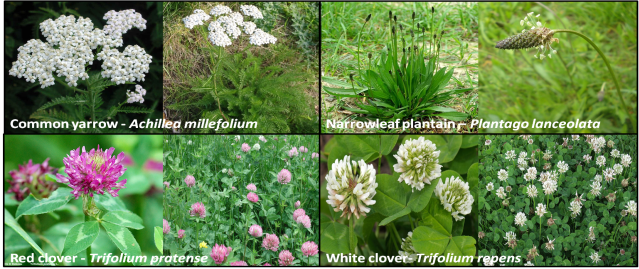
Non-native common yarrow in a grassland in northern Sweden
The pushy character of non-native species has of course never been a secret. Several studies also showed undeniably that the aforementioned factors played a role in the matter. Yet science was far from solving all remaining mysteries in the mountains. To know which of these factors plays the decisive role, what drives the recent expansions of non-natives to colder environments, and – most importantly – what the future of plant invasion in mountains will be, an overarching experiment was needed to disentangle what was seen in observational studies. With that idea in mind, a team of ecologists from Europe and South-America joined forces. They went to extreme ends of the world to set up an experiment in two sub(ant)arctic mountain areas, one in the northern Scandes in Sweden, the other in the southern Andes in Chile.
There they seeded ten different non-native plant species, varying the levels of disturbance, nutrients and amount of seeds, on an elevation gradient that reached far above the current range edge of the species. The ideal design to finally disentangle the roles of these key factors in the life of the mountain invaders.

Experimental set-up in the mountains in Swedish Lapland
The results showed how much the experiment was needed to shake up all we know and expected from plant life in the mountains: no matter how high in the mountains, disturbance was the biggest positive driver of the performance of the non-natives. Even at the highest elevations, the invaders had to deal most and foremost with competition, with only little chances for germination and growth underneath the slow-growing yet dense alpine vegetation. Removing this vegetation significantly increased the chances for the non-natives to succeed. A result that could not contrast more with the usually observed facilitation at high elevations, a process in which the established vegetation at high elevations actually helps invader establishment, as it reduces the impact of the harsh climate.

Success of the non-natives was followed from up close. ( (c) Ive van Krunkelsven)
Even though the alpine climate did reduce the performance of the invaders, and nutrient addition was often needed to add successful reproduction to the establishment, the non-natives clearly performed best at and above their current range edge, close to the tree line. This result is worrisome: it suggests that it might be mostly a matter of time before levels of invasion at these elevations will increase, especially when there are roads, trails or other disturbances to give them the headstart. If then the climate keeps warming, non-native species will only find more chances to colonise currently cold environments, unless we manage to contain disturbances and climate change within reasonable boundaries.

Our presence in the mountains does impact its nature, and it is our task to at least be aware of the consequences.
Want to know more?
The research got recently published in PNAS (the Proceedings of the National Academy of Science from the USA) and can be found here:
Lembrechts et al. (2016). Disturbance is the key to plant invasion in cold environments. PNAS.

Red clover is doing great in roadsites in the arctic mountains. There they profit clearly from human disturbances.

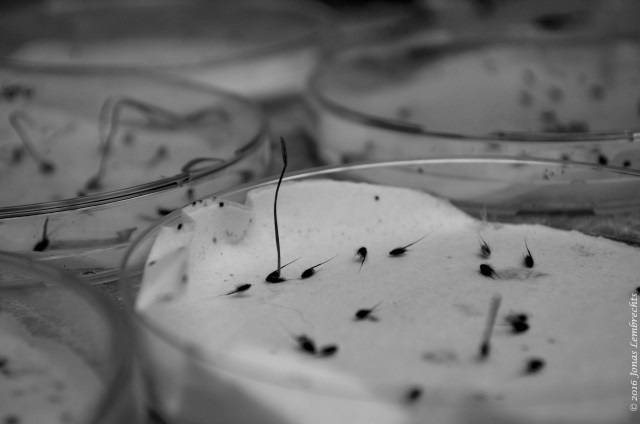 You might recall my excitement from a few weeks ago (here): we sew the seeds we harvested this summer in the subarctic mountains. Our expectations for them where pretty low, as the plants had to go through so much stress throughout their life that it was highly unlikely that they would have found enough energy to invest in their future.







 The 3D lab