Count the birds

This weekend will bring Belgium its yearly ‘bird counters weekend’! This event is one of the best examples of citizen science in the country, as every person with a garden can participate. You just have to spend half an hour in the weekend counting the birds that come and visit the garden.

Female house sparrow

With a little help of bird feeders, these visits can be fairly spectacular with impressive diversity. Natuurpunt, our main organisation for nature conservation, collects the data from all these gardens over the whole country and uses them to follow the patterns of our garden birds over the years.

Male house sparrow

For my Belgium readers, this post can serve as a little reminder to put out some food and keep an eye on the window for a while this weekend.

Feeding house sparrows out of hand

The non-Belgians can just enjoy these pictures of house sparrows enjoying delicious bread crumbs. Year after year, the house sparrow turned out to be the most common garden bird, but unfortunately, numbers are declining steadily lately.

Feeding house sparrows

It had to give its gardenbird-crown to the finch and the great tit, but I hope for upward trends one day that bring back these cute fellows to our gardens!

 Female house sparrow Male house sparrow

Posted in General | Tagged , , , , , , , , , , | 7 Comments

Uphill (and downhill!)

Our climate is changing, that much is clear. The main effect of this changing climate is that what once was balancing now starts shifting. As if our little world became a plate full of beer pulls, losing its balance on the shaking hands of an inexperienced innkeeper. One of the most obvious effects of climate change on plant and animal life is visualised in the shifting geographical ranges of many  species.

Scientists have been hunting for these range shifts for years, resulting in a growing pile of scientific papers on the matter. Case after case, the hypothesis is clear: the climate is warming, so species will follow the track of these increasing temperatures: uphill and to higher latitudes, towards the arctic and alpine world. Indeed, more and more longterm experiments and observations bring exactly those patterns to light. These results are accompanied by the worrying message that the original inhabitants species of the invaded cold environments themselves don’t have anywhere to go.

Invasive plants like this chamomile in the Chilean Andes hike surprisingly fast uphill.

Invasive plants like this chamomile in the Chilean Andes hike surprisingly fast uphill.

As the proof of this invasion of heat-loving species adds up and the risk for the alpine and arctic vegetation becomes more apparent, it is easy to forget that some species might act opposite of our expectations. An important amount of species indeed seems to hurry uphill, but an as important (albeit smaller) group in the meantime moves downwards, against all odds.

On a steep slope, going downhill might just be a lot easier than going up.

On a steep slope, going downhill might just be a lot easier than going up.

For years, this lasts group has been pushed aside as a mere statistical side effect, nothing more than noise on the data, the inevitable variance around a positive average. Concluding as such however ignores the importance of this group of species. Climate change includes more effects than only this warming trend. Not only temperatures change, but the climatic water balance undergoes drastic alterations as well. In several dry areas, precipitation patterns might even be more influential than the warming effect. In that case, those changing precipitation levels can unexpectedly push species downhill, in a hunt for similar climatic conditions.

In the mountains, water often plays an as important role as temperature.

In the mountains, water often plays an as important role as temperature.

There are alternative explanations for these patterns as well. A lot of species are for example not limited by the climate at the warm side of their distribution. They only taste defeat due to competition with faster growing species. As a result of the changing climate, however, those competitive dominances start shifting, which creates new opportunities at these lower range edges.

Many mountain plants have a large dispersal potential, as they can rely on the omnipresent winds.

Many mountain plants have a large dispersal potential, as they can rely on the omnipresent winds.

Bottom-line is that most effects in ecology might and will be in different directions at once. As a scientist, it is important to keep this in mind and give the unexpected minority the attention it deserves. I stumbled on this story when I was looking at the expected distribution shifts of invasive species in the mountains. The lesson is clear: better not forget to look downhill once!

DSC_0382

I hope to bring you more on that matter as soon as some more stories make it through the review process.

Two relevant reads:

Crimmins, S. M., Dobrowski, S. Z., Greenberg, J. A., Abatzoglou, J. T. & Mynsberge, A. R. (2011) Changes in Climatic Water Balance Drive Downhill Shifts in Plant Species’ Optimum Elevations. Science, 331, 324-327.

Lenoir, J., Gegout, J.-C., Guisan, A., Vittoz, P., Wohlgemuth, T., Zimmermann, N. E., Dullinger, S., Pauli, H., Willner, W. & Svenning, J.-C. (2010) Going against the flow: potential mechanisms for unexpected downslope range shifts in a warming climate. Ecography, 33, 295-303.

Posted in The research | Tagged , , , , , , , , , , | 2 Comments

The blanket removed

Earlier, I was so positive about the effects of snow on my little plants trying to survive the colds of winter. How the white blanket would protect them against the unbearable frost outside.

The benefits from this free winter protection however seem to be a little limited in my experimental set-ups. Those plants that use the strong positive effects of disturbance to colonise new systems might face some microclimatic problems that do not exist in the established vegetation.

Melting snow in disturbance

It should already have been clear from my earlier posts that the microclimate within disturbed gaps is totally different from elsewhere, but the pictures I managed to take last week show exactly what that means in reality.

Microclimate in gaps

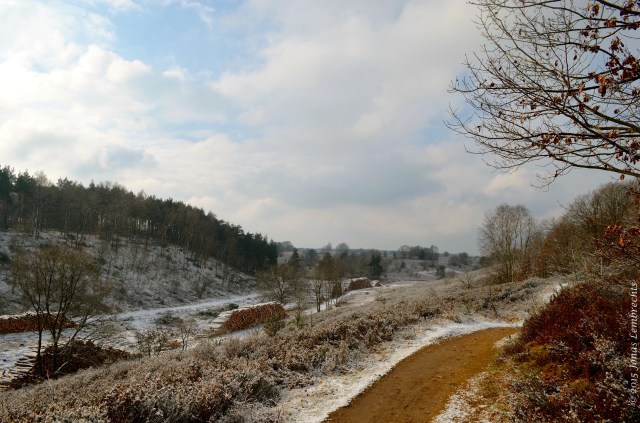
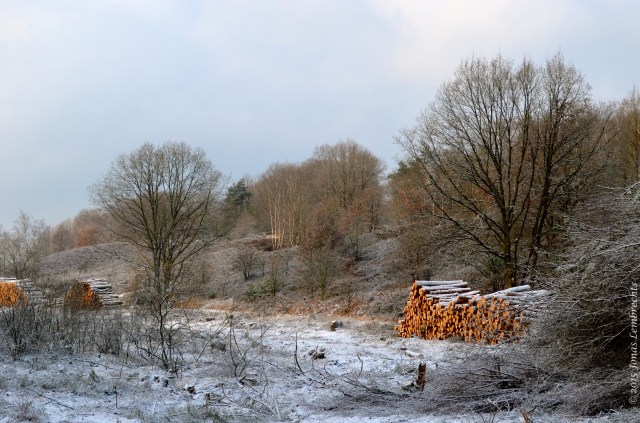
The protective snow blanket disappeared much faster within the gaps than next to it, an observation with some major implications: open environments might be more vulnerable to freezing, but they will also benefit from a longer growing season. Better keep those ideas in mind whenever I think about disturbance in the future!

Little note: these striking differences only occur when snow layers are shallow, off course. In the subarctic, where the biggest part of my research is located, the snowy blanket will most of the time cover everything, regardless of the foundation, wiping out most of the differences.

Posted in Belgium | Tagged , , , , , , , , | 1 Comment

Waarom bergwandelaars best hun zolen poetsen

Waarom bergwandelaars best hun zolen poetsen.

I got invited to blog at Scilogs, the blog from the science communicating journal EOS. Off course, I could not resist such an honour, so I will occasionally write in Dutch about mountain ecology there.

Really excited about it!

Posted in Belgium | Tagged , , , , , , , , , , | 2 Comments

What the new year will bring

DSC_0112

A PhD lasts only for a short period in one’s life. The plan is to get as much out of it as possible, that is for sure. I would like to make use of the beginning of this new year to wrap up some of the plans I have for the next 365 days. Plans that can immediately serve as a little promise for what my blog will bring over the next months.

 Publishing

Autumn mountains Abisko

First things first, I want to get my next two papers out. I hope to get three papers out of the way before I started to work on the first ‘main’ paper of my PhD. I am still on track, as the first one got published in March 2014, the second one is facing the reviewers right at the moment and the third one saw his major breakthrough in the data analysis just some weeks ago. I will still focus on these stories until April cause then I will go to…

Chile

The first week of Chile will bring the final fieldwork for our first experiment. We will collect the very last data of our first experiment and add them to the finished dataset from Sweden. Then we will have enough information to disentangle the effects of disturbance, nutrients and propagule pressure on alien success on different elevations. And then, it is writing, writing, writing as I might want to aim high for this one… until summer, when we have fieldwork plans again in…

Guanaco1

Sweden

Experiment number two will be finished this summer, providing us enough information on the roll of microclimate and topography in my PhD-story. We will go back again two times to the high north, to count winter survival and harvest summer growth, as well as to set up a small new experiment. But we have even bigger plans than those, as we will step up our game in the…

Plot with a view

Global network

We set up a project in a somewhat bigger dimension together with all our partners of the MIREN-network. We will install a microclimatic measurement system in mountains and roadsides in 8 different regions on all continents except for Antarctica. While 2014 served to think out the project, in 2015 it should go to full speed, providing us with a first year of data in 2016. But I am thinking already about 2017, when these plans will result in the most important publications of my PhD! A long-term project, but not free of ambition.

iButtons, endless rows of iButtons!

Belgium

I had some bad luck with my Belgian experiment in the summer of 2014, as my seedlings failed to establish twice. This little trial however allowed me to learn a lot about what I want to do, and I started ‘the real thing’ already one month ago. 2015 should bring a full microclimatic dataset of within-gap variation and the effects of this variation on gap colonisers.

Big gap

Modelling

2015 will also be the year to bring the range modelling on full speed, with the help of our partner in Amiens. This global approach aims to be an integration of the whole PhD-story. I can clearly see the first steps of this process now and I am eager to get the first results.

The bigger picture

As the first answers result in new and even more exciting questions, help is needed to get all stories told. We are investing a lot to increase the man-power of our project.

My first students will finish their projects in June from this year, and in summer some new student experiments will start. I am excited to see their final results ‘published’ in their thesis and I hope I will be able to put some interesting conclusions on this blog. If they work well, they provide very important additions to my work.

We even hope to get one or two extra PhD-students to work on the topic of mountain plant invasions, but that depends off course on the funding.

Enjoying the PhD

Blogging

I got invited only a few days ago to start blogging at the EOS Scilogs-platform at scilogs.be, a huge honour that will improve my scientific communication within Belgium and that might even result in some publicity in the EOS-journal.

Off course, I will keep on blogging here, as I continue expanding this blog as my personal website, with all information on my PhD. I am currently on hold as a blogger for INTERACT, but I hope to get back there as I return to Northern Scandinavia in summer.

How does this little brave Saxifraga experience its environment? The iButtons will tell!

Last year brought me the Photographing Ecologist, a short and interesting series on Biodiverse Perspectives, and I plan to get back there with some more scientific analyses in the next year.

Photography on the edge

Posted in The research | Tagged , , , , , , , , , , , , | 2 Comments

Touchy

Touchscreen gloves and Garmin gpsThe holidays brought some awesome equipment to level up my outside game. I got a pair of warm touchscreen gloves, equipped with two white fingertips that allow me to use all my touchscreen devices outdoors, without having to expose my precious fingers to the cold.

Winter view on the Zenne, Mechelen

I used a nice sunny winter walk along the Zenne in Flanders to verify that they work fantastic on both my gps and my smartphone. Gone are the frozen fingertips when looking for my plots! In is the opportunity to start experimenting with tablet-notes in the field! Let’s see how that goes in the future…

Posted in General | Tagged , , , , , , , , , , , | Leave a comment