By Journey Verspeek – master student in the team
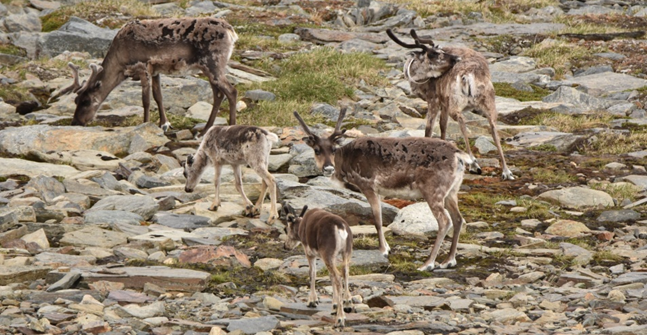
And there you are, in the middle of nowhere, face to face with a snorting reindeer charging straight at you. Of course, not all fieldwork days looked like that; mostly we were just surrounded by small Arctic plants, which are substantially less intimidating.
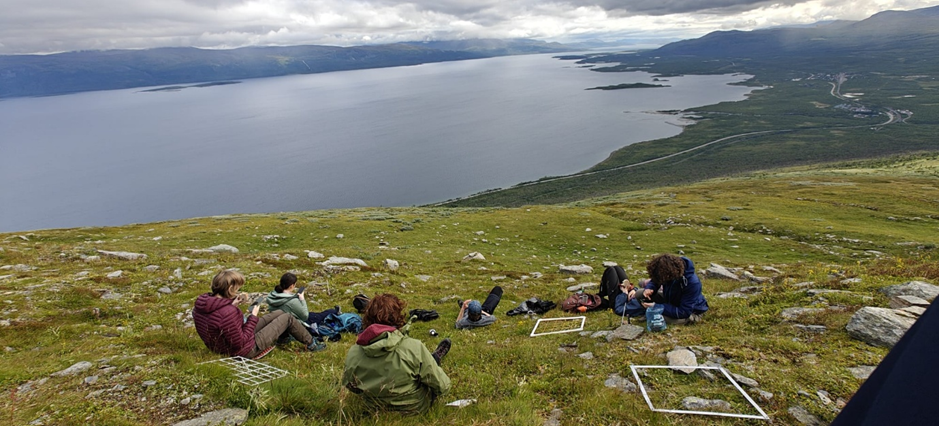
We were in Abisko (northern Sweden) to study snowbed communities. Seventy-five years ago, the botanist Olav Gjærevoll did plant surveys in snowbeds all across the area, and we wanted to compare his findings with the communities we find nowadays, considering the impact of climate change. On top of that, I am using satellite data to understand how the melt characteristics of each snowbed have changed over the last decades. This brings us to the methods! Nine satellite pixels of 10 × 10 m were chosen per snowbed, and within this area we randomly surveyed five plots of 0.5 × 0.5 m, documenting the species and their abundances.
So, what did a fieldwork day look like? It really depended on the day and the mountain. Three snowbeds were surveyed on Nuolja. We would take a ski lift to get higher up and then hike further to reach the right snowbed. There we would stand in the middle of the snowbed and throw four sticks to randomly select the placement of the plots. We worked with a great team, and each pair surveyed one plot, working together and sometimes struggling to identify the many tiny sprouts…
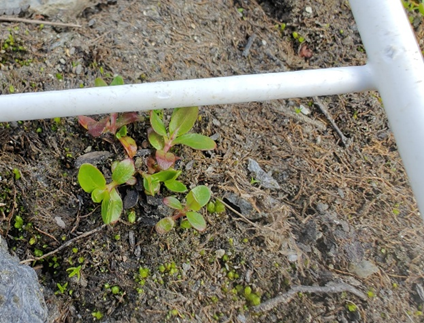
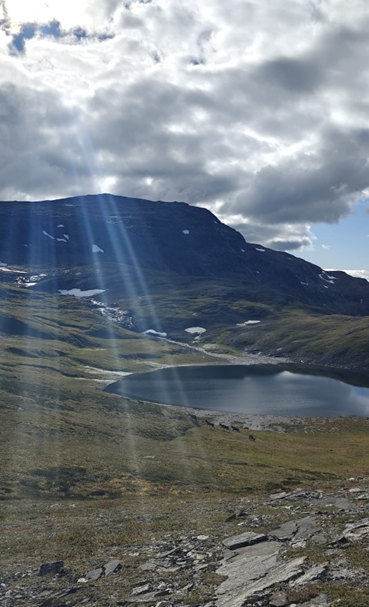
It was super cool: we were often so focused on these tiny plants that we forgot we were on a mountain with the best view in Sweden!
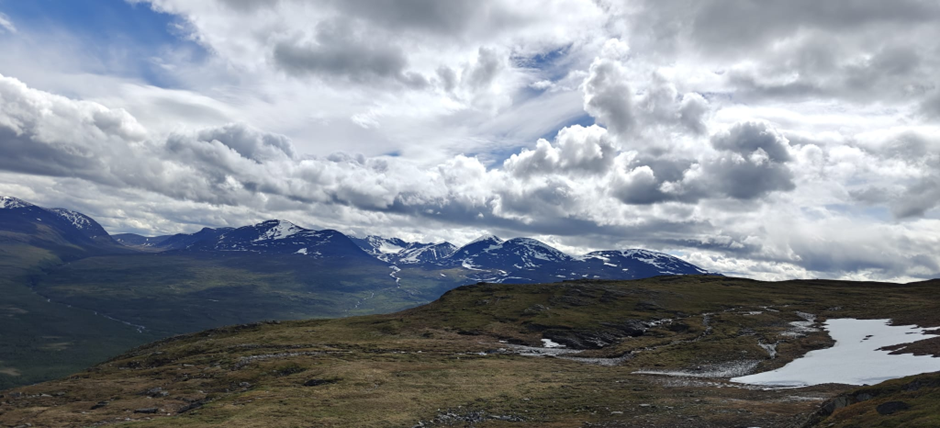
This was, however, not the case when it started pouring. We were wet through and through, with nowhere to go! Very much aware of our location…
One time we went to Laktatjakko and left the trail, leaving all hikers in the area behind. The coordinates led us to a beautiful place; I even got tears in my eyes to be there. A spot where, perhaps, since Olav Gjaerevoll no other hikers had been. A rare fieldwork day in the sun! The season had been mostly cloudy, so the sunshine felt like a nice surprise. While we were working, a reindeer ran toward us and we had no idea what it would do. But it was not charging at us; it was heading for the herd behind us. She got separated from her calf, and they reunited right before our eyes.
After collecting all the data, we made camp close by, eating pesto pasta and listening to fun stories. That was the most plant-diverse and memorable snowbed we visited.
Now, after two amazing months in Abisko, it’s time to analyse the data. It is difficult to understand how snowmelt patterns have changed under the influence of climate change, but I hope to find a correlation between the change in snowmelt timing and the communities we find per pixel. Even though it would be the worst-case scenario, we expect to find less species-rich communities at pixels where snowmelt has shifted over the last decade.
This research could serve as an extra argument that climate change negatively influences biodiversity, even in environments that seem less affected by rising global temperatures.


