There we go!

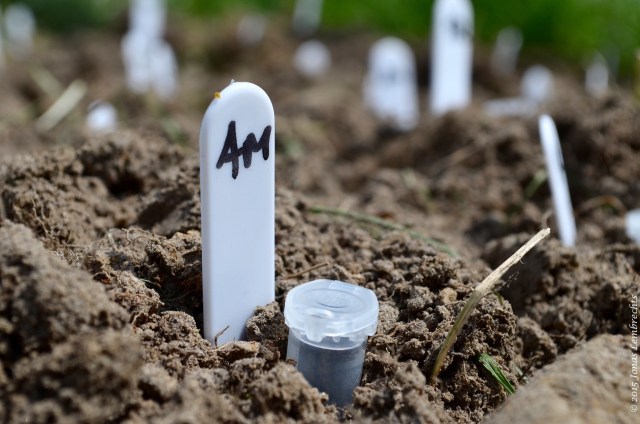
Labels of the experiment

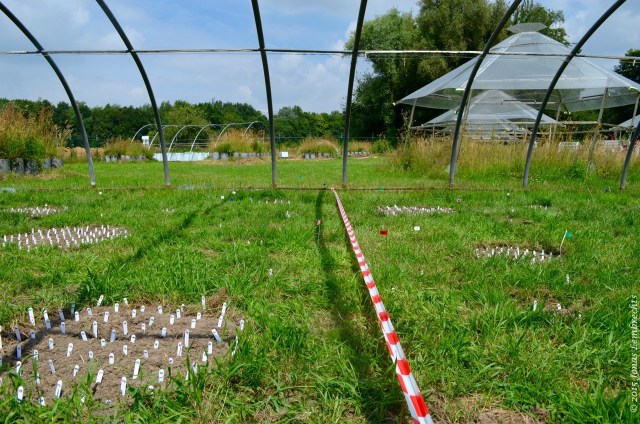
This week, I officially launched the new fieldwork season outside the office by installing my plots on the experimental field site at the university.

The experiment

Two days of digging holes, putting labels and seeding a mind-blowing amount of 15.000 seeds, resulted in a beautiful minefield under my greenhouse shelter.

15 seeds in a tube, ready to be seeded

While I was busy in the field, the weather forecast decided to change from moderately wet to very hot, so I hope at least some of my plants will survive this sweaty summer weather. I try to keep them happy by regularly watering them, but if it stays like this for weeks, there will be no need for me to simulate a drought extreme, as it will be there all naturally.

Keeping them alive

Anyway, I am excited to see what happens and test what the favourite hiding place against the summer temperatures will be for my tiny plants.

 The experiment in the sun

Posted in Belgium | Tagged , , , , , , , , , , , , | Leave a comment

The fascinating story of Ox-eye Daisy

Let me tell you a little story. It is an impressive story, one of the more exciting stories from the world of plant invasions I have heard so far. It sounds like a fairytale, but do not settle for a happy ending, as it is still real live we are talking about.

Flower of ox-eye daisy

The setting is Australia, the continent were all big stories seem to happen. More precisely in Kosciuszko National Park, a reserve of about 600,000 ha of mountainous country in the south-eastern part of the country. The main character is called Ox-eye Daisy (if that does not sound like a fairytale to you…), or Leucanthemum vulgare, a meadow species well known from any European countryside.

As is so often the case in historic tales, it is hard to pinpoint the moment when it all begun. The species probably escaped from gardens in the beginning of the 20th century in Australia, first observations in the mountains of the national park of our story date back to the sixties. After that, not much happened (but you might guess ‘not much’ is not why I am telling you the story…)

Budding ox-eye daisy

Fast forward to the beginning of the 21st century. Vegetation relevees in the Kosciuszko park mention virtually no Ox-eye Daisies. There had been a tiny patch next to a stream for a decade or two, but there did not seem to be any expansion from there. And then, boom, all of a sudden in January 2010, park managers noticed a hill completely (completely!) covered with the species. Tens of hectares within the landscape showed a virtually hundred percent cover of Ox-eye Daisies, turning them into beautiful but worrying white snow landscapes. The first question was obvious: had a growing patch of daisies managed to escape from the observing eye of scientists and park managers during decades, even though the infected area was huge and clearly visible from the road?
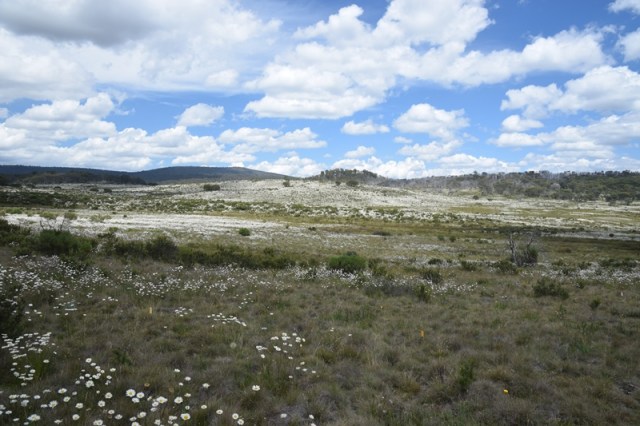
Ox-eye daisy invasion in Australia

A ‘snowy’ hill covered in Ox-eye daisies in Kosciuszko National Park – K.McDougall

Of course, such an assumption is a bit unrealistic, even for a fairytale. But it turns out the truth might be even more fascinating. Recent experimental research in the park revealed some characteristics of the Ox-eye Daisy, showing the species is just an incredible survivor. The seeds and seedlings easily survive under a very dense native vegetation, without any access to light. During years, they do not grow or flower, patiently remaining small and unnoticed. Until times are right…

Field of Ox-eye daisy

The seeds of this curious species are spread easily by animals , and those are plentiful in the park: native kangaroos, wallabies and wombats and non-native horses all roam freely through the hills, and they might have been spreading seeds from the small known patch of Daisy flowers at the stream for years. As soon as the seeds got dropped somewhere under the vegetation, they germinated and patiently waited, or remained there as seeds in the soil. Until times were right…

Flower of ox-eye daisy

In 2007, a wildfire, started by lightning, burned tens of hectares on a (previously mentioned) hill in the park. It had been the first fire on that location since the 1960s. That fire was the trigger for the massive expansion of our L. vulgare. The species grew much faster than the native vegetation and easily outcompeted it after a disturbance event like this, leaving virtually no room for other plants.

Park management noticed another similar event only last year, after a massive die-off of the native grass vegetation.

Flower of ox-eye daisy

So it is clear, again, how disturbance serves as the main driver of invasion, and this story is just another example. Where to go for a happily ever after is still uncertain. Management currently aims for containment of the Ox-eye daisy within the infected areas, but it is impossible to tell how far the seeds and seedlings have been spreading over the years. It is even harder to prevent them from spreading even further now, as the animals that carry them cannot be contained.

 Ox-eye daisies

This story originated from a personal communication from Keith McDougall, botanist at the Office of Environment and Heritage in New South Wales, Australia. More information can be obtained via keith.mcdougall@environment.nsw.gov.au or genevieve.wright@environment.nsw.gov.au.
Posted in Australia | Tagged , , , , , , , , , , , , , , | 5 Comments

Summer in the field

Poppy

Just two pictures as a friendly reminder that summer has arrived! It becomes visible everywhere, in fields and forests, through birds and insects.

Potato f

I love summer in the fields, it reminds me that biodiversity is not as dead as it might have looked and that even the poorest field still holds some natural beauty. The flowering potato plant is the best example of this forgotten beauty.

My preparations for the fieldwork season are coming to an end, and everything is getting into motion. Luckily, there is plenty of daylight to make everything fit in a short period of time!

Posted in Belgium | Tagged , , , , , , , , , , , , | 1 Comment

Like a phoenix

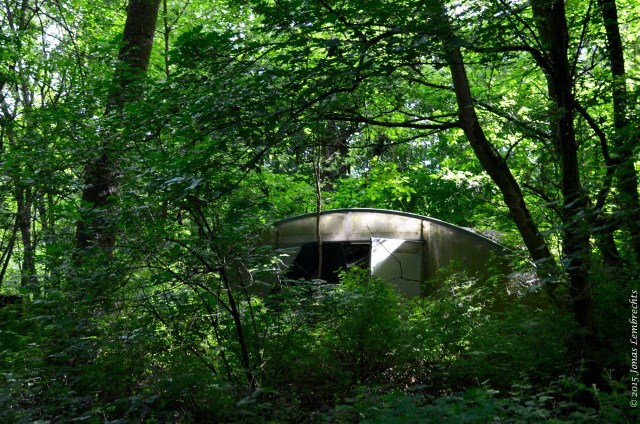
You might remember the obscure pictures of the old abandoned greenhouse we found in the forest at the university (from this post).

Greenhouse in the woods

We had two highly efficient days of cleaning, destroying, throwing out and removing the old stuff that was ‘living’ inside.

Where is the greenhouse?

Afterwards, there was another big job of disassembling the steel construction, as it was more or less merged with the forest and firmly hold in place by surprisingly stubborn roots and branches.

Greenhouse detail

Big job, but with a lot of people we won the fight against the old creature and we managed to move it to our own experimental field site. There we rebuilt it for one of my experiments this summer.

Greenhouse detail

Now it is happy and shining again as if it has never been used. The steel bars seem to be truly high quality, as it stands as strong as ever, ignoring the 30 years that have passed since it came into existence.

Greenhouse

 The field site is now ready for the summer. Next week, I will initiate the experiment and sow the first seeds of the year. Exciting plans!

Greenhouse

Posted in Belgium | Tagged , , , , , , , , , | Leave a comment

Residing at the castle

They provide a beautiful example of a marriage between nature and culture, between history and conservation: castle parks.

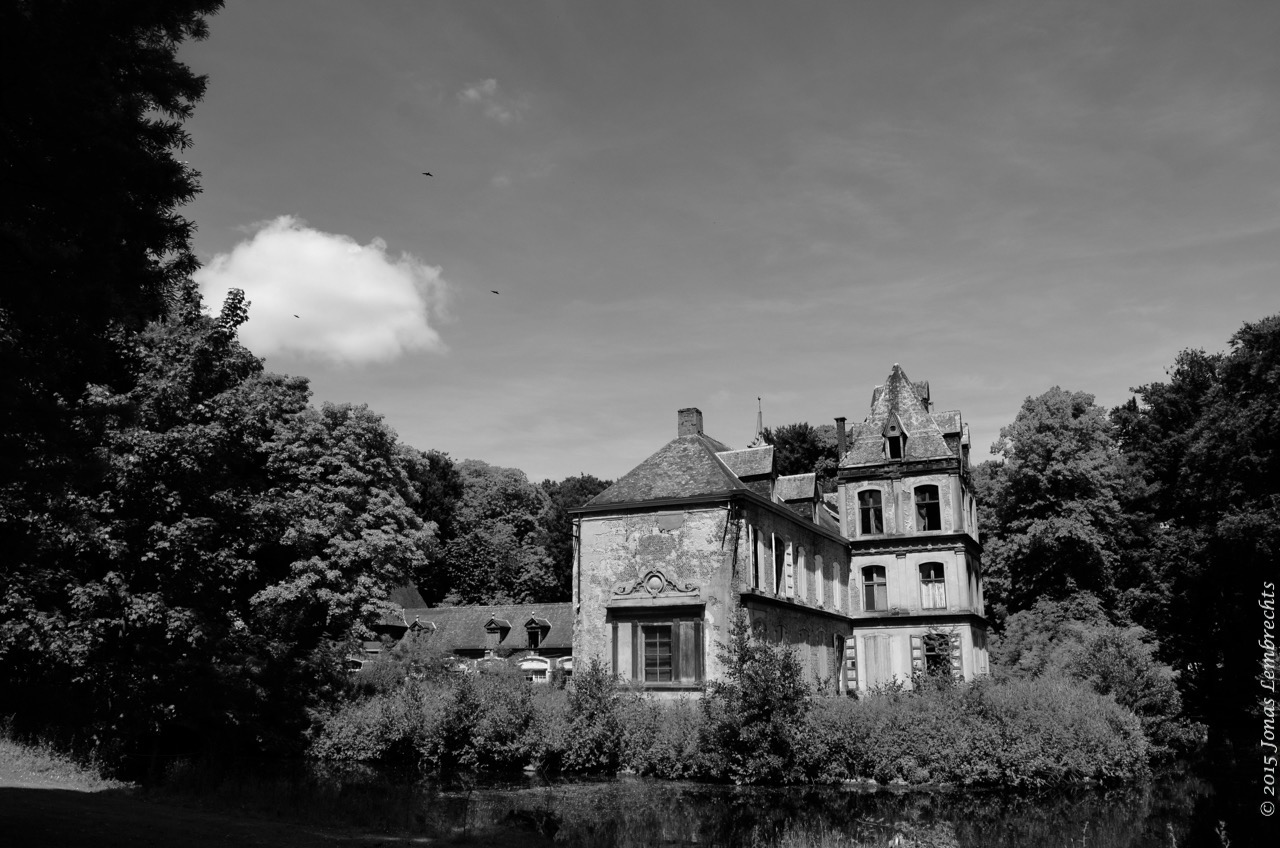
Castle in the lake

I realised this more than ever earlier this week, when I (almost accidentally) stumbled upon a beautiful little park with the ruins of a castle right along one of Belgiums most disgusting highways: the A12.

A12 highway in Wilrijk

Not that much further, the landscape looked like on the above picture: dirty concrete and countless cars, as far as the eye could see. The A12 is a combination of a highway – funnelling thousands of cars from Antwerp to Brussels and back – and a shopping street with massive shopping palaces. Together, this does not leave much place for nature.

 Old abandoned castle

And still, in between all this chaos, there is a little oasis of peace: the Hof ter Beke, a mansion with a history dating back at least to the 14th century. Although it is very small, and bordered on every side by industry, it has a long history and as a consequence even some remnants of old-growth forest.

Castle Hof ter Beke

Such a small park hosts a large variety of habitats and a large diversity. It is important to know that even such tiny little pieces of nature will never ever be too small to deserve conservation, as they can always serve as a stepping stone or sink population for countless species.

Even though you can never shut out the sound of passing trucks completely, there is an occasional goose protecting its young that might outclass this background noise.

Posted in Belgium | Tagged , , , , , , , , , , , , , , , | 3 Comments

A suspicious amount of green tea

That I seemed to love tea, the cashier of my local supermarket noticed. A fairly unusual conversation starter, where it not that he could impossibly ignore the obvious fact: I had a cart with only green tea, 140 tea bags of green tea, more precisely.

Tea on my terrace

I do love tea, that is out of the question, but I was not planning on living this week on a diet of 20 cups of green tea a day. On the contrary, I only allowed myself to drink one of these 140, just to get the taste of it.

Tea on my terrace

The suspicious pile of green tea has a role in a little experiment in Sweden this summer. We will participate – again, for those who recall last year – in the creation of a global tea bag index, an index that gives decomposition rates in all kinds of soils based on how fast bags of tea decompose.

A lot of Lipton green tea

That might sound a bit shady, but it is in fact really strong in its simplicity. If everybody uses the same tea and protocol, we can perfectly compare how different soils and soil organisms handle these samples. The result will be an outstanding dataset on a global scale with easily comparable data, and that makes me very excited.

Tea on my terrace

Aim is to use both green tea and rooibos tea, as both types have a different ratio of carbon and nitrogen, important nutrients in defining the decomposition speed. Sadly for me, none of my local supermarkets sell this Lipton rooibos tea!

Lipton Green Tea, our global saver

They do sell some other fancy tastes, like ‘Strawberry cupcake’, but I am not completely sure if they would pass the scientific jury…

So I am currently still on a hunt for 140 bags of Lipton rooibos tea, to make another cashier doubt my sanity.

A little tea party for one person, that is definitely something I deserved!

A little tea party for one person never hurts anybody. 140 of them maybe do…

Posted in Belgium | Tagged , , , , , , , , , , , | 4 Comments