An easy solution to a complicated issue

Biodiversity is important. That is a fact, and it would take a fool to deny it. Yet how important is it exactly? How much does it matter how many species an ecosystem has, or which? Ecologists have been searching for answers to these questions for decades now.
24542585418_c071a0bd05_o.jpg

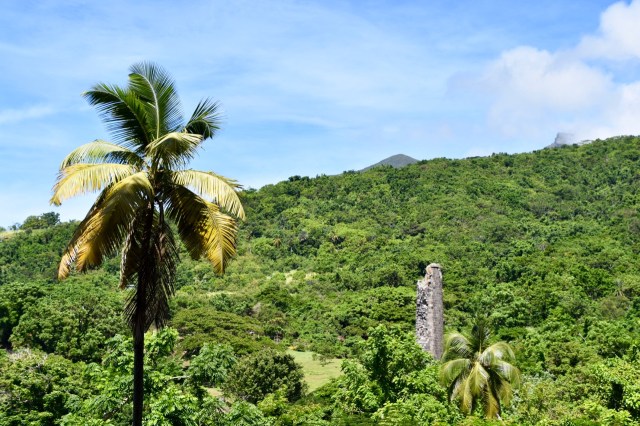
The role of biodiversity – here a highly diverse tropical rainforest in St. Kitts – on the functioning of ecosystems has been the subject of study for decades.

A common approach to search for the role of biodiversity is through experiments with a very simple set-up: make artificial little ‘ecosystems’ with a varying amount of species in it (from 1 to 20 plant species, for example), give them the same treatment, and measure the effect of this varying species richness on the functioning of the ecosystem (through the production of biomass, for example).

Such experiments undeniably revealed that species richness is crucial, with every added species positively affecting the functioning of the ecosystem (albeit less and less significantly so with every extra species added).
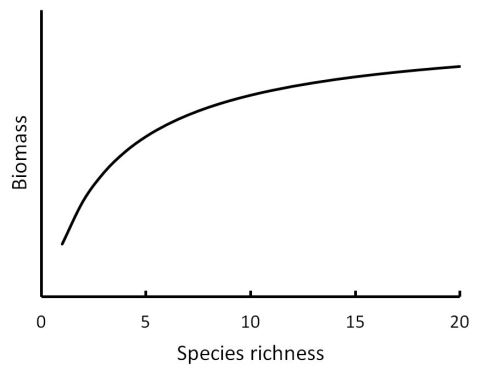
 

Fig. 1

Fig. 1: simplified curve of an ecosystem function (i. e. biomass production) as a function of species richness, showing the positive, yet saturating, effect of increasing species richness in an ecosystem.

Yet there is more to biodiversity than species richness alone. What if you have 20 species in your ecosystem, yet one of them takes up 99 percent of the space, leaving only a tiny bit of space for the 19 others? While theoretically a very rich ecosystem, it does not feel like these 19 species can have much of an effect on ecosystem functioning, does it? It doesn’t. The level of dominance of one or a few species in an otherwise species rich ecosystem is expressed as ‘evenness’. A system with all species equally represented is  called ‘even’; a system with one or a few dominant species is named ‘uneven’.

36357524530_d554ee9943_o

Alpine tundra (here in northern Norway) is often highly uneven, as it is dominated by a few dwarf shrub species.

Now you could use the same type of experiments as before to try to unravel the role of this evenness on the functioning of the ecosystem. Unfortunately, this extra dimension makes the amount of combinations  virtually infinite. You would have to vary the relative dominance of several species at several different levels of species richness, and that requires a ton of artificial little ecosystems. For that reason, such experiments are much less frequently executed, and the exact role of evenness in ecosystem functioning had still to be proven conclusively.

And that is exactly where we step in. With our group, we came up with an easy solution for this complicated problem. In our latest paper in the journal Oikos, we show that there is no need for all these demanding experiments varying species evenness. The effects of evenness on ecosystem functioning can easily be derived from the existing richness experiments. It requires only a little trick, as the results of the latter are actually hiding the effects of evenness within them.

This little trick is nothing more than the realisation that a highly uneven ecosystem with one species being dominant, and all others having only one individual, is virtually the same as an ecosystem in which that dominant species is the only one present. Present or not, these individuals of the rare species on average only have the fraction of an impact on ecosystem functions like biomass production.

The great thing is: we already know the ecosystem functioning of the ecosystem with only one species (a monoculture) from the richness experiments, and this can thus simply be transformed to an estimated effect of high unevenness on ecosystem functioning.

Applying this little trick to real experimental data worked great. It also revealed that the effects of species richness and evenness on ecosystem functioning point in the same direction (and are both positive). Moreover, we can now see for all ecosystem functions that the positive effect of evenness increases with increasing richness of the ecosystem, without the need for resource-intensive experiments.

Simple as that.

38390737392_e964a825ee_o.jpg

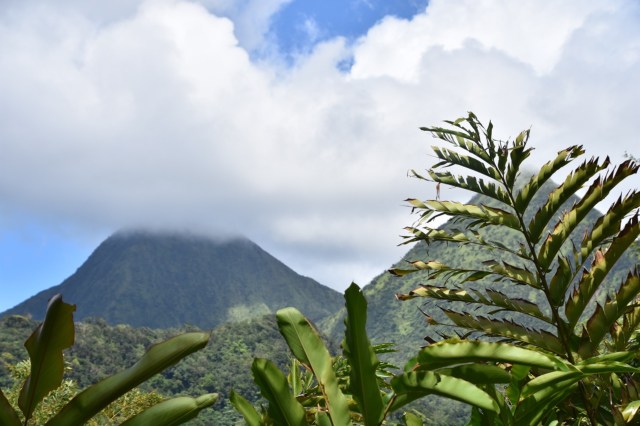
A true loss of species and a loss of evenness within your species community both have similar negative effects on the functioning of your ecosystem. Picture showing rainforest in Martinique.

To get all the details on our trick, check out the paper!

Lembrechts JJ, De Boeck H, Liao J, Milbau A, Nijs I (2017). Effects of species evenness can be derived from species richness – ecosystem functioning relationships. Oikos. 10.1111/oik.04786.
Posted in Science | Tagged , , , , , , , , | 5 Comments

We’re back!

It has been quiet here on the blog for a while, but now we are finally back, with tons of new stories to share!

38421949721_0779b31568_o

Lush rainforest in Martinique

We took a little break from it all, to the Caribbean, before diving back in head first into the fascinating world of mountain ecology.

26644318049_29bac9278f_o

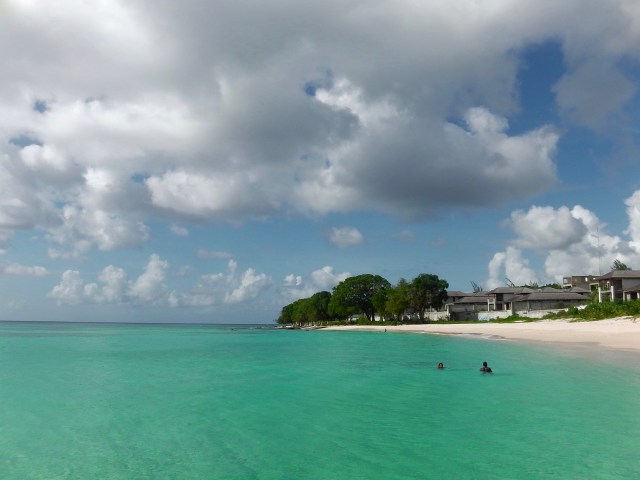
Beach-beauty in Barbados

26645658379_2cbcd96e5f_o

Anole lizard in a botanical garden in Martinique

So I hope these pictures from paradise convince you there were good reasons to stay off the radar for a bit, while hot beaches and tropical rainforest provided a welcome contrast to the – never dissapointing, though – cold roughness of the mountains. The last month however saw a lot more going on behind the scenes than only relaxing. We have been frantically setting up some new projects and consolidating some fascinating new plans, which we will share with you soon!

38367018256_0361402303_o

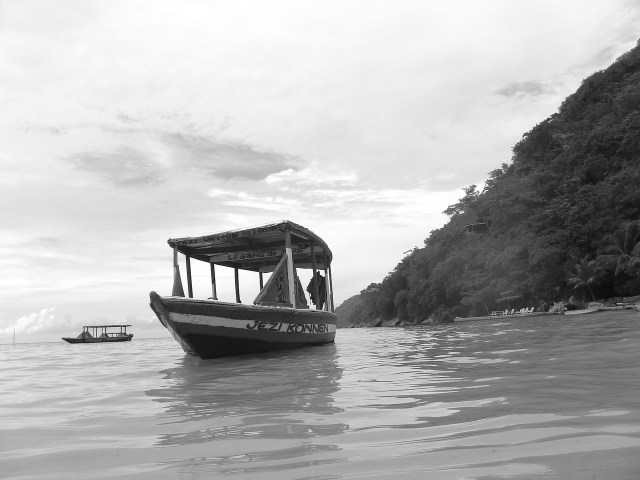
Water-taxi in Haiti

So, welcome back, enjoy all the new stuff we will be bringing you shortly, and join us into the final year of the amazing journey that has been this PhD. But more on that later…


26645817879_5a19beeaf2_o

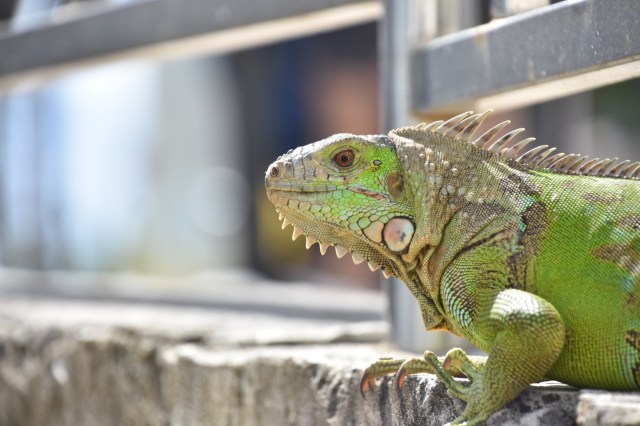
Iguana in the city-center of Fort-de-France, Martinique

24542591888_eca7cba81a_o

Rainforest view with tower of old rum distillary (bottom left), St. Kitts

Posted in Caribbean, General | Tagged , , , , , , , , | 1 Comment

A visit to the south

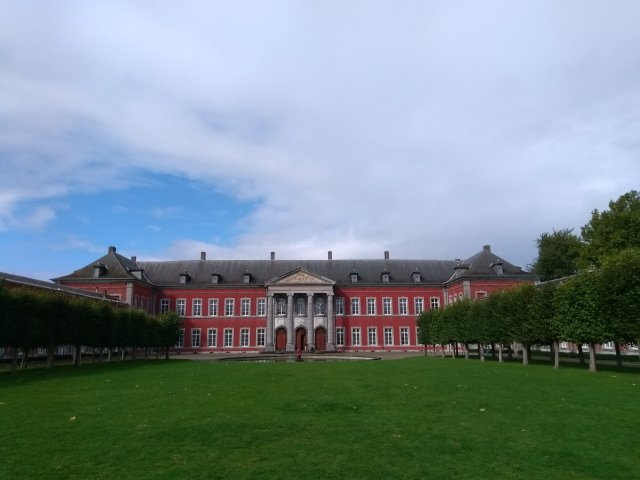
The faculty of agro-science in Gembloux

Today, we spent the day in Gembloux, in the southern part of Belgium. A cosy little city with a beautiful university.

While the always-welcoming feel of the south made it feel like a holiday, it was far from that: we’re finally starting our joint project on plant invasion in Belgian cities, and it promises to be awesome!

Posted in Belgium, Uncategorized | Tagged , , , , , , , , | Leave a comment

Lab-time

IMG_20170825_145232

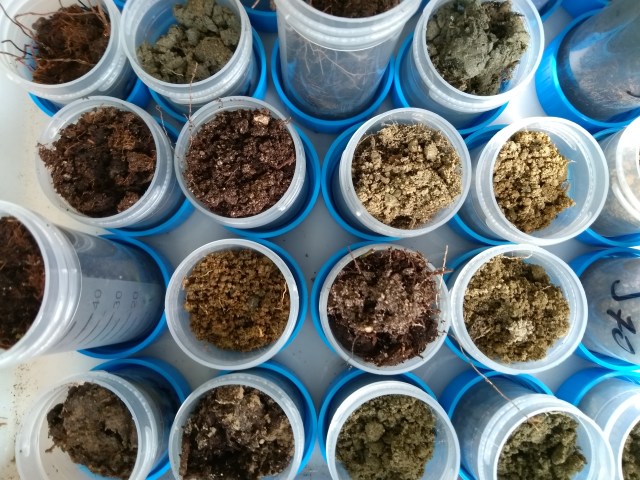
More than ever, we will be spending time in the lab this autumn. Finally, the big step has been made: we are digging belowground! It had been high on my wishlist for a long time, but besides a few interesting trials, it never really happened. Too expensive, too much work and, most of all, not the priority to find the answers to the questions we were looking at.

35387883334_e20d04c7cc_o

Now we are going for it head-on, without looking back: pH measurements, nutrient analyses, root staining, even DNA-analyses, no technique is being overlooked. It turns out the soil is hiding countless answers to our follow-up questions, which all arose after we answered what happened above the surface. So we are down for a new and exciting trip, as we slowly open the ‘black box’ the soil has always been, and take a look at what’s inside.

Highly promising stuff, I can assure you, and stuff we will want to dig deeper into even more the next years.

Posted in Norway, Science | Tagged , , , , , , , | Leave a comment

Biology Research Day

The study of biology at the University of Antwerp is surprisingly diverse. With research groups covering all scales, from the smallest cell to the largest ecosystem, and all aspects of biology, from behavioral ecology till molecular physiology, the department can be proud of its significant role in local and global advancements in the field.

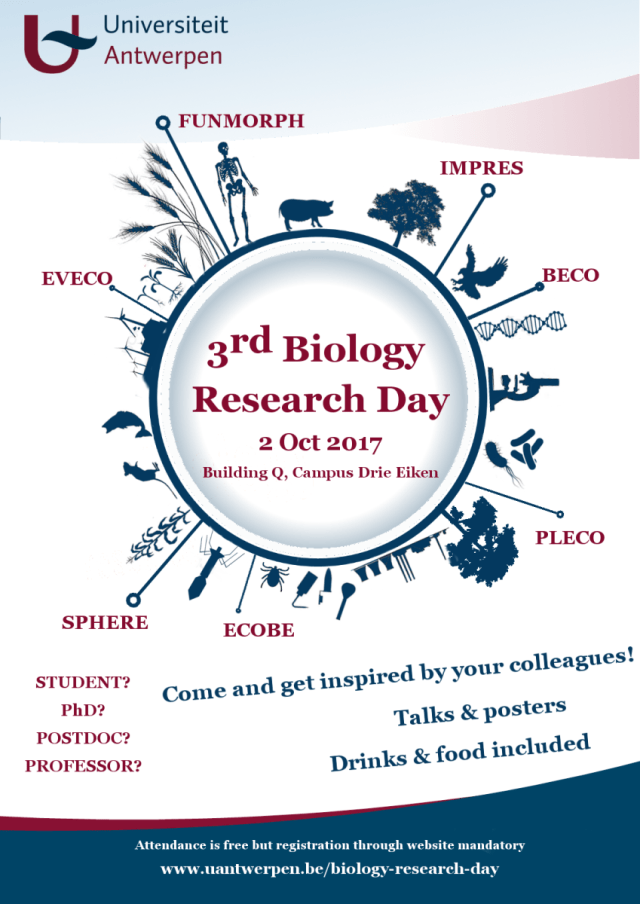
I am thus honoured to co-organise the 3rd Biology Research Day, a yearly meeting bringing together all scientists and students from across all biological research groups within our university.

Poster_BRD2017

Such a research day is not only a great way from students to get an idea of everything what is going on here. It is also from major importance for the science itself, as the field is broad (making one less likely to look over the fence to his neighbour and ask what he is doing), yet parallels and shared interests are everywhere. Science makes most progress at the edges between different fields, as unexpected yet fruitful collaborations open up different ways of viewing our world. And with such collaborations getting more established within the department, the study of biology in all its facets within the department becomes more alive, and more relevant, than ever.

Impatiens - 3

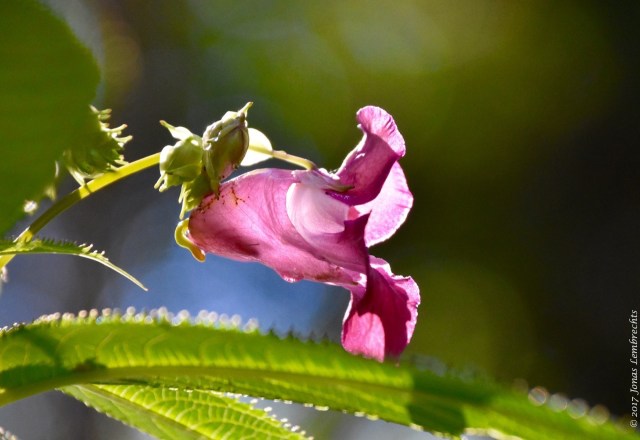
Studying Impatiens glandulifera (Himalayan balsam) for its hormonal components, for its intriguing way of distributing seeds, for its rapidly changing distribution or for its impacts on ecosystems? It’s all biology!

It is every year a surprise to see who else is working on climate change, for example, and how they are approaching the issue from an ecosystem, plant or animal perspective. I am thus awaiting this event with high anticipation!

Posted in Belgium, General | Tagged , , , , , , , , | 1 Comment

Worth it

Just imagine: your commute to your office includes a one hour drive, followed by a six kilometer hike with a 600 meter elevation increase. Two hours of consecutive hiking, if you follow a decent pace. And then your office day still has to start. And after 8 hours you still have to head back.

Heavy? No doubt, but imagine now that this would be the view from your office:

Rombak - 1

Then it does not matter anymore how long the hike, how high the climb, how hard the work, this view is worth it all.

This was exactly what we got on the last day of our second 10-day-fieldtrip to Northern Scandinavia this summer. We had had some disappointments along the way: closed road barriers, whole valleys shut down due to a broken truck on the only access road, hours of rain… All of these disappointments added up to us having to include a pretty hard day at the very end of our trip.

Rombak - 3

Luckily, weather was (finally truly) on our side that day, offering us a morning with the brightest, nicest, sunniest Arctic summer weather one could imagine. If that doesn’t make your day, nothing will.

With morning unfolding around you, slowly hiking up towards and above the treeline, and seeiing the beauty of the northernmost Norwegian mountains unfold around you; it is those things that make you fall in love with the mountain ecology everyday.

Rombak - 6

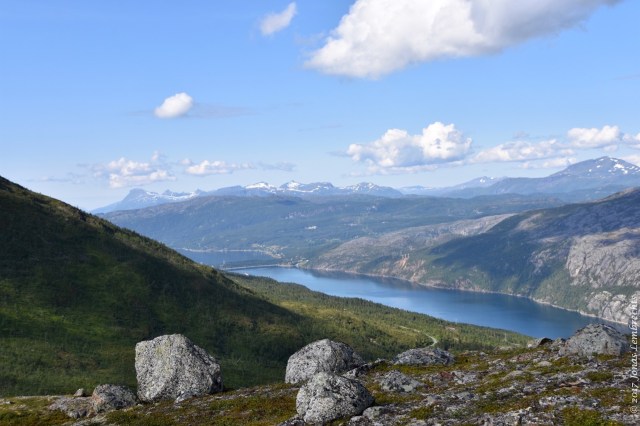
As soon as we reached the top, we spend the rest of our day monitoring plants up there, overlooking fjord Rombaken and the wild mountains surrounding it.

Rombak - 5

Fieldwork with a view over fjord Rombaken in northern Norway

I have to apologise to you now: this story is not building up to any kind of punchline. Even worse, you might have read the best of it already; it just serves as an opportunity to share the beauty of our workspace with you. After this, the story will only go down again. As we did. Down the road to the valley in the evening, following the setting sun and admiring the changing colors.

Rombak - 7

Evening in the mountains

It was definitely a day to remember, this last day of our 2017 field campaign in the north, thanks to the mountains and weather playing together to set up an incredible show. Probably just to make sure I’ll be back next summer.

Rombak - 2

Fireweed (Epilobium angustifolium) overlooking fjord Rombaken

Posted in General, Norway | Tagged , , , , , , , , , , | Leave a comment