New MIREN website!

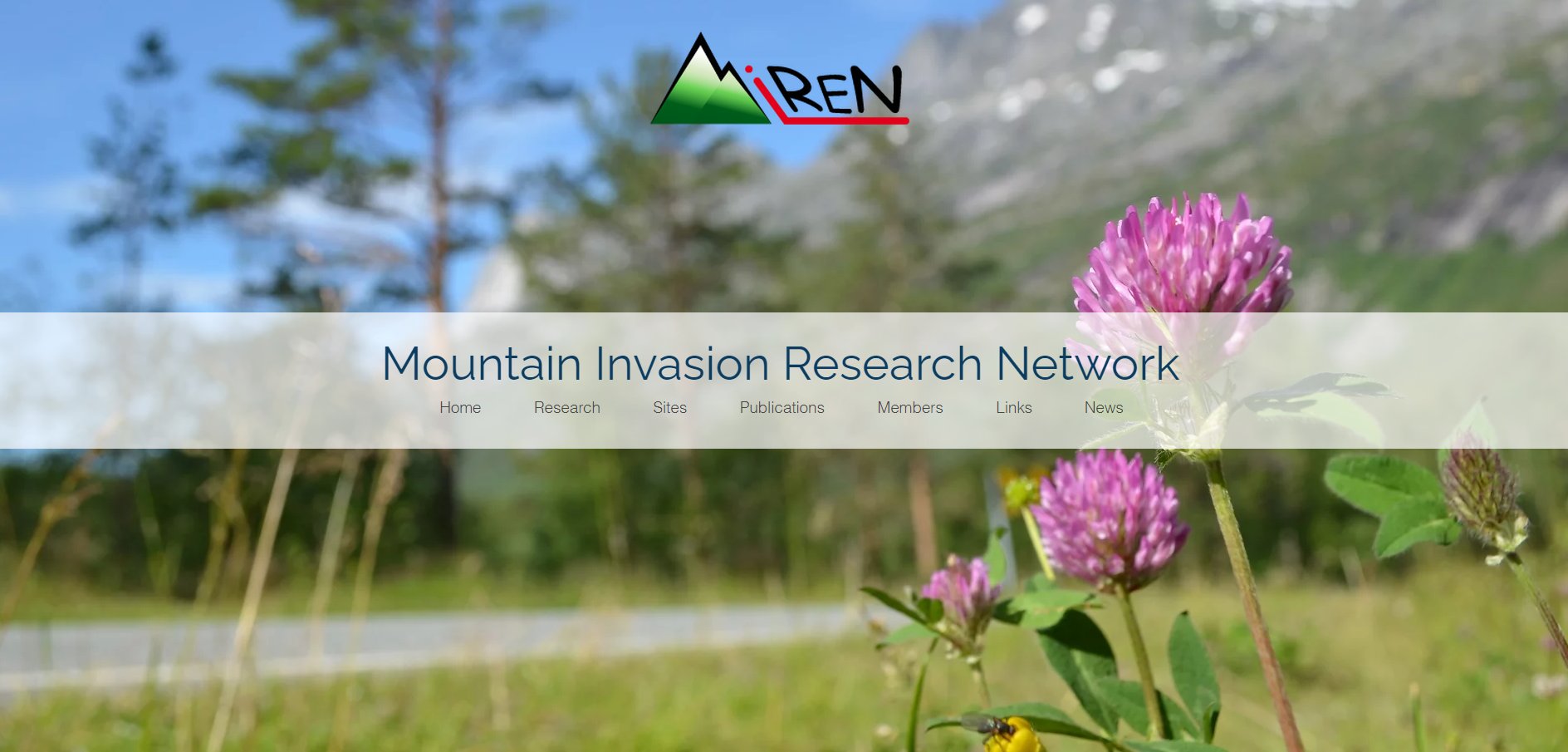
Exciting news! We made a new website for MIREN, the Mountain Invasion Research Network. It still sits at www.mountaininvasions.org, yet is now a lot more visually attractive. Visit the site for the nice mountain views, stay for the cool mountain ecology!

Afbeelding

Heaps of thanks to my wife for her design-skills!

Posted in General | Tagged , , , , , | Leave a comment

Something cooking

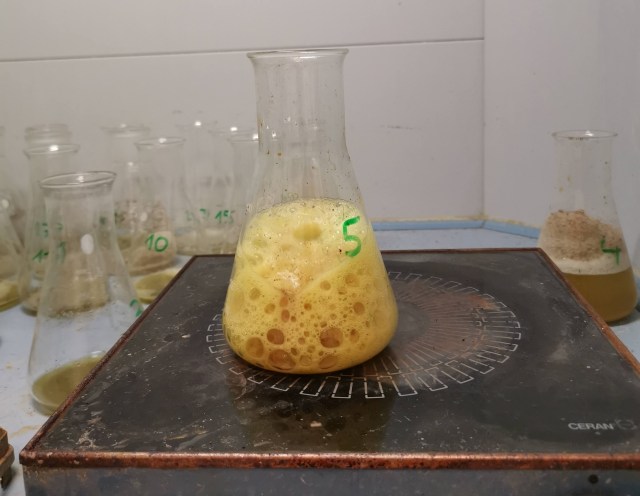
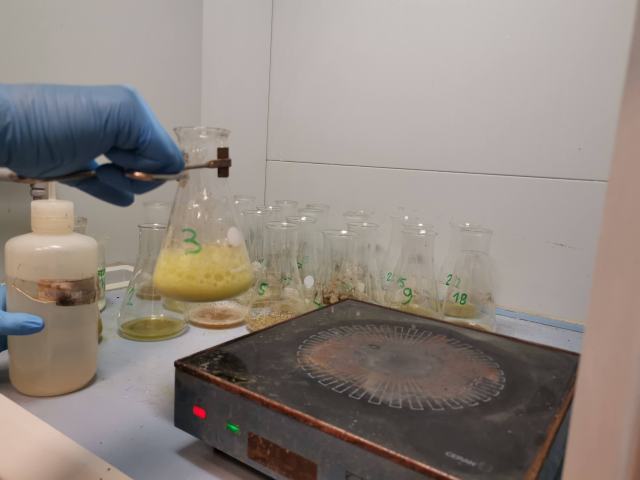
There is something cooking in the kitchen, and it is looking far from tasty!

IMG_20200804_113758_1

It is a nice mixture of hydrogen chloride and hydrogen peroxide, with a pinch of soil added for flavour. The boiling and simmering of this disgusting soup will remove all the organic material from the soil, leaving us with the pure basics: grains of sand, silk and clay.

IMG_20200804_111617

These, we analyze with the fancily named Grainsizer 2000, a laser-scanner for particles, that will tell us the soil texture of our samples. Important, as it will help us calibrate the soil moisture measurements from our ‘microclimate daggers’.

IMG_20200321_132816

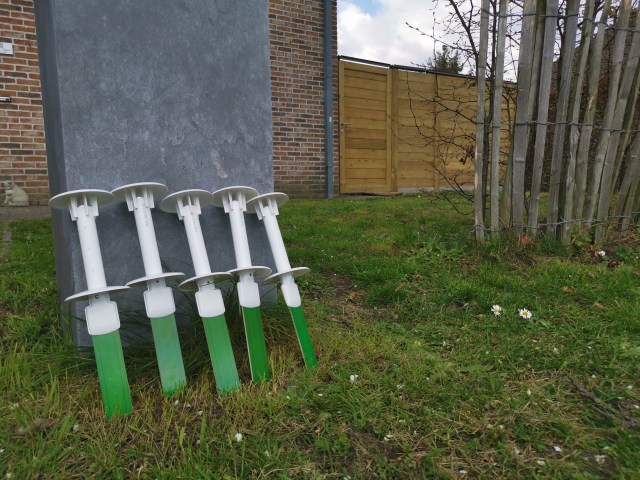
These green daggers measure the soil moisture, yet their values will vary between different soil types. Our ‘kitchen crew’ is finding out how that looks!

As the grain size of a soil defines how much water it can hold, such a calibration excercise is critical to know what water is truly available in these soils we are looking at. A big job, but the team is on it!

Posted in General | Tagged , , , , , , , | Leave a comment

Gezocht: meningen over natuur!

Waar ligt voor u de grens tussen natuur en cultuur? Ecologen van de Universiteit Antwerpen willen graag uw* mening over UW definitie van natuur in deze snel veranderende wereld. Beantwoord hun vragen op www.natureornot.be!

*Als je in Vlaanderen of Nederland woont

De coronacrisis heeft in de laatste maanden nog maar eens aangetoond hoe cruciaal natuur is voor onze ge­zondheid en ons welbevinden. Maar wat is ‘natuur’ eigenlijk? Hoeveel ‘cultuur’ maakt groen onnatuurlijk? Onze meningen hierover zouden wel eens verrassend ver uit elkaar kunnen liggen, stellen onderzoekers Jonas Lembrechts en collega’s van de Universiteit Antwerpen en Luik. Beschouwt u heidegebieden, die enkel blijven bestaan als ze worden beheerd, bijvoorbeeld als natuur? En parken, tuinen en braakliggende stukken grond, vallen die binnen de definitie? En wat met invasieve exoten?

NatureOrNot (1)

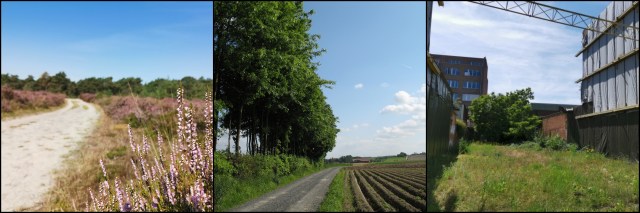
Natuur of niet, dat is de vraag! Vallen de typische Vlaamse heide, landbouwgebieden en braakliggende terreinen voor jou onder de definitie van natuur?   

De onderzoekers proberen nu deze verschillen in perceptie in kaart te brengen. Lembrechts legt uit: ‘we kunnen verwachten dat de definitie zal verschillen van persoon tot persoon, afhankelijk van hun ervaringen met het groen om ons heen.’ Zo kan je woonplaats je definitie van natuur sterk beïnvloeden: wie in de stad leeft, heeft een heel ander beeld van groen dan wie zijn hele leven ‘op de boerenbuiten’ heeft door­gebracht. Daarnaast kan ook leeftijd een rol spelen: de oudere generatie herinnert zich bijvoorbeeld nog wel hoe je boven haast elke akker een leeuwerik kon horen kwinkeleren. Voor jongeren is het dan weer een verrassing dat er vroe­ger géén luidruchtige parkieten door de Brusselse parken vlogen. Vaak zijn we ons nauwelijks bewust van die verschillen in perceptie.

Zolang we die verschillen in perceptie niet duidelijk in beeld brengen, blijven we hangen in onbegrip rond maatregelen die de natuur pro­beren te versterken. Dat mondt uit in gebakkelei over bo­men kappen om heidegebied te herstellen, of in verhitte discussies over het bestrijden van al dan niet aaibare exoten. Ook wordt het moeilijk voor het beleid om natuurbeschermingsmaatregelen in cijfers uit te drukken als we het niet eens zijn over wat we nu exact onder natuur verstaan. Enkel bossen meetellen volstaat niet – al gebeurt dat soms in het kader van koolstofvastlegging. Focussen op al het groen in ons landschap helpt ons ook niet verder. Hoe groen een voetbalveld ook mag zijn, het label ‘natuur’ verdient het niet.

20190625_082444

Een beter begrip van wat we als natuur ervaren, kan uitklaren hoe we hopen dat die natuur er in de toekomst uitziet. Nog belangrijker: het geeft natuurbeheerders de kans om in hun beleid en communicatie meer rekening te houden met die waaier aan persoonlijke de­finities. Zo vergroten we het draagvlak voor broodnodig natuurbeheer. Aan de slag dus! Surf naar www.natureornot.be en vul de vragenlijst in. Je bewijst onze natuur er een serieuze dienst mee.

Het project #NatureOrNot is een initiatief van de Universiteit Antwerpen en Luik. Voor meer informatie, neem contact op met
Jonas Lembrechts (
jonas.lembrechts@uantwerpen.be, 032651727) of bezoek de website www.natureornot.be.

Posted in Belgium, General | Tagged , , , , , | Leave a comment

Wanted: opinions about nature!

Where would you draw the line between nature and culture? Ecologists from the University of Antwerp would like your* opinion on YOUR definition of nature in this rapidly changing world. Answer their questions now via www.natureornot.be!

*If you’re living in Flanders or the Netherlands, that is.

The corona crisis has once again shown how crucial nature is to our health and well-being. But what is ‘nature’ really? How much ‘culture’ makes green unnatural? Our opinions on this could be surprisingly far apart, researchers Naomi De VriesJonas Lembrechts from the University of Antwerp and Liège suggest. Would you for example consider heathland areas – which can only exist if they are managed – ‘nature’? And parks, gardens and fallow land, do they fall within the definition? And what about invasive exotic species?
NatureOrNot (1)

Nature or not, that’s the question! Would you consider the typical Flemish heathlands, agricultural sceneries or fallow land to fall within the definition of nature?

The researchers are now trying to identify these differences in perception. We can expect that the definition will differ from person to person, depending on their experiences with the greenery around us. For example, your place of residence can strongly influence your definition of nature: those who live in the city have a completely different picture of green than those who have spent their whole life ‘on the farm’. In addition, age can also play a role: the older generation, for example, remembers how you could hear a lark chirping above almost every field. For young people, it is a surprise that no noisy parakeets flew through the parks of Brussels. Often we are hardly aware of these differences in perception.

As long as we do not clearly depict these differences in perception, we will remain stuck in a lack of understanding about measures that try to strengthen nature. This results in bickering about cutting down trees to restore heathland, or in heated discussions about combating cuddly exotic species. It also makes it difficult for governments to quantify nature conservation measures if we disagree on what exactly we mean by nature. Just counting forests is not enough – although this sometimes happens in the context of carbon sequestration. Focusing on all the greenery in our landscape does not help us either. However green a football pitch may be, the label ‘nature’ does not deserve it.

20190625_082444

A better understanding of what we experience as nature can explain what we hope nature will look like in the future. Even more importantly, it gives nature managers the opportunity to take more notice of this range of personal definitions in their policy and communication. In this way, we increase support for much-needed nature management. So let’s get to work! Surf to www.natureornot.be and complete the questionnaire. You are doing our nature a tremenduous service.

The #NatureOrNot project is an initiative of the University of Antwerp and Liège. For more information, contact Jonas Lembrechts (jonas.lembrechts@uantwerpen.be, 032651727) or visit the website www.natureornot.be.
Posted in Belgium, General | Tagged , , , , , , , , , | Leave a comment

Sensors

Eleven thousand and counting! This summer has been huge for our SoilTemp-database. Little could we have imagined that our project would become such a tremenduous success, with people contributing from all over the world!

SoilTemp

Temperature loggers from all over the world: from Belgium to the Pyrennees, from Slovenia till Australia, from Sweden to Cameroon, a glimpse of the myriad of contributions to our database

We are now collecting pictures as well, to see where all these heaps of data are coming from. It is only then, when you see the huge variability in landscapes and locations, that you start to grasp the true scope of this endeavour: yes, we are covering all terrestrial landscape types from all biomes across the world! Each of these eleven thousand sensors is a dataset on its own, whispering a story about its own little piece of the world. Together, these stories become a roaring thunder of over hundred thousand months of temperature data, collectively taking the temperature of the world.

And when we’ll be done, the soil climate will hold no secrets anymore.

Keep track of our sensor count on our cool microclimate app!

Posted in General | Tagged , , , , , , , | Leave a comment

Microclimate in the city

Summer 2020 is now in full swing, and that means our trial for our garden microclimate project is in full swing! Let me guide you through some of the plans with some awesome pictures:

IMG_20200531_110423

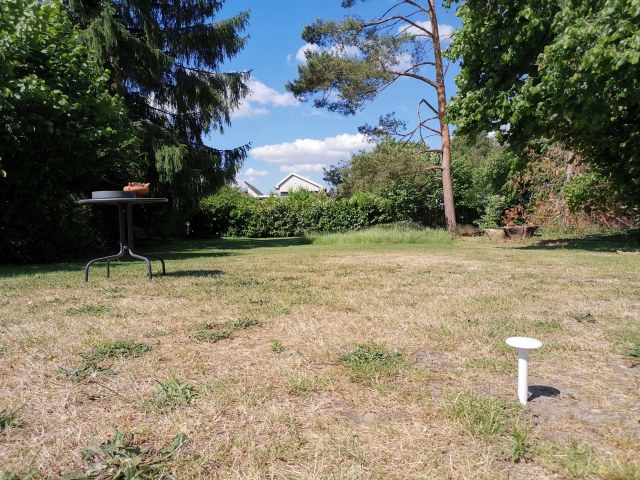
Lawns, lawns, lawns! We plan to fill thousands of lawns in Flanders with our ‘garden daggers’ (TOMST TMS4 microclimate stations). This summer, we already have up to 50 gardens equiped to monitor drought (here a picture from this springs’ long drought) and heat

IMG_20200528_142745

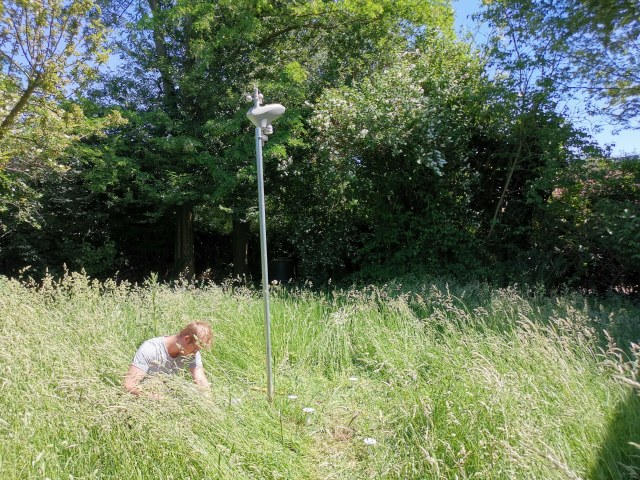
We are teaming up with some other ongoing climate measuring initiatives, among which the super awesome Leuven.cool community science project. They measure urban heat islands effect in air temperature, we match our loggers on and in the soil, to study vertical gradients in temperature.

We use these set-ups from Leuven.cool also to test small-scale variation: how much does temperature and moisture vary within a few meters in a lawn? How wide of a circle can we capture using one garden dagger?

IMG_20200528_105519

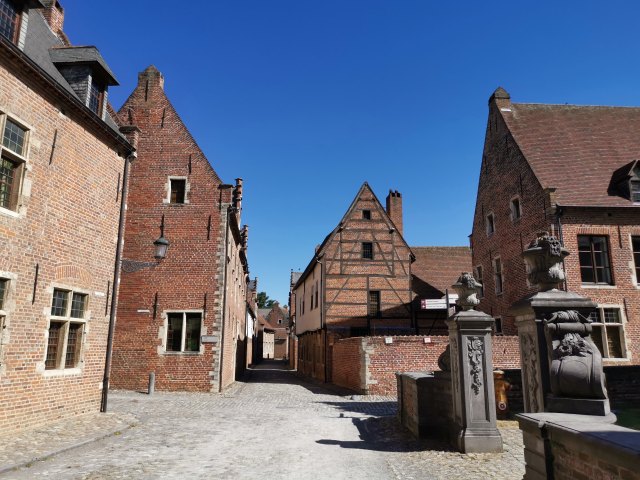
We have gardens ranging from the very center of the city – here a view from the ‘Begijnhof’ in the center of Leuven – to the more rural parts of the country, allowing us to test for the effect of garden location on patterns in drought and heat

IMG_20200528_121539

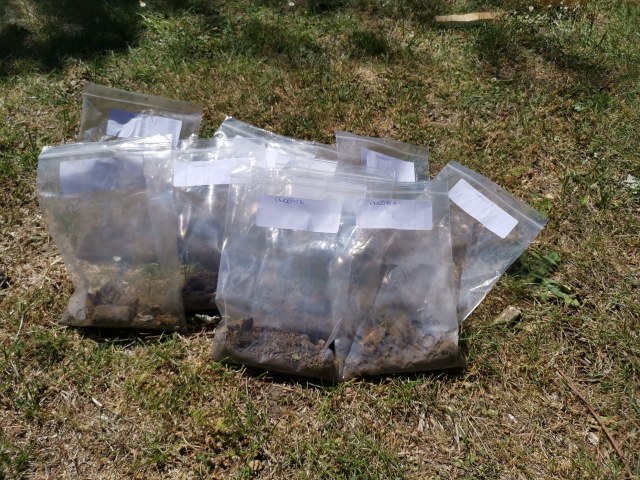
No project on soil moisture and temperature without soil samples! We dig up soil in all the gardens we are studying, to study soil texture and carbon storage potential

Looking forward to see what these trials will bring, and so ready to roll out this project in full next year!

Posted in Belgium, General | Tagged , , , , , , , , | Leave a comment