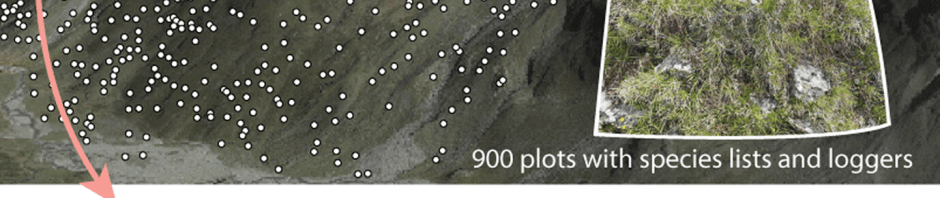
Microclimate data are finally finding their way more routineously into ecological models – and rightly so. Hooray for that! The growing availability of in-situ measurements is helping us bridge the gap between the coarse world of macroclimate and the fine-scale environments that organisms actually experience. But as more researchers start integrating these data into distribution models or other ecological questions, a new issue has arisen, and it’s one we have to deal with soon: what do we actually do with all this detail?
When faced with high-frequency microclimate time series, the temptation is often to reduce them to a familiar set of summary statistics – mean temperature, perhaps minimum and maximum values, or that so-familiar set of bioclimatic variables that we are so used to be using. Yet, those choices strip your microclimate data of its power. The real story lies in its variability, its seasonal contrasts, and the way it interacts with snow, vegetation, and topography. In other words: the fine-scale thermal landscape is more than a few summary statistics.
So, what do we do then?? A good starting point is to explore a broader range of summary statistics. Yes, this can feel like stepping into chaos – dozens of potential variables, each telling a slightly different story. Like trying to cook a soup with everything in your pantry — from chocolate chip cookies to bean sprouts.
But here comes our recent paper in Oikos – expertly led by Kryštof Chytrý – with a recipe to avoid disaster. As with the right tools, the complexity becomes manageable. A straightforward cluster analysis, for example, can help reveal sets of variables that move together. Rather than drowning in endless variation, you’ll see that many microclimate metrics are strongly correlated, allowing you to identify a few meaningful clusters that capture most of the relevant information.

Depending on your study system, these clusters will likely make ecological sense. In snow-affected regions, for instance, winter and summer temperatures tend to form distinct groups, each shaping species distributions in opposite directions. Spring and autumn may emerge as their own transitional cluster, with temperature dynamics that reflect phenological shifts. Meanwhile, variables capturing variability — the day-to-day swings, or microclimate buffering capacity — form yet another cluster, particularly important when studying ecological stability or resilience.

The broader message here is one of balance. We shouldn’t oversimplify microclimate data into a handful of familiar metrics, but neither should we be paralysed by the complexity. Using our new summary statistics – even after reducing them through cluster analysis – consistently outperformed traditional bioclimatic variables in capturing ecological variation. There is a pattern in the noise, and finding it takes that extra analytical step, as we describe in this paper.
This is more than a technical issue; it’s a conceptual one. As microclimate data become increasingly available, the community needs to converge on best practices for summarising, selecting, and interpreting these variables. Our choices here will shape the next generation of distribution models, biodiversity forecasts, and ecosystem predictions.
I see this paper as a conversation starter, but a very important one. We now need similar analyses across diverse ecosystems to test whether these clustering patterns hold up, and if parameter simplification is achievable everywhere. But there’s reason for optimism: modelling species distributions with only a few climatic variables seems to be a viable strategy. It’s just that the most suitable variables may often be different from those that are commonly used nowadays.
Reference: Chytrý et al. (2025). Reconsidering climatic predictors for high-resolution niche models of alpine plants. Oikos. https://doi.org/10.1002/oik.11545


