Oh, finally! Finally, after such a long time: a research visit!
The waterfront of Amiens, host town of this weeks’ research visit
I’m spending two very short days in Amiens, visiting the lab of friend and SoilTemp co-founder Jonathan Lenoir, and meeting up with two other partners in SoilTemp-crime while there. The main goal: real-life science discussions! No Teams, no Zoom, no Skype, just sitting in a room – at a safe distance from each other – and let the minds roam free.
I truly felt this was necessary to spark some fires, focus some thoughts, and solidify some research directions; things that are a lot harder to achieve in virtual meetings or over emails. I really wanted to get some priorities straight, as in my enthusiasm for the sciences it’s often tricky to see what should be done first and – perhaps more importantly – convince the funders of those priorities.
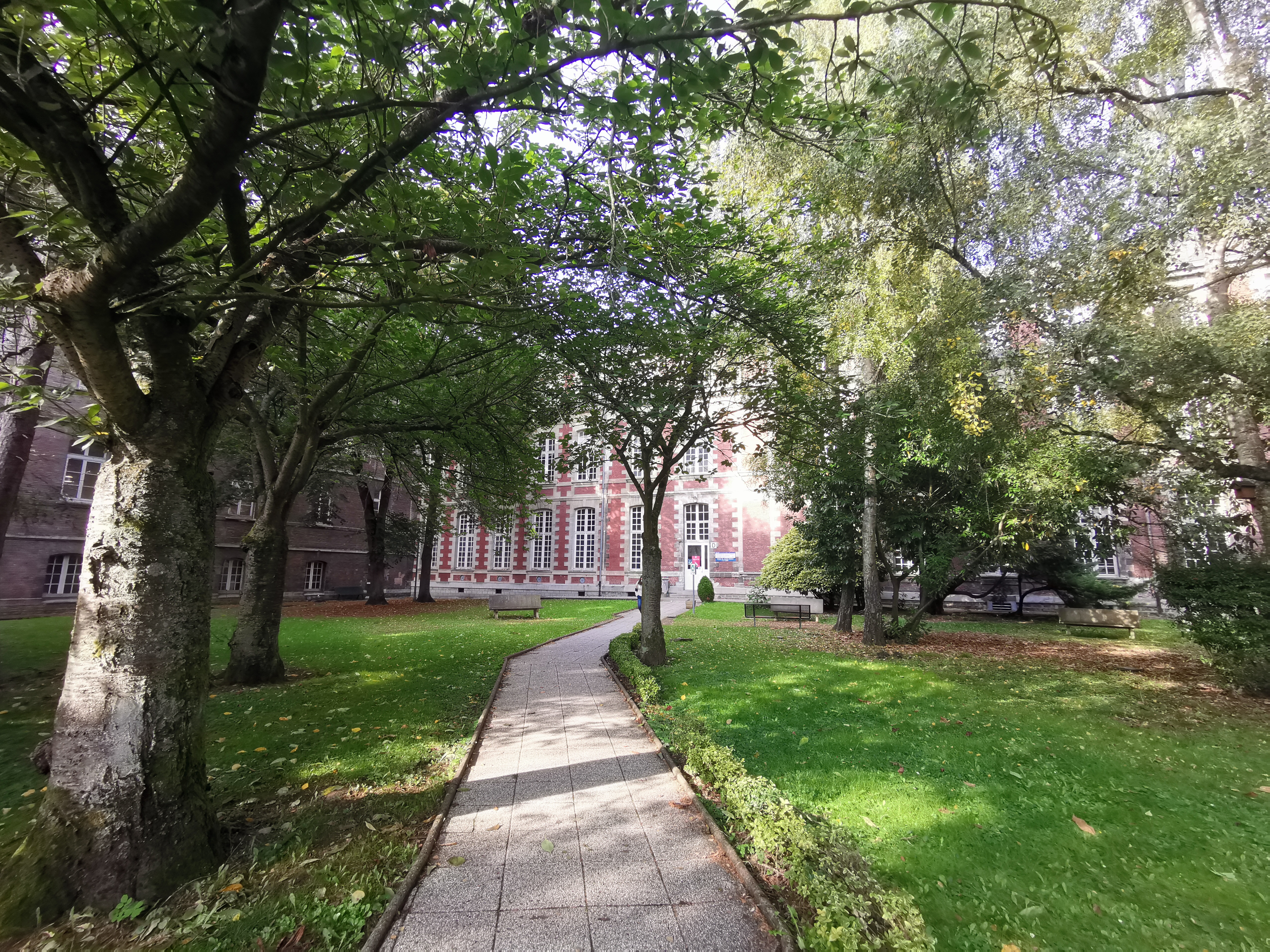
The campus of the Université de Picardie Jules Verne, an inspiring backdrop to think about science
And just the mere fact of being here has already made a massive difference: we established the backbone for my next research proposal, one that should keep me on the rails for again a little bit longer, and one that should – if the Gods of Money are Generous – allow us to turn our plans into reality.
We also had some great meandering discussions on the scientific topics of interest, those kind of creative jumps and bousts of inspiration that are so much easier to realize over a shared cup of tea than when staring at each others’ pixelated face over crappy webcams.
The cathedral of Amiens, a stony giant and a landmark all across the city
While staring up at Amiens cathedral, I realized: I am not that ambitious that I need to build such a stony monster for myself, but I do strongly feel that our world needs a ‘cathedral of science’ to tackle the ongoing climate and biodiversity crisis, and that we need it fast. And I think I have a few more crucial bricks that I could contribute to the pile, and would love to get that chance!
Forest canopies cool summer temperatures with up to 10°C. An international team of scientists led by researchers from the KU Leuven in Belgium now mapped the temperature of all European forest patches to quantify the airco function of each and every one of them.You can explore how that looks for Flanders at https://www.sglobelab.com/forestairco/
Mini-weather stations on the forest floor
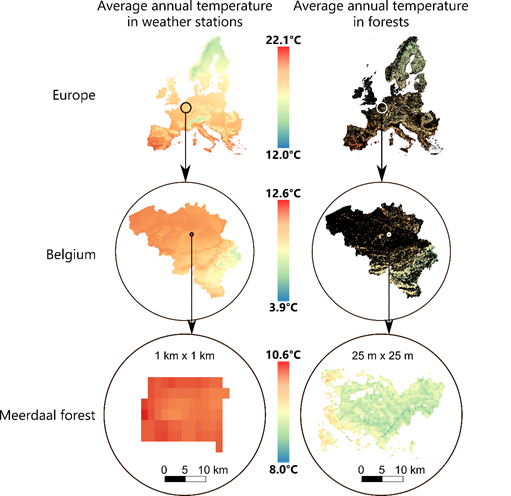
On a hot summer day, forests can feel a lot cooler than the surrounding area. Yet how much cooler a certain forest patch could be has been a lot harder to quantify for ecologists. Up till now, as an international team of researchers, led by PhD student Stef Haesen and Prof. Koenraad Van Meerbeek from the KU Leuven, Belgium, has now quantified the temperature of each and every European forest at a resolution of 25 meters, a resolution much finer than any of the 1-km resolution datasets that were currently available.
Using a unique dataset of more than 1200 mini-weather stations across all of Europe’s forests, the 52 researchers from more than 10 European countries quantified the difference in temperature between the forest understory and the existing weather station network. “This network of sensors on the forest floor is unique,” explains Stef Haesen, lead author from the study, “as it accurately captures the true temperature under the forest canopy, for forests big and small.”
Forests as thermal insulation
The data show that the maximum summer temperature in forests across Europe are on average 2°C (and up to 10 degrees) lower than outside forests. Similarly, minimum temperatures in winter can be 2°C (up to 12 degrees) higher than outside forests.
“With their foliage and branches in the canopy, trees create a thermal insulating layer above the forest floor”, explains Haesen. “For this reason, summer maximum temperatures are much lower inside forests than outside. Summer heat waves are thus strongly moderated below the tree canopy.” Forest canopies provide as such an effective air conditioning, increasingly important in a warming climate.
“Now this is the first time we have such a map at such a high resolution and over such a large spatial extent,” says Haesen. “This is a real scientific and technical breakthrough that will undoubtedly improve predictions from distribution models for forest species,” he adds. As the researchers worked at a higher resolution than ever before, their analyses also revealed never seen differences between and within forests: no two forests are the same, and differences in canopy cover, topography or tree species composition create significant variation in temperatures.
The new high-resolution forest temperature maps thus provide crucial information for researchers to analyse impacts of climate on and in forests across Europe. Haesen summarizes: “If we want to know why certain forest species grow where they are growing, we cannot use climate data from weather stations outside forests, we need the information from the location where the organisms live. These maps here are a real revolution in terms of information accuracy to know, but also to manage, the temperatures as felt by the tree saplings that constitute the forests of tomorrow.” That information becomes more important every year, as this protective shield is weakened by climate change and the increased frequency of extreme weather events (droughts and storms) that threaten the integrity of the canopy.
Unique high-resolution predictions of forest temperatures of all European forests reveal the significant temperature buffering caused by the forest canopy. Here shown for the ‘Meerdaalwoud’ close to Leuven in the centre of Belgium. On the left, you see the existing temperature data based on weather stations, on the right the new high-resolution temperature data product for all of Europe’s forests.
Blogpost written by Bart Deronde, and originally published (in a much prettier shape) on the blog of VITO.
In spring 2021, the largest citizen science campaign ever on the impact of heat and drought in Flanders’ gardens & fields ‘CurieuzeNeuzen in de Tuin’ took off, assuming that we would again suffer from heat waves and long dry spells as we got used to in the past years. But, weather isn’t predictable over a whole season and hence it turned out differently …
In this blog we dig into the meteorological observations, the measurements by the CurieuzeNeuzen sensors installed on the potato fields, the impact of the extreme weather on the cultivation of potatoes, and we give an outlook on the analyses planned.
CITIZEN SCIENCE ON DROUGHT! WAIT, WHAT?
In spring 2021, ‘CurieuzeNeuzen in de Tuin’ was kicked off. Led by the University of Antwerp and De Standaard, this massive citizen science project wants to gain insight in the microclimate and measures to which extent our gardens, public green spaces, and agricultural fields are susceptible to heat and drought. Expecting again a dry and hot summer season, 5000 “gazondolken” or “lawn daggers” were installed to measure the temperature and soil moisture between April and October 2021. But … the summer of 2021 will be remembered as the wettest summer ever in Belgium. What does this mean for a citizen science campaign on heat & drought?
Sentinel-1 satellite images of 9 and 15 July 2021 clearly show the effects of the exceptional rainfall.
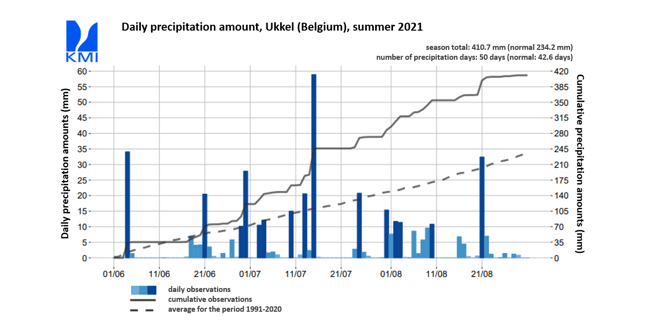
The meteorological observations tell the story of this summer. We had to cope with intense and heavy rainfall. After a warm and dry onset during the first two weeks of June, the weather pattern drastically changed. Pouring rain was on the menu almost every week, with regularly days of more than 15 mm. In Brussels, the Royal Meteorological Institute recorded 410 mm of rain during the meteorological summer (June-Aug) while the average is only 234 mm. But there were also major regional differences. As we all know, the South-east of Belgium suffered from extreme rainfall, leading to catastrophic floods, while the North of Belgium experienced rather normal weather conditions.
Daily amount of rain in Brussels during the summer of 2021.
500 SOIL AND TEMPERATURE SENSORS IN VARIOUS FIELDS
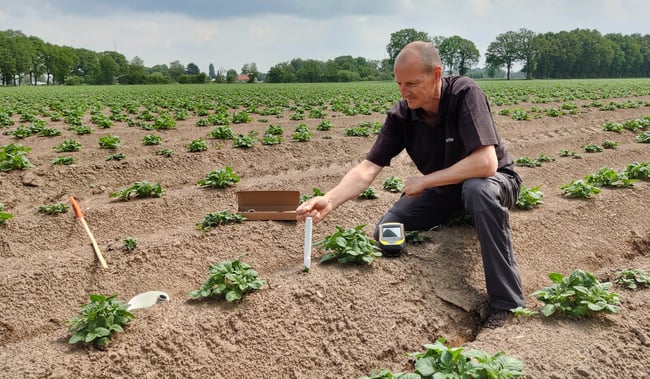
Within the CurieuzeNeuzen project we’re not only looking to private gardens and public green spaces, we’re also gathering data on fields to learn more about the impact of extreme weather, either dry or wet, on our agriculture. In June 2021, at the start of the growing season, we installed almost 500 sensors in 295 potato fields spread over Flanders. Additionally, we installed 30 sensors in orchards (pear, strawberry, blueberry and vineyard) as a side experiment.
Installation of 500 soil and temperature sensors in several potato fields spread over Flanders.
Why do we focus on potatoes? Not only because it’s the favourite crop of many Belgians. The potato plant is also highly susceptible to extreme weather. Most potato varieties cultivated in western Europe prefer air temperatures between 20-25°C and soil (root) temperatures between 15-20°C, while the soil is preferably moist but not too wet. On average, Flanders is blessed with these moderate weather conditions. However, periods of drought, heat waves, or excessive rainfall, can all impact the quality and quantity of the yield. Thanks to the highly professional know-how throughout the entire chain, constant innovation and a detailed quality system to ensure excellent potato quality, the Belgian potato industry plays a significant role in the Belgian economy. Belgium is for example the largest exporter of processed frozen potato products in the world. Being able to anticipate and to respond to changing weather conditions in order to guarantee the availability of potatoes is therefore utmost important.
THE EFFECT ON THE CULTIVATION OF POTATOES
This summer the major threat for the potato cultivation was the combination of persistent high humidity and moderate temperatures, resulting in severe disease stress. Late blight, Phytophthora and Alternaria were widely observed. Erosion gullies and difficulties to access the field with heavy machinery were other problems farmers faced. However, regular precipitation and moderate temperatures result also in favourable growing conditions. After a cold start in the spring with initially low yield predictions, a period of rapid growth followed in June and July. As a result, the expected potato yields are still more or less at the level of the multi-year average, as shown by samples taken by FIWAP / Carah in Wallonia and Inagro / PCA in Flanders between 6 and 8 September 2021 for the storage varieties like Fontane and Challenger.
But high quantity doesn’t always mean good quality. On the contrary, the quality will be inferior on many fields this year. The large amount of precipitation, often in combination with the presence of a lot of nitrogen in the soil, caused an explosive growth of the tubers, resulting in growth cracks and hollowness, mainly with Fontane. Some Fontane plots even started to flower again indicating new leaf and tuber growth. This will result in immature tubers. Where the ridges were washed away by runoff we see lots of green tubers. Quality checks during storage will be extremely important to timely detect rotten tubers and avoid losing large quantities.
READY TO ANALYZE THE SENSOR DATA
Unlike the measurements of the sensors in private gardens and public green spaces, which are collected and visualized in a personal dashboard, the measurements in the potato fields are stored in WatchITgrow, our online platform supporting growers to monitor their crops in view of increasing yields in a sustainable way. WatchITgrow allows combining remote sensing data with in-situ data using big data analytics and machine learning to provide growers with more timely and personalized advice.
Looking at the sensor measurements we already see that these low-cost devices were able to capture very precise and accurate measurements. Growers can easily access the soil moisture and soil temperature data, next to already available satellite images, greenness derived from Sentinel data, rainfall and temperature data.
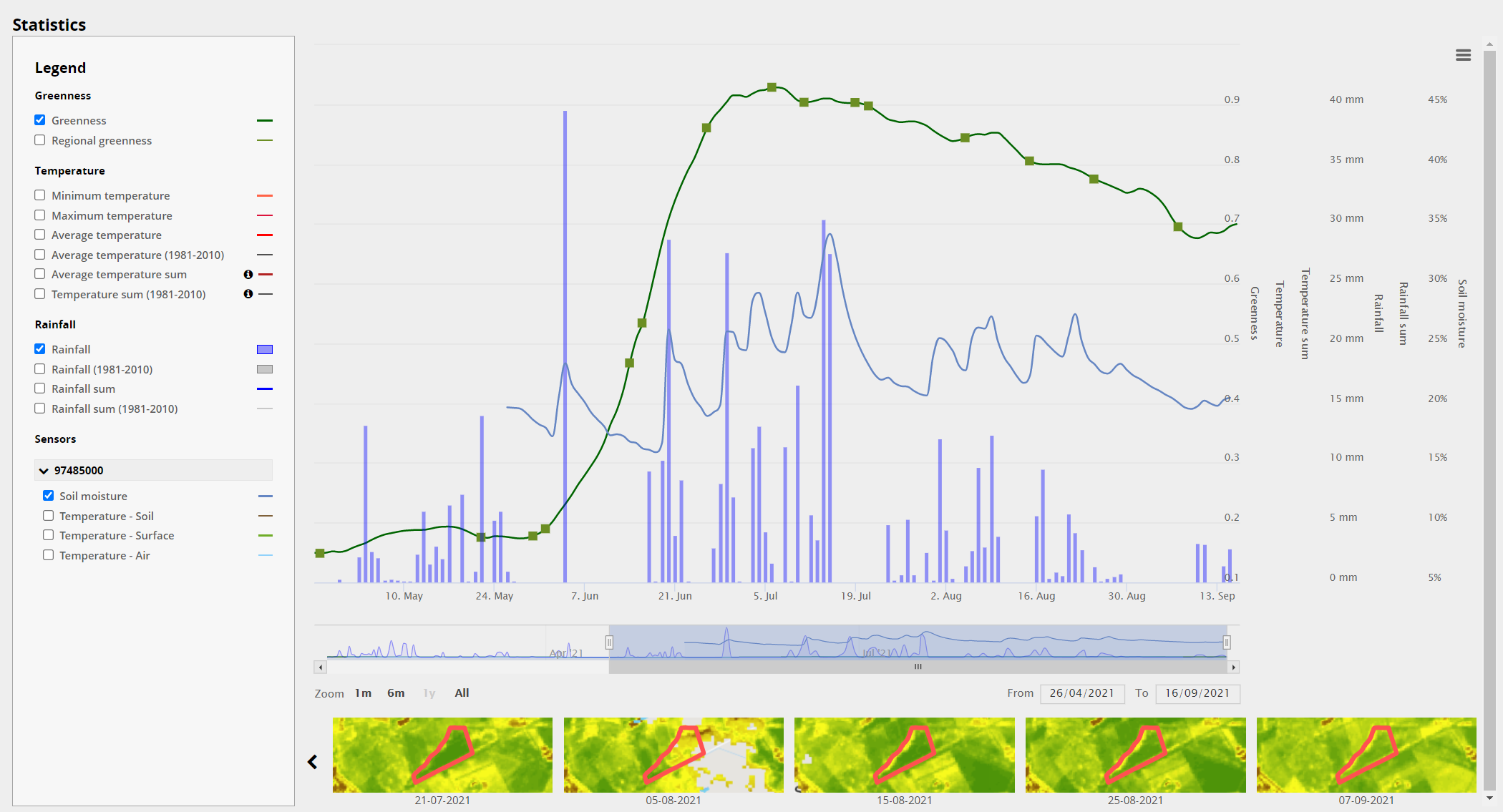
Evolution of the greenness (fAPAR based on Sentinel 1 & 2 > CROPSAR technology) of a potato field in the North of Belgium, indicated in green. Daily amount of rainfall shown in blue bars, and the soil moisture as measured by the CurieuzeNeuzen sensors indicated with a blue line.
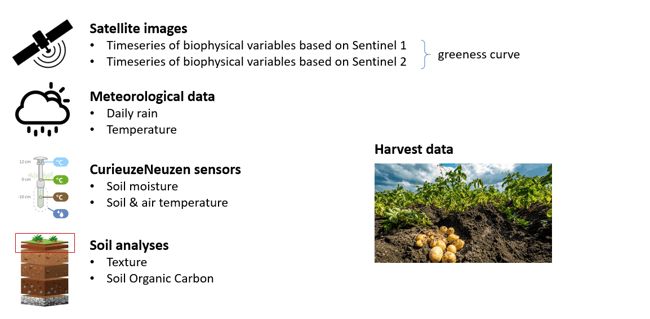
Once the harvest is over we will collect all sensors and start a detailed analysis of all measurements. Our remote sensing experts will combine all sensor data and link the soil sensor time series and soil properties measured in the field with:
meteorological observations
the greenness of the vegetation derived from satellite images
soil properties derived through soil sampling
Time series analyses of satellite derived greenness and soil sensor measurements will elucidate factors contributing to crop development and performance during the season. Machine learning methods will be applied to realize multivariate time series forecasting in aid of yield estimation.
The temperature and soil moisture data captured by the CurieuzeNeuzen sensors will be combined with satellite data, meteorological observations and soil analyses to assess crop performance and harvest.
This will yield insight in the crop development and crop quality during the extreme weatherconditions we experienced. Although the prime objective of CurieuzeNeuzen was to measure the impact of heat and drought on the cultivation of potatoes, also the impact of extreme precipitation is very relevant as projected to occur more often in the future. First results of this analysis will be shared in December 2021. Stay tuned!
‘CurieuzeNeuzen in de Tuin’ (CNidT), the large-scale citizen science project on drought, heat and moisture in gardens is playing extensions. After a summer that was exceptionally wet, the project hopes to collect additional data on heat and drought.Find out all in the original story in De Standaard (here a shortened translation).
An ailing summer that never really got off the ground, with extreme flooding in large parts of Flanders in July. It was not the ideal setting for ‘the largest citizen survey on drought and heat ever’ in Flanders. Nevertheless, CuriousNoses in the Garden, a project by De Universiteit Antwerpen, De Standaard and many partners, was an unexpected success. We collected unique information on temperature differences between gardens, with data from cold freezing nights in April to insights into urban heat islands. The wettest summer in 200 years came as an unexpected godsend: the 5,000 sensors in garden soils give us a unique insight into the role of gardens as sponges during extreme rainfall, which will be reported in detail in October.
The one of a kind pluche ‘garden dagger’
Drier and wetter
But to live up to the baseline of research on heat and drought, more information is needed. The researchers at the University of Antwerp are curious about the interaction between drought and heat, want to find out how gardens work as air conditioners during heat waves and how long gardens retain water during drought. That’s why the citizen research with the ‘garden daggers’ is being extended for a year. There is a real chance that we will have a drier and hotter summer next year. In that case, the questions above can be answered, and we can compare data: how do gardens experience a warm day in a wet year versus a warm day in a dry year?
With climate change, scientists predict that we will get more of both: longer periods of drought and heat, interspersed with periods of heavy rainfall. This trend has already manifested itself in recent years. The extension of the citizen survey provides a unique opportunity to cover the whole picture and map the effects of both drought and flooding on a large scale and in fine detail. But even if 2022 has another ailing summer in store, it would provide relevant insights, for example about rain infiltration and groundwater.
1,000 candidates
The extension of the citizen survey provides a unique opportunity to map the effects of drought and flooding on a large scale and in a detailed manner. To obtain this data, the researchers are looking for at least 1,000 participants who want to continue the climate survey in their garden.
One of my dreams since the start of the SoilTemp project: bringing all microclimate enthusiasts together at their own dedicated conference…
Now, this dream will become a reality with #MEB2022, an international conference on Microclimate Ecology & Biogeography which we will host here at the University of Antwerp.
Today, we launched the website (www.meb2022.com) and abstract submission, hoping to attract up to 100 international experts to Antwerp.
Now crossing fingers on this exciting ride to March 28th, 2022.
Consider development of microclimate sensors a closed and finished field: the ultimate product is now on the market!
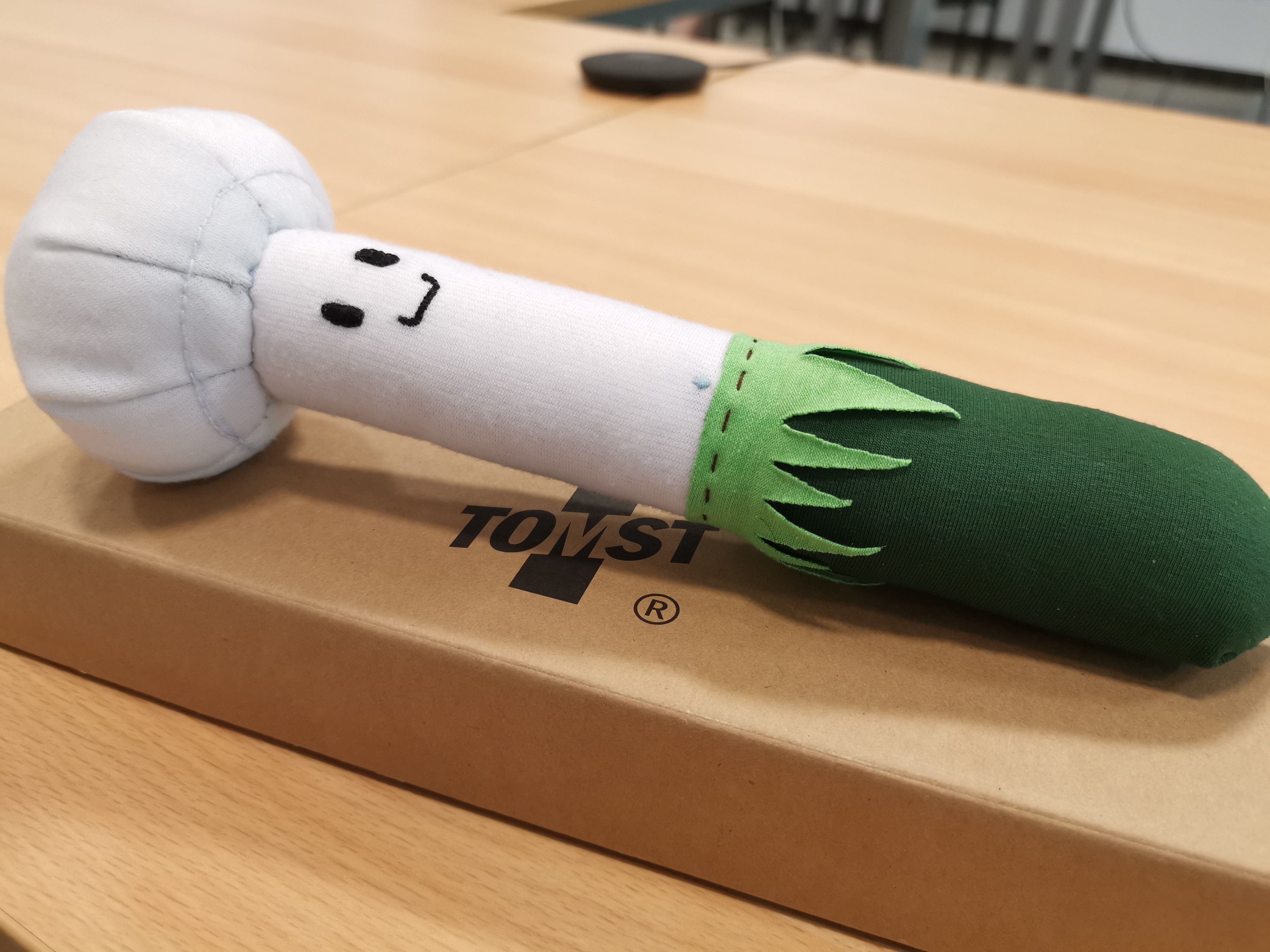
Thanks to the partner of our colleague Stijn, I got the most beautiful pluche version of a TMS-version, which we immediately bombarded to the mascotte of our citizen science project.
Look what an absolute cutie!
The youngest microclimate ecologist here at home is in any case a big fan of the new ‘mushroom’, although she still really loves those funny ones with the blue blinking light that daddy distributes all through the garden.
Lake Törnetrask, Abisko Research Station, Abisko, Sweden
Lake Torneträsk, Abisko, Sweden
Little red-and-white lighthouse
Norway
Laktatjakka valley
Hallerbos 2017
Young bluebell (Hyacinthoides non-scripta) surrounded by flowers of yellow archangel (Lamium galeobdolon)
The common bluebell (Hyacinthoides non-scripta), the signature flower of the Hallerbos
Single bluebell flower surviving on a wetter spot, as indicated by the field of wild garlic (Allium ursinum)
A really wet patch of forest, with giant horsetail (Equisetum telmateia) in a field of wild garlic (Allium ursinum)
Wild garlic (Allium ursinum) in the Hallerbos flowers a bit later than the bluebells, yet this one was already in full bloom
A bumblebee visiting yellow archangel (Lamium galeobdolon)
A bumblebee visiting yellow archangel (Lamium galeobdolon)
Wild garlic (Allium ursinum)
Wild garlic (Allium ursinum)
Weirdly beautiful, the inflorescence of pendulous sedge (Carex pendula), typical for the wettest spots in the forest
Weirdly beautiful, the inflorescence of pendulous sedge (Carex pendula), typical for the wettest spots in the forest
A little stream in the Hallerbos, surrounded by endless fields of wild garlic (Allium ursinum)
The herb-paris (Paris quadrifolia), less common in the forest
Wild garlic (Allium ursinum)
Bluebells (Hyacinthoides non-scripta)
Weirdly beautiful, the inflorescence of pendulous sedge (Carex pendula), typical for the wettest spots in the forest
Another one from the wet plots: large bitter-cress (Cardamine amara)
Another one from the wet plots: large bitter-cress (Cardamine amara)
Young beech leaves, as soon as they are fully grown, spring in the understory is over
A beech forest without understory, most likely too dry and too acid for any survivors
A young beech seedling (Fagus sylvatica), looking nothing like a beech, yet everything like a tiny dancer
Young beech seedling (Fagus sylvatica)
Bluebells (Hyacinthoides non-scripta)
Bluebells (Hyacinthoides non-scripta)
Bluebells (Hyacinthoides non-scripta)
Mountain melick (Melica nutans), a grass in the most amazing green
Bluebells (Hyacinthoides non-scripta) in a rare patch of mountain melick (Melica nutans), a grass in the most amazing green
Bluebells (Hyacinthoides non-scripta)
Bluebells (Hyacinthoides non-scripta)
Montpellier 2017
The entrance to the cathedral of Montpellier
The cathedral of Montpellier
The entrance to the cathedral of Montpellier
The cathedral of Montpellier
Narcissus poetics
The cathedral of Montpellier
The botanical garden of Montpellier
The botanical garden of Montpellier
The botanical garden of Montpellier
Brackish Camargue vegetation
Brackish Camargue vegetation
Brackish Camargue vegetation
A typical lagune
Brackish Camargue vegetation
Camargue horses
Camargue horses
Camargue horses
Brackish Camargue vegetation
Brackish Camargue vegetation
Brackish Camargue vegetation
Camargue horses
Brackish Camargue vegetation
Little egret in the evening sun
Flamingo’s in the evening sun
A typical lagune
Dandelion fuzz
Grass lily
Grass lily
Dandelion fuzz
Veronica in a sea of poplar fluff
Euphorbia in a sea of poplar fluff
Poplar
Gare du Midi, Brussels
Gare du Midi, Brussels
Gare du Midi, Brussels
Gare du Midi, Brussels
Sweden autumn 2016
Autumn in Abisko
Yellow leaves of mountain birch, with lake Torneträsk in the background.
Lapporten, the gate to Lapland, in Abisko
Rain blowing over the Abisko National Park
The colours of the north: red fireweed and yellow mountain birches, with lake Torneträsk on the background
Yellow leaves of mountain birch, with lake Torneträsk in the background.
Rain on the background, the ski lift in Abisko on the foreground
The steep slope of mount Nuolja on a dramatic looking morning
The beautiful colors of lake Torneträsk in Abisko
A little stream on top of the mountain, with a view on Lapporten, the gate to Lapland
Well, that is a beautiful table with a nice view on lake Torneträsk in Abisko
Our little experiment on top of the mountain in Abisko, with a view on Lapporten
Autumn in Abisko is extremely colorfull
The ski lift with a view on Abisko National Park and Lapporten
Hiking dowhill towards lake Torneträsk
This green is greener than the greenest green: moss on top of mount Nuolja
Well, that is a beautiful table with a nice view on lake Torneträsk in Abisko
The ski lift with a view on Abisko National Park and Lapporten
The ski lift with a view on Abisko National Park and Lapporten
The most beautiful hiking trail of the world: Nuolja in Abisko
Angelica archangelica, often the biggest plant of the Arctic
The most beautiful hiking trail of the world: Nuolja in Abisko
Cirsium helenioides, the melancholy thistle
Hiking down mount Nuolja
The steep slope of mount Nuolja on a dramatic looking morning
The colours of the north: red fireweed and yellow mountain birches, with lake Torneträsk on the background
The prettiest yellow and blue: autumn in Abisko
Fireweed, Epilobium angustifolium
Campanula or bellflower, I think ‘uniflora’
Vaccinium myrtillus
Cornus suecica, the prettiest red of the world
Hieracium alpinum, alpine hawkweed
Carex atrata, one of my favourite sedges
Alpine clubmoss, Diphasiastrum alpinum
Agrostis capillaris, bentgrass
Common yarrow (Achillea millefolium)
Anthoxanthum odoratum, sweet vernal grass, fully grown and mature
Snow scooter trail
Our plot in the mids of a field of horsetails (Equisetum pratense)
Equisetum pratense
Cliff overlooking the valley with the road to Norway
Seedling of Taraxacum officinale, the dandelion, after two years of growing in bad conditions
Poa alpina, the alpine meadow-grass, with its viviparous seeds
Massive flowerhead of Angelica archangelica
Angelica archangelica
Blueberry (Vaccinium myrtillus) in autumn
A lowland marsh in Abisko in autumn
Installing the plots of our trail observations on top of mount Nuolja
Installing the plots of our trail observations on top of mount Nuolja
Tanacetum vulgare (Tansy), non-native for the high north
Autumn forest down in the valley
The valley of Nuolja to Björkliden
Summer on the Nuolja-side
A full rainbow behind mount Nuolja in Abisko
It’s raining in the west, clouds trapped behind the mountains
A strong wind blowing rain from behind the mountains to our side
A strong wind blowing rain from behind the mountains to our side
Betula nana, the dwarf birch, mini autumn forest
Betula nana, the dwarf birch, mini autumn forest
The valley of Björkliden in autumn
The valley of Björkliden in autumn
The valley of Björkliden in autumn
The valley of Björkliden in autumn
Sweden spring 2016
Silene acaulis
Trifolium pratense
Overlooking the valley of Laktajakka
A rainy hike
Dryas octopetala
Salix reticulata
Cornus suecica
Ranunculus glacialis
Although the alpine zone has been harder for invasives to access than most places, human structures like trails are often an easy gateway for the invaders to get up there. Picture from Abisko, Swedish Lapland.
Eriophorum vaginatum
The valley of the lakes
Ranunculus glacialis
Rubus arcticus
Western European species like the red clover (Trifolium pratense) here are often listed as non-native species in mountain regions.
Trifolium repens
Bartsia alpina
Silene suecica
Melting snowpatch on a lake
Oxyria digyna
Amiens
Cathedral seen from the frozen Parc Saint-Pierre
The southern side
Just outside of Amiens
Enjoying silence and the morning sun
Sunny but cold, the Quai Bélu
Frozen mirror
View from my office window
Cold!
Cathedral at night
Sunny but cold, the Quai Bélu
Cathedral at night
House on the square before the cathedral
Gargoyle planning to eat the cathedral
Nice architectural curve
View from my office window
Almost cold enough for ice-skating
The museum behind the beautiful gates
Maria without a shirt
Colourful mirror
Amiens is filled with cute little houses
Cathedral with a glimpse of spring
Sun rising above the water
Winter sun on the Place du Don
Frozen to the bone
Cathedral at night
Cathedral at night
Le Club d’Aviron in winter weather
Sweden autumn 2015
Lichen
Sweden summer 2015
View on the 1000 meter plots
Doing research on a cold Arctic morning
Plots flooded by the snowmelt
Flooded by the snowmelt
Meltwater river, racing down the mountain
After a hike, even the most basic house looks cosy. Little hut in the mountains, open for everybody
Snowbridge, maybe don’t cross…
Snowbridge
View from a cliff
Silene acaulis or cushion pink, cutest plant of the Arctic
Two seasons in one image
Steep slope
Hiking down
Narvik Kirche, church of the subarctic
Narvik Kirche
Reindeer on top of the mountain
Narvik Kirche
Summer at the church
Summer flowers
Massive waterfall
Young willow catkins
View from Narvik’s hospital, with lilac flowers
Building a bridge over the fjord will gain al drivers at least an hour
Norwegian fjord
Posing with the water, getting soaked
Minimalistic mountains
Insect investigating our reindeer antler
Catching mosquitoes with our license plate, harvest of the year!
Posing with the plot
Fieldwork on the most beautiful spot of the world
Fieldwork on the most beautiful spot of the world
Summer bridge – still next to the sadly impassable river
Rhinanthus flower in the mountains
Plateau in the valley, beautiful brown
Experimental view from my favourite plot
Salix catkins
Extremely old Betula tree
Waterfall from a cliff
Buttercup is the earliest in spring, here
Rocks!
Alpine views
Views!
Fieldwork
Jumping over rivers
Plot
Golden plover
Angry lemming
Green, the whole north is green!
Snow, so much snow left!
Minimalistic mountain moments
Fieldwork
The research center
Red clover – focal invader
Look at this tiny cute snail!
Massive floods of melting water
Bartsia alpina
Hooray, a toilet!
Dryas octopetala
Lowest elevation plots
Butterball!
That’s a lot of water
Midnight sun is the best
At the lakeside
Beautiful Bistorta vivipara
Don’t fall in the water
Midnight sun
Wild river
Art – made by ages of wild rivers
Baby firework for America’s independence day
Midnight sun at the lake
The Abisko canyon was wilder than ever
That’s a crazy amount of water!
The Abisko canyon was wilder than ever
The Abisko canyon was wilder than ever
Black and white
Stone-man overlooking Abisko
Nothing as soft as a willow catkin
Label and soil temperature sensor attached
I’d drive to the top every day
Reflections
Rocks and clouds
Brave little birch
Brewing our camping poison
Basic camping stuff
Camping in Norway
Home-made temperature houses
Roadside research at its best
Norway is crazy
Horsetail is so funny
Little creek in magical forest
Birches, birches everywhere
Beautiful rock, a gift from the river
Another roadside fellow
Lichen
Ready to rock the summer
Collecting mosses
That’s a crazy old lichen
Tiny tiny piny trees, but old, so old!
Ready to jump into the fjord?
Ready to jump into the fjord?
That’s a spiky stone!
Views on Norwegian fjords
Silene in the mountains
Cute little orchid
Skua
Attacking skua, mind your heads!
Watch out for the attack of the fierce skua!
Black snail
New plot!
Still a lot of snow to melt, but this spot was free for a new plot
Reindeer are better than people
Two seasons in one picture
Let’s see what is happening to the balance in mountains! Is this a starting avalanche, or will it last a bit longer?
Cute little hut
Climbing mountains by car
Softest moss in history
Drosera in the marsh
Hiking in no-man’s land
The clouds are coming
Abisko valley
‘Butterball’
Fieldwork in the tundra
Abisko valley
Little plot
Clouds and sun and mountains
Making soup on a campfire with a view
Little creek on high elevations
Skua on the look-out
Melting snow in a river
Rhodiola rosea and the Törnetrask lake
Beginning of spring
Flooded plots, melting snow, impassible wetness
Ferns and horsetails
Chile 2015
Trips to the field sites were sometimes a real adventure, especially right after snowmelt
Lunch made by our local colleague, with funny bread (tasty as well!)
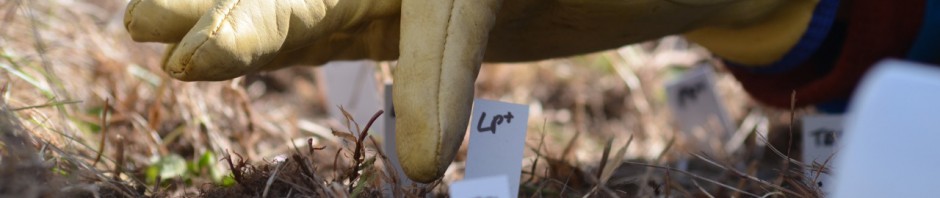



 Installation of 500 soil and temperature sensors in several potato fields spread over Flanders.