This is a massively important paper. At least for me.
It brings together the work I’ve been doing in the Mountain Invasion Research Network and the Microclimate Ecology & Biogeography Network. And it finally answers one of the key research questions I was left with at the end of my PhD, back in the good old days of 2018.
During my PhD, I studied plant species distributions along mountain roads. That gradually pulled me into the world of microclimate, which seemed to be one of the core mechanisms shaping where mountain plant species can and cannot occur. One of my hypotheses – supported by experimental data from my PhD – was that roadsides create warmer microclimates, potentially allowing lowland plant species to move higher into the mountains.
A reasonable hypothesis, of course, and one we brought up in many papers since. But we still had to test it.So we started installing sensors along mountain roadsides across the network. But somewhere along the way, I got distracted. I started wondering: why limit ourselves to mountain roadsides? Microclimate is crucial everywhere. That eventually led to building SoilTemp, and later the MEB network.
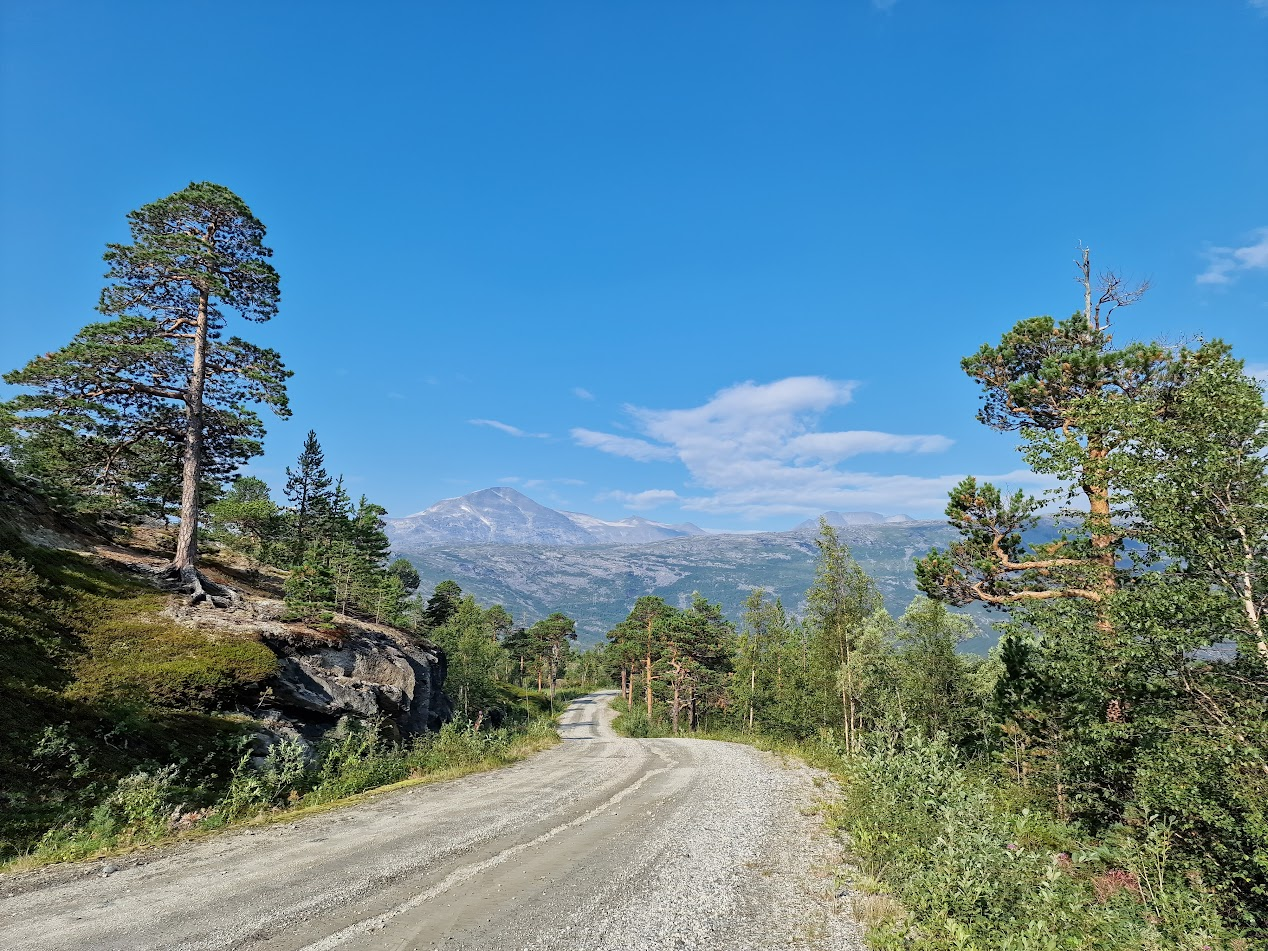
Yet the roadside sensors stayed there, and the data accumulated.
Eventually, we retrieved the data and slowly started making sense of it. I worked on it on the side for quite a while, until others joined in and really helped push it forward (Renee and Eduardo – thank you!). And now, after all those years, the results are finally published.
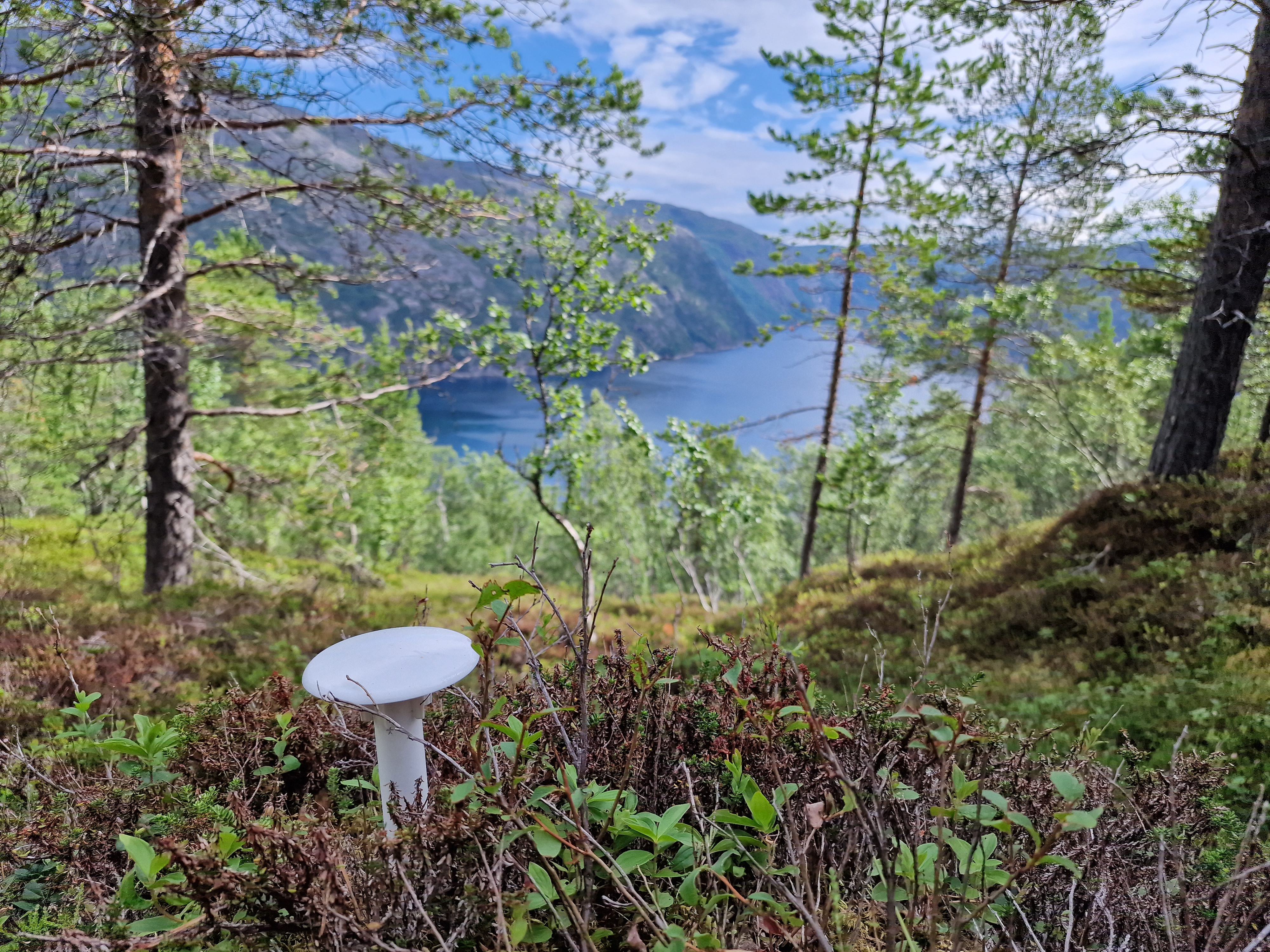
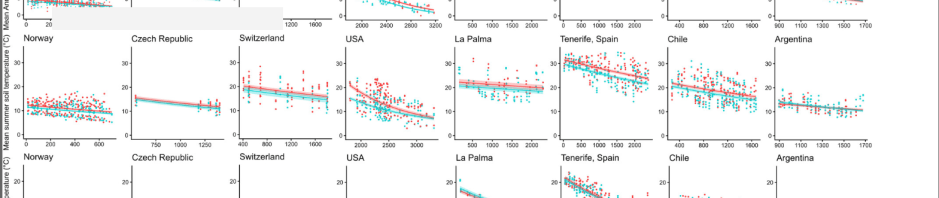
And boy, are they worth it! We observed on average a 1°C shift in mean annual temperature in roadsides as compared with the adjacent vegetation 50 m away from the road. That – and that’s quite mind-boggling – corresponds to more than 200 m of elevational displacement of the temperature regime (as we found a 0.45 degree Celsius elevational lapse rate). That means that plants could find similar average temperatures 200 m higher on the mountain in these roadsides – likely quite helpful with the observed upward movements of both non-native and native species.
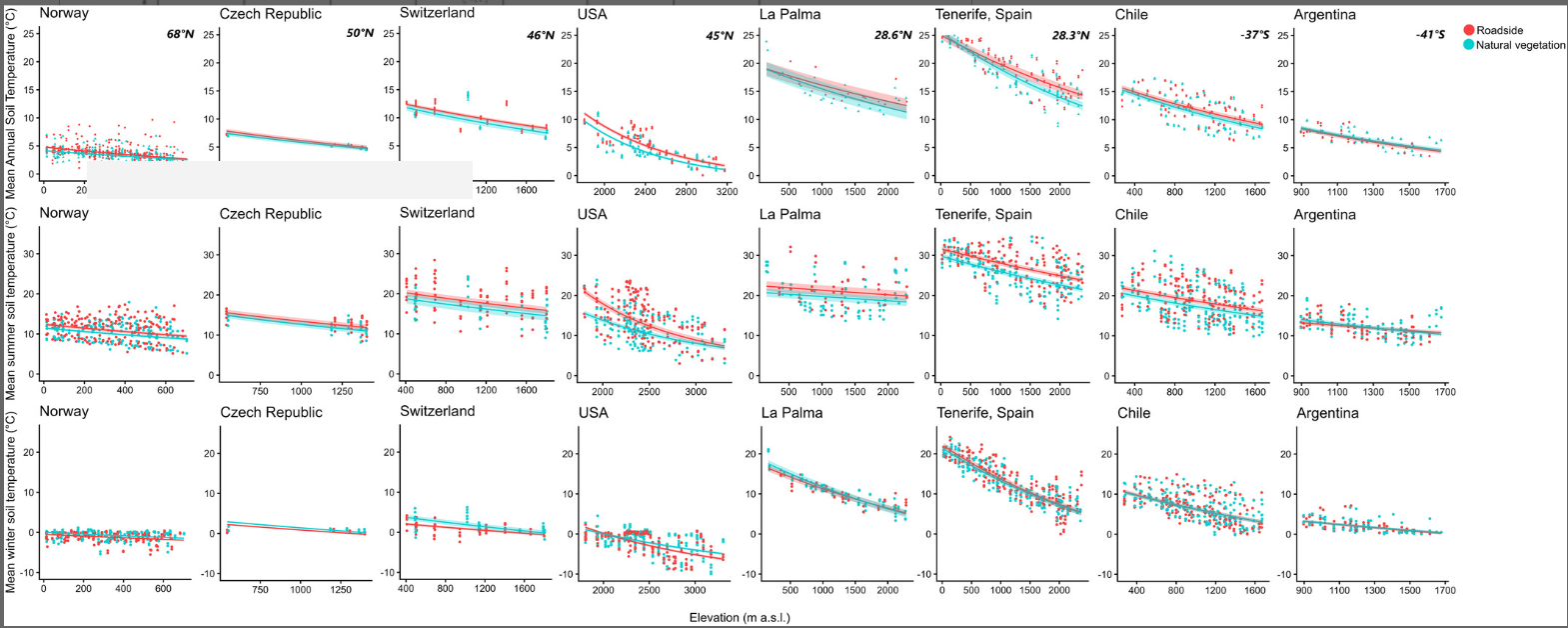
While we observed significant variation in these trends between regions, we especially found strong evidence for warmer annual maxima and summer mean soil temperatures along roadsides compared to the adjacent vegetation, and lower annual minima and mean winter soil temperatures on roadsides at high elevations. Overall, the results suggest that roadside microclimates are much more tightly coupled to macroclimatic fluctuations than nearby natural vegetation. In contrast, intact vegetation appears to buffer temperature extremes, making those systems less directly exposed to broader climatic variation.
Another interesting pattern emerged in winter. Temperature differences between roadsides and adjacent vegetation likely reflect differences in snow cover and snow depth. Roads are often cleared of snow, while adjacent vegetation can accumulate deeper snowpacks through wind redistribution or ploughing. At higher elevations, where snow persists longer, those differences may become especially important.
So after years of assumptions, hypotheses, and scattered observations, the numbers are finally there: mountain roadsides substantially alter microclimatic conditions, often creating much more extreme thermal environments than the surrounding vegetation. Now comes the next step: testing whether those altered microclimates are indeed driving changes in species distributions.