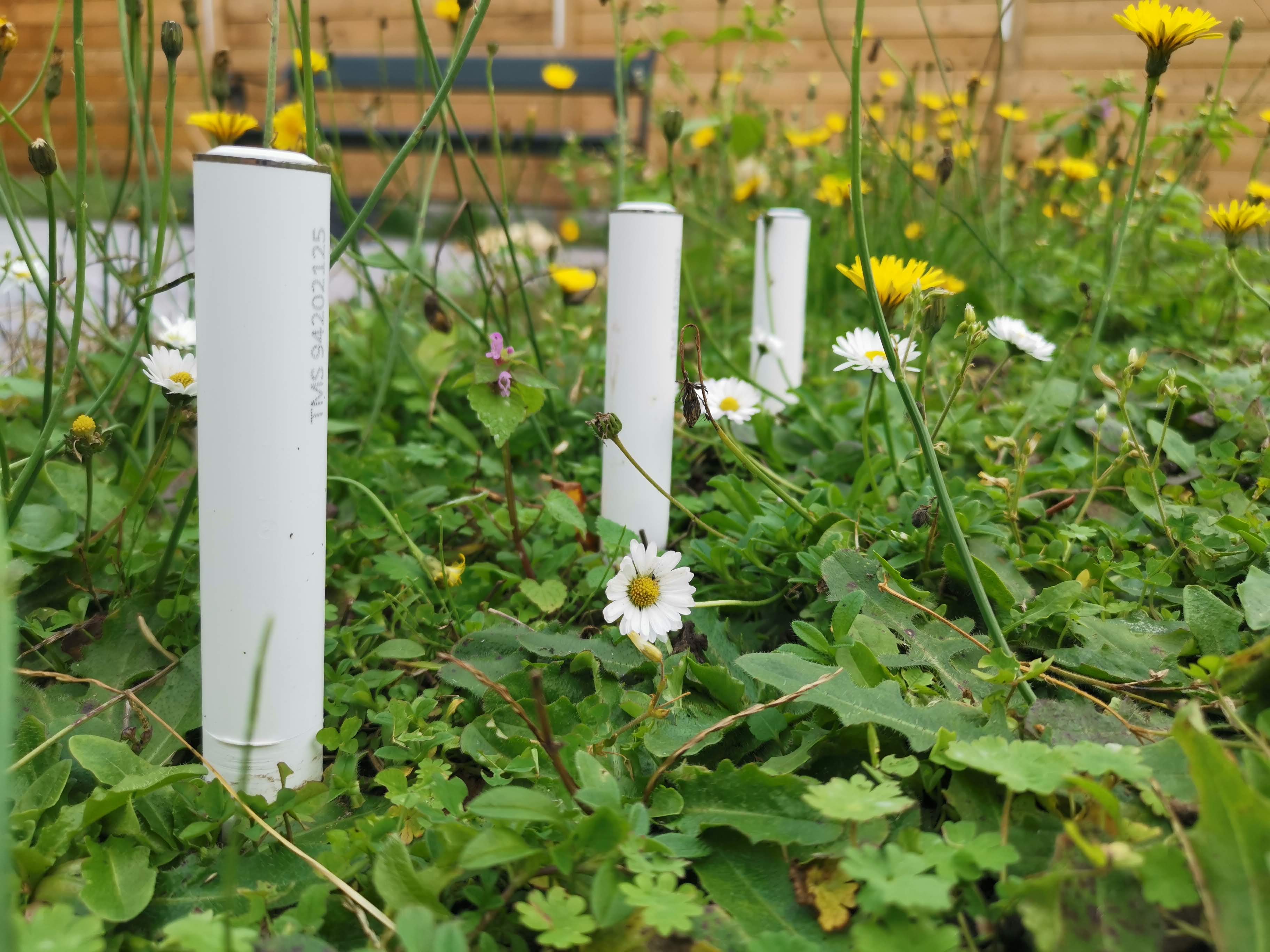
What you see brightening up my garden on the picture above is what we hope will be the future of microclimate monitoring: a TMS-logger with connection to the internet! Yes, you read that correctly, TOMST is currently working on a new version of their beloved logger that allows real-time data transmission, opening up a world of possibilities towards remote monitoring, science communication, and climate network management.
What I have here, is the first prototype (serial number …00000 of this new device!), ready to test it out in the garden. For the first time, we’ll see if data transmission from the field to the database works out as planned, bringing that bright future another step closer.
The prototype in all its glory, with see-through casing!
So this prototype now joins the army of microclimate loggers already occupying my garden, all in full preparation of what’s coming to us in Flanders next year: the biggest community science project on climate change ever!
Some other members of the army of TMS-microclimate loggers between the daisies in my garden – these ones measuring the impact of depth of device placement on the surface temperature
Last week, we had a new PhD candidate starting in the lab! His name is Stijn, and he is here to pull our fabulous citizen science project ‘CurieuzeNeuzen in de Tuin’, in which we will measure summer heat and drought in 5000 gardens, parks and farms across Flanders.
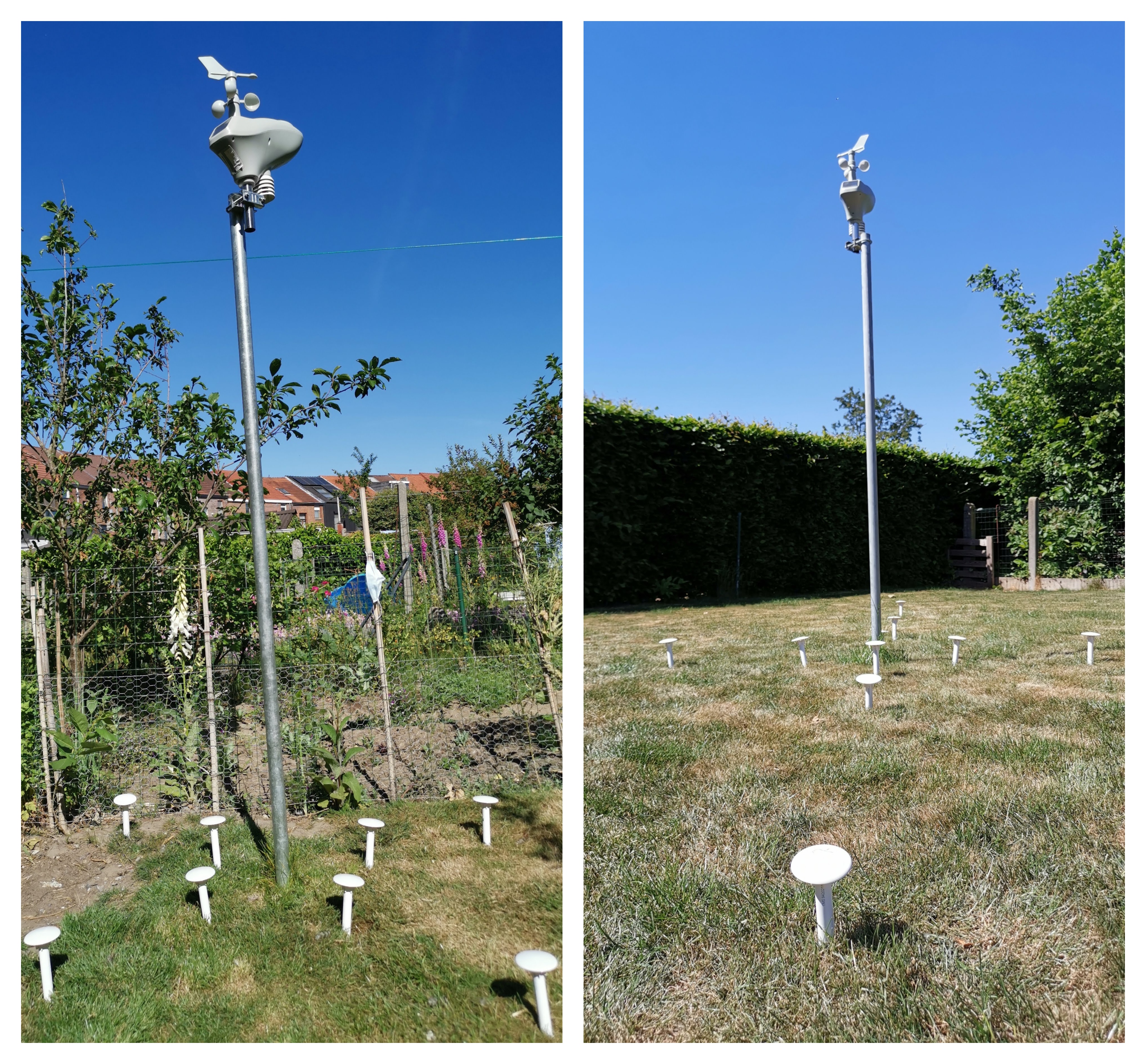
Stijn in action last summer – installing our microweather stations in a grassland
He will be doing the big data crunching on this one: modelling drought and heat indices over the summer, making pretty maps of temperatures across the region, and disentangling what drives the small-scale variation in our temperature and soil moisture. Exciting stuff to say the least!
Mysterious mushroom circles in the gardens, that’s the trial project of ‘CurieuzeNeuzen in de Tuin’ Already looking forward to see these mushrooms popping up all over Flanders next spring!
You will definitely hear more from him, as not only is he tremenduously motivated to get things rolling, he also fell in love with science communication already. And let that be exactly the kind of thing we love to do around here!
By now we know quite well that non-native plant invaders are fond of human disturbances. We have seen many times, across many different ecosystems, that these foreign plants use the more welcoming disturbed sites as their entry points towards new ecosystems. Roadsides and trails in particular make for great pathways for these non-native plants, which use them to spread out to new ranges that would have otherwise remained unattainable.
While this pattern clearly exist, we are still in the process of trying to understand exactly what it is about these disturbed sites that makes them so welcoming for non-native plants. Is it due to reduced competition? Abiotic changes to pH and nutrient availability? Or maybe increased seed availability thanks to transport by cars and blissfully unaware hikers? As is often the case in ecology the answer is most likely: “a bit of all of the above”.
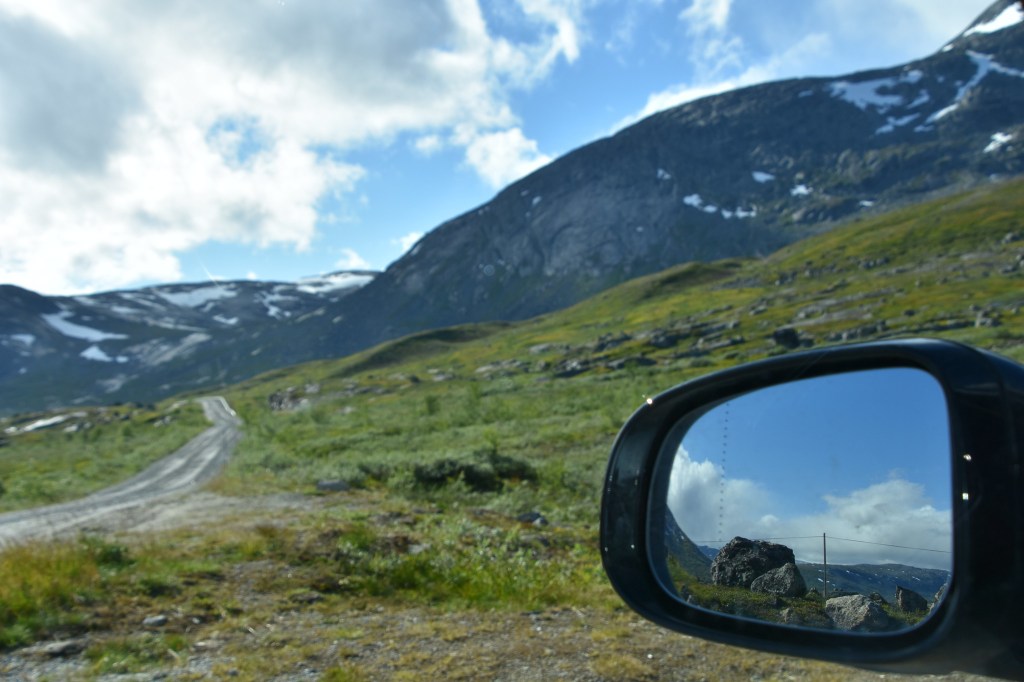
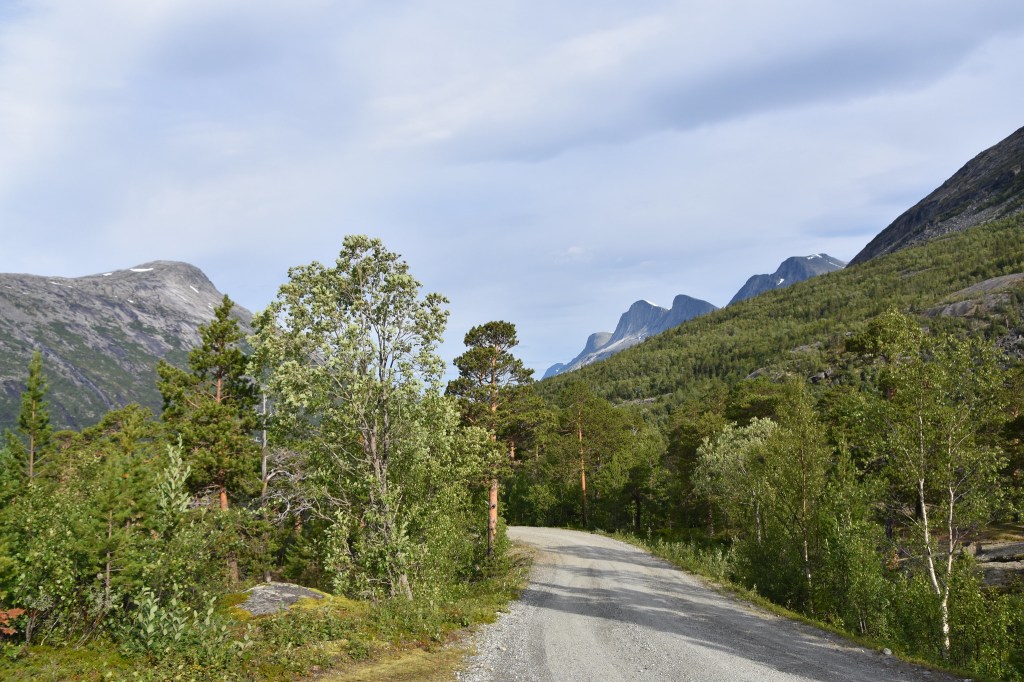
Cars are known to transport seeds of non-native species along mountain roads, like here in northern Norway.
However, there is another factor that could prove to play a large role in facilitating non-native success and that has remained largely unstudied. That is, the relationship between plants and their fungal mutualists: mycorrhizas. This crucial symbiosis between plants and fungi, in which plants exchange sugars for precious nutrients, is a difficult one to study as it takes place wholly belowground and at microscopic level. However with ongoing improvements to our methods, it is becoming clear that these little fungi are instrumental in shaping the processes and composition of ecosystems all across the world. And as such, it is not unreasonable to think that they could shape how non-native plants benefit from human disturbance.
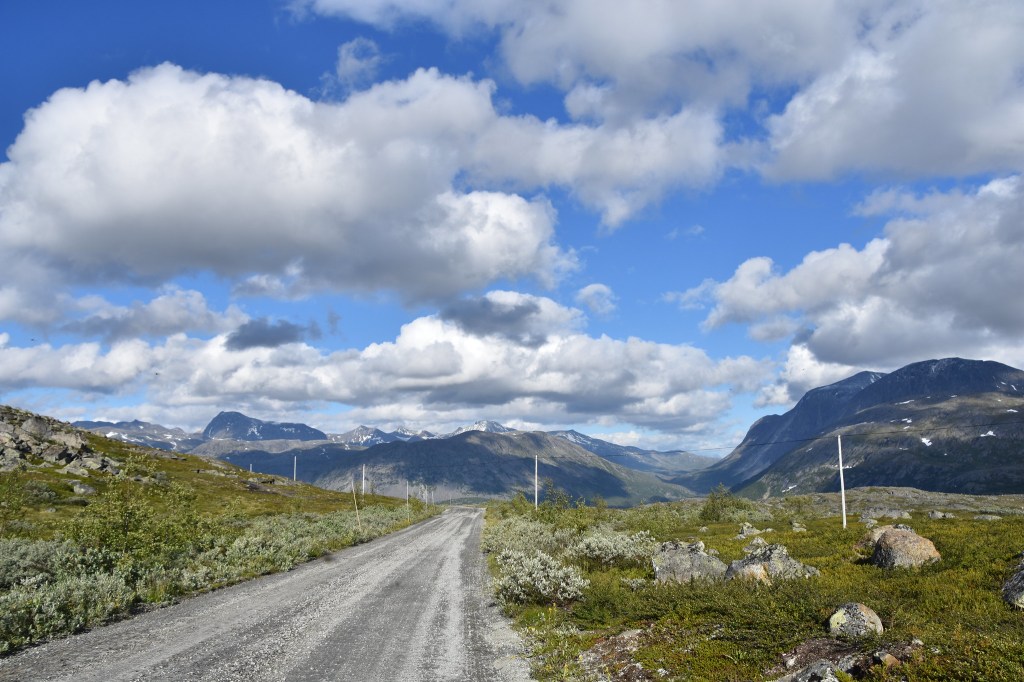
To test for that hypothesis we went back to our trusty roads in the beautiful northern Scandes. The great thing about these roads is that not only do we already know that they favor non-native species thanks to our previous surveys (see chapter 2 here), there is also a clear distinction between the type of mycorrhizas that naturally associate with the local plants (called ericoid and ecto-mycorrhizas) and the type that non-native plants like to associate with (arbuscular mycorrhizas or AM). This clear distinction in mycorrhizal types is really helpful as we can simply track the changes in AM and have an idea of how impacted our non-native plants are going to be.
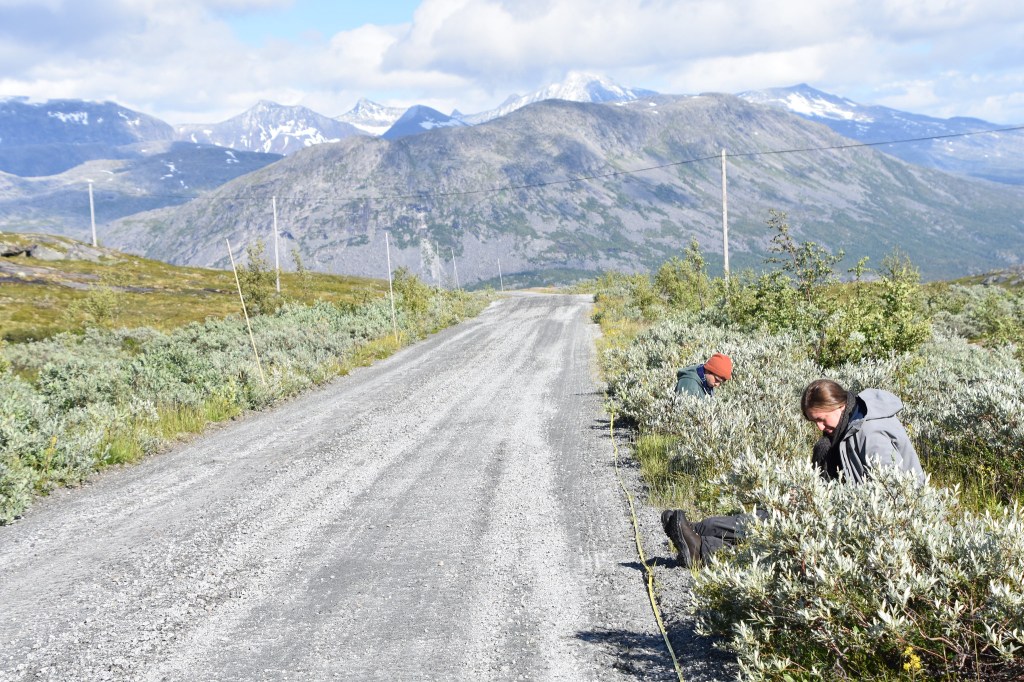
Part of the team digging for roots of non-native species along Norwegian mountain roads
After many a day of root collecting, soil sampling and mosquito swatting, we sent a few hundred of samples taken all over our mountains roads to our home base in Antwerp, where we went looking for mycorrhizas. We did so both visually, under the microscopes, to know the quantity of mycorrhizas there was in each root, as well as through DNA analysis, to know which ‘species’ of mycorrhizas were present .
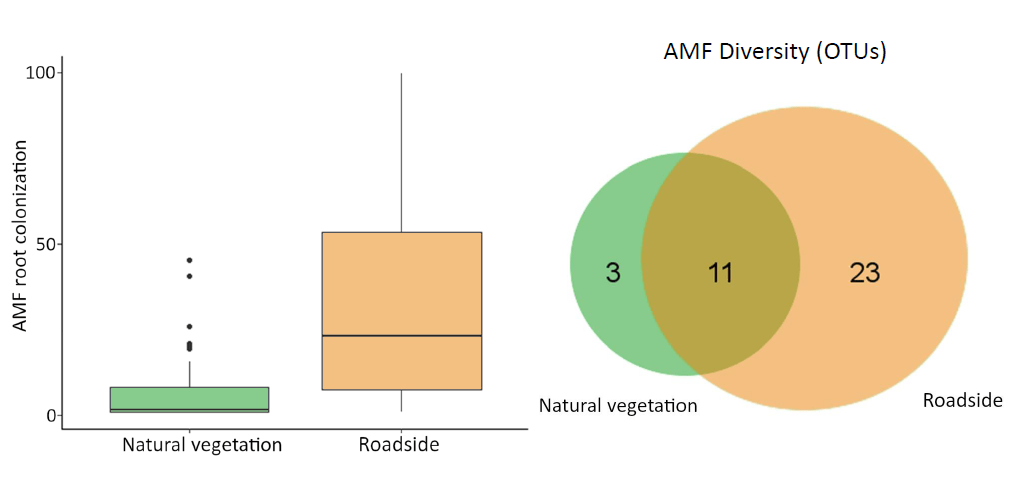
Figure 1: we found many more roots with arbuscular mycorrhizae in the roadsides than in the natural vegetation (left), as well as a much high diversity, with 23 OTUs (‘species’) unique for roadside roots.
By far the clearest result that came from all that work is that there is a very clear effect of the road disturbance on AM. There are way more of these arbuscular mycorrhizas in roadside roots than in the natural vegetation and they are also much more diverse! More AM in the roadsides means more non-native plants in the roadside, thus disturbance impacts mycorrhizas which in turn facilitate invasion success. Question answered, right? Well, if you have been around ecology for a while, you will know that things are never that easy. After all, the higher presence of AM could be a consequence of non-native plant success instead of a cause, or maybe these two things are wholly unrelated and they are both the consequence of some third factor, changes in pH for example. That’s what’s both fun and sometimes frustrating about ecology, it always keeps you guessing. But what we have found for sure is that this big difference in mycorrhizas is truly there. And that opens many exciting future research opportunities that are only asking to be seized! That chicken-and-egg problem of who’s driving what? That needs to wait till next summer, when we’ll get back to see how things have changed over time.
So we can be clear here, roadsides are full of mycorrhizae that can benefit our non-native plant species. Yet, there is something rather funny with this observation: while non-native plants have not yet reached the highest elevations of our mountain roads, that is not for a lack of adequate mycorrhizas. Indeed, contrary to our expectations we found AM to be present all over our elevation gradient, even well above the highest elevation reached by non-native plants. Moreover, the difference in mycorrhizas between roadside and natural vegetation was also constant all over that gradient. That tells us that adequate mycorrhizas are already available for non-native plants climbing up the roads, which is one less potential barrier to further invasion. So that is another chicken-and-egg problem for which we do have the answer already: while we don’t know who came first in the system, non-native plants or their mycorrhizae, the mycorrhizae where clearly first to reach the top. That non-native plants haven’t colonized highest elevations yet, is thus not from a lack of mycorrhizae. At least one potential explanation we can erase from the drawing board.
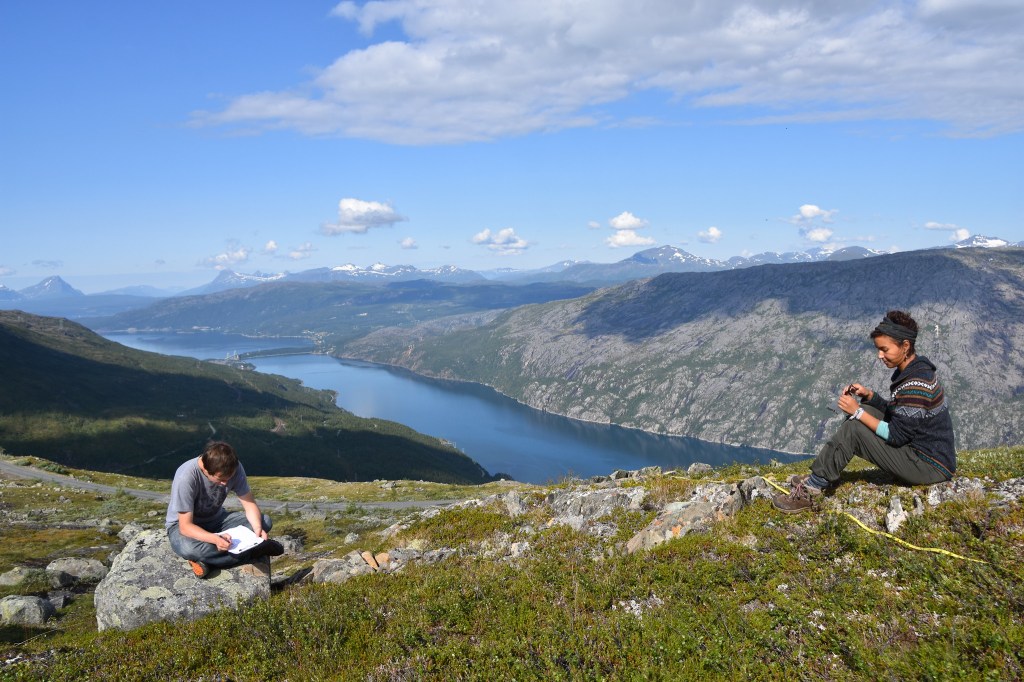
Fieldwork with a view, above a Norwegian fjord close to the city of Narvik
Introducing the world to a child gives conflicting feelings.
We started using the GR-routes – meandering throughout Europe – to discover the beauty of the world around us
On the one hand, there is a feeling of doom: how do I dare adding another child to this deteriorating world, without asking her if she wants to live in it – and without being able to promise her the safe and happy live I got myself, when our nature wasn’t on the brink of destruction yet. It is an argument recently more frequently used to restrain from procreating at all.
If the best nature around her is straight and artificial canals like this one – what is left to love?
Yet, perhaps a bit surprisingly, what I feel is mostly hope. Introducing the world to this fresh set of eyes, filled with wonder and curiosity, made me realize much more clearly that all is far from being lost. Even in our heavily populated corner of the world, between Brussels and Antwerp in the heart of Western Europe, there is natural beauty around us that fills my child with aw.
In a recent survey of more than 1200 Belgians and Netherlands, we asked if people experience a decline or increase in nature around them. 75% reported the former: they had the feeling that nature had deteriorated over their lifetime. This paints a gloomy picture at first sight, and the decline over time is undeniably there.
The open horizon with view of the church tower – a landscape that has been getting harder to come by in Flanders over the last decennia
Yet what that babies amazement made me realise more clearly is that we shouldn’t dwell too much in the past. Observing what has been lost is important to see the gravity of the situation we are in, but what matters is what we do with that knowledge, now and in the future. She did not observe a decline yet over her lifetime, and we can do our absolute best to keep it that way.
Impressed by an oak leaf
What I also realized this way, is that nature can be in the smallest things – an oak leaf, a bird or a meandering stream. It is not only about the forests or mountains, or the world heritage sites those lucky few on your Instagram feed get to visit. But that’s another thing we asked our 1200 survey respondents: what IS nature to you? Results are mixed: those agricultural landscapes that made me and my baby so thoroughly happy this weekend, would you call those nature? For us, at that moment, it most definitely qualified.
A Flemish agricultural landscape. Nature? Or not? The definition is far from clear on the matter, but dear lord that place was beautiful!
This baby has given me lots already, but one important present is a fresh look on nature around me. I am ready to fight harder than ever before to save this precious resource for her and everybody.
Want to help? You can start by giving us your opinion on your definition of nature (if from Belgium or the Netherlands), via www.natureornot.be!
This is the main preliminary result of a large-scale survey conducted by the Universities of Antwerp and Liège among more than 1200 Belgians. 60% indicated that the quality of nature in their municipality has decreased over the last 5 years, 75% observed a decline during their lifetime.
But on what exactly defines as nature, respondents showed much less agreement. The researchers asked which types of landscape were considered ‘nature’ by the participants and which were not. Respondents as expected strongly agreed that forests could be considered nature – and most found them beautiful. Wastelands however resulted in much more disagreement: they could either be seen as Noah’s arks where nature can express itself, or as abandoned areas craving for a clean-up.
“The definition of such a simple word as nature is far from obvious,” Jonas Lembrechts, one of the researchers, explains. “There is a large grey zone, landscapes on which everyone has a different opinion. It is precisely this grey zone that the researchers want to map out with this large-scale survey. Lembrechts explains: ‘we can expect that the definition will differ from one person to the next, depending on their experiences with the greenery around us’. For example, your place of residence can strongly influence your definition of nature: those who live in the city have a completely different picture of green space than those who have spent their entire lives in the countryside. In addition, age can also play a role: the older generation, for example, remembers how you could hear a lark chirping above almost every field. For young people on the other hand, it is a surprise that no noisy parakeets flew through the parks of Brussels a decade or two ago. Often we are hardly aware of these differences in perception.
The researchers also asked how people experienced nature during the Covid-19 lockdown period. Interestingly, a high proportion of people (60%) participating did not feel they had to miss nature, with about 70% saying they had spent more time in nature during lockdown than before. Although most respondents live in urban and suburban areas, most of them did consider themselves surrounded by nature on a daily basis. As about 80% of respondents reportedly has a garden, and 50% of them visit a green area in their municipality at least once a week, the importance of these local green patches cannot be underestimated.
A better understanding of what we experience as nature can explain what we hope nature will look like in the future. Even more importantly, it gives nature managers the opportunity to take this range of personal definitions into account in their policy and communication and increase support for much-needed nature management. Indeed: the definition might be vague, but survey participants showed strong agreement on at least one topic: that nature conservation matters.
You can still express your opinion about nature! The survey runs until November 1st and can be found at http://www.natureornot.be.
The #NatureOrNot project is an initiative of the University of Antwerp and Liège. For more information, contact Jonas Lembrechts (jonas.lembrechts@uantwerpen.be, 0471475321) or visit http://www.natureornot.be.
Nature or not, that’s the question! Do the typical heathlands, agricultural areas and fallow lands fall under the definition of nature for you?
Meer dan 1200 Belgen en Nederlanders namen al deel aan de grootschalige natuurenquête #NatureOrNot van de Universiteit Antwerpen en Luik. 60% geeft aan dat de kwaliteit van de natuur in hun gemeente de laatste vijf jaar is afgenomen, 75% vindt dat er tijdens hun leven een verslechtering is opgetreden.
Maar wat die natuur is, daar zijn we het veel minder over eens. De onderzoekers vroegen namelijk ook welke landschapstypen voor de deelnemers onder het begrip ‘natuur’ vielen, en welke niet. Dat een beukenbos of een heidevennetje mooi is en als natuur geldt, daar waren zowat alle respondenten het over eens. Maar als het bijvoorbeeld gaat over het opschietende groen op een braakliggend stuk grond, lopen de meningen sterk uiteen – tot 50% vindt dan nog dat we van natuur kunnen spreken.
“Je zou het niet verwachten, maar de definitie van een eenvoudig woord als natuur is helemaal niet zo vanzelfsprekend”, vertelt bioloog Jonas Lembrechts, een van de onderzoekers. “Er is een grote grijze zone, landschappen waar iedereen een andere mening over heeft.”
Grijze zone
Het is net die grijze zone die de onderzoekers in kaart willen brengen met deze grootschalige enquête. Lembrechts legt uit: “We kunnen verwachten dat de definitie zal verschillen van persoon tot persoon, afhankelijk van hun ervaringen met het groen om ons heen. Zo kan je woonplaats je definitie van natuur sterk beïnvloeden: wie in de stad leeft, heeft een heel ander beeld van groen dan wie zijn hele leven ‘op de boerenbuiten’ heeft doorgebracht. Daarnaast kan ook leeftijd een rol spelen: de oudere generatie herinnert zich bijvoorbeeld nog wel hoe je boven haast elke akker een leeuwerik kon horen kwinkeleren. Voor jongeren is het dan weer een verrassing dat er vroeger géén luidruchtige parkieten door de Brusselse parken vlogen. Vaak zijn we ons nauwelijks bewust van die verschillen in perceptie.”
De onderzoekers vroegen ook hoe mensen de natuur ervaren hebben tijdens de Covid-19-lockdown. Interessant: een groot deel van de respondenten (60%) gaf aan de natuur niet te hebben gemist, en 70% bracht juist meer tijd in de natuur door tijdens de lockdown dan voordien. Hoewel het merendeel van de respondenten in (rand)stedelijke gebieden woonde, voelden de meesten zich op dagelijkse basis toch door natuur omringd. Vermits 80% rapporteerde een tuin te hebben, en 50% aangaf wekelijks een lokaal groengebied te bezoeken, wordt hiermee het belang van dat lokale groen nog eens extra onderstreept.
Broodnodig natuurbeheer
Een beter begrip van wat we als natuur ervaren, kan uitklaren hoe we hopen dat die natuur er in de toekomst zal uitzien. Lembrechts: “Nog belangrijker: het geeft natuurbeheerders de kans om in hun beleid en communicatie meer rekening te houden met die waaier aan persoonlijke definities, en zo het draagvlak voor broodnodig natuurbeheer te vergroten. Want de definitie zelf mag dan niet altijd duidelijk zijn, over één ding zijn zo goed als alle respondenten (98%) het toch eens: natuurbeheer is belangrijk.”
Wil jij ook je mening laten weten over de natuur, dat kan nog! De enquête loopt nog tot 1 november en kan je vinden op www.natureornot.be.
Natuur of niet, dat is de vraag! Vallen de typische Vlaamse heide, landbouwgebieden en braakliggende terreinen voor u onder de definitie van natuur?
Lake Törnetrask, Abisko Research Station, Abisko, Sweden
Norway, Narvik
Narvik, Northern Scandes, Norway
Narvik, Norway
Diapensia lapponica in one of our plots
Seen from Nuolja, Abisko
Skjomen valley, northern Norway
Little red-and-white lighthouse
Hallerbos 2017
Young bluebell (Hyacinthoides non-scripta) surrounded by flowers of yellow archangel (Lamium galeobdolon)
The common bluebell (Hyacinthoides non-scripta), the signature flower of the Hallerbos
Single bluebell flower surviving on a wetter spot, as indicated by the field of wild garlic (Allium ursinum)
A really wet patch of forest, with giant horsetail (Equisetum telmateia) in a field of wild garlic (Allium ursinum)
Wild garlic (Allium ursinum) in the Hallerbos flowers a bit later than the bluebells, yet this one was already in full bloom
A bumblebee visiting yellow archangel (Lamium galeobdolon)
A bumblebee visiting yellow archangel (Lamium galeobdolon)
Wild garlic (Allium ursinum)
Wild garlic (Allium ursinum)
Weirdly beautiful, the inflorescence of pendulous sedge (Carex pendula), typical for the wettest spots in the forest
Weirdly beautiful, the inflorescence of pendulous sedge (Carex pendula), typical for the wettest spots in the forest
A little stream in the Hallerbos, surrounded by endless fields of wild garlic (Allium ursinum)
The herb-paris (Paris quadrifolia), less common in the forest
Wild garlic (Allium ursinum)
Bluebells (Hyacinthoides non-scripta)
Weirdly beautiful, the inflorescence of pendulous sedge (Carex pendula), typical for the wettest spots in the forest
Another one from the wet plots: large bitter-cress (Cardamine amara)
Another one from the wet plots: large bitter-cress (Cardamine amara)
Young beech leaves, as soon as they are fully grown, spring in the understory is over
A beech forest without understory, most likely too dry and too acid for any survivors
A young beech seedling (Fagus sylvatica), looking nothing like a beech, yet everything like a tiny dancer
Young beech seedling (Fagus sylvatica)
Bluebells (Hyacinthoides non-scripta)
Bluebells (Hyacinthoides non-scripta)
Bluebells (Hyacinthoides non-scripta)
Mountain melick (Melica nutans), a grass in the most amazing green
Bluebells (Hyacinthoides non-scripta) in a rare patch of mountain melick (Melica nutans), a grass in the most amazing green
Bluebells (Hyacinthoides non-scripta)
Bluebells (Hyacinthoides non-scripta)
Montpellier 2017
The entrance to the cathedral of Montpellier
The cathedral of Montpellier
The entrance to the cathedral of Montpellier
The cathedral of Montpellier
Narcissus poetics
The cathedral of Montpellier
The botanical garden of Montpellier
The botanical garden of Montpellier
The botanical garden of Montpellier
Brackish Camargue vegetation
Brackish Camargue vegetation
Brackish Camargue vegetation
A typical lagune
Brackish Camargue vegetation
Camargue horses
Camargue horses
Camargue horses
Brackish Camargue vegetation
Brackish Camargue vegetation
Brackish Camargue vegetation
Camargue horses
Brackish Camargue vegetation
Little egret in the evening sun
Flamingo’s in the evening sun
A typical lagune
Dandelion fuzz
Grass lily
Grass lily
Dandelion fuzz
Veronica in a sea of poplar fluff
Euphorbia in a sea of poplar fluff
Poplar
Gare du Midi, Brussels
Gare du Midi, Brussels
Gare du Midi, Brussels
Gare du Midi, Brussels
Sweden autumn 2016
Autumn in Abisko
Yellow leaves of mountain birch, with lake Torneträsk in the background.
Lapporten, the gate to Lapland, in Abisko
Rain blowing over the Abisko National Park
The colours of the north: red fireweed and yellow mountain birches, with lake Torneträsk on the background
Yellow leaves of mountain birch, with lake Torneträsk in the background.
Rain on the background, the ski lift in Abisko on the foreground
The steep slope of mount Nuolja on a dramatic looking morning
The beautiful colors of lake Torneträsk in Abisko
A little stream on top of the mountain, with a view on Lapporten, the gate to Lapland
Well, that is a beautiful table with a nice view on lake Torneträsk in Abisko
Our little experiment on top of the mountain in Abisko, with a view on Lapporten
Autumn in Abisko is extremely colorfull
The ski lift with a view on Abisko National Park and Lapporten
Hiking dowhill towards lake Torneträsk
This green is greener than the greenest green: moss on top of mount Nuolja
Well, that is a beautiful table with a nice view on lake Torneträsk in Abisko
The ski lift with a view on Abisko National Park and Lapporten
The ski lift with a view on Abisko National Park and Lapporten
The most beautiful hiking trail of the world: Nuolja in Abisko
Angelica archangelica, often the biggest plant of the Arctic
The most beautiful hiking trail of the world: Nuolja in Abisko
Cirsium helenioides, the melancholy thistle
Hiking down mount Nuolja
The steep slope of mount Nuolja on a dramatic looking morning
The colours of the north: red fireweed and yellow mountain birches, with lake Torneträsk on the background
The prettiest yellow and blue: autumn in Abisko
Fireweed, Epilobium angustifolium
Campanula or bellflower, I think ‘uniflora’
Vaccinium myrtillus
Cornus suecica, the prettiest red of the world
Hieracium alpinum, alpine hawkweed
Carex atrata, one of my favourite sedges
Alpine clubmoss, Diphasiastrum alpinum
Agrostis capillaris, bentgrass
Common yarrow (Achillea millefolium)
Anthoxanthum odoratum, sweet vernal grass, fully grown and mature
Snow scooter trail
Our plot in the mids of a field of horsetails (Equisetum pratense)
Equisetum pratense
Cliff overlooking the valley with the road to Norway
Seedling of Taraxacum officinale, the dandelion, after two years of growing in bad conditions
Poa alpina, the alpine meadow-grass, with its viviparous seeds
Massive flowerhead of Angelica archangelica
Angelica archangelica
Blueberry (Vaccinium myrtillus) in autumn
A lowland marsh in Abisko in autumn
Installing the plots of our trail observations on top of mount Nuolja
Installing the plots of our trail observations on top of mount Nuolja
Tanacetum vulgare (Tansy), non-native for the high north
Autumn forest down in the valley
The valley of Nuolja to Björkliden
Summer on the Nuolja-side
A full rainbow behind mount Nuolja in Abisko
It’s raining in the west, clouds trapped behind the mountains
A strong wind blowing rain from behind the mountains to our side
A strong wind blowing rain from behind the mountains to our side
Betula nana, the dwarf birch, mini autumn forest
Betula nana, the dwarf birch, mini autumn forest
The valley of Björkliden in autumn
The valley of Björkliden in autumn
The valley of Björkliden in autumn
The valley of Björkliden in autumn
Sweden spring 2016
Oxyria digyna
Cornus suecica
Salix reticulata
Bartsia alpina
Trifolium repens
Eriophorum vaginatum
Ranunculus glacialis
Dryas octopetala
Western European species like the red clover (Trifolium pratense) here are often listed as non-native species in mountain regions.
Melting snowpatch on a lake
Trifolium pratense
Overlooking the valley of Laktajakka
Although the alpine zone has been harder for invasives to access than most places, human structures like trails are often an easy gateway for the invaders to get up there. Picture from Abisko, Swedish Lapland.
A rainy hike
Silene suecica
Silene acaulis
Ranunculus glacialis
The valley of the lakes
Rubus arcticus
Amiens
Sunny but cold, the Quai Bélu
Sun rising above the water
The southern side
Just outside of Amiens
Cold!
Almost cold enough for ice-skating
Cathedral at night
Amiens is filled with cute little houses
Maria without a shirt
The museum behind the beautiful gates
House on the square before the cathedral
View from my office window
Sunny but cold, the Quai Bélu
Frozen to the bone
Cathedral at night
Cathedral with a glimpse of spring
Nice architectural curve
View from my office window
Colourful mirror
Winter sun on the Place du Don
Cathedral at night
Enjoying silence and the morning sun
Cathedral seen from the frozen Parc Saint-Pierre
Frozen mirror
Cathedral at night
Gargoyle planning to eat the cathedral
Le Club d’Aviron in winter weather
Sweden autumn 2015
Lichen
Sweden summer 2015
View on the 1000 meter plots
Doing research on a cold Arctic morning
Plots flooded by the snowmelt
Flooded by the snowmelt
Meltwater river, racing down the mountain
After a hike, even the most basic house looks cosy. Little hut in the mountains, open for everybody
Snowbridge, maybe don’t cross…
Snowbridge
View from a cliff
Silene acaulis or cushion pink, cutest plant of the Arctic
Two seasons in one image
Steep slope
Hiking down
Narvik Kirche, church of the subarctic
Narvik Kirche
Reindeer on top of the mountain
Narvik Kirche
Summer at the church
Summer flowers
Massive waterfall
Young willow catkins
View from Narvik’s hospital, with lilac flowers
Building a bridge over the fjord will gain al drivers at least an hour
Norwegian fjord
Posing with the water, getting soaked
Minimalistic mountains
Insect investigating our reindeer antler
Catching mosquitoes with our license plate, harvest of the year!
Posing with the plot
Fieldwork on the most beautiful spot of the world
Fieldwork on the most beautiful spot of the world
Summer bridge – still next to the sadly impassable river
Rhinanthus flower in the mountains
Plateau in the valley, beautiful brown
Experimental view from my favourite plot
Salix catkins
Extremely old Betula tree
Waterfall from a cliff
Buttercup is the earliest in spring, here
Rocks!
Alpine views
Views!
Fieldwork
Jumping over rivers
Plot
Golden plover
Angry lemming
Green, the whole north is green!
Snow, so much snow left!
Minimalistic mountain moments
Fieldwork
The research center
Red clover – focal invader
Look at this tiny cute snail!
Massive floods of melting water
Bartsia alpina
Hooray, a toilet!
Dryas octopetala
Lowest elevation plots
Butterball!
That’s a lot of water
Midnight sun is the best
At the lakeside
Beautiful Bistorta vivipara
Don’t fall in the water
Midnight sun
Wild river
Art – made by ages of wild rivers
Baby firework for America’s independence day
Midnight sun at the lake
The Abisko canyon was wilder than ever
That’s a crazy amount of water!
The Abisko canyon was wilder than ever
The Abisko canyon was wilder than ever
Black and white
Stone-man overlooking Abisko
Nothing as soft as a willow catkin
Label and soil temperature sensor attached
I’d drive to the top every day
Reflections
Rocks and clouds
Brave little birch
Brewing our camping poison
Basic camping stuff
Camping in Norway
Home-made temperature houses
Roadside research at its best
Norway is crazy
Horsetail is so funny
Little creek in magical forest
Birches, birches everywhere
Beautiful rock, a gift from the river
Another roadside fellow
Lichen
Ready to rock the summer
Collecting mosses
That’s a crazy old lichen
Tiny tiny piny trees, but old, so old!
Ready to jump into the fjord?
Ready to jump into the fjord?
That’s a spiky stone!
Views on Norwegian fjords
Silene in the mountains
Cute little orchid
Skua
Attacking skua, mind your heads!
Watch out for the attack of the fierce skua!
Black snail
New plot!
Still a lot of snow to melt, but this spot was free for a new plot
Reindeer are better than people
Two seasons in one picture
Let’s see what is happening to the balance in mountains! Is this a starting avalanche, or will it last a bit longer?
Cute little hut
Climbing mountains by car
Softest moss in history
Drosera in the marsh
Hiking in no-man’s land
The clouds are coming
Abisko valley
‘Butterball’
Fieldwork in the tundra
Abisko valley
Little plot
Clouds and sun and mountains
Making soup on a campfire with a view
Little creek on high elevations
Skua on the look-out
Melting snow in a river
Rhodiola rosea and the Törnetrask lake
Beginning of spring
Flooded plots, melting snow, impassible wetness
Ferns and horsetails
Chile 2015
Lunch made by our local colleague, with funny bread (tasty as well!)
Trips to the field sites were sometimes a real adventure, especially right after snowmelt





 The 3D lab