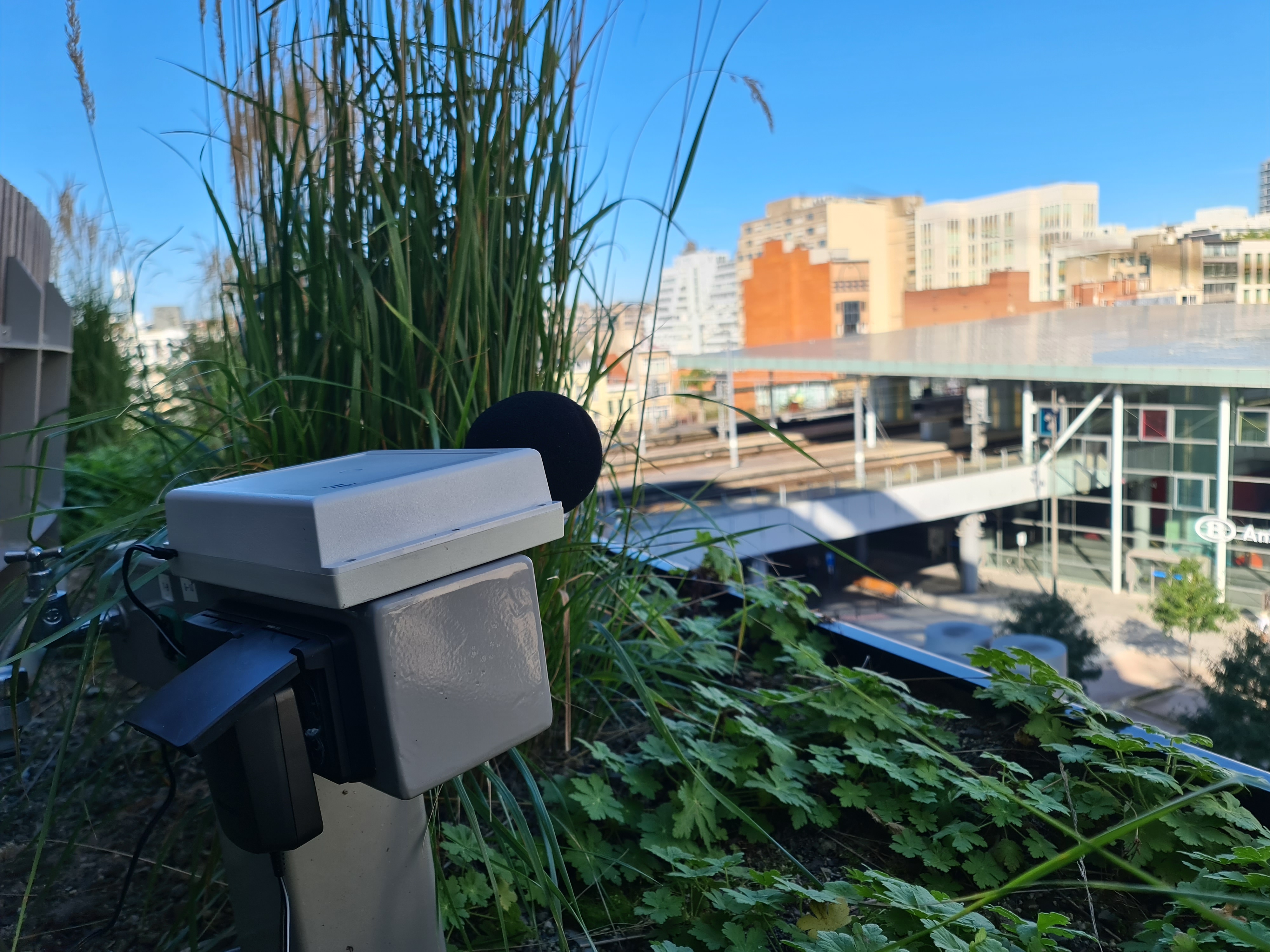
Here and there across the city of Antwerp, curious boxes with funny black noses are starting to appear. While their presence for now remains subtle, it heralds the exciting beginning of a new impending roller coaster ride of discoveries!
These boxes are smart sound sensors, designed to measure the variety of sounds in the urban context. They are the predecessors of a large citizen science project on sound and its impact on our lives; a collaboration between University of Antwerp, the Universitary Hospital (UZA) and media partner De Morgen, and I am proud and happy to be in charge of the scientific roll-out of this project.
The sound sensor is designed by ASAsense, a Belgian company, and its a nice, smart box: it sends data over the internet in real time to our database, but it also has a smart algorithm implemented, which allows it to identify the sources of sound it hears.
We’ve embarked on a preliminary journey ahead of the grand project scheduled for later this year. Our primary goal now is to capture the diverse urban soundscape using these sensors. We aim to collect data encompassing a wide range of sounds. Our team, including a group of dedicated students, will meticulously classify these sounds. This data will then become the basis for training machine learning models within the sensors to recognize specific sound patterns in our main project.
Our first foray into the real world yesterday already garnered media attention, including a detailed article in our media partner, De Morgen, and an engaging interview on regional radio and television.
Now it’s full speed ahead to the main project coming up soon!
Finally, we got to publish something that was véry long overdue: the necessary correction to our ‘Global maps of soil temperature’. A correction, indeed, as we had identified an error in the analyses that had to be rectified.
So, what happened? When calculating the monthly mean temperatures of each of the in-situ temperature time series from the SoilTemp database, I accidentally shifted these microclimate time series forward with half a month by using a faulty R-code. Or, in different words: I thought I had found a smart way to summarize the data to monthly values, but I didn’t… As this coding error did not occur when computing the corresponding monthly mean temperatures from the ERA5 macroclimate data, we ended up calculating our temperature offsets with half a month of temporal mismatch. The result was that the microclimatic offsets for let’s say June were calculated using the microclimate data from half of June and half of May instead.
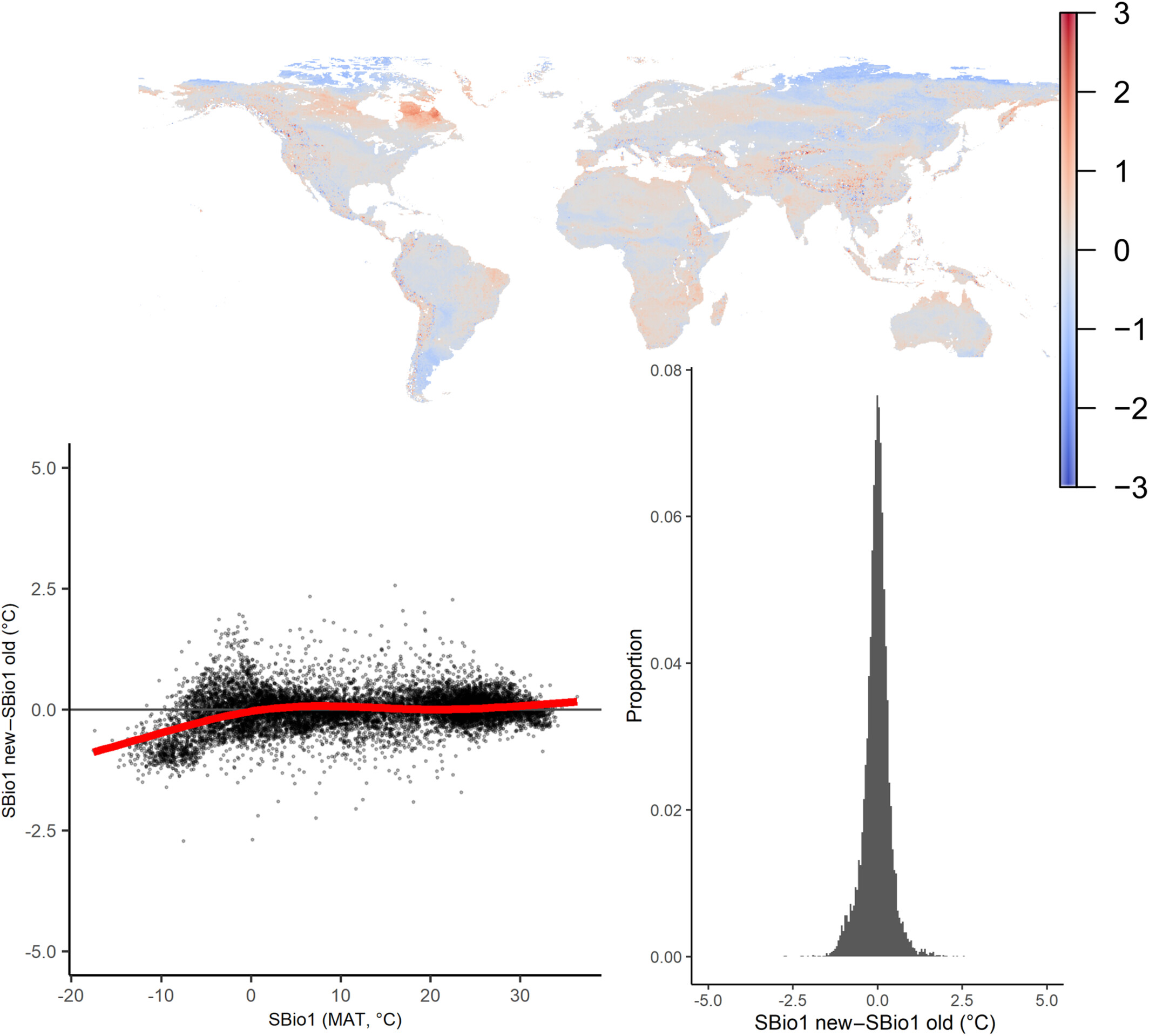
Such a tiny error could have pretty major implications, so the moment we discovered this, we immediately dove back into the data to rerun our analyses. We were both lucky and unlucky. First, lucky: most of the analyses in the paper were at the yearly level, and there the implications of shifting the data with two weeks were minor: the corrected mean annual soil temperature was estimated to be on average only 0.006°C higher than the original one, with a Root Mean Square Error (RMSE) between the old and new map of just 0.330°C (Corrigendum Figure 1). Consequently, all conclusions in the main text of the published paper about biome-specific patterns in mean annual temperature remained unaffected (see below for details).
Difference between the modeled mean annual temperature in the topsoil layer (SBio1) following the corrected (new) calculation versus the original (old) calculation were fairly minor. (a) Pixel-level differences in temperature (new minus old). (b) Temperature differences (new minus old) as a function of SBio1, showing more consistent lower temperatures in cold climates following the corrected calculations. (c) Histogram of errors in mean annual temperature.
Due to the nature of the error (a half-month shift in soil temperature time series), implications for seasonal bioclimatic variables were larger, however, especially in cold environments. That’s the unlucky part, as we had made our bioclimatic variables openly available, and people were thus using erroneous maps. We made sure to rectify that as soon as possible, and updated our maps on Zenodo, where one should use ‘version 2’.
The difference between the modeled maximum temperature of the warmest month following the corrected (new) calculation versus the original (old) calculation was substantially larger than in the figure above.
The urgency was lower to update the paper, due to the minor impact on the findings, but we wanted to do that as well, so the paper came with the necessary warning associated with it. That corrigendum is now online, bringing this saga to an end.
So how to prevent such errors in the future? I don’t know… This was a paper seen by so many people, this was data and code I had shared with several others. But the error was such a minor thing that looked reasonable at first glance, and the resulting data and patterns all looked so reasonable, that it was hard to spot. I guess I can only say: be as open as you can, share your data, share your code, and let people look at it all. The error came to light after a few back and forths with the lead author of a sister paper (Haesen et al. 2021, which also got a correction), who wanted to redo some calculations using new data for a follow-up analysis, and could not reproduce my numbers. That made me rerun my own numbers, and discover the mistake.
2. A warning
So are the maps now perfect? Far from! I want to take this opportunity to highlight another example of an issue that is still in the maps. It’s less of an error, but more a limitation of our data and analysis, and one that we can only correct by rerunning the analyses with a much larger dataset.
A while ago, a data user contacted us with a question: some parts of the global map of bioclimatic variable 3 (SBIO3) seemed impossible: SBIO3 is the isothermality, which is simply put the mean diurnal range (variation within a day, SBIO2) divided by the annual range (variation over a year, SBIO7).
Due to the nature of that index, it can not go below zero, as that would mean that any of these two ranges is negative, which would suggest a higher minimum than maximum temperature. Impossible!
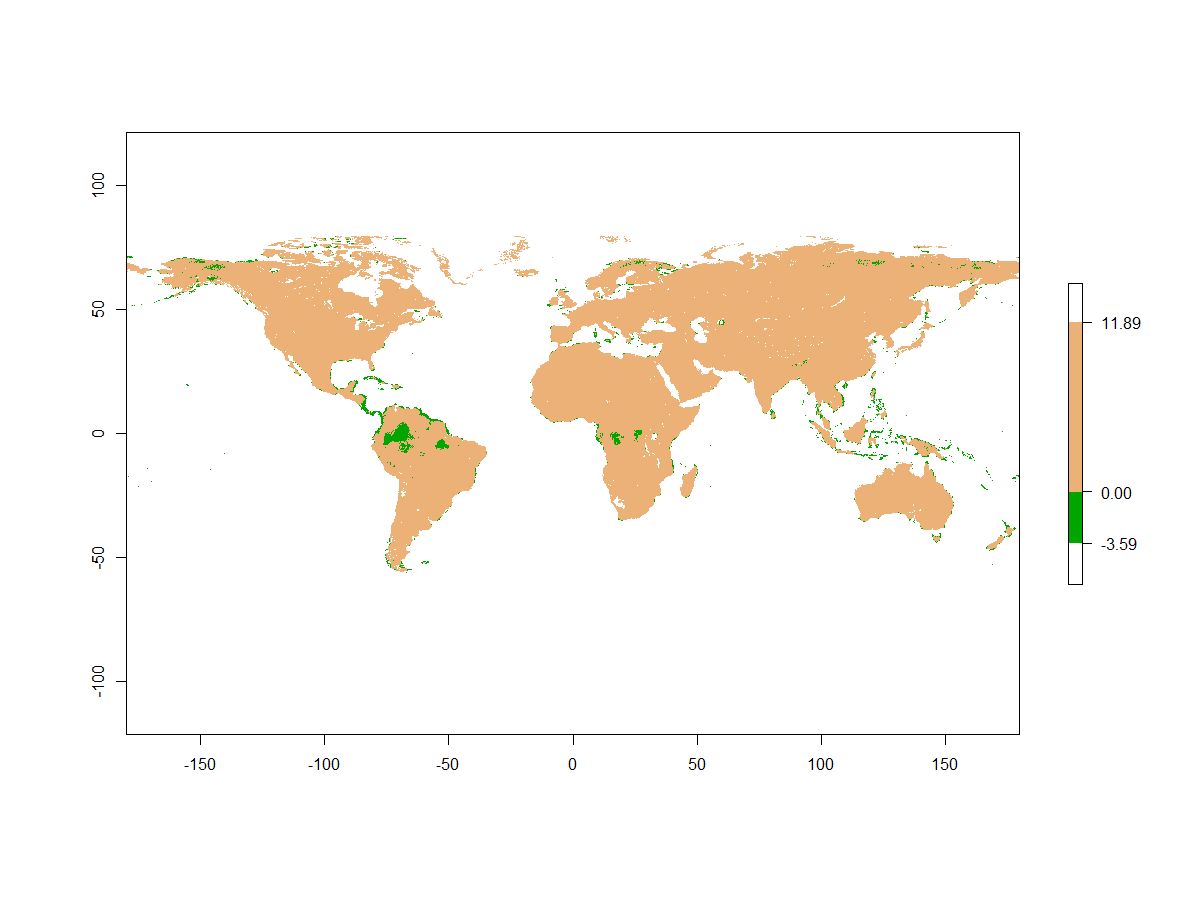
Bicolor map of SBIO3, highlighting in green where impossible negative values were observed.
Now, it turned out that in a few cases, especially in the tropics, SBIO3 was indeed negative (see the map, around 3% of points across the globe)! This, in turn, was the result of a few negative values in SBIO2, the diurnal range. This can occur in our models in areas with very little difference in daily minimum and maximum, such as in warm and wet regions like the tropics. There, it is most likely the result of an extrapolation of our machine learning models of the underlying variables. Indeed, we did not inform any model of the fact that SBIO2 should never be below 0, as we calculated this range simply based on the separately modelled minima and maxima. Especially in very warm and wet areas – where diurnal ranges are low – it might therefore have extrapolated beyond what is possible in reality.
Such errors are amplified by the fact that SBIO3 is a derivative variable: it is calculated based on SBIO2 and SBIO7, with SBIO2 in turn being calculated based on our modelled minima and maxima. Each layer adds another opportunity for error, with the end result being less trustworthy than the input data. What is more, the models of minima and maxima themselves are the results of in-situ measurements and environmental explanatory layers, all in turn with their own errors.
So, while global modelling has great potential, one should never forget that such assessments – as so many – have inherent errors resulting from amplified uncertainties.
So what to do? The best is that when using SBIO3, one might consider to mask out these areas with impossible values. You can mask those erroneous pixels out directly, or get rid of all areas with potential uncertainties stemming from extrapolation of the model. We provide a mask for this, called ‘PCA_int_ext_5_15cm’ in the repository. When you take a very stringent threshold of 0.95, most of the erroneous areas are masked out, including several more that might have had enough accurate measurements to allow perfect modelling. 0.95 means that the model is doing at least 5% of extrapolation outside of the environmental space covered by the data.
Areas in green on this map are extrapolating for at least 5% of the environmental predictor layers, which could potentially result in such errors as described above – or at least a higher chance for those.
One day, a fantastic gift arrived from one of my Chilean colleagues: a compendium of non-native plant species in the country. Beautifully illustrated and brimming with clear information, I immediately found it to be a go-to resource for understanding ruderal vegetation back home… in Belgium.
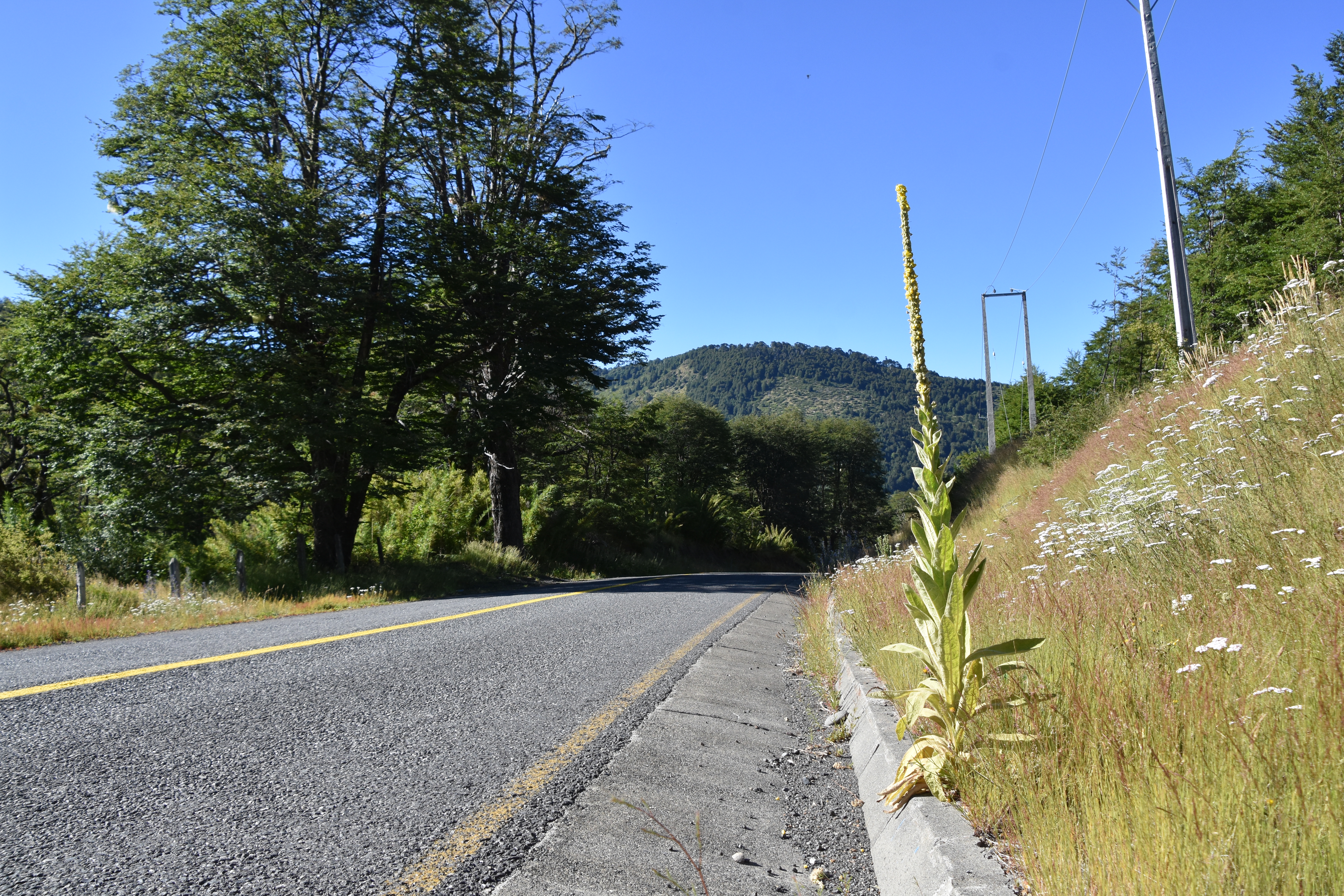
A very typical Chilean roadside with a very typical European vegetation, dominated by an impressive individual of Verbascum thapsus
In Belgium, diving into the non-native flora of South America feels remarkably familiar, like returning home! The abundance of European ruderal species that have firmly established themselves – with the help of humans – in the Andes is mind-boggling. Dandelions (Taraxacum sp.), red and white clovers (Trifolium pratense and repens), Scotch broom (Citysus scoparius), Viper’s-bugloss (Echium vulgare), and simple street grass (Poa annua) – Chilean roadsides often appear surprisingly similar to their European counterparts.
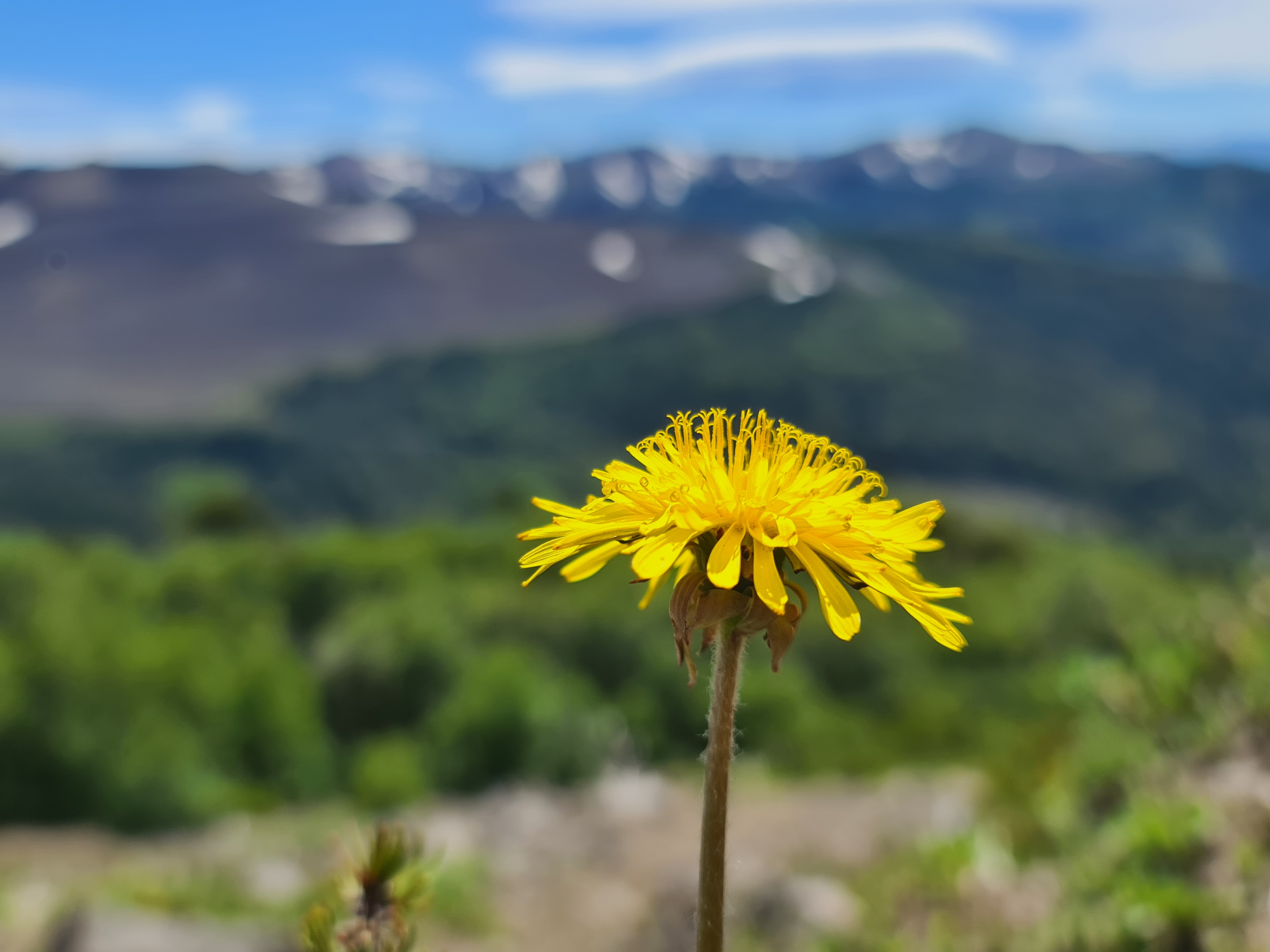
High above the treeline on a beautiful Chilean mountain: Taraxacum officinale – the common dandelion. Probably arrived there in the footsteps of human hikers.
As you ascend the Andes, the number of these European weeds diminishes. However, the few that remain raise a vital question: to what extent does the problem of invasive species penetrate the breathtaking and valuable landscapes of the Andes?
The Andean flora is filled with unique native species – non-native species like the dandelion could become highly disruptive
Yet, as unfortunately still so often is the case, very little information existed. The concept of invasive species in mountains itself only recently caught the attention of ecologists, with the launch of the Mountain Invasion Research Network (MIREN) in 2005, marking a global first in addressing this question at a large scale. Since then, several important local studies have been undertaken in the Andes, with South American scientists playing an active role within MIREN. Despite these efforts, a comprehensive overview remained elusive.
As you can likely predict by now in this text, we embarked on a journey to fill this void. Local hero Eduardo Fuentes-Lillo, now deservedly Dr. Fuentes-Lillo, dug deep into the literature to consolidate all existing knowledge about plant invasions in the Andes – their patterns, drivers, and impacts. This endeavor unearthed intriguing truths, as you’ll discover in our latest paper.
Lead author Eduardo monitoring plant species along a Chilean mountain road
First and foremost, the patterns of non-native plant invasion in the Andes closely resemble those found in mountainous regions around the world. Lowland (often European) ruderal species follow disturbances uphill, gradually thinning until only the most adaptable species (like the dandelion) survive in the alpine zone.
In the Andes, just like elsewhere, anthropogenic disturbances play a pivotal role in driving these plant invasions. Where humans venture, especially along mountain roads, non-native species inevitably follow. And here’s the notable aspect: even at high elevations above the treeline, several non-native species thrive, including mimosa (Acacia dealbata), lupine (Lupinus polyphyllus), mullein (Verbascum virgatum), and bugloss (Echium vulgare), and the Andes seems to have surprisingly many of these examples. This surprisingly high non-native diversity at high elevations implies that climate serves less as a limiting factor for plant invasions in the Andes than one might anticipate; instead, disturbances enable these species to successfully establish above their expected limits.
Non-native species in the Andes relate more closely to disturbance – here caused by horseriding – than to climatic constraints
Ultimately, two important questions need to be answered: what impacts do these species have on the native Andean ecosystems, and what are we (or should we be) doing about them? Here lies a real challenge – we currently know very little about the impact of non-native species in the Andes, with only a handful of scattered studies touching upon a limited range of potential consequences. Clearly, there’s much work ahead!
Much of the information on non-native species impacts in the Andes is coming from research on Pines, one of the most impactful groups of invaders in the region
So, where do these findings lead us? The paper concludes with a strong warning message and a call to action: Andean countries have some catching up to do, particularly concerning impact studies, policy frameworks, and management. Achieving this ideal involves crucial cross-country communication, facilitating the optimization of strategies throughout the entire Andean region. Undoubtedly challenging, but as anthropogenic pressures on the Andes intensify and the climate warms, the risks, and impacts of non-native species in the Andes could rapidly escalate.
It was a misty morning in the heart of July, yet the sky held the promise of turning into a brilliant blue canvas. Our team embarked on a short but steep hike to conquer the summit of mount Nuolja, setting out for an extraordinary day immersed in one of the most captivating long-term monitoring endeavors I have ever come across: the Fries-gradient.
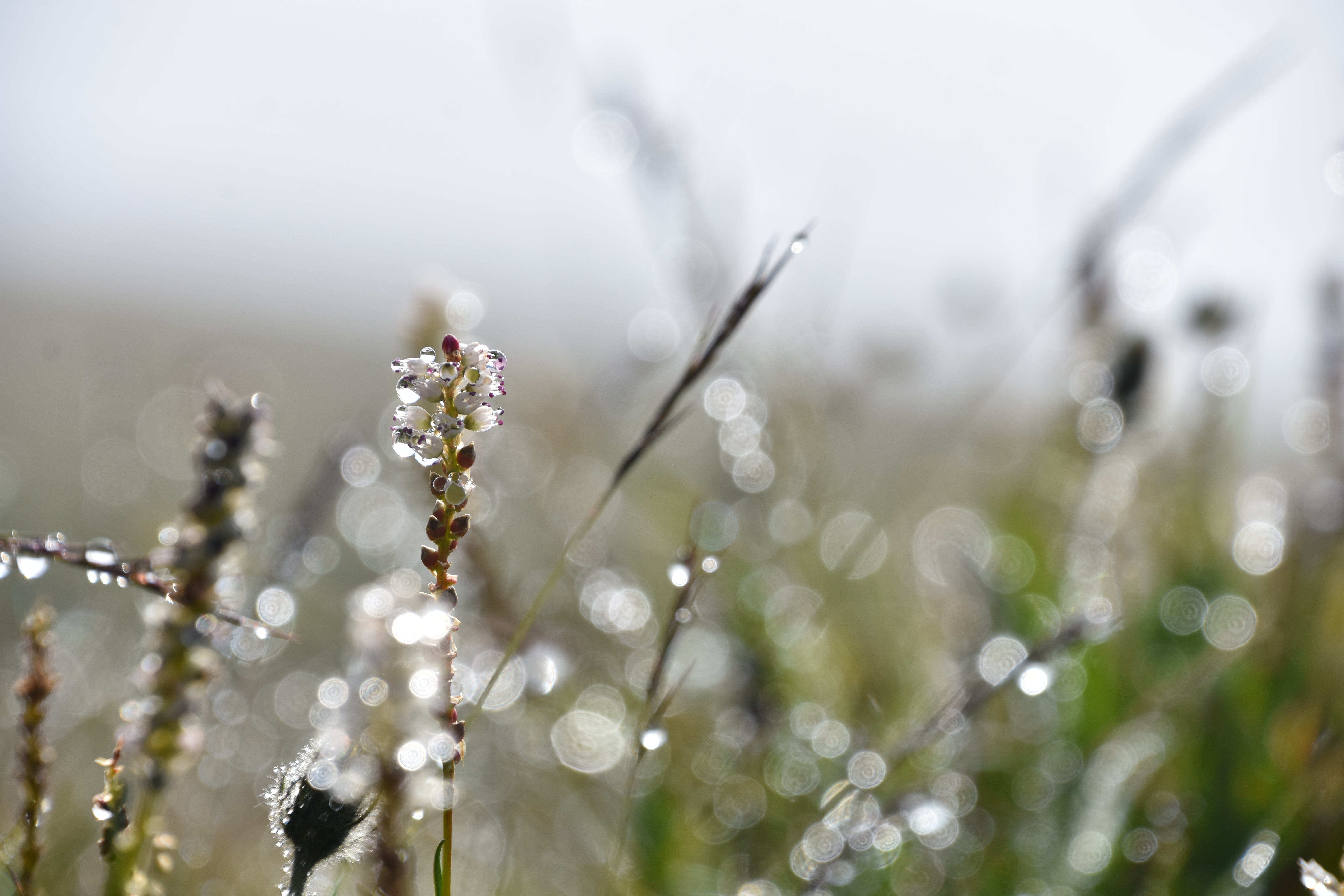
Early morning on mount Nuolja, the alpine plants all draped in their most beautiful pearly dresses
Back in the years spanning from 1917 to 1919, Thore Fries dedicated himself to a meticulous scrutiny of the vegetation along a linear track from the mountain’s base to its rocky peak. With unwavering determination, he ascended and descended the mountain every five days throughout those three summers. Armed with an acute eye, he recorded each species he encountered, meticulously documenting their phenological stages – whether they were budding, flowering, producing seeds, or succumbing to the passage of time.
Fast forward to 2017, when a team of scientists from Abisko’s Climate Impact Research Center (CIRC), led by my friend and mentor Dr. Keith Larson, embarked on an audacious mission: to resurrect that century-old monitoring transect. This brilliant initiative, as you might intuitively feel, holds tremendous promise. A long-term investigation of this nature can furnish us with invaluable insights into the intricate interplay between climate change, species distributions, and phenology.
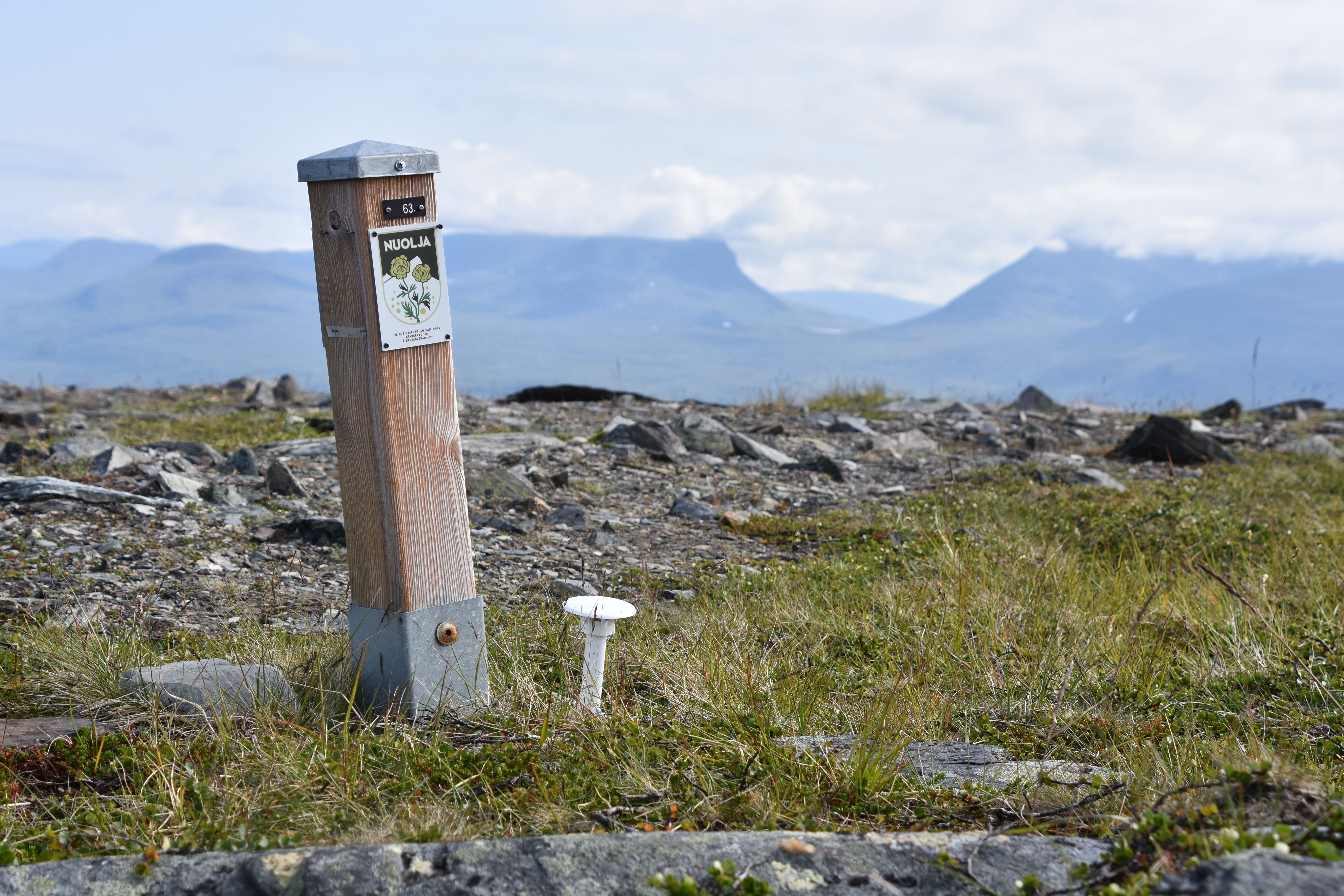
However, the reason why this long-term survey is even more special than others of its sort, is Thore Fries’ remarkable foresight during his era. He marked his trail with sturdy wooden poles, placed at regular intervals spanning from the mountain’s base to its top. A significant number of these poles endured the test of time, marking the exact survey locations even a century later. Thanks to additional careful documentation by Fries himself, the precise locations of the remaining markers were successfully deduced. The ‘Fries’-gradient thus stands as one of those exceedingly rare instances of century-old vegetation surveys where we are gifted with the EXACT coordinates of the original investigation.
In recent years, Fries’ old poles have been replaced by this beautiful sturdy fellows, made to last us another long while. This project truly has longterm ambitions!
In recent years, our team has joined forces with Keith’s, uniting our strengths to keep this monitoring endeavor alive. We have not only ‘pimped’ the gradient with our beloved microclimate sensors but are now also faithfully undertaking the pilgrimage to the mountain’s summit each summer, diligently observing and documenting the ever-changing plant life.
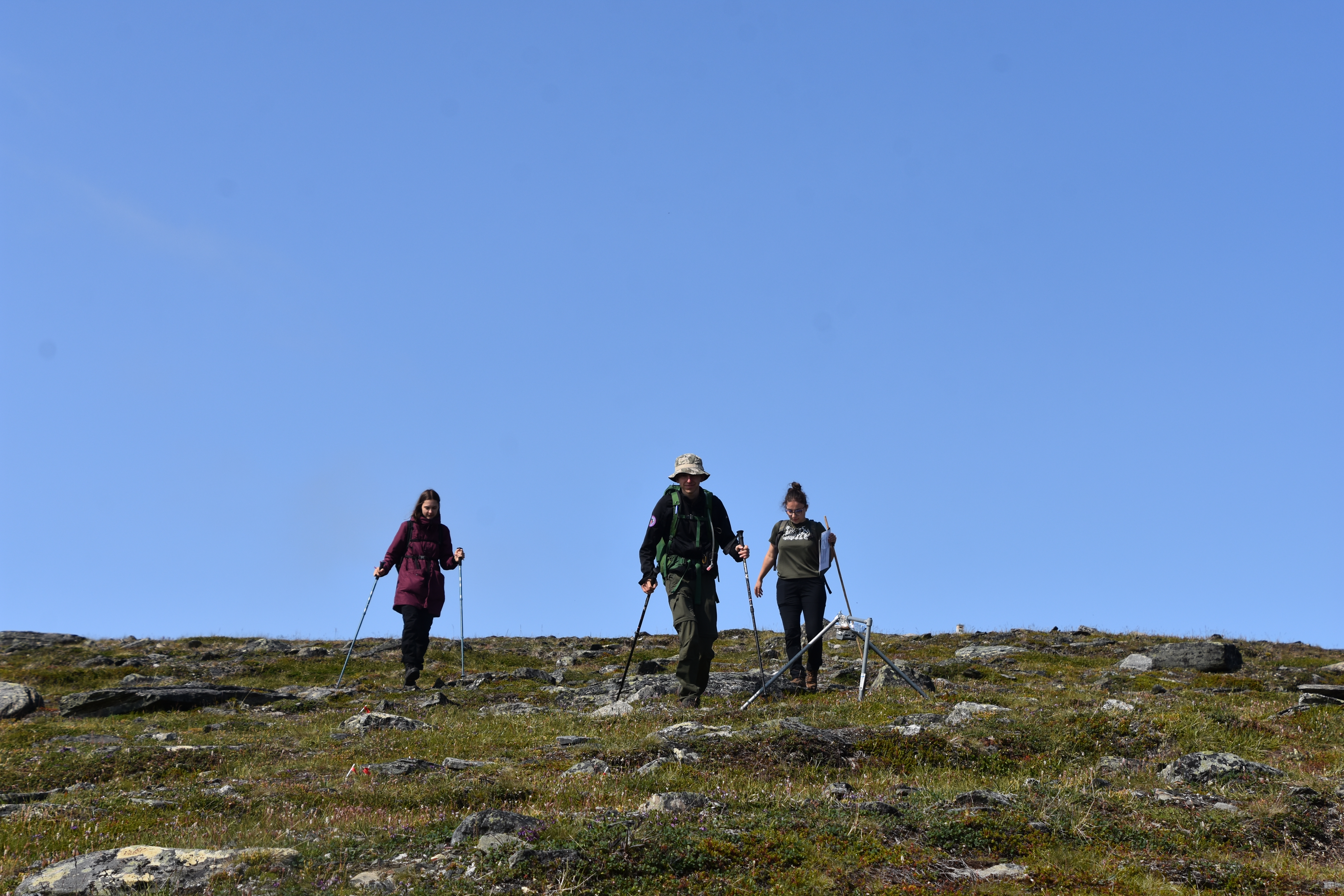
Our team hiking its way down along the transect
This year, we have master student Beau ready to dive into the wealth of data. Beau will capitalize on the astonishing fact that over the course of three summers in the 1910s and an additional seven summers in recent years, the plant species have been subjected to a watchful eye every five days. This cumulative effort has yielded a remarkable collection of nearly 300 vegetation surveys along the same transect. An unprecedented dataset, indeed, poised to address a long-standing query that has intrigued plant ecologists for generations: how frequently must we monitor a plot or region to observe all of its resident species?
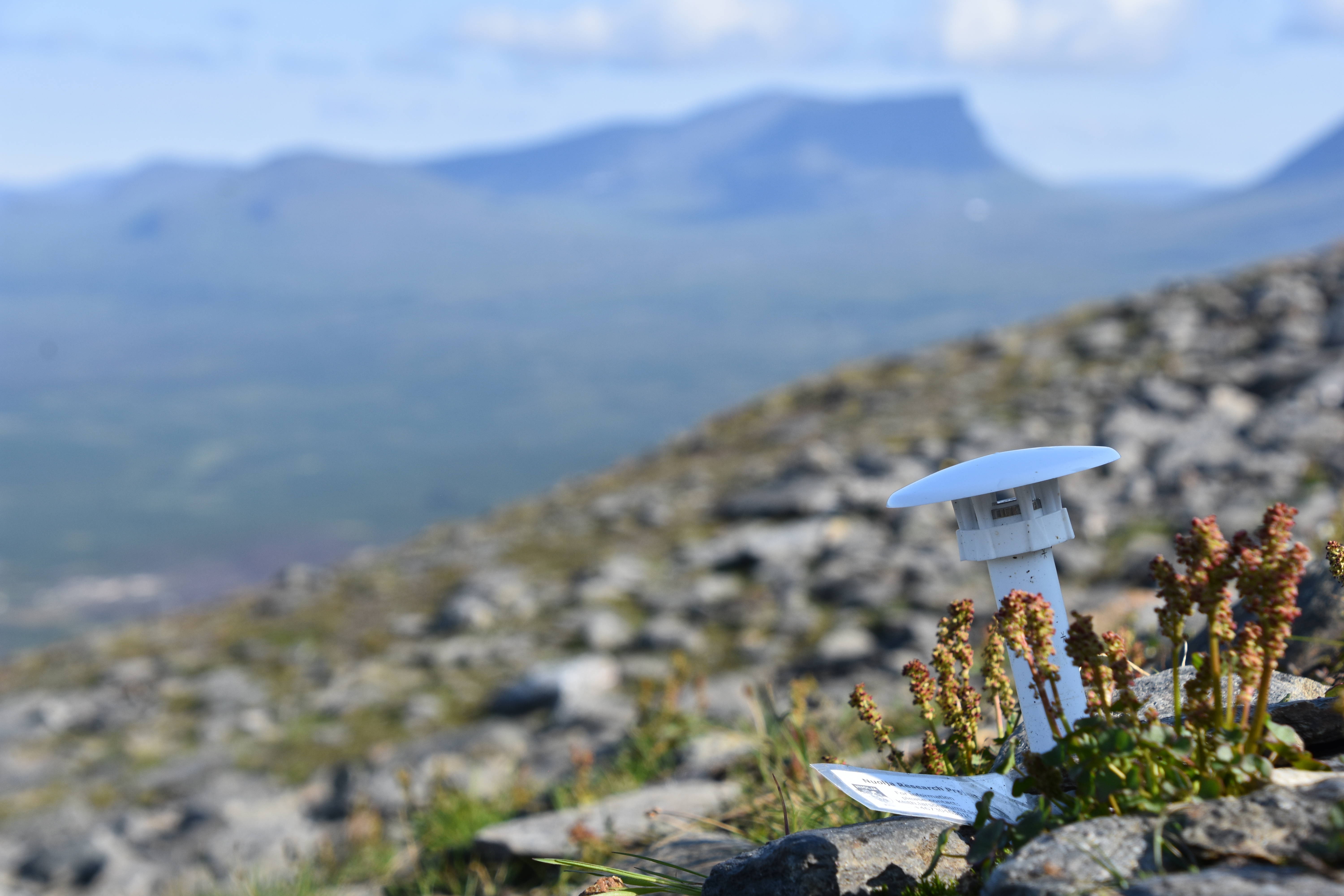
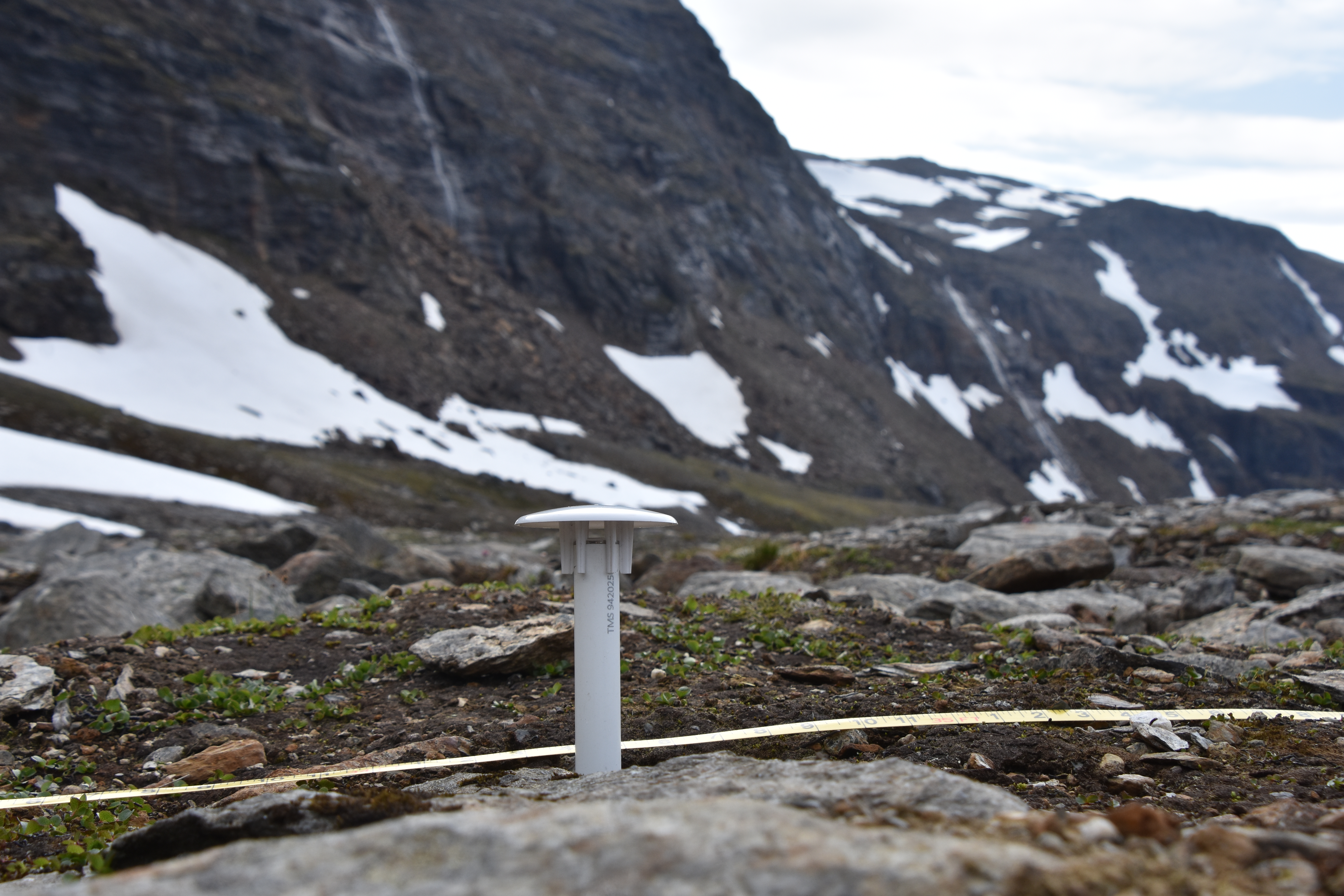
Microclimate sensor on a rocky snowbed patch above the treeline, with the distinct ‘Lapporten’ mountain gap in the background
In many instances, constraints limit us to just one single visit to a given plot. Yet, due to a multitude of factors including seasonality, year-to-year fluctuations, observer bias, and numerous others, a singular survey often falls dramatically short of capturing the full spectrum of species within an area. We all know it – but there is little we can do about it.
There are many reasons why a species might escape our eyes. Beautiful flowering plants like this Campanula are hard to miss, but not all in the mountains is so outspoken in its beauty
How many revisits that takes, and which species are most often overlooked and when, that’s what Beau will try to find out. All this, of course, once we manage to tear our eyes away from the captivating vistas of mount Nuolja on a sunny summer day.
An alpine meadow filled with buttercups, overlooking lake Torneträsk
In 2016, a significant endeavor began as we initiated the monitoring of vegetation along two cherished mountain trails in the Abisko region. Our primary objective was to assess the impact of these trails on the mountain vegetation. Specifically, we had a hunch that the trails might induce similar effects to what we had observed along roads: a notable reshuffling of mountain plants, allowing species to travel up and down the mountain, following the footsteps of hikers on the trails.
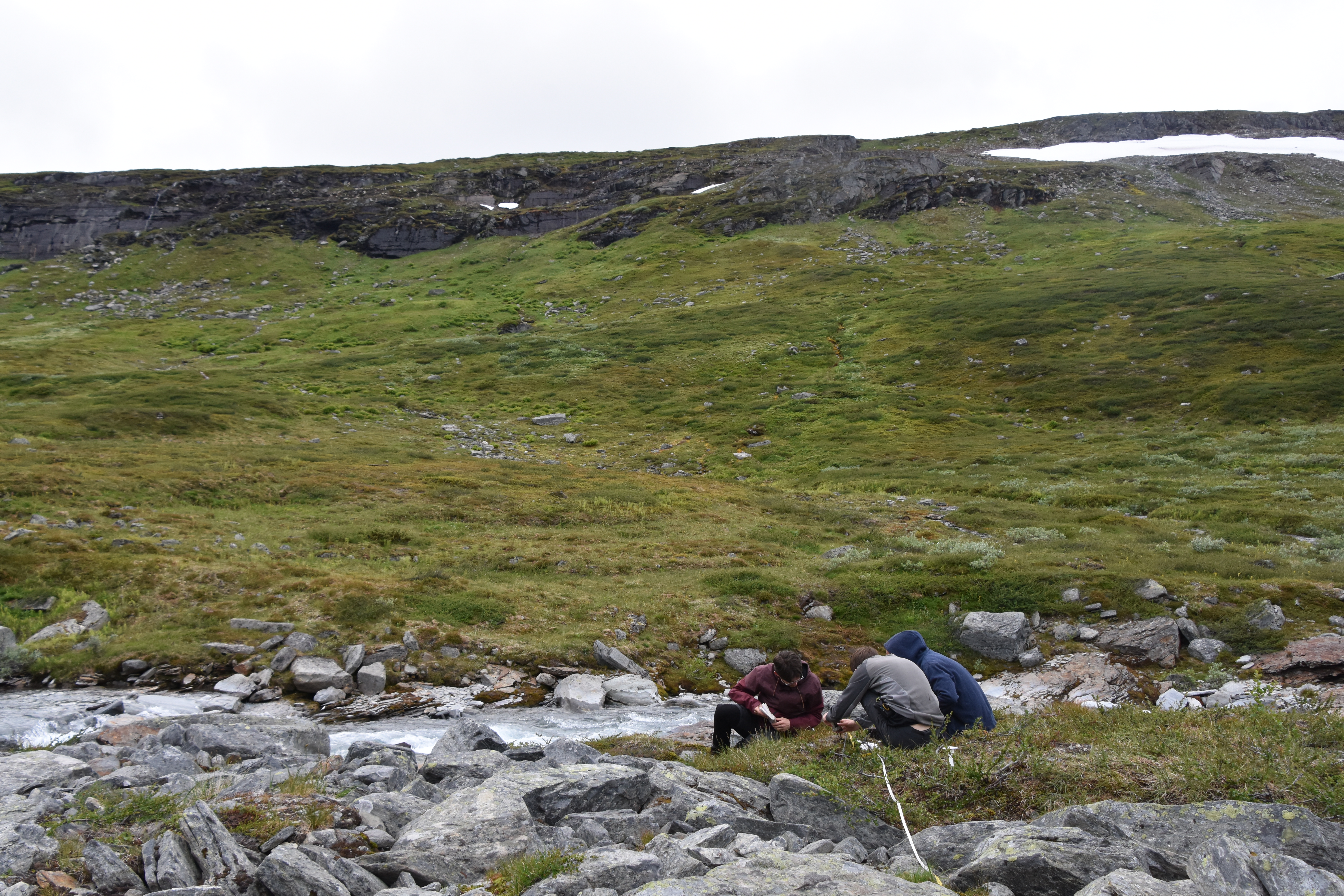
The team monitoring the vegetation on the bank of a little river, flowing noisily down from the best-studied mountain in the region: mount Nuolja
Understanding changes in species distribution becomes much smoother when tracking the same plants over an extended period. Therefore, it required persistence. With some resourceful juggling of funds and time, we succeeded in assembling the necessary crews to revisit these trails in 2018 and 2020 (though we have to admit, Covid almost thwarted our plans!).
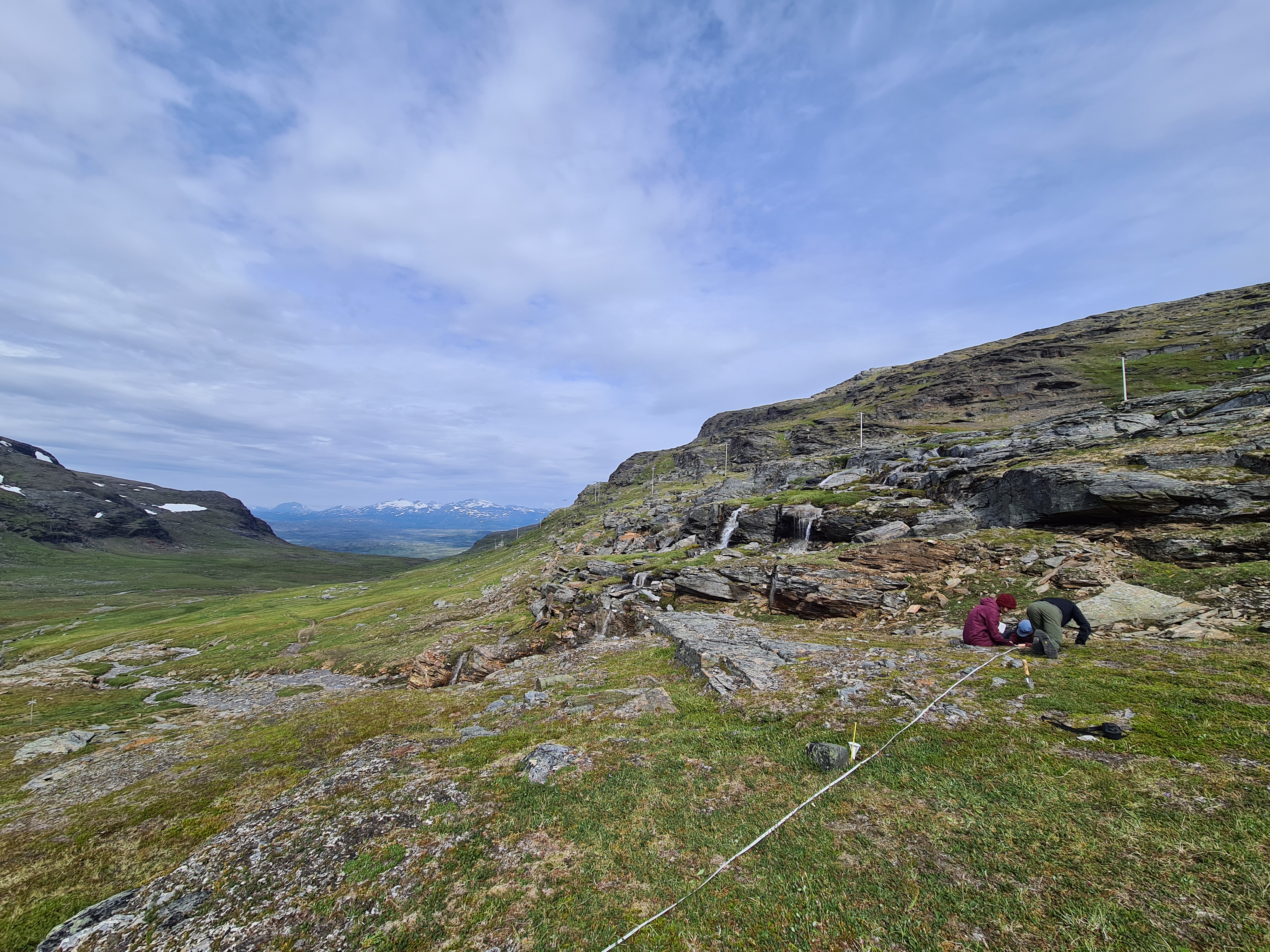
Botanizing with a view on the slopes of Laktatjakka valley
Now, in 2023, our team has returned, fully recharged and eager to embark on another year of monitoring. To add to the excitement, we’ve welcomed new master students to our ranks, two of whom will delve into the intriguing topic of how these trails impact the vegetation.
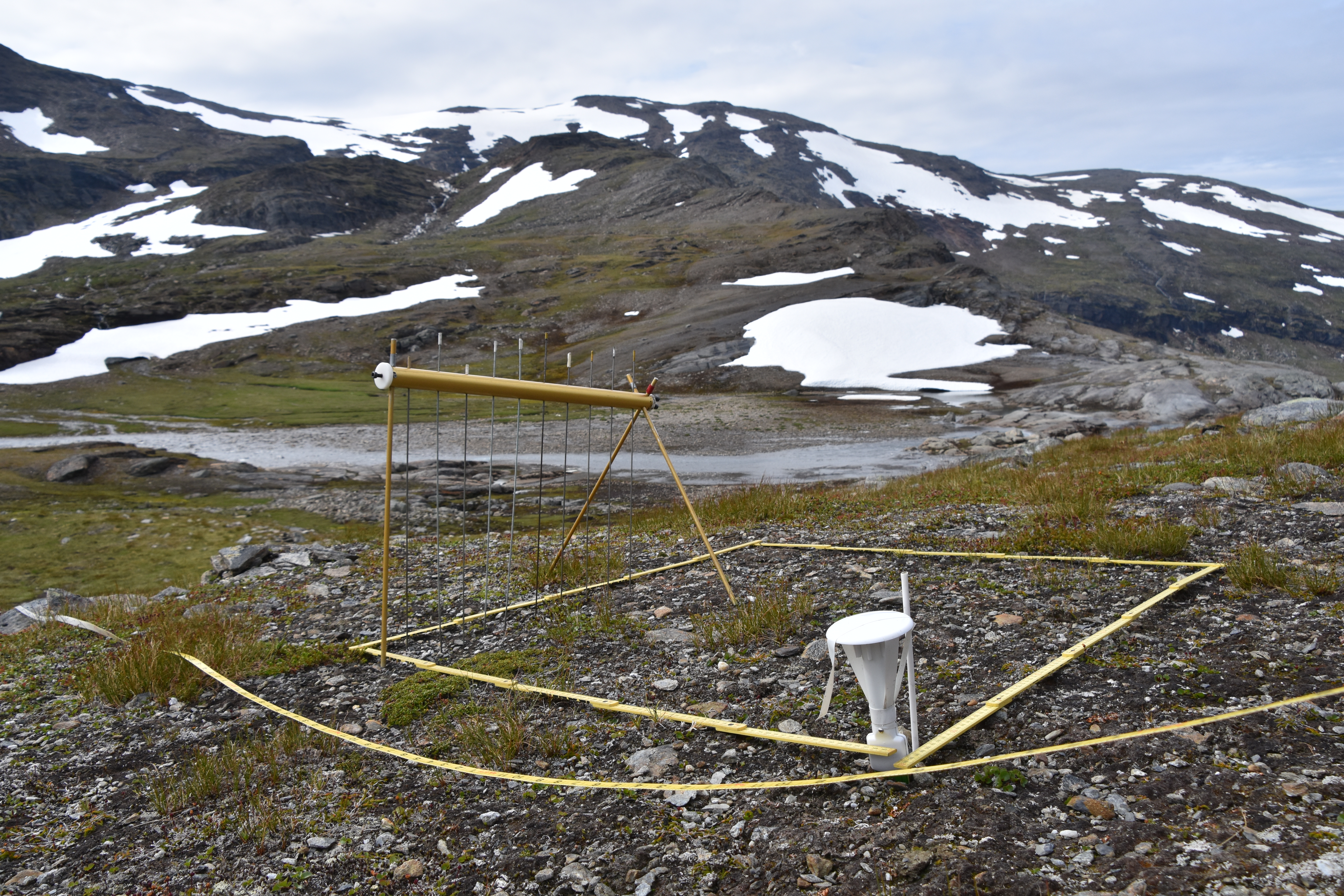
Microclimate sensor, and one-meter survey plot with a pin-point frame. Pins are dropped 100 times in such a plot, and we write down every plant that is touched, to get an as objective as possible idea of the plant community in the plot.
Tist will focus on the temporal dynamics, paying close attention to non-native species. We already know that non-native species tend to thrive near trails worldwide, although perhaps not as fervently as they do near roadsides. In the northern Scandes, however, these non-native species seem to have been limited along the trails so far, possibly due to the extremely cold climate and the comparatively lower number of non-native species in European mountain regions. Nonetheless, such circumstances can change rapidly, which is why Tist will diligently monitor their movements: Are they reaching higher elevations in 2023 compared to 2016? Is their coverage increasing?
Microclimate sensor towards the top of the Laktatjakka trail. The nival zone is home to just a few species, such as the dwarf willow (Salix herbacea) and the glacier buttercup (Ranunculus glacialis). No home for non-native species, for sure, but never say never!
Meanwhile, Violetta will be investigating belowground, focusing on the crucial organisms known as mycorrhizae. We wonder whether our trails are affecting the mycorrhizal communities to a similar extent as roads do. The prevailing idea is that the impact on these communities will be noticeable but less intense than that observed along mountain roads due to the trails’ lower disturbance levels.
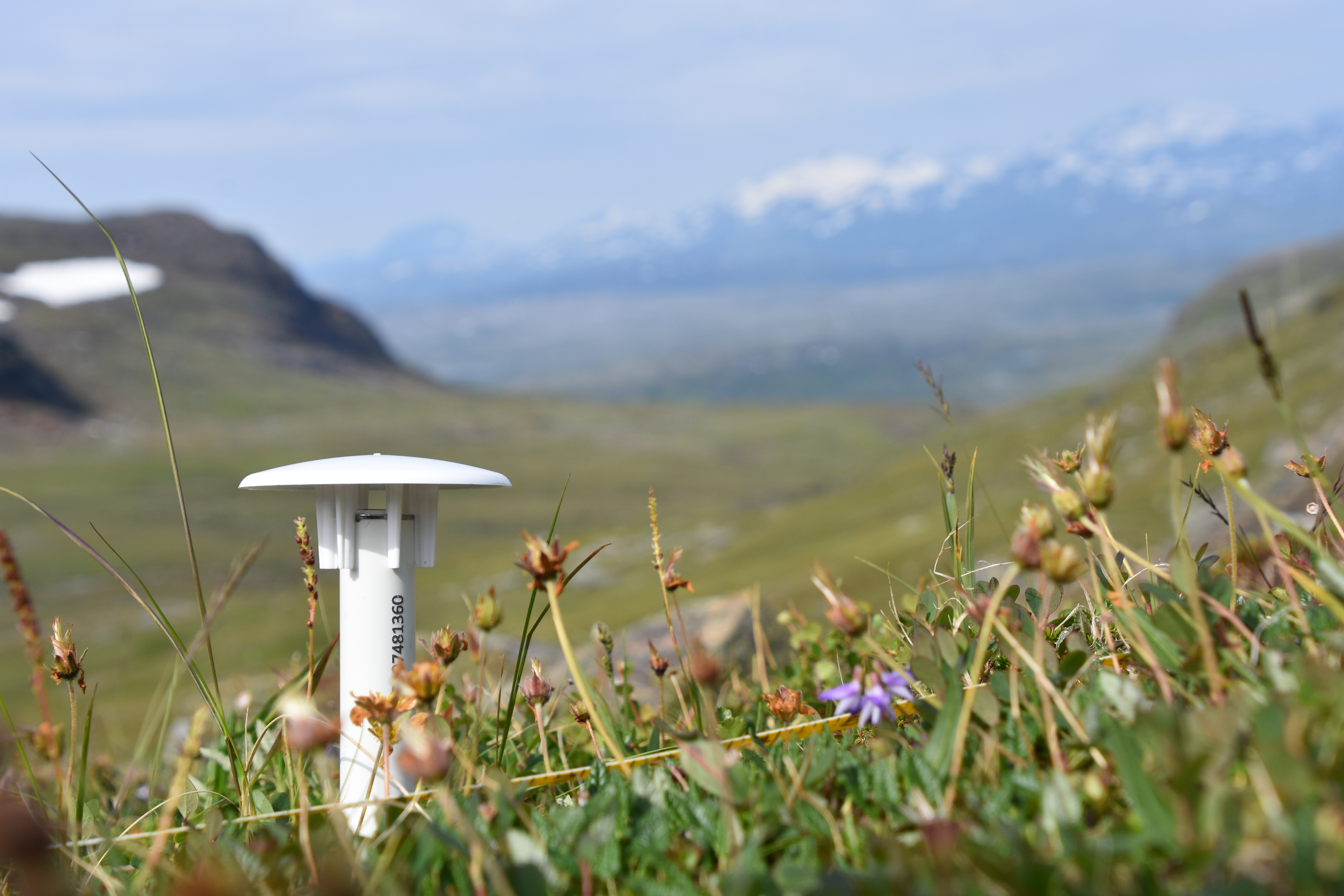
Microclimate sensor overlooking the valley in a typical alpine meadow. Most plants in this meadow are associated with the same mycorrhizal types, but the big unknown is what trail disturbance does with those assocations
Let the journey of discovery begin! Until then, our team will traverse those beautiful slopes in pursuit of botanical wonders, eager to unravel the secrets that lie beneath the canopy.
We had stumbled upon a great treasure, when our colleague Keith, from Abisko in northern Sweden, found an old research paper from the 1950s written by a botanist called Olav Gjaerevoll. This Olav had spent several summers in the 1940s exploring the mountainsides in the northern Scandes around Abisko, during those times when the Kiruna-Narvik railroad line was transporting tons of iron ore to satisfy the ever-iron-hungry Nazi-Germany war machine.
Mr. Gjaerevoll, a passionate botanist, had fallen in love with the snowbed vegetation of the northern Scandinavian mountains. He meticulously classified the different snowbed vegetation types and their association with soil pH and soil moisture.
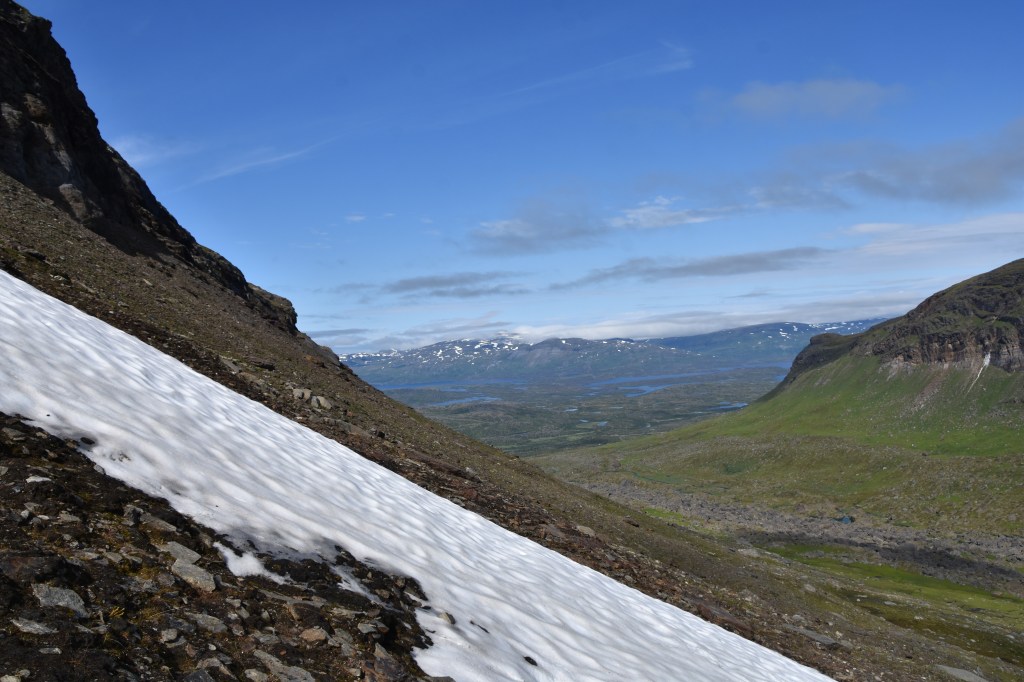
Mid July, snowbeds are still common around 1000 m and higher in the northern Scandinavian mountains. The one pictured here forms the topic of today’s adventurous tale.
Since the 1940s, much has changed. The railroad line still transports tons of iron ore, but the climate in the region has substantially warmed and become more erratic. We became curious about how a resurvey of those snowbeds from the 1940s would look now and how the communities might have changed.
Of course, locating the exact plots was not feasible. Gjaerevoll had provided us with mountain names, orientations, and heights, but that often left us with several snowbeds to choose from. Moreover, he didn’t describe his sampling scheme in enough detail to locate the exact plots precisely. Nevertheless, we were determined to get as close as possible and uncover an interesting story.
Scouting for the optimal snowbed up in the rocky nival zone of the valley
Thus, we embarked on a journey following the faded tracks of this mid-twentieth-century botanist. Our first target was an easy one – a snowbed right underneath the touristic chair lift on Mount Nuolja, next to Abisko. For our second day of adventure, we aimed a bit higher. We noticed that Olav Gjaerevoll had visited a few snowbeds high up on the flanks of the Kärkevagge-valley, the valley of the ‘lake of the trolls’, or ‘Trollsjön’. This trail was highly popular among tourists and led to a beautiful lake at the end of a gentle slope, surrounded by steep mountains on all sides but the north.
It was the perfect season to visit Kärkevagge-valley, with the gentle slopes of the valley covered with a wide diversity of flowering plants. The picture here holds beauties like Astragalus alpinus, Ranunculus acris, Bistorta vivipara, Bartsia alpina, and Pyrola minor as the most common ones.
However, we didn’t just want to follow the tourist track to the lake. Our goal was to reach the steep slopes where the winter snow still blanketed the rocky flanks. Just before reaching the lake, we thus veered off track, ventured into the valley, crossed the stream barefoot, and ascended the steep slopes on the other side.
The only way is through. Extremely cold meltwater, but the best our feet could dream off after a few hours of hiking!
After a brisk climb and some contemplation on ‘what would Gjaerevoll do’, we discovered a lovely little snowbed. We got down close to the ground, just a few centimeters from the snow, to identify the diverse array of centimeter-sized plants that were flourishing there. The sight was astounding – so many Saxifragas, funny little sedges and Luzulas, such pretty millimeter-sized flowers! It was a feast for the eyes!
Ranunculus nivalis, the queen of the rocks in the Scandinavian mountains. One of the last flowers found at the very highest elevation sites.Luzula spicata, a tender Luzula that has stole my heartThe beautiful white bell-flowers of the ‘moss heather’, Cassiope hypnoides. A plant so small it is easy to confuse with moss, but not so when it’s flowering!
The scientific findings we could make up there will have be the subject of another blog post, as well as a master thesis by our dedicated ‘Olav’ of the present, Brent. Yet the journey had clearly started in a sufficiently epic manner, promising a great project ahead of us!
Snowbed monitoring with a view. You wouldn’t say it from the rocks, but there was a surprisingly large diversity of plant species to be found!The beautiful purple of Bartsia alpina against the low polar sun.
Lake Törnetrask, Abisko Research Station, Abisko, Sweden
Diapensia lapponica in one of our plots
Laktatjakka valley
Norway
Narvik, Norway
Hallerbos 2017
Young bluebell (Hyacinthoides non-scripta) surrounded by flowers of yellow archangel (Lamium galeobdolon)
The common bluebell (Hyacinthoides non-scripta), the signature flower of the Hallerbos
Single bluebell flower surviving on a wetter spot, as indicated by the field of wild garlic (Allium ursinum)
A really wet patch of forest, with giant horsetail (Equisetum telmateia) in a field of wild garlic (Allium ursinum)
Wild garlic (Allium ursinum) in the Hallerbos flowers a bit later than the bluebells, yet this one was already in full bloom
A bumblebee visiting yellow archangel (Lamium galeobdolon)
A bumblebee visiting yellow archangel (Lamium galeobdolon)
Wild garlic (Allium ursinum)
Wild garlic (Allium ursinum)
Weirdly beautiful, the inflorescence of pendulous sedge (Carex pendula), typical for the wettest spots in the forest
Weirdly beautiful, the inflorescence of pendulous sedge (Carex pendula), typical for the wettest spots in the forest
A little stream in the Hallerbos, surrounded by endless fields of wild garlic (Allium ursinum)
The herb-paris (Paris quadrifolia), less common in the forest
Wild garlic (Allium ursinum)
Bluebells (Hyacinthoides non-scripta)
Weirdly beautiful, the inflorescence of pendulous sedge (Carex pendula), typical for the wettest spots in the forest
Another one from the wet plots: large bitter-cress (Cardamine amara)
Another one from the wet plots: large bitter-cress (Cardamine amara)
Young beech leaves, as soon as they are fully grown, spring in the understory is over
A beech forest without understory, most likely too dry and too acid for any survivors
A young beech seedling (Fagus sylvatica), looking nothing like a beech, yet everything like a tiny dancer
Young beech seedling (Fagus sylvatica)
Bluebells (Hyacinthoides non-scripta)
Bluebells (Hyacinthoides non-scripta)
Bluebells (Hyacinthoides non-scripta)
Mountain melick (Melica nutans), a grass in the most amazing green
Bluebells (Hyacinthoides non-scripta) in a rare patch of mountain melick (Melica nutans), a grass in the most amazing green
Bluebells (Hyacinthoides non-scripta)
Bluebells (Hyacinthoides non-scripta)
Montpellier 2017
The entrance to the cathedral of Montpellier
The cathedral of Montpellier
The entrance to the cathedral of Montpellier
The cathedral of Montpellier
Narcissus poetics
The cathedral of Montpellier
The botanical garden of Montpellier
The botanical garden of Montpellier
The botanical garden of Montpellier
Brackish Camargue vegetation
Brackish Camargue vegetation
Brackish Camargue vegetation
A typical lagune
Brackish Camargue vegetation
Camargue horses
Camargue horses
Camargue horses
Brackish Camargue vegetation
Brackish Camargue vegetation
Brackish Camargue vegetation
Camargue horses
Brackish Camargue vegetation
Little egret in the evening sun
Flamingo’s in the evening sun
A typical lagune
Dandelion fuzz
Grass lily
Grass lily
Dandelion fuzz
Veronica in a sea of poplar fluff
Euphorbia in a sea of poplar fluff
Poplar
Gare du Midi, Brussels
Gare du Midi, Brussels
Gare du Midi, Brussels
Gare du Midi, Brussels
Sweden autumn 2016
Autumn in Abisko
Yellow leaves of mountain birch, with lake Torneträsk in the background.
Lapporten, the gate to Lapland, in Abisko
Rain blowing over the Abisko National Park
The colours of the north: red fireweed and yellow mountain birches, with lake Torneträsk on the background
Yellow leaves of mountain birch, with lake Torneträsk in the background.
Rain on the background, the ski lift in Abisko on the foreground
The steep slope of mount Nuolja on a dramatic looking morning
The beautiful colors of lake Torneträsk in Abisko
A little stream on top of the mountain, with a view on Lapporten, the gate to Lapland
Well, that is a beautiful table with a nice view on lake Torneträsk in Abisko
Our little experiment on top of the mountain in Abisko, with a view on Lapporten
Autumn in Abisko is extremely colorfull
The ski lift with a view on Abisko National Park and Lapporten
Hiking dowhill towards lake Torneträsk
This green is greener than the greenest green: moss on top of mount Nuolja
Well, that is a beautiful table with a nice view on lake Torneträsk in Abisko
The ski lift with a view on Abisko National Park and Lapporten
The ski lift with a view on Abisko National Park and Lapporten
The most beautiful hiking trail of the world: Nuolja in Abisko
Angelica archangelica, often the biggest plant of the Arctic
The most beautiful hiking trail of the world: Nuolja in Abisko
Cirsium helenioides, the melancholy thistle
Hiking down mount Nuolja
The steep slope of mount Nuolja on a dramatic looking morning
The colours of the north: red fireweed and yellow mountain birches, with lake Torneträsk on the background
The prettiest yellow and blue: autumn in Abisko
Fireweed, Epilobium angustifolium
Campanula or bellflower, I think ‘uniflora’
Vaccinium myrtillus
Cornus suecica, the prettiest red of the world
Hieracium alpinum, alpine hawkweed
Carex atrata, one of my favourite sedges
Alpine clubmoss, Diphasiastrum alpinum
Agrostis capillaris, bentgrass
Common yarrow (Achillea millefolium)
Anthoxanthum odoratum, sweet vernal grass, fully grown and mature
Snow scooter trail
Our plot in the mids of a field of horsetails (Equisetum pratense)
Equisetum pratense
Cliff overlooking the valley with the road to Norway
Seedling of Taraxacum officinale, the dandelion, after two years of growing in bad conditions
Poa alpina, the alpine meadow-grass, with its viviparous seeds
Massive flowerhead of Angelica archangelica
Angelica archangelica
Blueberry (Vaccinium myrtillus) in autumn
A lowland marsh in Abisko in autumn
Installing the plots of our trail observations on top of mount Nuolja
Installing the plots of our trail observations on top of mount Nuolja
Tanacetum vulgare (Tansy), non-native for the high north
Autumn forest down in the valley
The valley of Nuolja to Björkliden
Summer on the Nuolja-side
A full rainbow behind mount Nuolja in Abisko
It’s raining in the west, clouds trapped behind the mountains
A strong wind blowing rain from behind the mountains to our side
A strong wind blowing rain from behind the mountains to our side
Betula nana, the dwarf birch, mini autumn forest
Betula nana, the dwarf birch, mini autumn forest
The valley of Björkliden in autumn
The valley of Björkliden in autumn
The valley of Björkliden in autumn
The valley of Björkliden in autumn
Sweden spring 2016
Ranunculus glacialis
A rainy hike
Oxyria digyna
Although the alpine zone has been harder for invasives to access than most places, human structures like trails are often an easy gateway for the invaders to get up there. Picture from Abisko, Swedish Lapland.
Bartsia alpina
Dryas octopetala
Western European species like the red clover (Trifolium pratense) here are often listed as non-native species in mountain regions.
Cornus suecica
Trifolium pratense
Trifolium repens
Overlooking the valley of Laktajakka
Silene suecica
Melting snowpatch on a lake
Rubus arcticus
Eriophorum vaginatum
The valley of the lakes
Ranunculus glacialis
Silene acaulis
Salix reticulata
Amiens
Cathedral seen from the frozen Parc Saint-Pierre
Nice architectural curve
Almost cold enough for ice-skating
Cathedral at night
Maria without a shirt
Sun rising above the water
The museum behind the beautiful gates
Amiens is filled with cute little houses
Frozen to the bone
Gargoyle planning to eat the cathedral
Colourful mirror
Cathedral at night
Cathedral at night
The southern side
Sunny but cold, the Quai Bélu
Cathedral at night
Le Club d’Aviron in winter weather
Cold!
Frozen mirror
View from my office window
Sunny but cold, the Quai Bélu
Cathedral with a glimpse of spring
Just outside of Amiens
Enjoying silence and the morning sun
View from my office window
House on the square before the cathedral
Winter sun on the Place du Don
Sweden autumn 2015
Lichen
Sweden summer 2015
View on the 1000 meter plots
Doing research on a cold Arctic morning
Plots flooded by the snowmelt
Flooded by the snowmelt
Meltwater river, racing down the mountain
After a hike, even the most basic house looks cosy. Little hut in the mountains, open for everybody
Snowbridge, maybe don’t cross…
Snowbridge
View from a cliff
Silene acaulis or cushion pink, cutest plant of the Arctic
Two seasons in one image
Steep slope
Hiking down
Narvik Kirche, church of the subarctic
Narvik Kirche
Reindeer on top of the mountain
Narvik Kirche
Summer at the church
Summer flowers
Massive waterfall
Young willow catkins
View from Narvik’s hospital, with lilac flowers
Building a bridge over the fjord will gain al drivers at least an hour
Norwegian fjord
Posing with the water, getting soaked
Minimalistic mountains
Insect investigating our reindeer antler
Catching mosquitoes with our license plate, harvest of the year!
Posing with the plot
Fieldwork on the most beautiful spot of the world
Fieldwork on the most beautiful spot of the world
Summer bridge – still next to the sadly impassable river
Rhinanthus flower in the mountains
Plateau in the valley, beautiful brown
Experimental view from my favourite plot
Salix catkins
Extremely old Betula tree
Waterfall from a cliff
Buttercup is the earliest in spring, here
Rocks!
Alpine views
Views!
Fieldwork
Jumping over rivers
Plot
Golden plover
Angry lemming
Green, the whole north is green!
Snow, so much snow left!
Minimalistic mountain moments
Fieldwork
The research center
Red clover – focal invader
Look at this tiny cute snail!
Massive floods of melting water
Bartsia alpina
Hooray, a toilet!
Dryas octopetala
Lowest elevation plots
Butterball!
That’s a lot of water
Midnight sun is the best
At the lakeside
Beautiful Bistorta vivipara
Don’t fall in the water
Midnight sun
Wild river
Art – made by ages of wild rivers
Baby firework for America’s independence day
Midnight sun at the lake
The Abisko canyon was wilder than ever
That’s a crazy amount of water!
The Abisko canyon was wilder than ever
The Abisko canyon was wilder than ever
Black and white
Stone-man overlooking Abisko
Nothing as soft as a willow catkin
Label and soil temperature sensor attached
I’d drive to the top every day
Reflections
Rocks and clouds
Brave little birch
Brewing our camping poison
Basic camping stuff
Camping in Norway
Home-made temperature houses
Roadside research at its best
Norway is crazy
Horsetail is so funny
Little creek in magical forest
Birches, birches everywhere
Beautiful rock, a gift from the river
Another roadside fellow
Lichen
Ready to rock the summer
Collecting mosses
That’s a crazy old lichen
Tiny tiny piny trees, but old, so old!
Ready to jump into the fjord?
Ready to jump into the fjord?
That’s a spiky stone!
Views on Norwegian fjords
Silene in the mountains
Cute little orchid
Skua
Attacking skua, mind your heads!
Watch out for the attack of the fierce skua!
Black snail
New plot!
Still a lot of snow to melt, but this spot was free for a new plot
Reindeer are better than people
Two seasons in one picture
Let’s see what is happening to the balance in mountains! Is this a starting avalanche, or will it last a bit longer?
Cute little hut
Climbing mountains by car
Softest moss in history
Drosera in the marsh
Hiking in no-man’s land
The clouds are coming
Abisko valley
‘Butterball’
Fieldwork in the tundra
Abisko valley
Little plot
Clouds and sun and mountains
Making soup on a campfire with a view
Little creek on high elevations
Skua on the look-out
Melting snow in a river
Rhodiola rosea and the Törnetrask lake
Beginning of spring
Flooded plots, melting snow, impassible wetness
Ferns and horsetails
Chile 2015
Trips to the field sites were sometimes a real adventure, especially right after snowmelt
Lunch made by our local colleague, with funny bread (tasty as well!)