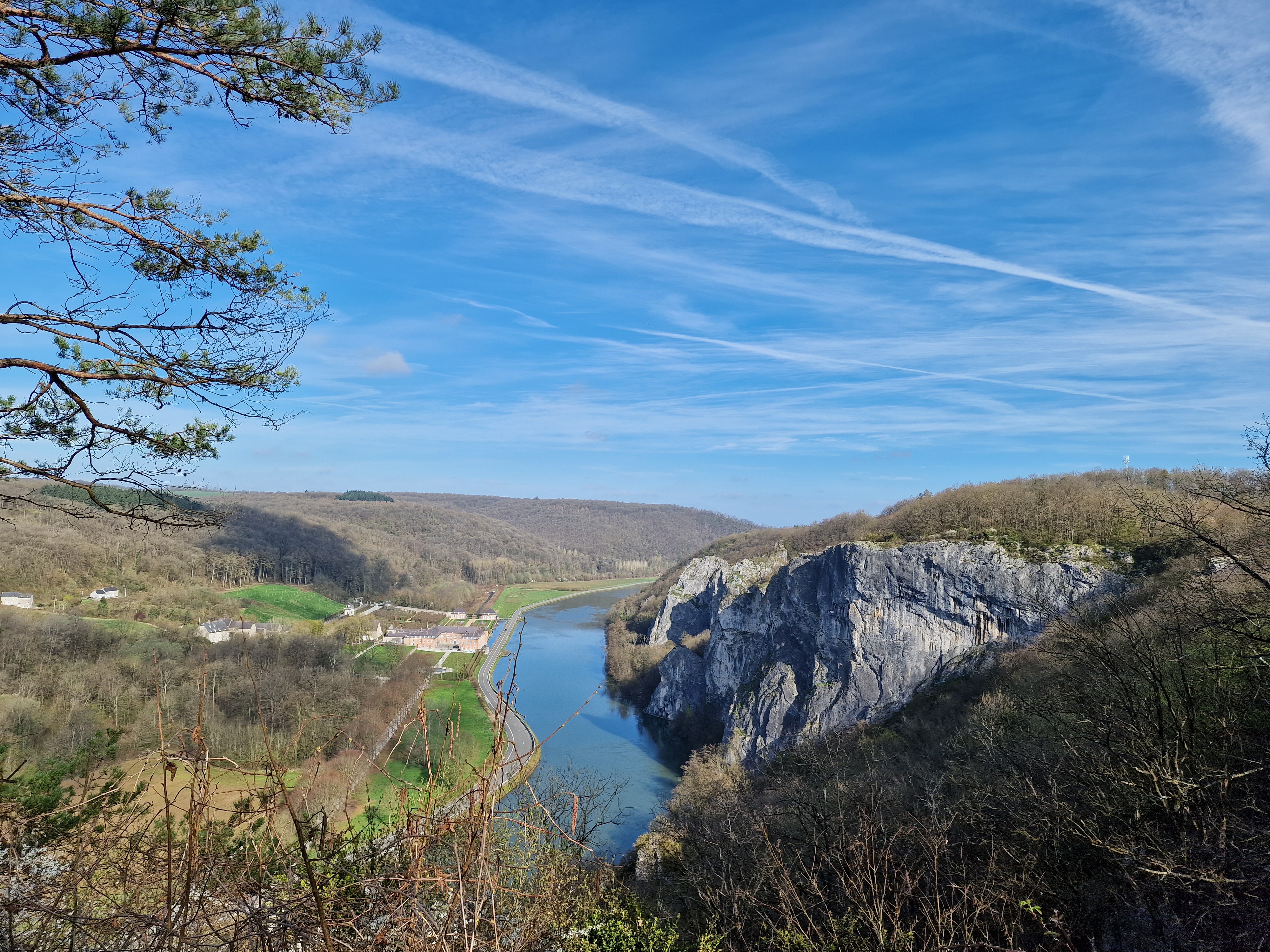
On a sunny day in early spring, our team took the car to one of the most monumental locations in Belgium: the cliffs of Freÿr. These beautiful slabs of ‘naked’ limestone of up to 120 meter, overlooking the river Meuse, provide one of the most – if not the absolute most – favourite rock climbing locations in the whole of Belgium.
Overview of ‘les Rochers de Freÿr’ towering over the river Meuse.
With easily a 1000 climbing routes, ranging from the easiest to the hardest, the rock is legendary in Belgium rock climbing milieus. It is there that we headed to for the final scouting for a new – and extremely exciting – global survey: ‘MIREN Rocks’ (more on that – and how to join – here!).
Scouting the area for the perfect survey sites with local guide David
Indeed, as we speak, we finalized the protocol for MIRENs’ global rock survey, using our experience from the cliffs of Freÿr as an example. We checked for routes to sample, estimated variability in orientation, difficulty and botanical diversity and, most importantly, tested out ways to install microclimate sensors on a cliff face.
Microclimate monitoring on the cliffs with the TOMST thermologgers
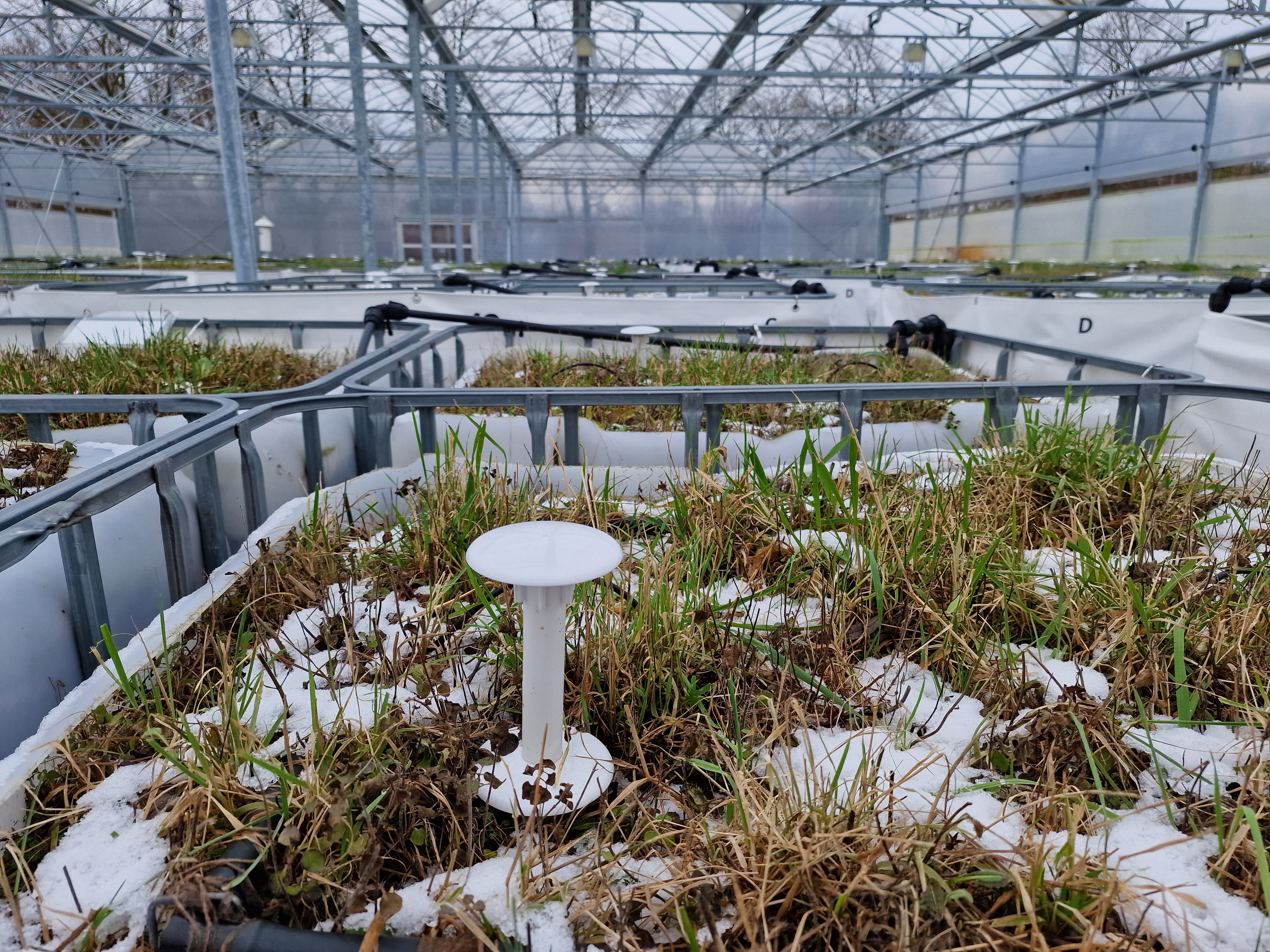
It’s the latter that perhaps makes me most excited: we can now plug in one of our trusted TOMST loggers – the simpler thermologger one – in a gap in the cliff face, and as such start measuring the true temperatures our cliff plants are experiencing. The ultimate cross-over between my two favourite networks, MIREN and SoilTemp.
The three-layered shield helps reduce the error resulting from direct solar radiation. Nevertheless, it will be hard to get accurate reads of the local temperature due to the extreme radiation absorbed, reflected and emitted by sunbathing cliffs
Now, that protocol is ready for action, also thanks to the extensive contributions by experts from across the globe. As such, the protocol has grown into a true community effort, and we hope it will be a resource for many climbers and ecologists to help us track rock cliff vegetation and the implications of rock climbing on it.
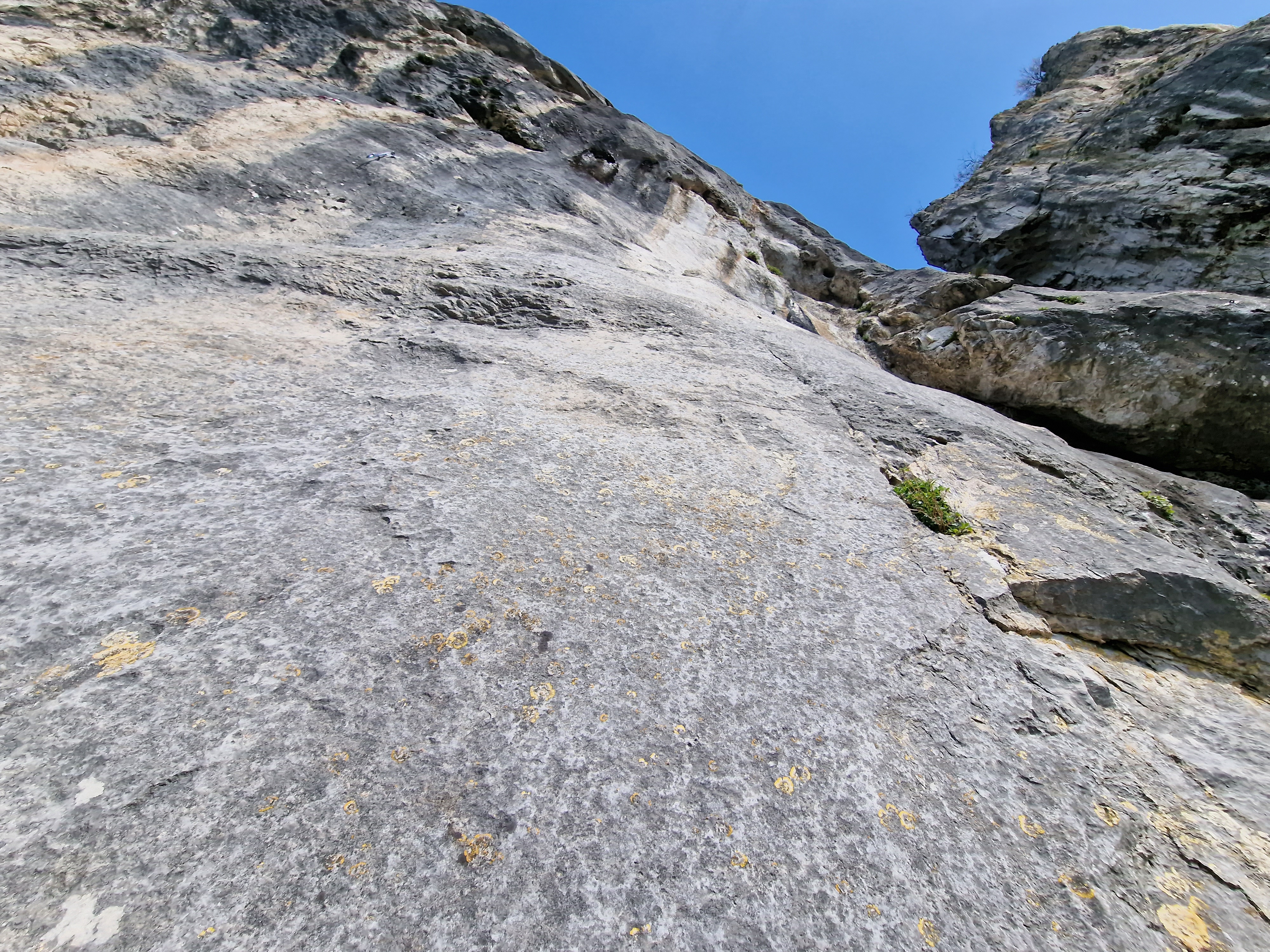
Selecting the optimal climbing routes for our upcoming monitoring
So, take this as a wake-up call: are you an ecologists, botanist or the like, and do you like to climb rocks? Then please join MIREN Rocks! All information can be found here.
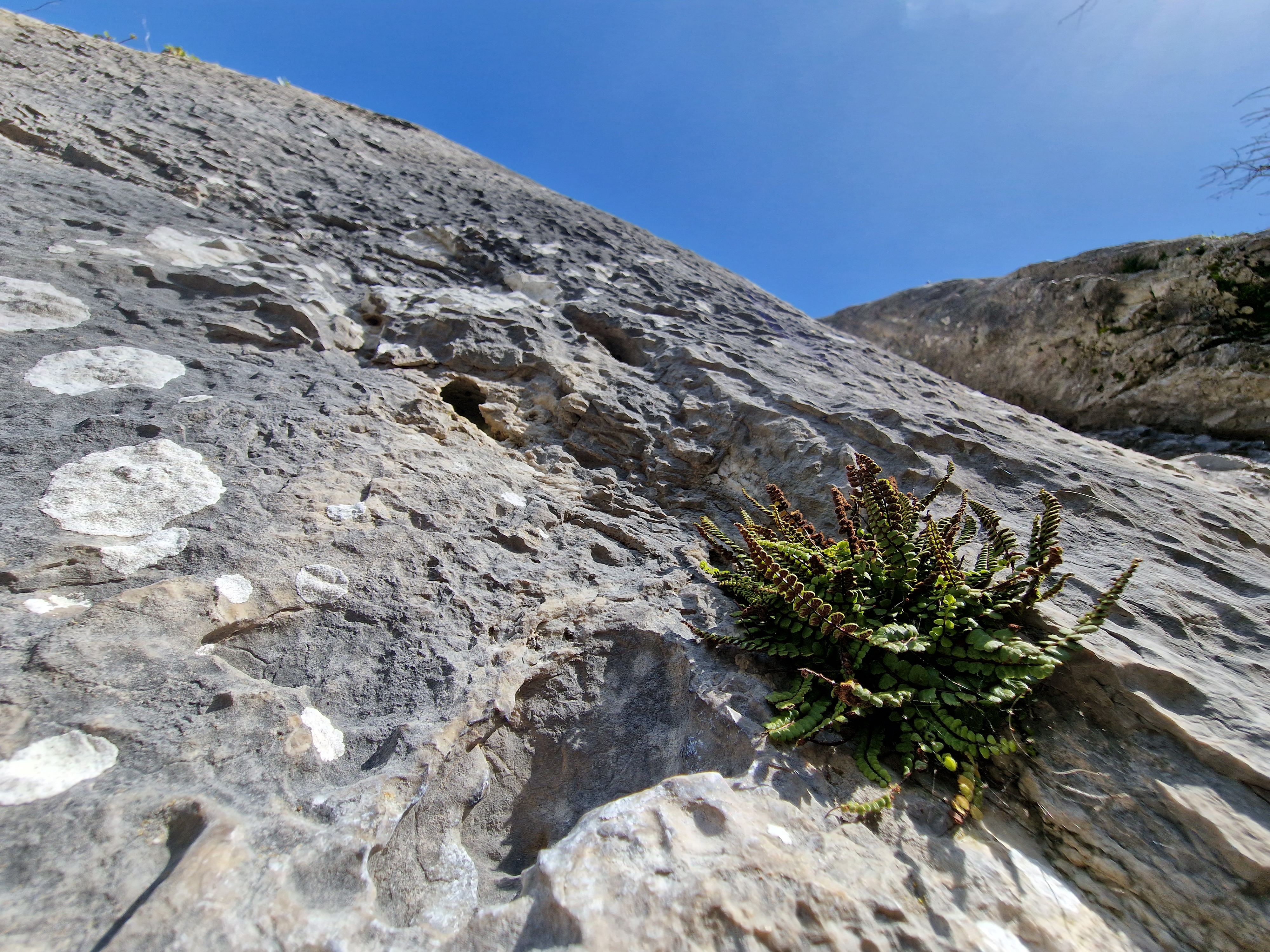
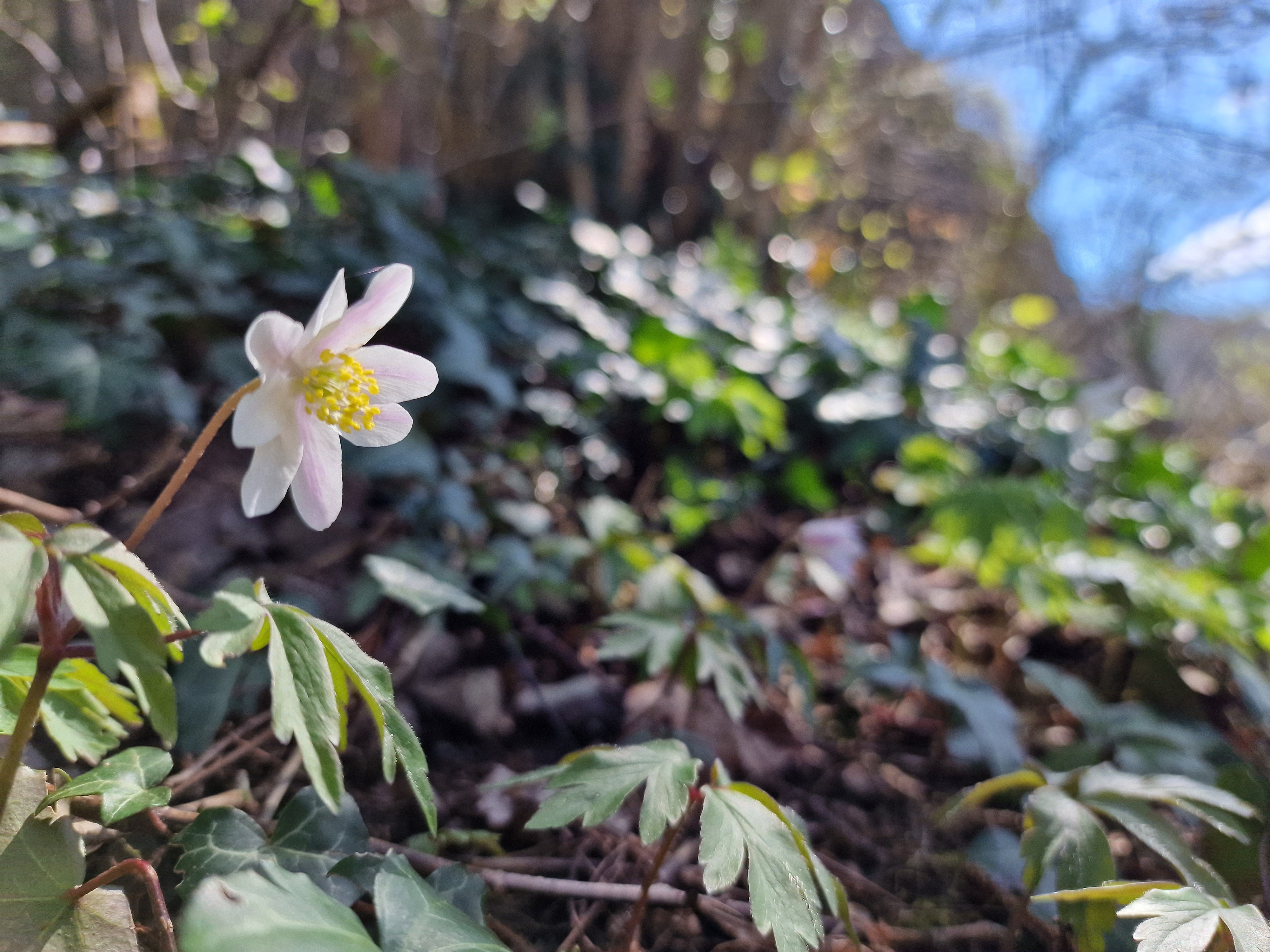
Cliff surveys would go fast in some places if you count the number of plants on them – where it not for the issues related with getting up there!Asplenium sp. – lover of cliffsIn some spots, the cliffs drop directly into the MeuseThe surrounding Natura 2000-forests were starting to be covered in beautiful spring flowers – here Anemone nemorosa
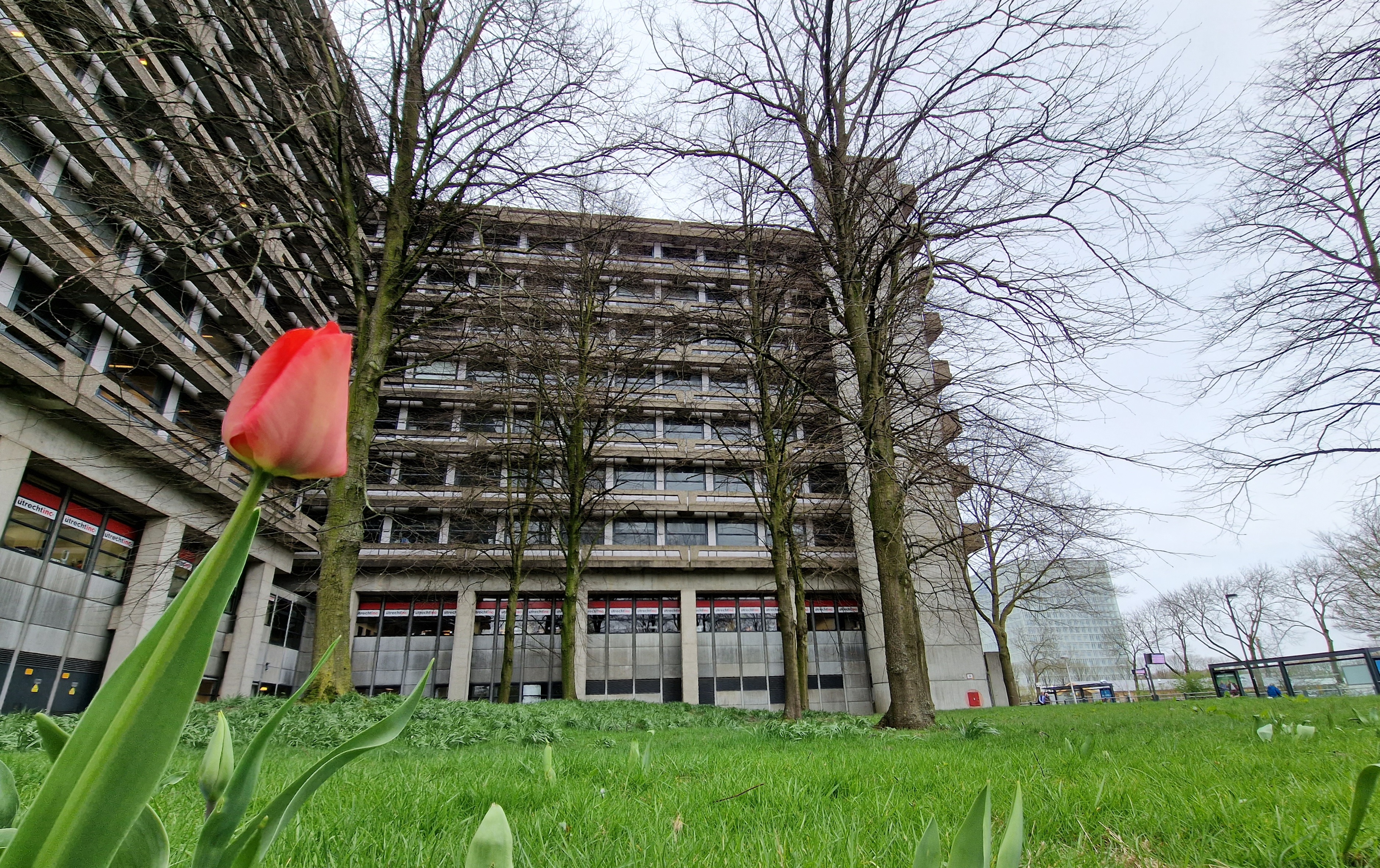
Last week, I spent a delightful day at my soon-to-be new home university in Utrecht. A day packed with discussions on scientific ambitions, teaching plans, and meeting new colleagues and ongoing research in the group. The first tulip of the year made it all feel like an official new beginning.
The real start will have to wait till May 1st, but you bet that I’m already making plenty of exciting new plans in advance!
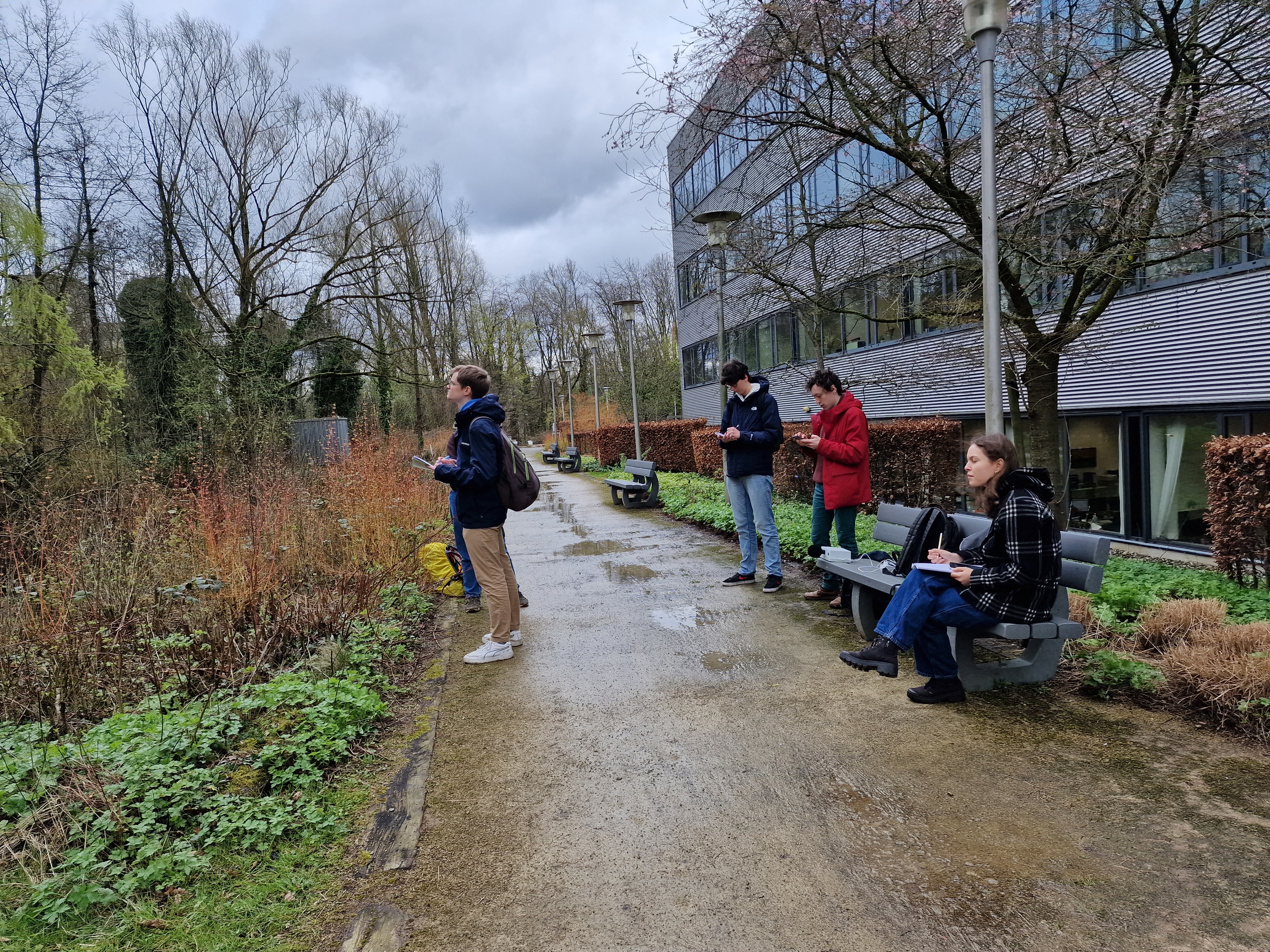
Last week, you could find an enthusiastic subset of our team hanging around suspiciously on the campus of the University Hospital in Antwerp, booklets in hand and an ominous device close by.
Ten minutes of just listening and nothing else – science can be highly therapeutic as well
This was the kick-off of a new measurement campaign in the framework of ‘De Oorzaak’, our ongoing large-scale citizen science project on urban soundscapes. Our trip to the hospital allowed us to catch multiple birds with one stone.
First of all, we’re out in the real world capturing sounds. We need a whole lot of different sounds, from all kind of sources, to feed in the AI-models that will automatically detect sound sources in our upcoming large-scale measuring campaign. We listen, the sensor records, and we write down exactly what we hear, greatly facilitating manual labelling of the soundbites afterwards.
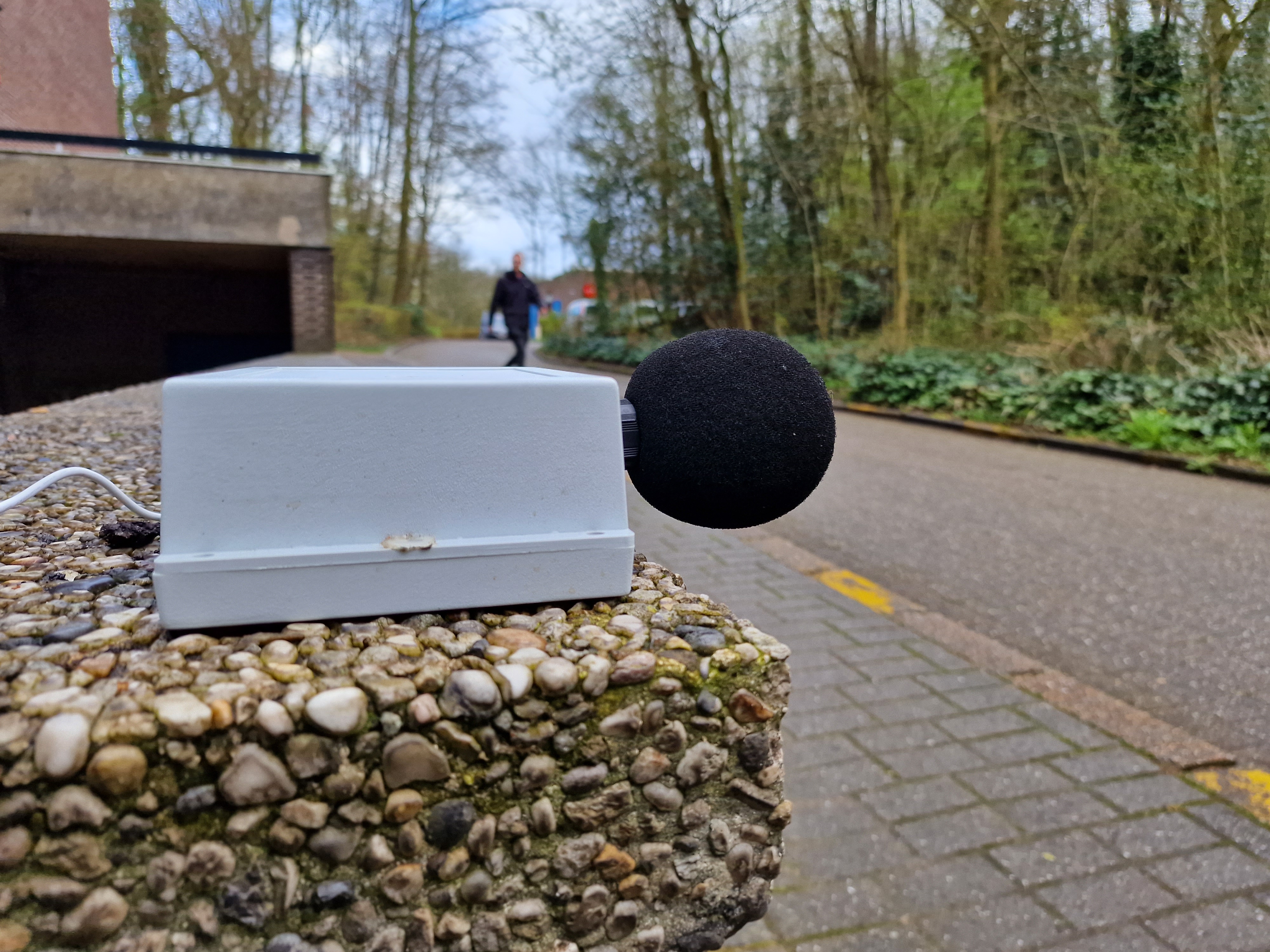
This box-with-a-microphone is doing most of the legwork for the project. It has sufficient battery to survive a day without an energy source, allowing us to take it onto a walk into the city.
Second, we are interest in the soundscape on the campus of the university hospital itself. We want to know what sounds patients residing on campus experience, and how that affects their health. And, as we are ecologists at hard, we want to figure out what role a greener hospital campus can play in that regard.
Third, we made use of this trip to start recording bird sounds. We hope to use our extensive sensor network to make a unique spatiotemporal assessment of the distribution of bird sounds in the city. For that, we of course again need to listen to a lot of birds ourselves. Luckily, those were starting to wake up for spring: great tits, blue tits, robins, wrens, ducks, moorhens, even a long-tailed tit: our bird sound dataset is starting to grow!
Finally, we can provide a subjective assessment of that soundscape: how nice was it, how lively, how chaotic? Following standardized terminology, we can create a dataset that links objective sound measurements to our experience of that sound.
Glad this is on a role again, and much more to come!
Major milestone: first of May, The 3D Lab is making a big move to Utrecht University in the Netherlands, and it is doing so following my recent appointment as an assistant professor in the Ecology & Biodiversity-group there. Major milestone, indeed, as this means I have left the realm of temporary postdoc positions, and entered the world of long-term academic security (pending tenure, of course).
I’m very honored to be stepping into the role of ‘assistant professor in ecological scaling,’ a unique title that perfectly aligns with my current and future aspirations. Ecological scaling involves delving into ecological mechanisms at a fine resolution and assessing their validity, robustness, and broader applicability on regional or even global scales. This scaling up of ecology has been at the forefront of my work since my first involvement with the Mountain Invasion Research Network (MIREN), back in the days of my master’s thesis in 2012. Through MIREN, our aim is to delve into the factors driving species redistributions in mountainous regions and understand how these dynamics scale up from specific regional settings to the entire spectrum of mountains worldwide.
This switch to the Netherlands marks the end of twelve years of research at the University of Antwerp. Yet, I won’t be cutting all ties, and will keep a strong connection with students and team members staying behind, and will ensure the smooth running of the citizen science trains currently on track.
Scaling up ecology is also a key component of my work with another project dear to my heart: the SoilTemp network. This initiative aims to extend the understanding of microclimate—a phenomenon inherently local in nature—to broader regional and global contexts. These two networks – SoilTemp and MIREN – will therefore remain core pillars of my future work. With the added security of a long-term position, I am eager to finally stop nibbling and start taking full bites out of my long-term vision to explore the intricate mechanisms governing both microclimate dynamics and species redistributions from local to global scale.
However, I am also eager to push the boundaries further, particularly in unraveling the intricate mechanisms driving biodiversity dynamics. To achieve this, I look forward to collaborating with the exceptional expertise in experimental research within the Ecology & Biodiversity group at Utrecht University. Together, we will tackle the issue of ecological scaling both top-down and bottom-up. A lot of room left for future developments in the area of scaling up experimental findings, for sure. To be continued, so stay tuned for the coming few decades…
‘Ecological scaling’ to me is the perfect blend of theory and practice. It involves a lot of fundamental ecology, yet with the ultimate goal to save the world. I will also make it a crucial point to build that link from theory to practice and work further on the scaling of ecosystem services and ecological management, the way we have for example been working in our citizen science project ‘CurieuzeNeuzen in de Tuin’.
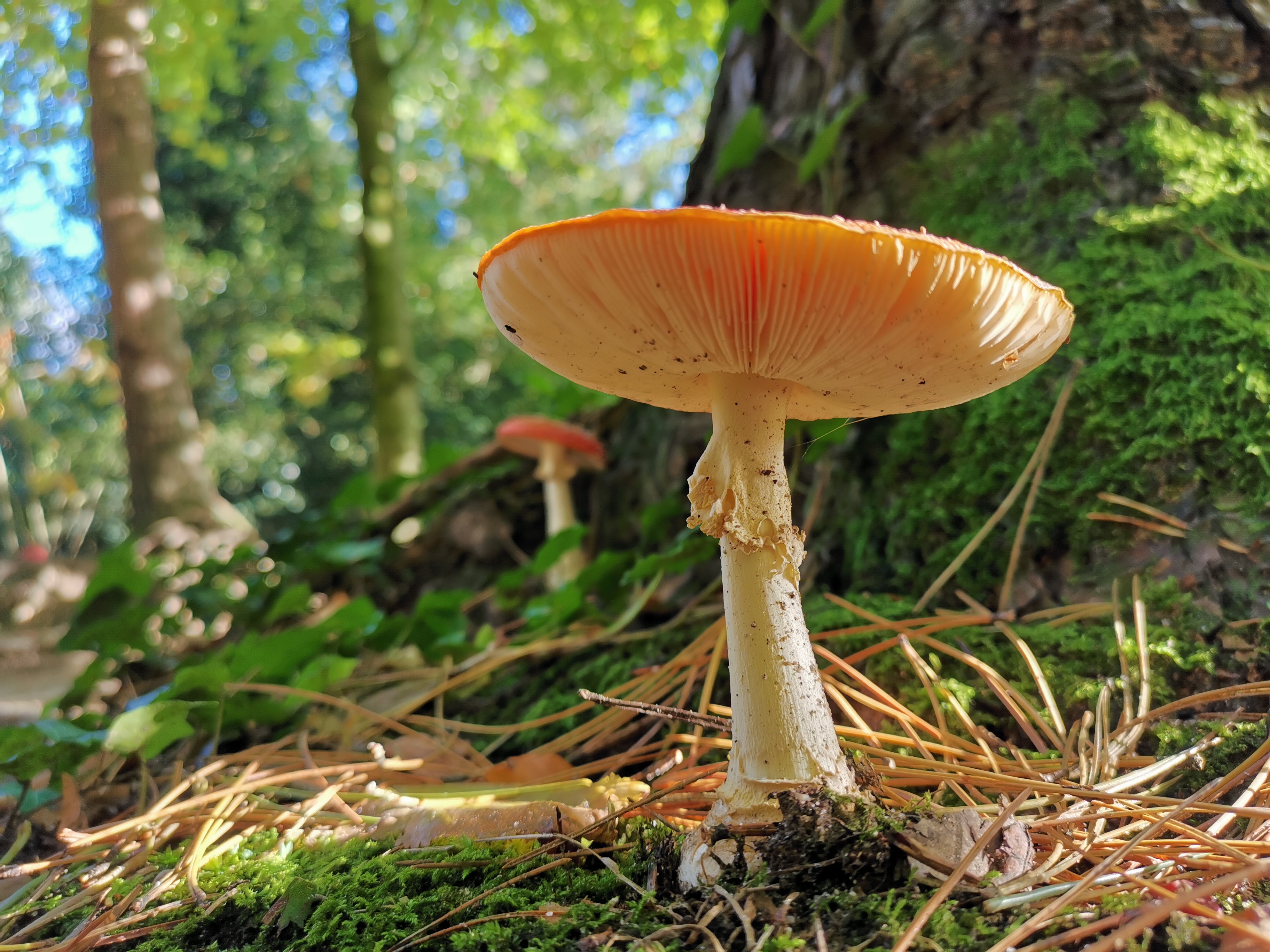
A fly agaric in a Dutch forest, the fruit of an ectomycorrhizal fungus living in close interaction with the trees surrounding it. I also aim to work further towards understanding these kinds of interactions across scales, to conserve beautiful natural sceneries like this one.
Above all, however, I see this new position as a once-in-a-lifetime opportunity to further expand my role as a mentor. The 3D Lab will continue to evolve into a nurturing environment where aspiring young scientists can learn and thrive as part of a team. While the physical transition to the Netherlands won’t include my team members, our strength in virtual collaboration remains a hallmark of the group. Moreover, I’m committed to leveraging all available resources to enhance opportunities for those working alongside me—a goal that was previously constrained by the uncertainty of my own position.
That mentoring will also expand further as I join the teaching staff for the over 400 biology students in Utrecht. I will take my time – and am extremely grateful for the opportunity – to think critically about what and how we should be teaching the next generation, and if any updates are to be made.
A flower-rich (but species-poor) meadow close to Maastricht, last summer. Ready to turn my gaze to the issues and opportunities of Dutch nature as well
So: are you interested in doing science in the Netherlands, or are eager to forge collaborations on the expansive topics of microclimate, species redistributions, and scaling up ecology, now’s the time to reach out! The opportunities are endless, and I’m excited to explore them together. Let’s embark on this journey of discovery!
Yes, you read that correctly—300% faster! That’s the remarkable leap in speed I’ve experienced in tackling my most common R programming challenges ever since I enlisted the help of a certain robotic companion to think alongside me.
That companion, as you might have guessed, is none other than ChatGPT. It’s become a trusted ally in various aspects of my research. While its prowess in aiding writing tasks has been widely discussed, I stumbled upon its true strength in assisting with my all-to-common R-isuses.
Let me start with a disclaimer: I consider myself fairly decent in R, but I’m perhaps a bit old-fashioned when it comes to embracing new ideas. My focus tends to be on results, sometimes neglecting code cleanliness or efficiency. These days, I find myself using R much less frequently than during my PhD, mainly for data manipulation, while also doing a lot of debugging of student code.
So, what magic does that friendly robot perform for me?
First off, ChatGPT is surprisingly adept at coding. Describe an issue, and it often churns out a correct, clear, and concise solution. For example, filtering a dataset based on specific criteria and then calculating averages across factor levels—a task more proficient R users might do from memory, but one I often find myself looking up the functions for.
Sure, I could turn to traditional help files and forums, but with ChatGPT, everything I need is in one place. I can formulate queries easily and get immediate responses, bypassing the need to scour forums or craft elaborate forum posts myself.
It gets even better when faced with a series of tasks. ChatGPT remembers previous actions within the same conversation, offering suggestions that build upon each other, simplifying code integration throughout a workflow.
When you get a suggestion back from ChatGPT that does not do exactly what you want it to do, you can simply describe where or what is not according to expectations, and ChatGPT immediately provides an alternative. I can even paste error codes directly from R, providing the robot with the context it needs to troubleshoot effectively. This way you can truly get into conversation with the robot, slowly but steadily molding and improving the code into your wishes.
If you provide the dataset and column names in your queries – or even snippets of your own code – the R-code generated by ChatGPT uses these names immediately when generating code, making it much easier to see what goes where.
Many of the tasks I encounter in R are ones I’ve tackled before. But digging through files to find previous solutions takes time, whereas ChatGPT provides guidance swiftly and efficiently.
I’ve noticed my students increasingly relying on ChatGPT as well, empowering them to resolve issues independently, reducing dependency on my assistance and time.
Fabulous, no? To me, this works pretty fluently, and allowed me to effectively speed up some daunting R-tasks, especially regarding data wrangling.
I also see very few drawbacks:
One concern is plagiarism, though in coding, this seems less of an issue compared to academic writing. Personally, I’ve borrowed code snippets without explicit credit before, though I do ensure proper attribution for packages used, so that has not changed much by switching to the robot.
There is a minor drawback that ChatGPT would not include the most recent developments in R. However, for most general tasks, for example regarding data wrangling, it does have access to everything we need.
There’s also the minor drawback of potentially limiting oneself to popular R packages, as ChatGPT may not be well-versed in lesser-known ones. But given my pragmatic approach to coding, as long as I achieve the desired outcomes, this limitation isn’t a major concern to me.
In conclusion, integrating ChatGPT into my coding workflow has streamlined my R programming endeavors, particularly in data wrangling. There might of course be a lot more to say about this, but I thought it might be beneficial to many to at least get the conversation going.
Now, I’m curious—have you used ChatGPT for your coding issues, and if so, what has been your experience? Are there drawbacks that I have – perhaps in my naivety – overlooked?
Lake Törnetrask, Abisko Research Station, Abisko, Sweden
Narvik, Norway
Norway
Little red-and-white lighthouse
Lake Torneträsk, Abisko, Sweden
Sweden
Diapensia lapponica in one of our plots
Lake Torneträsk, Abisko, Sweden
Laktatjakka valley
Lake Törnetrask, Abisko Research Station, Abisko, Sweden
Laktatjakka valley
Saxifraga aizoides, Narvik, Norway
Common heather
Seen from Nuolja, Abisko
Narvik, Norway
Narvik, Norway
Lake Torneträsk
Lake Torneträsk, Abisko, Sweden
Oenanthe oenanthe, alpine tundra Abisko, Sweden
Angelica archangelica
Hallerbos 2017
Young bluebell (Hyacinthoides non-scripta) surrounded by flowers of yellow archangel (Lamium galeobdolon)
The common bluebell (Hyacinthoides non-scripta), the signature flower of the Hallerbos
Single bluebell flower surviving on a wetter spot, as indicated by the field of wild garlic (Allium ursinum)
A really wet patch of forest, with giant horsetail (Equisetum telmateia) in a field of wild garlic (Allium ursinum)
Wild garlic (Allium ursinum) in the Hallerbos flowers a bit later than the bluebells, yet this one was already in full bloom
A bumblebee visiting yellow archangel (Lamium galeobdolon)
A bumblebee visiting yellow archangel (Lamium galeobdolon)
Wild garlic (Allium ursinum)
Wild garlic (Allium ursinum)
Weirdly beautiful, the inflorescence of pendulous sedge (Carex pendula), typical for the wettest spots in the forest
Weirdly beautiful, the inflorescence of pendulous sedge (Carex pendula), typical for the wettest spots in the forest
A little stream in the Hallerbos, surrounded by endless fields of wild garlic (Allium ursinum)
The herb-paris (Paris quadrifolia), less common in the forest
Wild garlic (Allium ursinum)
Bluebells (Hyacinthoides non-scripta)
Weirdly beautiful, the inflorescence of pendulous sedge (Carex pendula), typical for the wettest spots in the forest
Another one from the wet plots: large bitter-cress (Cardamine amara)
Another one from the wet plots: large bitter-cress (Cardamine amara)
Young beech leaves, as soon as they are fully grown, spring in the understory is over
A beech forest without understory, most likely too dry and too acid for any survivors
A young beech seedling (Fagus sylvatica), looking nothing like a beech, yet everything like a tiny dancer
Young beech seedling (Fagus sylvatica)
Bluebells (Hyacinthoides non-scripta)
Bluebells (Hyacinthoides non-scripta)
Bluebells (Hyacinthoides non-scripta)
Mountain melick (Melica nutans), a grass in the most amazing green
Bluebells (Hyacinthoides non-scripta) in a rare patch of mountain melick (Melica nutans), a grass in the most amazing green
Bluebells (Hyacinthoides non-scripta)
Bluebells (Hyacinthoides non-scripta)
Montpellier 2017
The entrance to the cathedral of Montpellier
The cathedral of Montpellier
The entrance to the cathedral of Montpellier
The cathedral of Montpellier
Narcissus poetics
The cathedral of Montpellier
The botanical garden of Montpellier
The botanical garden of Montpellier
The botanical garden of Montpellier
Brackish Camargue vegetation
Brackish Camargue vegetation
Brackish Camargue vegetation
A typical lagune
Brackish Camargue vegetation
Camargue horses
Camargue horses
Camargue horses
Brackish Camargue vegetation
Brackish Camargue vegetation
Brackish Camargue vegetation
Camargue horses
Brackish Camargue vegetation
Little egret in the evening sun
Flamingo’s in the evening sun
A typical lagune
Dandelion fuzz
Grass lily
Grass lily
Dandelion fuzz
Veronica in a sea of poplar fluff
Euphorbia in a sea of poplar fluff
Poplar
Gare du Midi, Brussels
Gare du Midi, Brussels
Gare du Midi, Brussels
Gare du Midi, Brussels
Sweden autumn 2016
Autumn in Abisko
Yellow leaves of mountain birch, with lake Torneträsk in the background.
Lapporten, the gate to Lapland, in Abisko
Rain blowing over the Abisko National Park
The colours of the north: red fireweed and yellow mountain birches, with lake Torneträsk on the background
Yellow leaves of mountain birch, with lake Torneträsk in the background.
Rain on the background, the ski lift in Abisko on the foreground
The steep slope of mount Nuolja on a dramatic looking morning
The beautiful colors of lake Torneträsk in Abisko
A little stream on top of the mountain, with a view on Lapporten, the gate to Lapland
Well, that is a beautiful table with a nice view on lake Torneträsk in Abisko
Our little experiment on top of the mountain in Abisko, with a view on Lapporten
Autumn in Abisko is extremely colorfull
The ski lift with a view on Abisko National Park and Lapporten
Hiking dowhill towards lake Torneträsk
This green is greener than the greenest green: moss on top of mount Nuolja
Well, that is a beautiful table with a nice view on lake Torneträsk in Abisko
The ski lift with a view on Abisko National Park and Lapporten
The ski lift with a view on Abisko National Park and Lapporten
The most beautiful hiking trail of the world: Nuolja in Abisko
Angelica archangelica, often the biggest plant of the Arctic
The most beautiful hiking trail of the world: Nuolja in Abisko
Cirsium helenioides, the melancholy thistle
Hiking down mount Nuolja
The steep slope of mount Nuolja on a dramatic looking morning
The colours of the north: red fireweed and yellow mountain birches, with lake Torneträsk on the background
The prettiest yellow and blue: autumn in Abisko
Fireweed, Epilobium angustifolium
Campanula or bellflower, I think ‘uniflora’
Vaccinium myrtillus
Cornus suecica, the prettiest red of the world
Hieracium alpinum, alpine hawkweed
Carex atrata, one of my favourite sedges
Alpine clubmoss, Diphasiastrum alpinum
Agrostis capillaris, bentgrass
Common yarrow (Achillea millefolium)
Anthoxanthum odoratum, sweet vernal grass, fully grown and mature
Snow scooter trail
Our plot in the mids of a field of horsetails (Equisetum pratense)
Equisetum pratense
Cliff overlooking the valley with the road to Norway
Seedling of Taraxacum officinale, the dandelion, after two years of growing in bad conditions
Poa alpina, the alpine meadow-grass, with its viviparous seeds
Massive flowerhead of Angelica archangelica
Angelica archangelica
Blueberry (Vaccinium myrtillus) in autumn
A lowland marsh in Abisko in autumn
Installing the plots of our trail observations on top of mount Nuolja
Installing the plots of our trail observations on top of mount Nuolja
Tanacetum vulgare (Tansy), non-native for the high north
Autumn forest down in the valley
The valley of Nuolja to Björkliden
Summer on the Nuolja-side
A full rainbow behind mount Nuolja in Abisko
It’s raining in the west, clouds trapped behind the mountains
A strong wind blowing rain from behind the mountains to our side
A strong wind blowing rain from behind the mountains to our side
Betula nana, the dwarf birch, mini autumn forest
Betula nana, the dwarf birch, mini autumn forest
The valley of Björkliden in autumn
The valley of Björkliden in autumn
The valley of Björkliden in autumn
The valley of Björkliden in autumn
Sweden spring 2016
Silene acaulis
Dryas octopetala
Eriophorum vaginatum
Silene suecica
Rubus arcticus
Salix reticulata
Western European species like the red clover (Trifolium pratense) here are often listed as non-native species in mountain regions.
Although the alpine zone has been harder for invasives to access than most places, human structures like trails are often an easy gateway for the invaders to get up there. Picture from Abisko, Swedish Lapland.
The valley of the lakes
Trifolium repens
Oxyria digyna
Ranunculus glacialis
Melting snowpatch on a lake
Overlooking the valley of Laktajakka
Cornus suecica
Trifolium pratense
A rainy hike
Ranunculus glacialis
Bartsia alpina
Amiens
Cold!
Amiens is filled with cute little houses
Cathedral at night
Sunny but cold, the Quai Bélu
Cathedral at night
Almost cold enough for ice-skating
Just outside of Amiens
Cathedral with a glimpse of spring
Frozen to the bone
Cathedral at night
The museum behind the beautiful gates
Maria without a shirt
Gargoyle planning to eat the cathedral
Cathedral at night
Enjoying silence and the morning sun
Cathedral seen from the frozen Parc Saint-Pierre
Colourful mirror
The southern side
Winter sun on the Place du Don
Frozen mirror
View from my office window
Sun rising above the water
Nice architectural curve
House on the square before the cathedral
Le Club d’Aviron in winter weather
View from my office window
Sunny but cold, the Quai Bélu
Sweden autumn 2015
Lichen
Sweden summer 2015
View on the 1000 meter plots
Doing research on a cold Arctic morning
Plots flooded by the snowmelt
Flooded by the snowmelt
Meltwater river, racing down the mountain
After a hike, even the most basic house looks cosy. Little hut in the mountains, open for everybody
Snowbridge, maybe don’t cross…
Snowbridge
View from a cliff
Silene acaulis or cushion pink, cutest plant of the Arctic
Two seasons in one image
Steep slope
Hiking down
Narvik Kirche, church of the subarctic
Narvik Kirche
Reindeer on top of the mountain
Narvik Kirche
Summer at the church
Summer flowers
Massive waterfall
Young willow catkins
View from Narvik’s hospital, with lilac flowers
Building a bridge over the fjord will gain al drivers at least an hour
Norwegian fjord
Posing with the water, getting soaked
Minimalistic mountains
Insect investigating our reindeer antler
Catching mosquitoes with our license plate, harvest of the year!
Posing with the plot
Fieldwork on the most beautiful spot of the world
Fieldwork on the most beautiful spot of the world
Summer bridge – still next to the sadly impassable river
Rhinanthus flower in the mountains
Plateau in the valley, beautiful brown
Experimental view from my favourite plot
Salix catkins
Extremely old Betula tree
Waterfall from a cliff
Buttercup is the earliest in spring, here
Rocks!
Alpine views
Views!
Fieldwork
Jumping over rivers
Plot
Golden plover
Angry lemming
Green, the whole north is green!
Snow, so much snow left!
Minimalistic mountain moments
Fieldwork
The research center
Red clover – focal invader
Look at this tiny cute snail!
Massive floods of melting water
Bartsia alpina
Hooray, a toilet!
Dryas octopetala
Lowest elevation plots
Butterball!
That’s a lot of water
Midnight sun is the best
At the lakeside
Beautiful Bistorta vivipara
Don’t fall in the water
Midnight sun
Wild river
Art – made by ages of wild rivers
Baby firework for America’s independence day
Midnight sun at the lake
The Abisko canyon was wilder than ever
That’s a crazy amount of water!
The Abisko canyon was wilder than ever
The Abisko canyon was wilder than ever
Black and white
Stone-man overlooking Abisko
Nothing as soft as a willow catkin
Label and soil temperature sensor attached
I’d drive to the top every day
Reflections
Rocks and clouds
Brave little birch
Brewing our camping poison
Basic camping stuff
Camping in Norway
Home-made temperature houses
Roadside research at its best
Norway is crazy
Horsetail is so funny
Little creek in magical forest
Birches, birches everywhere
Beautiful rock, a gift from the river
Another roadside fellow
Lichen
Ready to rock the summer
Collecting mosses
That’s a crazy old lichen
Tiny tiny piny trees, but old, so old!
Ready to jump into the fjord?
Ready to jump into the fjord?
That’s a spiky stone!
Views on Norwegian fjords
Silene in the mountains
Cute little orchid
Skua
Attacking skua, mind your heads!
Watch out for the attack of the fierce skua!
Black snail
New plot!
Still a lot of snow to melt, but this spot was free for a new plot
Reindeer are better than people
Two seasons in one picture
Let’s see what is happening to the balance in mountains! Is this a starting avalanche, or will it last a bit longer?
Cute little hut
Climbing mountains by car
Softest moss in history
Drosera in the marsh
Hiking in no-man’s land
The clouds are coming
Abisko valley
‘Butterball’
Fieldwork in the tundra
Abisko valley
Little plot
Clouds and sun and mountains
Making soup on a campfire with a view
Little creek on high elevations
Skua on the look-out
Melting snow in a river
Rhodiola rosea and the Törnetrask lake
Beginning of spring
Flooded plots, melting snow, impassible wetness
Ferns and horsetails
Chile 2015
Lunch made by our local colleague, with funny bread (tasty as well!)
Trips to the field sites were sometimes a real adventure, especially right after snowmelt






 The 3D lab