Aliens and their way to the top

5 years later, we are getting ready for a re-survey of our longterm observational plots along the roads in the Norwegian mountains. The perfect moment to summarize what we learned from our first trip. This post was published first in a series on this summer’s field trip on the INTERACT blog.

Remember my story about how lowland roadsides are flooded with species that do not  belong in the natural system? Remember how these new species could profit from the lower competition when the natural vegetation got destroyed by the process of road building? A lot of these species are well known to Northern Scandinavia, but some of them are not. And this last group deserves our special attention.

A group of true culture-followers. The real roadside species. The ultimate weeds. They followed human development up to the north at one point in time, some decennia or centuries ago. We call them aliens: visitors (and sometimes invaders) from another ‘world’. (But do not let them fool you, because they are just species like our regular white clover!)

Trifolium repens

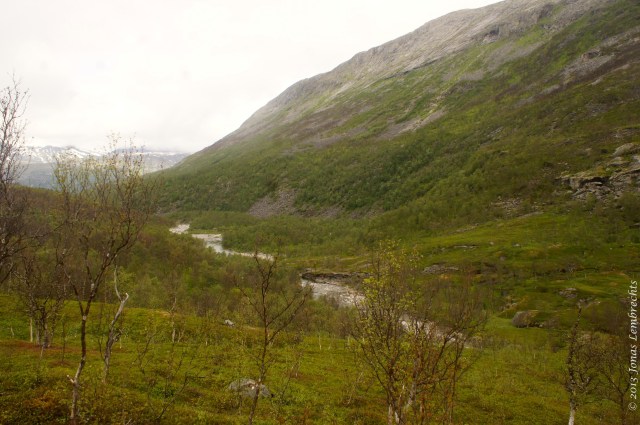
What is really curious is how almost all these aliens share the same story. Their invasion always starts in the lowlands, where they got introduced, after which they closely follow roads and human structures up into the mountains. Not too many of them really reach the top, however. We see a progressive drop-out of species on the way, victims to the cold alpine climate (but keep in mind this is a dynamic process, they could still be on their way!). This progressive loss of alien species with elevation got the fancy term ‘directional ecological filtering’ and it also seems to be happening in our subarctic ecosystem. The mountain acts as a filter, only allowing a select group of aliens to the highest elevations, while the weaker ones are filtered out (check the clear decrease in roadside alien richness with elevation as visualized by the black line on the graph).
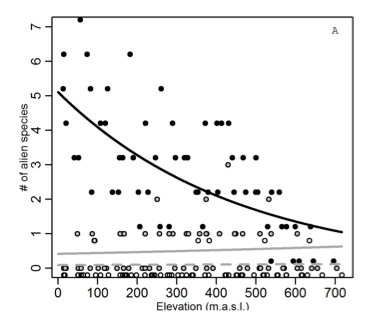
Alien species richness with increasing elevation in the roadsides (black) and the natural vegetation (grey).


The question is which skills are needed to sneak through this filter to reach the highest elevations in the mountains. It turns out that all winners of the race to the top follow a similar strategy: they are all generalists, which means they can thrive in a wide range of environments. That makes them different from the vast majority of plants that got adapted for one particular situation. It also makes them incredibly suited for mountain invasion. Mountain invaders have to overcome both lowland and alpine conditions. Strong competitors loom in the lowlands, where conditions are good and fast and efficient growing are the keys. In the highlands, the harsh climate demands stress-tolerant traits to survive the cold: growing slow, staying close to the ground and using resources to fight the harsh conditions.
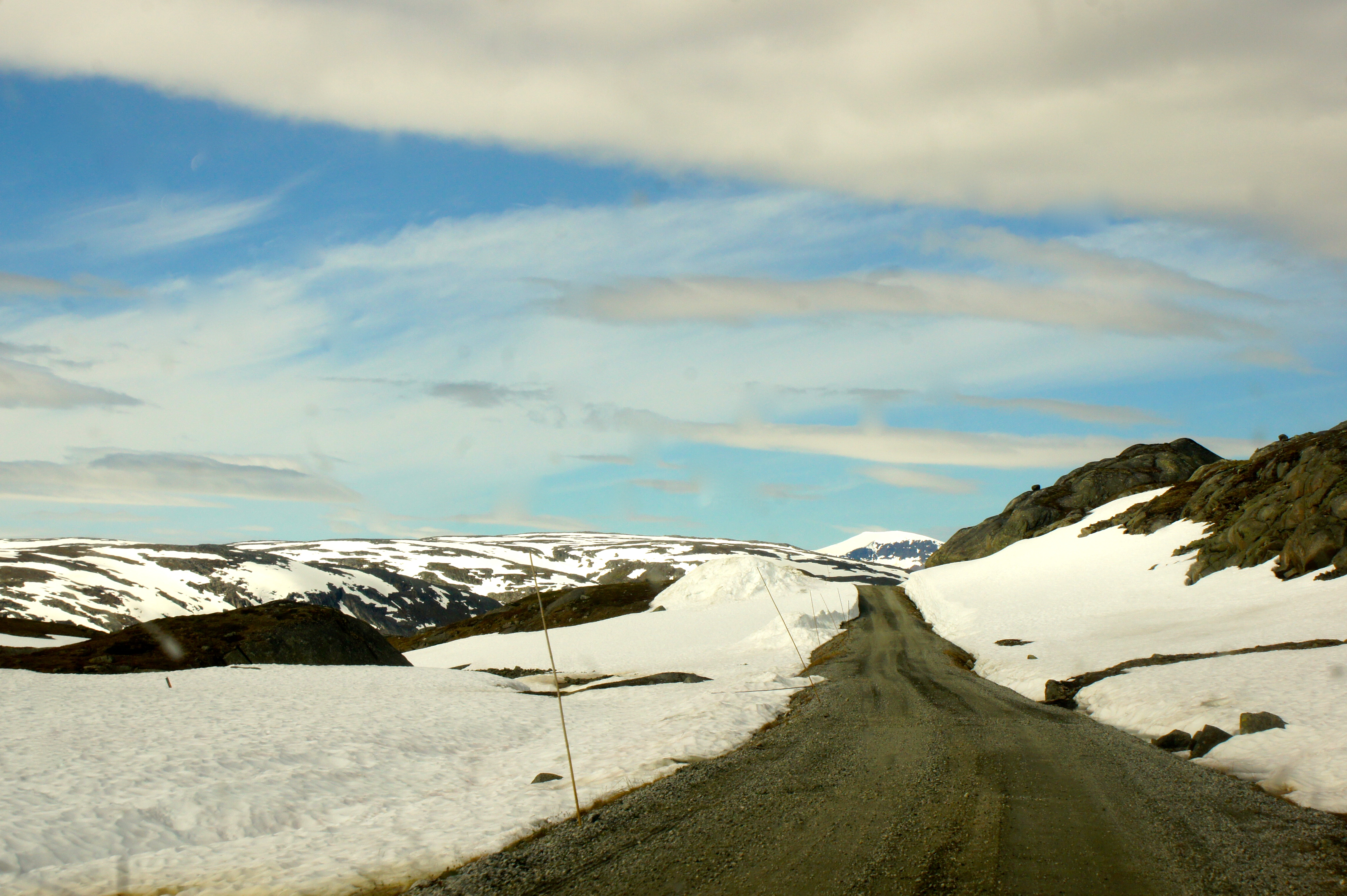
Summer snow

That is the reason why pure competitive alien species are stuck in the lowlands, while the generalists can follow the road all the way up to the alpine zone. While both know how to handle the intense competition in the lowlands, only the generalists can change their strategy to deal with the totally different alpine conditions from the highlands. And as soon as these generalists reach the top, they might become problematic and start escaping the roadsides, yet that’s a story for another post to tell.
Posted in Norway | Tagged , , , , , , , , , , | Leave a comment

So dry

19965654066_b7a1bf9f_89yzX

It is dry in Western Europe. Extremely dry. Dry enough for me to to write a blogpost about it for www.eoswetenschap.eu, our local popular science journal. They asked me if the current drought could serve as proof that the climate warming.

34486061094_9d654441_udT7O

Unfortunately, the blog is in Dutch, yet I’ll hint the answer for you: it’s not. We should always be wary about the difference between one weather event – no matter how extreme – and the global climate.

34599012684_78674729_gVGcf

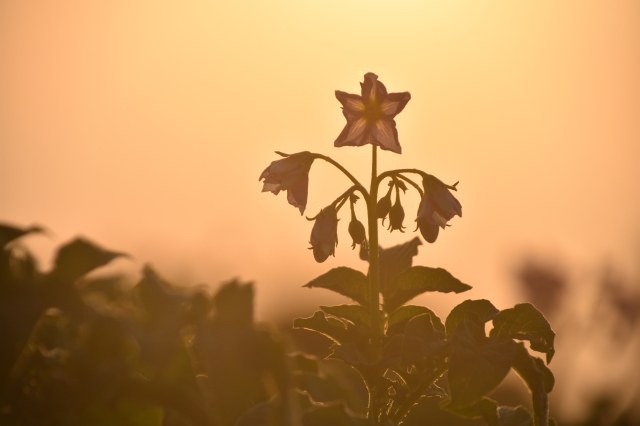
Potato flowering in a hot evening sun. Especially agriculture is suffering from the drought.

Yet the drought does fit in neatly in the observed ànd predicted increase in extreme weather events that come with climate change: more droughts, more heat waves, more and heavier storms… We are up for some years in which one weather record after the other will be broken, as climate gets more and more unpredictable.

And I think it is crucial that we are all aware of that fact.

Posted in Belgium | Tagged , , , , , , , | Leave a comment

Hidden treasures on the campus

Rare plant walk - 12

The common spotted orchid (Dactylorhiza fuchsii) 

When you think about a quest for rare plant species, you might imagine high-spirited adventurers travelling to the ends of the earths on a hunt for tropical flowers hidden in the depths of the jungle. Who might have imagined that rare plants are often hiding right underneath your nose, waiting to be discovered?

Rare plant walk - 17

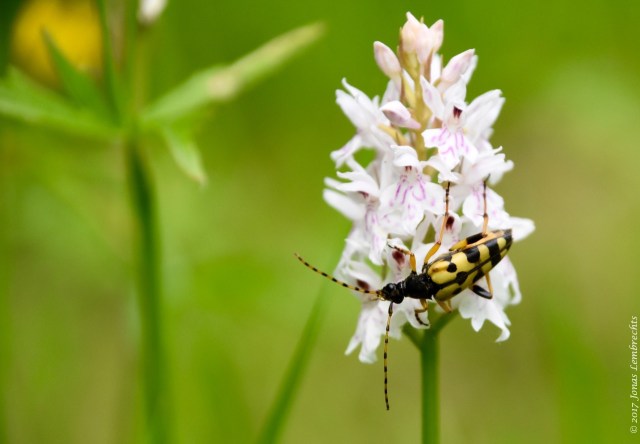
A spotted longhorn (Rutpela maculata) on common spotted orchid

Last week, the Global Change Ecology center from the University of Antwerp organised an excursion for such easily overlooked botanical treasures. Destination of the expedition as down-to-earth as can be: the university campus itself.

Rare plant walk - 6

Discovering the orchid meadow at the campus

Guided by a fascinatingly well-informed local botanist, we took off on a lunch walk towards the hidden botanical hotspots on our campus. And these hotspots were all more unexpected than the others: an overgrown pond, a forgotten corner next to a building, or even right in the middle of the parking lot.

Rare plant walk - 31

Discovering botanical treasures in the middle of the parking lot

Yet these extraordinary ordinary destinations made the harvest of this short scientific mission even more impressive: beautiful orchids, rare ferns and horsetails, and even an obscure tiny patch between two stones that listened to the name ‘hairy rupturewort’.  For several of these species, only a few populations can be found throughout Flanders.

Rare plant walk - 32

Hairy rupturewort (Herniaria hirsuta), easily overlooked, yet one of the botanical stars of the university campus

This surprising lunchtime walk serves as an example that even a green patch this close to home can host significant natural value. Just a few steps out of the office, and a whole botanical paradise enfolds. Yet at the same time it should be a reminder that we should not give up on this local nature too easily, no matter how disturbed and disrupted it might look. An ecologically inspired management plan for the green areas on the campus – or anywhere in the city for that matter – can play a crucial role here.

Rare plant walk - 30

Black spleenwort (Asplenium adiantum-nigrum) in an ignored ditch on the parking lot.

So please, do not just think of your local patches of nature as economical opportunities, and give them the ecological care they deserve. Our botanical treasures thank you.

Rare plant walk - 27

Rough horsetail (Equisetum hyemale) sprouting in a concrete trail

Posted in Belgium | Tagged , , , , , , , , , | Leave a comment

Interacting

img_20170606_223834_626_34333699383_o

A skipper and a damslefly interacting on a knapweed flower

Ecology is all about interacting. Interactions with the environment, interactions with the organisms living in this environment. A unimaginable multi-dimensional hyperspace-like spiderweb of interactions. A life-long source of scientific amazement. I love it.

Posted in Belgium, General | Tagged , , , , , , , , , , , | 3 Comments

Road effects

5 years later, we are getting ready for a re-survey of our longterm observational plots along the roads in the Norwegian mountains. The perfect moment to summarize for a second what we learned from our first trip. This post was published first in a series on this summer’s field trip on the INTERACT blog.

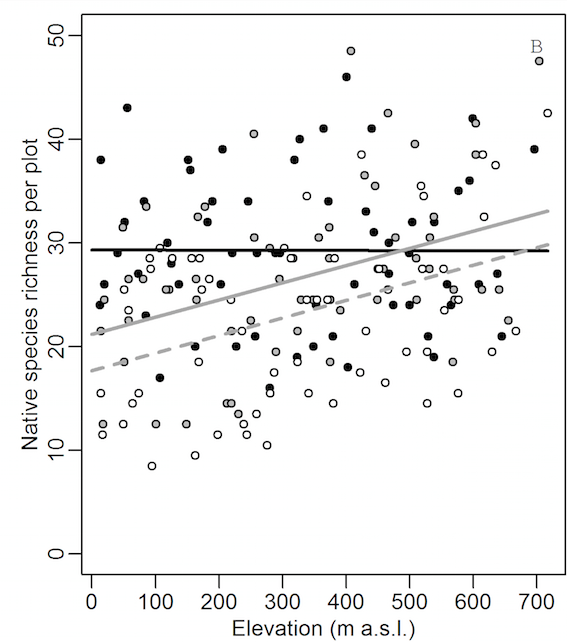
Roadsides host more plant species than the natural vegetation. That is the conclusion I drew in my previous post. While this difference is clear on low elevations, it vanishes as we get higher in the mountains, ending in similar species richness in the alpine zone above the tree line. Surprisingly, as can be seen on the graph, this pattern is the result of a higher diversity of alpine species (dashed grey line, white dots, versus the black line and dots representing the roadside) in the natural vegetation.

Graph native species richness

The alpine zone is a rocky, barren place without trees. That sounds as a bad thing for plants, but it also results in a higher availability of open places. The dominance of mosses and dwarf shrubs (like the crowberries mentioned in the previous post), is less intense here. More open spots, less competition, more diverse habitats, all kinds of factors that could explain the higher plant diversity as revealed by the graph. All of this explains the higher species richness on high elevations. But why don’t we have the additional higher species richness in roadsides here as well, as we saw in the lowland roadsides?

Alpine vegetation

Autumn in the Arctic mountains, the setting for our research. All pictures from the previous campaign in 2012.

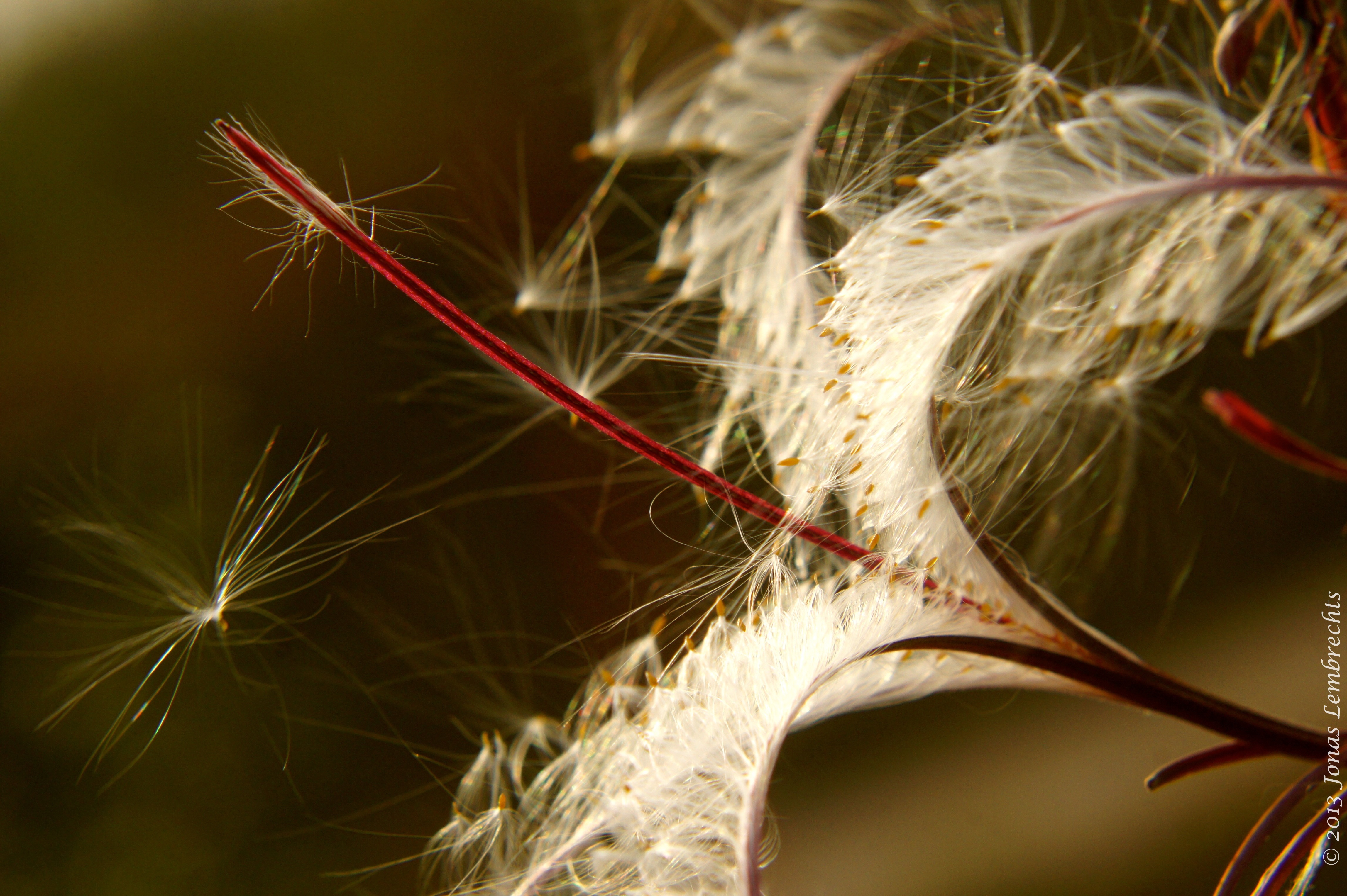
Here is why: the higher amount of species in lowland roadsides comes from a bunch of typical roadside species, mostly highly competitive weeds (e.g. willowweed, Epilobium angustifolium, see picture). They do not belong in such numbers in the ‘traditional’ undisturbed subarctic mountain vegetation, but typically follow humans, agriculture and the availability of rich soils and mild conditions. Such culture followers form an important part of the lowland roadside vegetation. These species are added on top of the baseline species richness of typical subarctic mountain vegetation. Therefore: higher roadside diversity.

Hairy willowweed, a typical competitive weed

Epilobium angustifolium


These competitive weeds are rare in the roadsides on high elevations, where conditions are a lot harsher. The roadsides there serve more as a refuge for stress-tolerant alpine species, because the difference in environmental conditions with the surrounding undisturbed areas is much smaller: both contain open, low vegetation, with a lot of bare rock, exposed to the harsh climate. Ideal circumstances for stress-tolerant plants (like Saxifraga stellaris, see picture), yet a disaster for the competitive kind.

Saxifraga, a typical stress-tolerant alpine species

Saxifraga stellaris

Conclusion: the subarctic mountain road has a much smaller effect on native plants than its lowland counterpart. Lowland roadsides suffer from the invading pressure of competitive weeds, while they serve on high elevations more as a refuge for a wide diversity of alpine species.

Roadside vegetation

You want to know the exact scientific story? Here it is!


Posted in Norway | Tagged , , , , , , , , , , | Leave a comment

Fallopia

Fallopia - 1

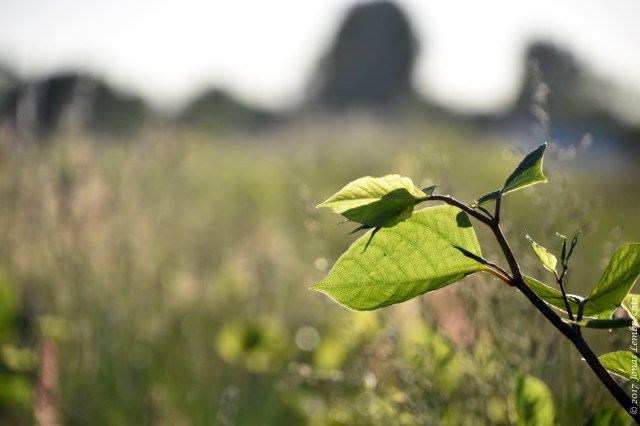
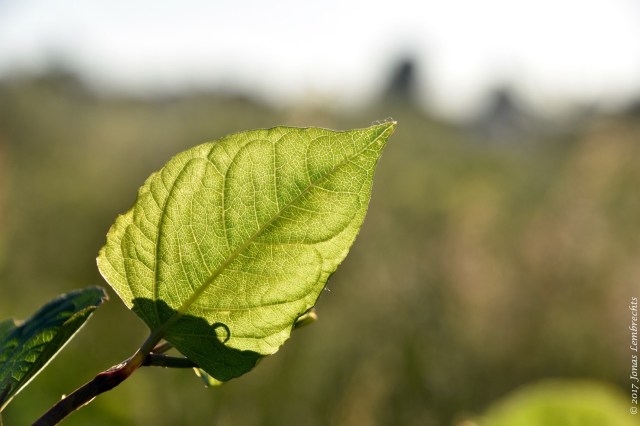
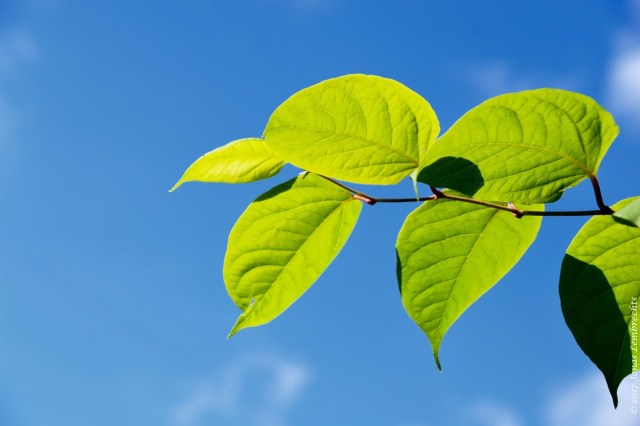
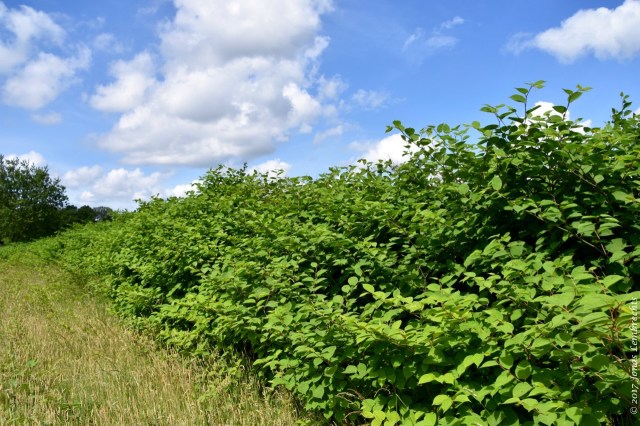
Fallopia japonica, or Japanese knotweed, a common non-native plant species in Belgium.

I have been hoping to expand my research area to my homeland for a while now. Working ‘On Top of the World’ never ceases to amaze, yet closer to home tons of intriguing questions arise all the time.

Fallopia - 2

Why is a non-native species – Fallopia japonica in this example – growing where it is growing? Why do we find the plant in so many spots, yet not others? What is the common denominator in all of these places, what is different?

Fallopia - 4

We are getting closer to that question, neatly disentangling all factors that possibly play a role. We have some great data to work with, and more great experiments in the pipeline.

Fallopia - 3

Hoping to write some more about this soon again.

Posted in Belgium | Tagged , , , , , , , , | Leave a comment