Short: in our recent review in Ecography, we propose an overarching approach to obtain microclimatic data for use in species distribution modelling. We now welcome anybody who has soil temperature data to join our SoilTemp-network and help us to apply the proposed techniques.

Ecologists like to know where species are living, and why. It is indeed one of the most critical questions in today’s ecology to ask what is behind the distribution of a species, and how that will be affected by global change. A highly popular tool in that regard are ‘species distribution models’ (SDMs), a statistical tool to link species occurrence data to data on background conditions.
Climate is a crucial background condition to consider in that regard, and climate variables are the most commonly used variables in SDMs. Yet there is a big issue there: what climate to use when modelling the distribution of a species? Ideally, one wants to use the conditions as experienced by the study organism, right? Traditionally, however, SDMs mostly rely on free-air temperature conditions with a coarse resolution (e.g. with pixel sizes of 1×1 km), as this has for long been the best data available. Such data however fails to capture the apparent temperature (cf. microclimate) as experienced by living organisms within their habitats.

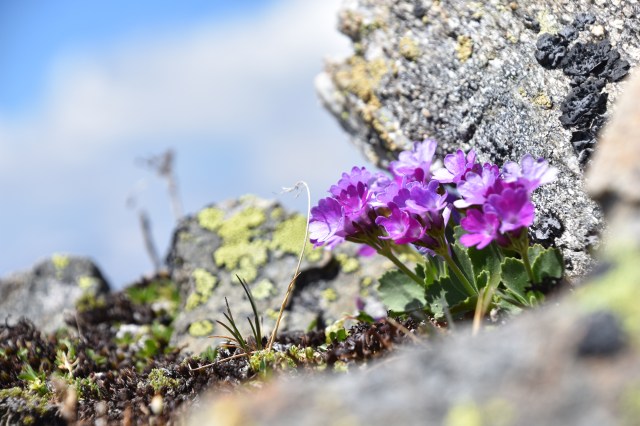
For mountain plants especially (in this case Pedicularis hirsuta in the northern Scandes), the climate they experience near the ground is far from what happens at 2m in the air.
There is indeed an important mismatch between the climatic data we have available, and the climate as experienced by many organisms. First of all, local variation in temperature is crucial in any habitat with a vertical component, like forests, mountains, or cities. In these environments, local temperatures can differ several degrees from the coarse-grained averages usually used. Additionally, free-air temperature and climate patterns also differ significantly from what happens at the soil surface, or a few centimeters below it. For many organisms in the soil and close to the surface (soil micro-organisms, ground beetles, herbs, forbs, mosses or tree seedlings, for example), this mismatch is fundamental.
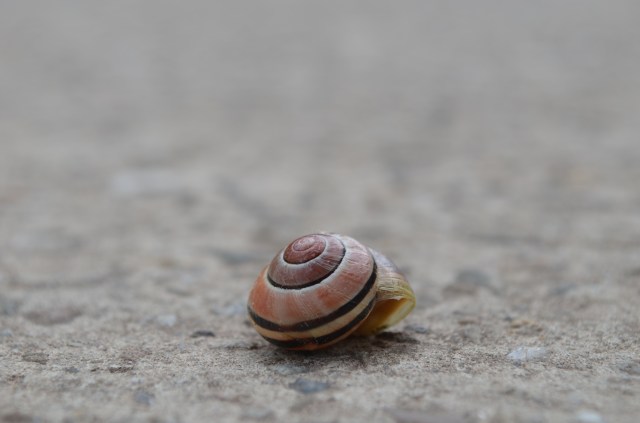
Most organisms, being it plants, insects, soil microbes or many many others, live totally decoupled from the climate at coarse resolutions as measured in weather stations. (Pictured: Cepaea nemoralis)
But no worries, the scientific community is on it! Several studies have already made considerable progress in tackling this problem from different angles in their effort to solve that mismatch. In our recent review in Ecography, we show how 1) in-situ climate measurements with tiny sensors, 2) remotely sensed data (from satellites, airplanes, or LiDAR, which provides high-resolution 3D reconstructions of the environment) and 3) microclimatic modelling, are all bringing us closer and closer to the climate our study organisms actually care about.

Several studies have been getting closer to modeling the actual climate experienced by species, for example by incorporating 3D-forest structures in models of climate on the forest floor. (Pictured: Crocus sp.)
We believe that instead of using all these approaches separately, we should combine them. We thus propose a framework that does exactly that: first of all, we suggest using a selection of appropriately-placed sensors, spanning a wide range of environmental conditions. Not too few, not too many. This real-time local data from exactly the location where your organisms live can then be combined with detailed measurements of the habitat 3D structure, for example derived from digital elevation models or airborne laser scanning to extrapolate it to the whole region. Finally, long-term records of free-air conditions from nearby weather stations can be used to extend your in-situ network through time. With this unified approach, we can obtain microclimatic data with the optimal resolution and extent – both in space and time – to accurately model current and future species distributions.

Summarizing our framework on how to get relevant microclimate data for use in ecological models.
Yet the proof of the pudding is in the eating, of course. The framework is there, but now we are stepping up the game: we want to apply our concept on the global scale. Therefore we launched SoilTemp, which is a global database of soil temperature data, with a double purpose: 1) we want to model soil temperature globally, combining this database of in-situ measurements with remote sensing and microclimatic modelling, and 2), we want to use the database to improve our models of species distributions. More on that here.
Interested, and have some soil temperature data lying around? Don’t hesitate and get in touch!

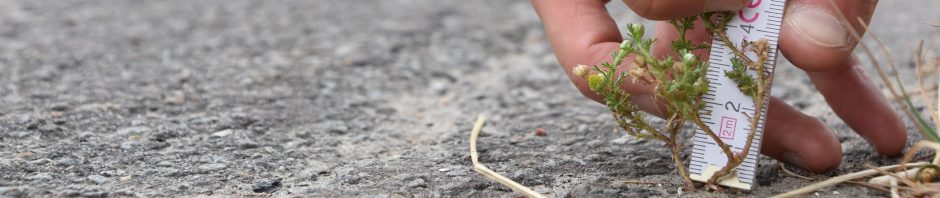
The concrete surface and tall buildings in cities create a unique microclimate that is highly different from large-scale climatic averages. (Pictured: Viola sp.)
Reference:
Lembrechts JJ, Nijs I, Lenoir J (2018). Incorporating microclimate into species distribution models. Ecography. doi: [10.1111/ecog.03947].