For MIREN, we are working on an awesome blog series summarizing our scientific findings from the last 15 years for conservation, policy makers and the global public. This is chapter 3 in the series, follow the whole story on www.mountaininvasions.org.
If there is one certainty about non-native plant invasions in mountain regions, it is the following: there are less non-natives at high elevations than in the lowlands 1,2. This pattern is indeed recurring in all mountain regions studied within the network, albeit with some regional variation (most notably another decline at low elevations in tropical regions where the lowlands are too hot for many species3-5.

Presence of non-native species at high elevations is much lower than what is seen in the lowlands. Here: Taraxacum officinale in southern Chile, defying all odds.
Yet what is behind this general observation? The answers can be found in the introductory history of these mountain colonizers. Most of these non-native species are first introduced in the lowlands, and they are pre-adapted to the relatively mild climatic conditions found there 3. From there, they start colonizing areas at higher elevations, often following human constructions like roads and trails 6. This expansion of non-native species from anthropogenic sources at low elevations towards the alpine zone, and the progressive dropping out of species on the way to the top, follows a process that we call ‘directional ecological filtering’ 7: one starts with a large non-native species pool at the bottom, and then sees a progressive drop-out of species on the way up.
As a consequence of this directional filter, the non-native plants reaching high elevations around the world are not the highly specialized stress and cold tolerators one might have expected there. On the other hand, these are mostly species with broad climatic tolerances capable of growing across a wide elevational range 7, with the high-elevation non-native species pool as a whole being a subset of the adjacent lowland pool 8. These ‘winners’ found at high elevation often are perennials (and not annuals), are from temperature origin (and not Mediterranean or tropical) 5,9, and have fewer flowers yet larger seeds 10.

Harsh climatic conditions at high elevations (here early November snow and short days in the Norwegian mountains) are commonly seen as the main limitation for non-native lowland species to invade the alpine zone.
Mountains thus act as a filter on non-native species 3,7. But how exactly does that ‘mountain filter’ work? The most obvious filter is the reduction in temperature and the increase in abiotic stress 11, which is a major limitation for many of these lowland species. This increased abiotic stress is however accompanied by other filters: a decline in the amount of seeds (through a reduction in human presence) 2,11,12 and a simple delay due to the longer physical distance from the introductory point 2,3. On the other hand, one might also observe a higher resistance against invasion by new-comers in mountains 11, while the power of the nonnative species to invade is reduced at this far edge of their distribution 2.
So which one of these drivers is the most important? Our experimental research showed that many non-native plants can establish, grow, and flower well above their current elevational limits in high-latitude mountains 13, defying the theory of the temperature filter. These results imply that cold-climate ecosystems are likely to see rapid increases in plant invasions in the near future as a result of increasing human-mediated disturbances and climate warming.
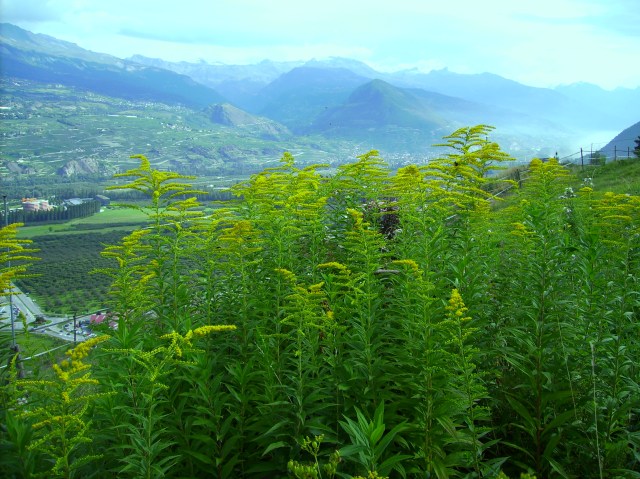
In studies on a selection of daisy species (family Asteraceae, here Solidago canadensis), all but one reached the same or even a higher altitude in the new range, so neither climatic adaptation nor propagule limitation seemed to be playing a crucial role 14,15.
Non-native species are indeed still moving upwards over time, albeit relatively slowly 2. The elevational ranges of species for example tended to increase with time since introduction on Tenerife, and the species reaching the highest altitudes were mostly old introductions 3. This movement is likely accelerated by climate warming 2,16. Nevertheless, we found little change in the elevation ranges limits of species over time in Switzerland, suggesting that at least in the Alps most species are not rapidly expanding at their high elevation range limits 17. For most species, populations were however more dynamic (with more colonizations and extinctions) at the upper range limit where their occurrence rapidly declined 17.

Common yarrow (Achillea millefolium) has been shown experimentally to be able to survive, grow and flower far above its current range limit in cold-climate mountains.
In short: invasion by lowland species at high elevations is slow yet ongoing, and most non-natives have not reached their upper limit yet. We should thus be prepared to see the problem become a lot more critical over the coming years and decades. Nevertheless, even though most of the current non-native mountain species have a lowland origin, invasion by cold-adapted non-native species actually provides a higher threat 16, as climatic matching increases invasion chance 9. Special care should thus be taken to limit introduction of cold-adapted alpine species from one mountain region to another.
References
- Otto, R. et al. (2014). Road edge effect and elevation patterns of native and alien plants on an oceanic island (Tenerife, Canary Islands). Folia Geobotanica 49, 65-82.
- Becker, T. et al. (2005). Altitudinal distribution of alien plant species in the Swiss Alps. Perspectives in Plant Ecology Evolution and Systematics 7, 173-183.
- Haider, S. et al. (2010). The role of bioclimatic origin, residence time and habitat context in shaping non-native plant distributions along an altitudinal gradient. Biological Invasions 12, 4003-4018.
- Arévalo, J. R. et al. (2005). Distribution of alien vs. native plant species in roadside communities along an altitudinal gradient in Tenerife and Gran Canaria (Canary Islands). Perspectives in Plant Ecology Evolution and Systematics 7, 185-202.
- Sandoya, V. et al. (2017). Natives and non‐natives plants show different responses to elevation and disturbance on the tropical high Andes of Ecuador. Ecology and evolution 7, 7909-7919.
- Lembrechts, J. J. et al. (2017). Mountain roads shift native and non-native plant species’ ranges. Ecography 40 353-364.
- Alexander, J. M. et al. (2011). Assembly of nonnative floras along elevational gradients explained by directional ecological filtering. Proceedings of the National Academy of Sciences of the United States of America 108, 656-661.
- McDougall, K. L. et al. (2011). Alien flora of mountains: global comparisons for the development of local preventive measures against plant invasions. Diversity and Distributions 17, 103-111.
- Arteaga, M. A. et al. (2009). How do alien plants distribute along roads on oceanic islands? A case study in Tenerife, Canary Islands. Biological Invasions 11, 1071-1086.
- Alexander, J. M. et al. (2009). Establishment of parallel altitudinal clines in traits of native and introduced forbs. Ecology 90, 612-622.
- Alexander, J. M. et al. (2016). Plant invasions into mountains and alpine ecosystems: current status and future challenges. Alpine Botany 126, 89-103.
- Jakobs, G. et al. (2010). Introduced weed richness across altitudinal gradients in Hawai’i: humps, humans and water-energy dynamics. Biological Invasions 12, 4019-4031.
- Lembrechts, J. J. et al. (2016). Disturbance is the key to plant invasions in cold environments. Proceedings of the National Academy of Sciences of the United States of America 113, 14061-14066.
- Alexander, J. M. et al. (2009). Plant invasions along mountain roads: the altitudinal amplitude of alien Asteraceae forbs in their native and introduced ranges. Ecography 32, 334-344.
- Poll, M. et al. (2009). Seedling establishment of Asteraceae forbs along altitudinal gradients: a comparison of transplant experiments in the native and introduced ranges. Diversity and Distributions 15, 254-265.
- Pauchard, A. et al. (2009). Ain’t no mountain high enough: plant invasions reaching new elevations. Frontiers in Ecology and the Environment 7, 479-486.
- Seipel, T. et al. (2016). Range limits and population dynamics of non-native plants spreading along elevation gradients. Perspectives in plant ecology, evolution and systematics 20, 46-55.