Extremes

I’ve just returned from a field visit to northern Sweden – above the Arctic Circle. It was close to thirty degrees Celsius this week. We nearly got burned off the mountain.

This kind of heat is no longer unusual. It followed a strange winter, where most of the snow had melted away by February – only to be replaced by a late-season snow event that buried the mountain under snow well into spring. These abrupt shifts are exactly what we’re tracking in our Fingerprints of Change project on mount Nuolja, close to Abisko: how increasingly erratic weather affects plants, bumblebees, and the ecosystems they hold together.

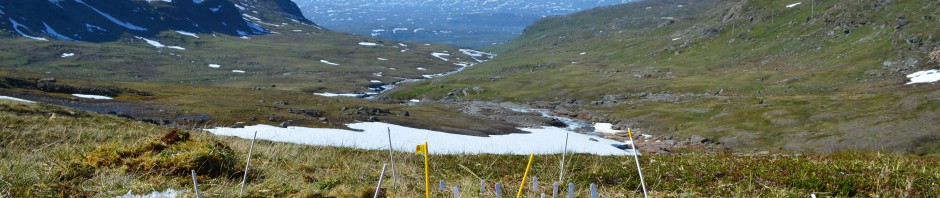
Lots of snow on our Fingerprints of change project still late in spring, substantially delaying phenology even when temperatures are high.

It’s too early to say what the full impact of this year’s extremes will be, but we already see it’s substantial. And more importantly: this isn’t a fluke. These kinds of events are happening more frequently – in this system, and in every system.

Because climate change doesn’t play out like a slow, steady dial toward 1.5°C. It comes in jolts. It hits us with heatwaves, droughts, late snows, floods, storms. Shocks that used to be “once-in-a-lifetime,” but now seem to happen all the time. These Extreme Weather and Climate Events (EWCEs) are no longer exceptions. They’re part of the story, and in many cases, the main driver of change.

Yet in ecology, we’ve barely started paying them serious attention.

In our new paper, just published in Trends in Ecology and Evolution (TREE), we argue that this lack of focus isn’t because extreme events don’t matter. It’s because the data hasn’t let us see them properly.
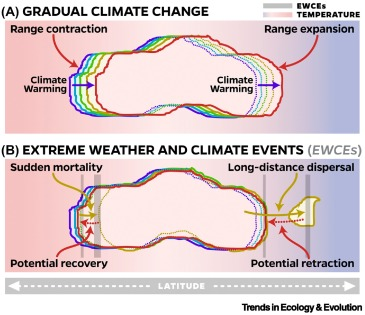
How gradual climate change and extreme events shape species’ range shifts
(A) In the classic view, climate warming drives a slow reshuffling of species. Populations gradually expand into newly suitable areas at the leading edge – typically toward higher latitudes, elevations, or ocean depths – while slowly disappearing from the trailing edge where conditions become too harsh. The result: a steady drift of ranges over time.
(B) But extreme weather can disrupt this smooth story. Sudden droughts, heatwaves, or cold snaps at the trailing edge can wipe out populations entirely, triggering abrupt contractions. These losses might be temporary (recovery is possible if conditions improve) but they can also leave lasting gaps. At the leading edge, storms or other extremes can fling seeds, spores, or individuals far ahead of the current range, sparking rapid expansions. Yet here too, the next extreme could push them right back.

What’s missing?

First: climate data. Most biodiversity studies still rely on coarse, long-term averages or climate station data far away from where organisms actually live. But extreme events are short-lived and highly local – meaning we need fine-scale data in both space and time to catch them. But what is more: as we don’t know where and when the most extreme events will happen, that fine-scaled data needs large spatial and temporal extents, and is that that is hardest to find.

Second: biodiversity data. Most monitoring efforts rely on just a few time points, maybe two or three surveys across several decades. That’s not enough to pick up the biological fingerprints of rapid, transient shocks.

This paper emerged from discussions at the Species on the Move conference in Florida. We highlight how extreme events can accelerate or limit species’ range shifts. For example:

  • Storms can blow seeds or insects far beyond current range limits.
  • Droughts and floods can wipe out entire local populations.
  • Cold snaps can halt the northward spread of warm-adapted species.

So, while background warming may drive slow and steady shifts, extreme events can spark sudden advances or abrupt setbacks.

Extreme events can result in extremely far propagule dispersal, as visualized here by the dispersal kernel.

Where do we go from here?

To understand these dynamics, we need better tools. Microclimate models at the necessary resolution are demanding, but increasingly feasible. Long-term, standardized monitoring – like what we’re doing with the Fingerprints of Change-project in Abisko and through global collaborations like in the MIREN network – is helping us fill the gaps.

And it’s not just about research. Conservation planning must also start factoring in extreme events. That means short-term interventions, like shading turtle nests during heatwaves. But more importantly: long-term strategies, like ensuring connectivity so disturbed populations can recover through recolonization.

The Dickcissel is used as an example in the paper: extreme events at the core of its range are reducing its abundance there, while warmer temperatures at the edges might promote range changes.

A call to think differently

As ecologists, we’re trained to look for trends. We love linearity, averages, gradual change in our data. But extremes defy those expectations. They’re noisy. They’re messy. It’s time we shift our perspective.

In this paper, we call for a different lens: from “microclimate” to “microweather.” From gradual trends to abrupt shocks. From averages to outliers.

Because it’s in the extremes where much of the future will unfold.
Posted in General | Tagged , , , , | Leave a comment

Join EcoFracNet – we’ve got sensors!

Whether you’re already knee-deep in site planning for EcoFracNet or MicroFracnet, or just hearing about it for the first time, we’ve got some exciting news to share—and maybe even a little incentive to get involved.

Wait, what is EcoFracNet again?

Great question. EcoFracNet is a growing international network of field ecologists working together to explore how biodiversity varies across spatial scales using a fractal monitoring design. Alongside it runs MicroFracNet, its microscale-focused sibling, adding more hierarchical levels into the mix. You can read more and see the recent call for participation here: MicroFracNet | The 3D lab.

We’re doing this all bottom-up: no big funding yet, just shared enthusiasm and a commitment to doing robust, comparable science across diverse ecosystems.

A bonus for current and future collaborators

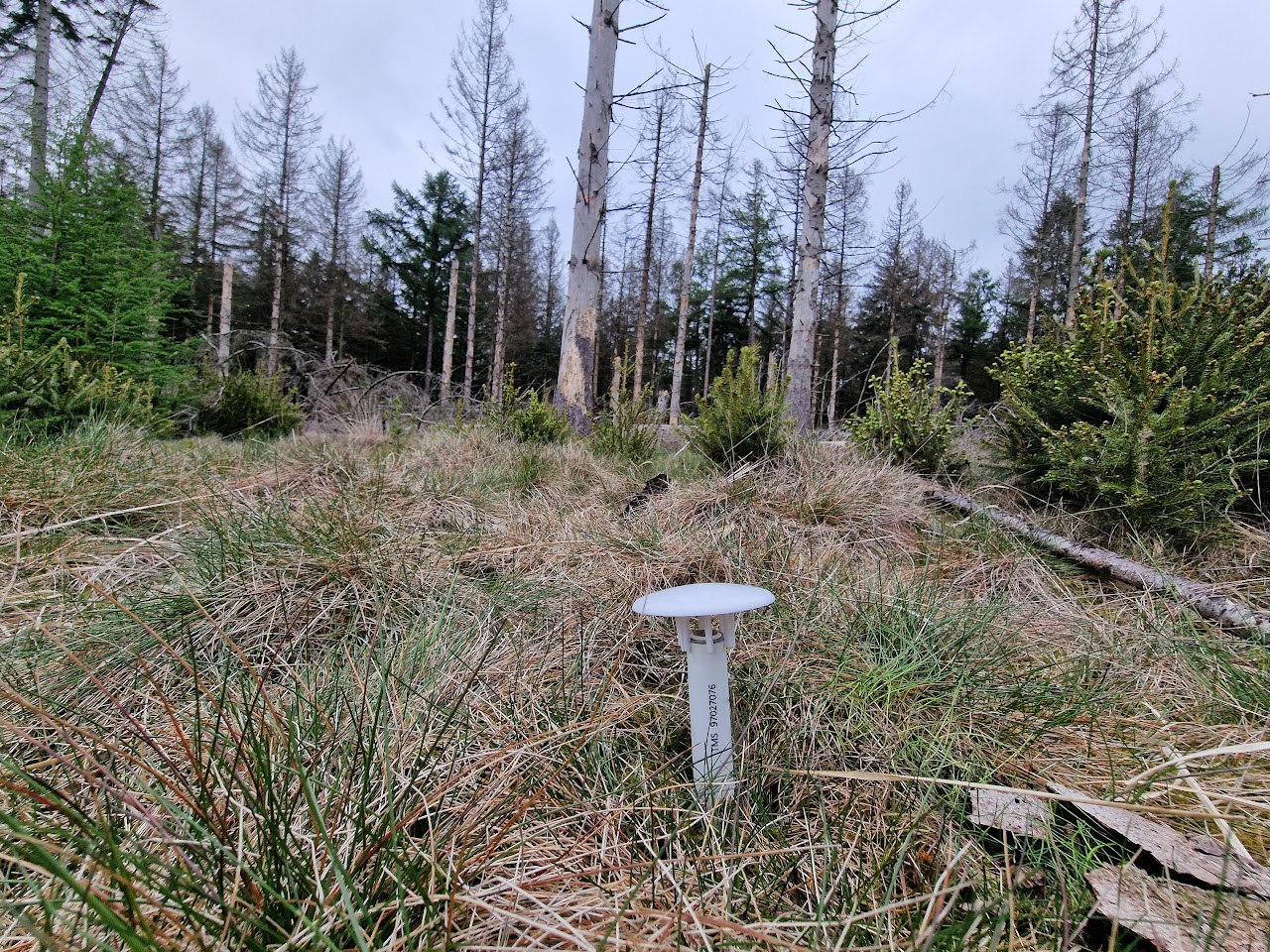
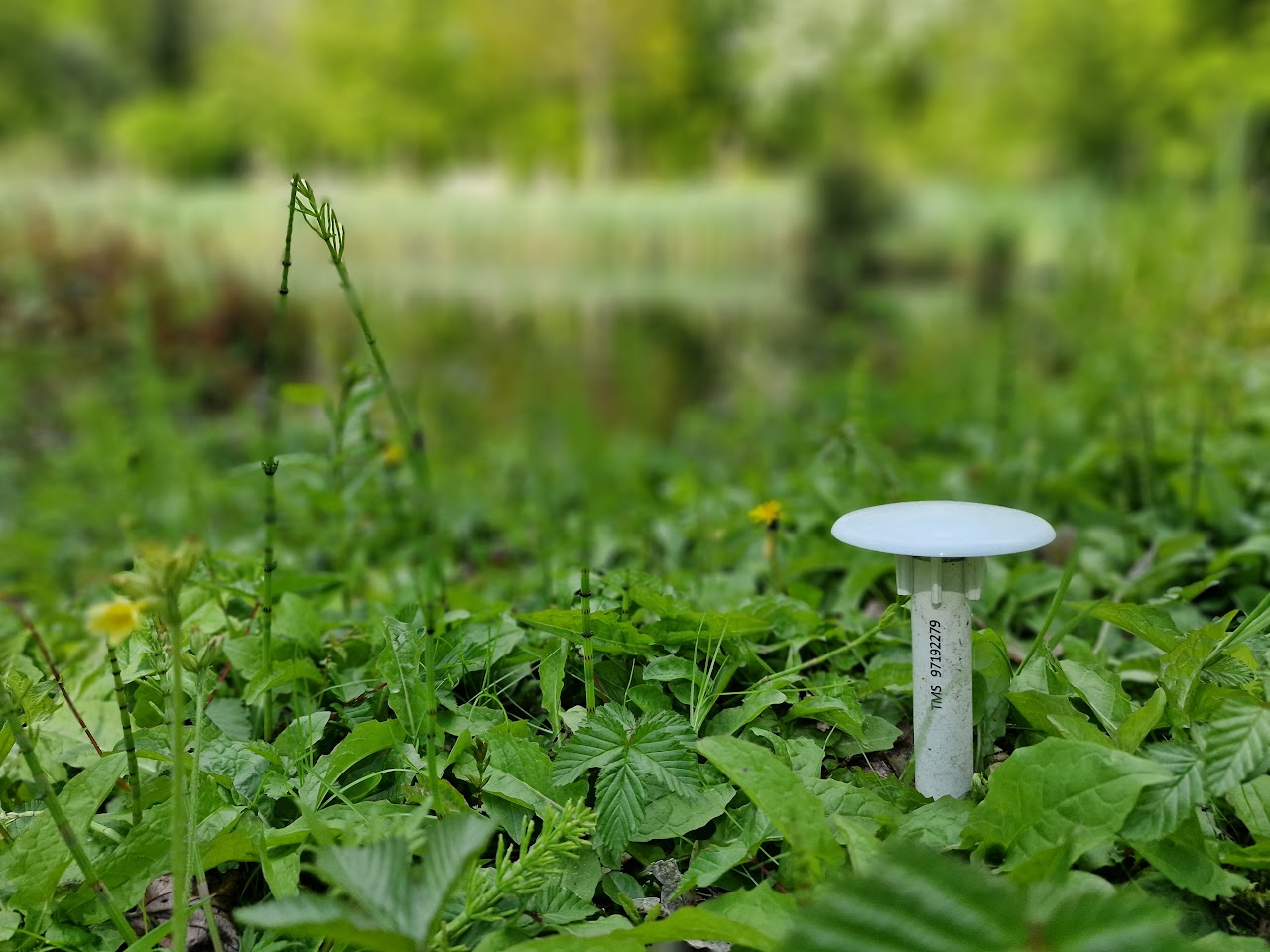
Although we’re still running both networks without external funding, you may be lucky. We’ve secured a batch of second-hand TOMST TMS4 sensors – those awesome little mushrooms that log soil temperature, moisture, and air temp just above the ground. And we’d love to share them with you.

We can lend up to 7 sensors per participating region, free of charge (until we run out, of course). Whether you’ve already joined the network or are still deciding, this could be a perfect way to get started.

A few important notes:

  • No TMD adapters included – We don’t have spares, so you’ll either need to buy one from TOMST for data download or send the sensors back to us after a year so we can extract the data for you.
  • Shipping – We can ship the sensors to you, but depending on where you are, it might be easier to coordinate through someone traveling to and from Belgium or the Netherlands. We’ll do our best to make it work!
  • Sensor quality – These are second-hand but should still have a couple of good years left. We can’t promise anything beyond that – but hey, free sensors.
  • Site setup map required – Before we send anything, we’ll need a clear map of your EcoFracNet setup (e.g., using Google My Maps). Use this example format:
    Blue = vegetation monitoring only
    Green = vegetation + sensor installation
    Red = no monitoring
    (Example Map from an agricultural field site in the Netherlands)
  • Timeline – With summer holidays and slow logistics, shipping will take a little time.
TOMST sensor in our EcoFracNet-site at Fochteloerveen in the Netherlands

Long-term vision

Remember, this isn’t just a one-off field season. EcoFracNet and MicroFracNet are being designed as long-term monitoring projects, with hopes of regular resurveys and extra measurements added in over time. The more consistent we are across sites, the more powerful the dataset becomes.

Ready to join in?

If you’re interested in borrowing sensors (or joining the network in general), please send us:

  • Your overview map (see above)
  • Your full shipping address
  • Your email + phone number

And yes, feel free to forward this to colleagues who might be curious or looking for an excuse to set up some long-term plots.

Haven’t signed up to the network yet? Do so here!

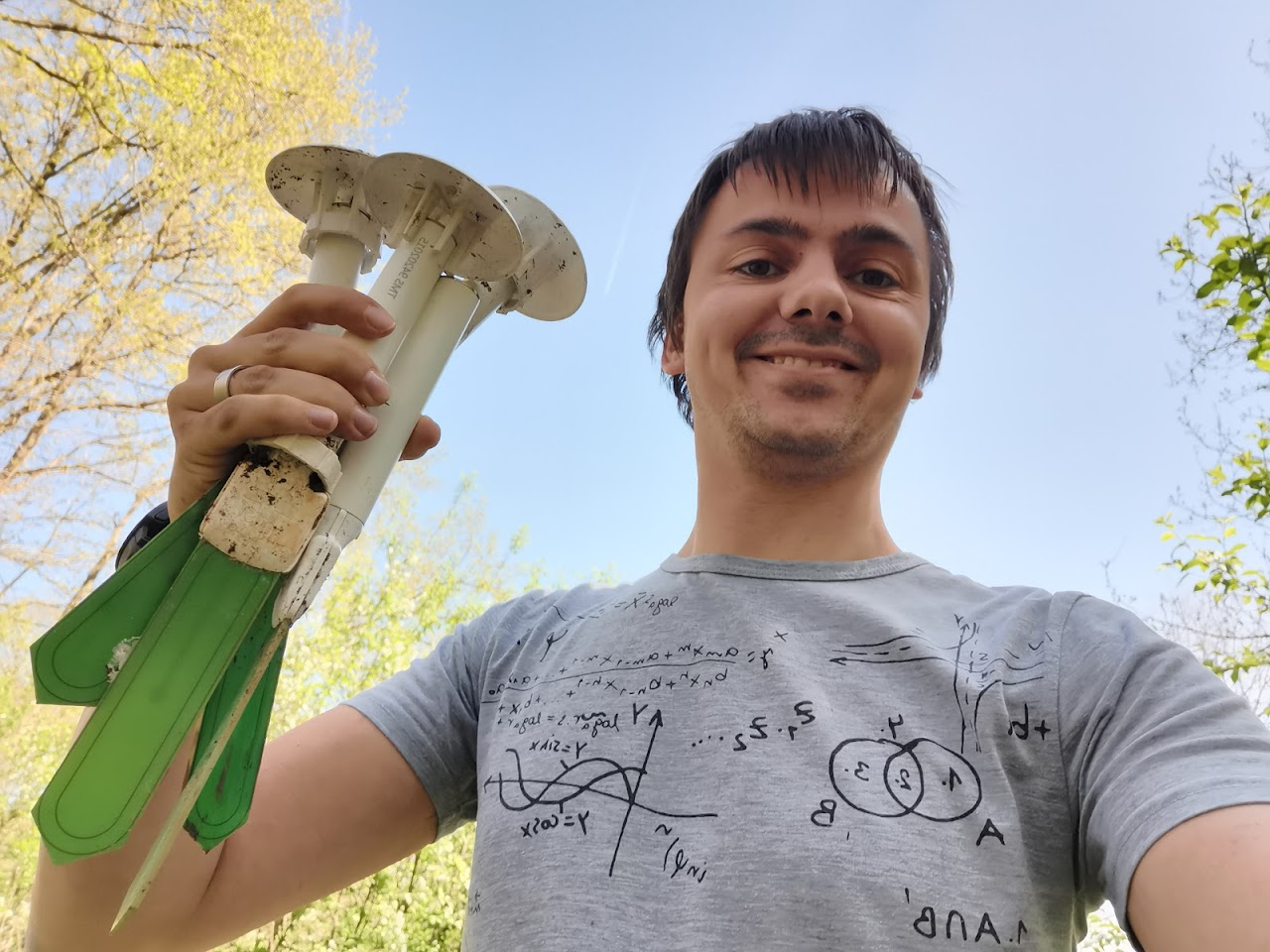
Me happy distributing sensors

Looking forward to hearing from you!

Jonas and Will – for the EcoFracNet team

Posted in General | Leave a comment

Boots in the bog

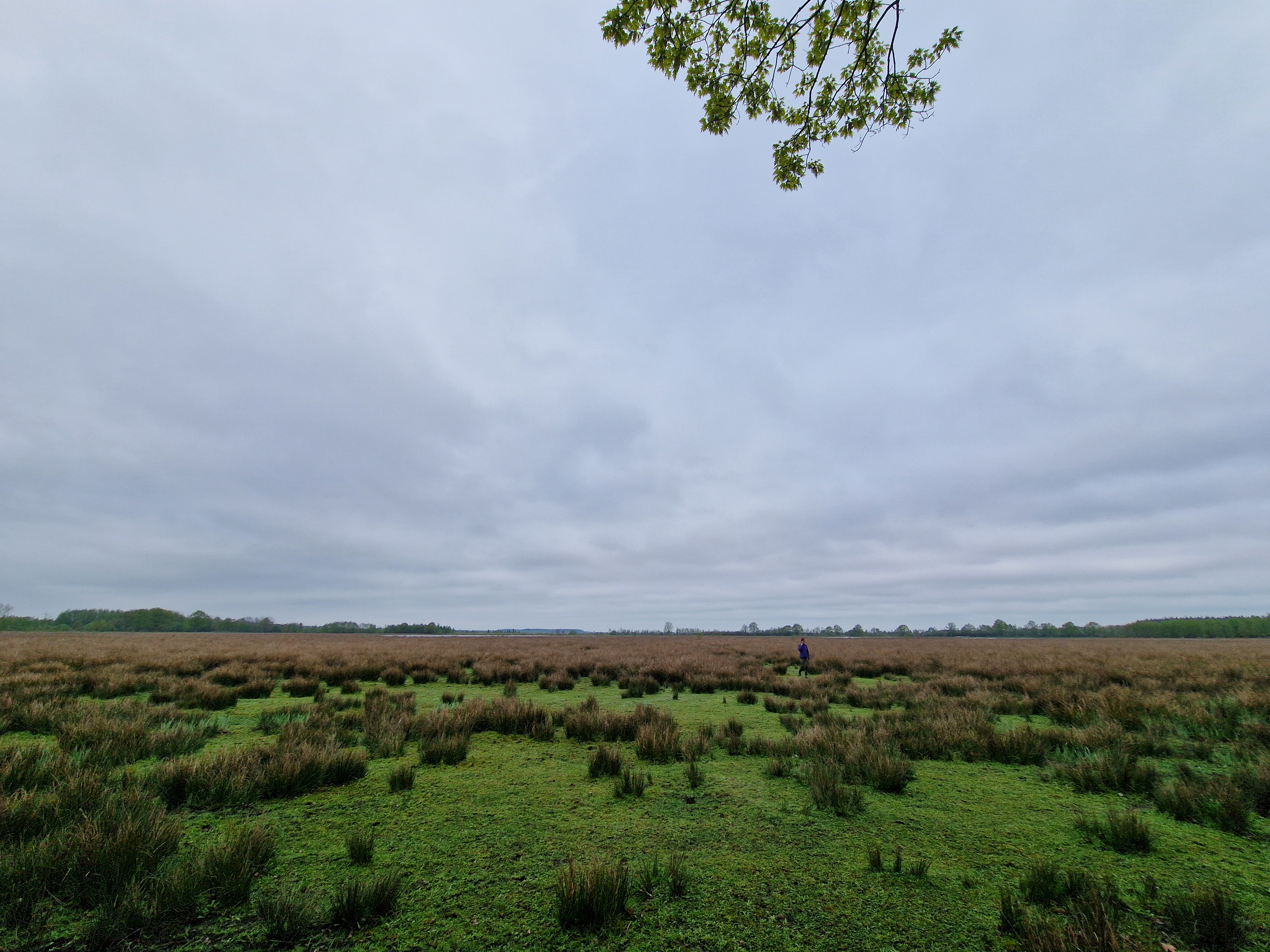
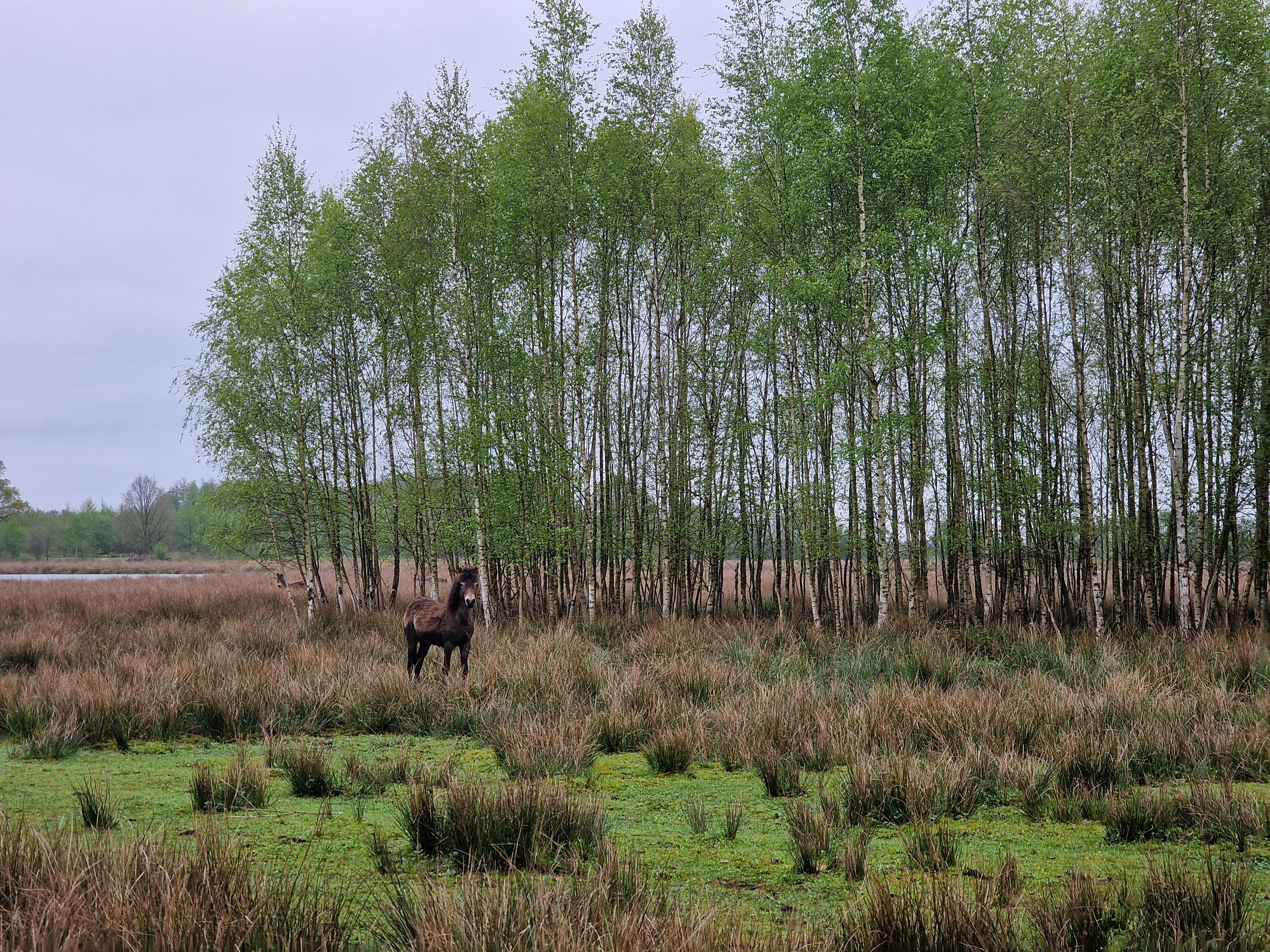
Far in the north of the Netherlands, on the border of Friesland and Drenthe, lies an endless sea of moor-grass, heather, and rushes – spread out across one of the last active raised bogs in the country: the Fochteloerveen.

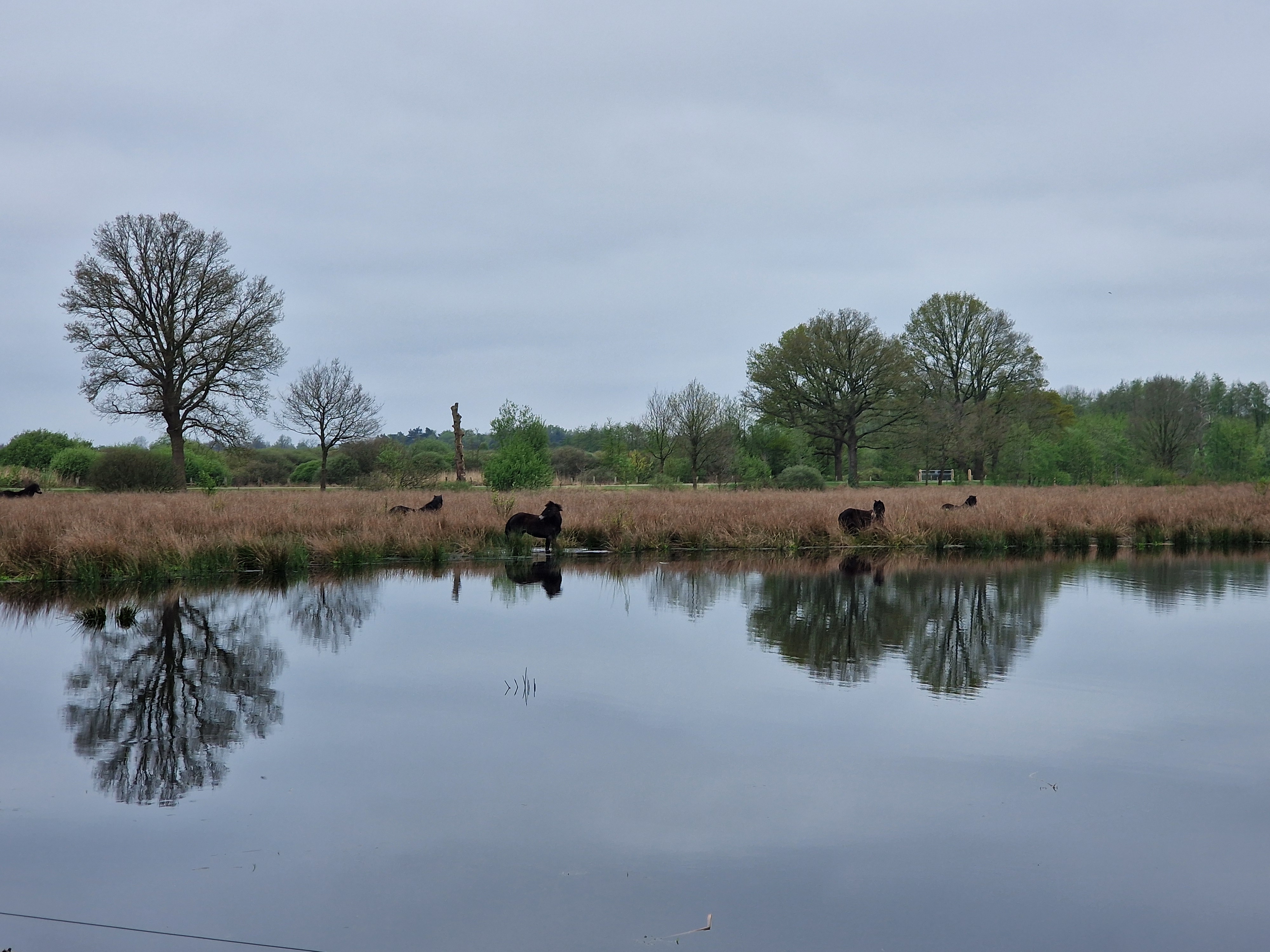
Throwback pictures of our first fieldwork trip to Fochteloerveen two months ago, when summer was still far away

A raised bog is something truly special. Formed over thousands of years, it’s a living landscape built entirely from rainwater and sphagnum moss. Layer by layer, the mosses grow, die, and decay, creating a domed blanket of peat that rises above the surrounding land. These bogs are wet, acidic, and nutrient-poor, yet support a unique and fragile web of life. Carnivorous sundews, rare dragonflies, and strange fungi find their niche here. And underneath it all, the peat holds centuries of carbon, making these bogs some of the most effective natural carbon stores on Earth.

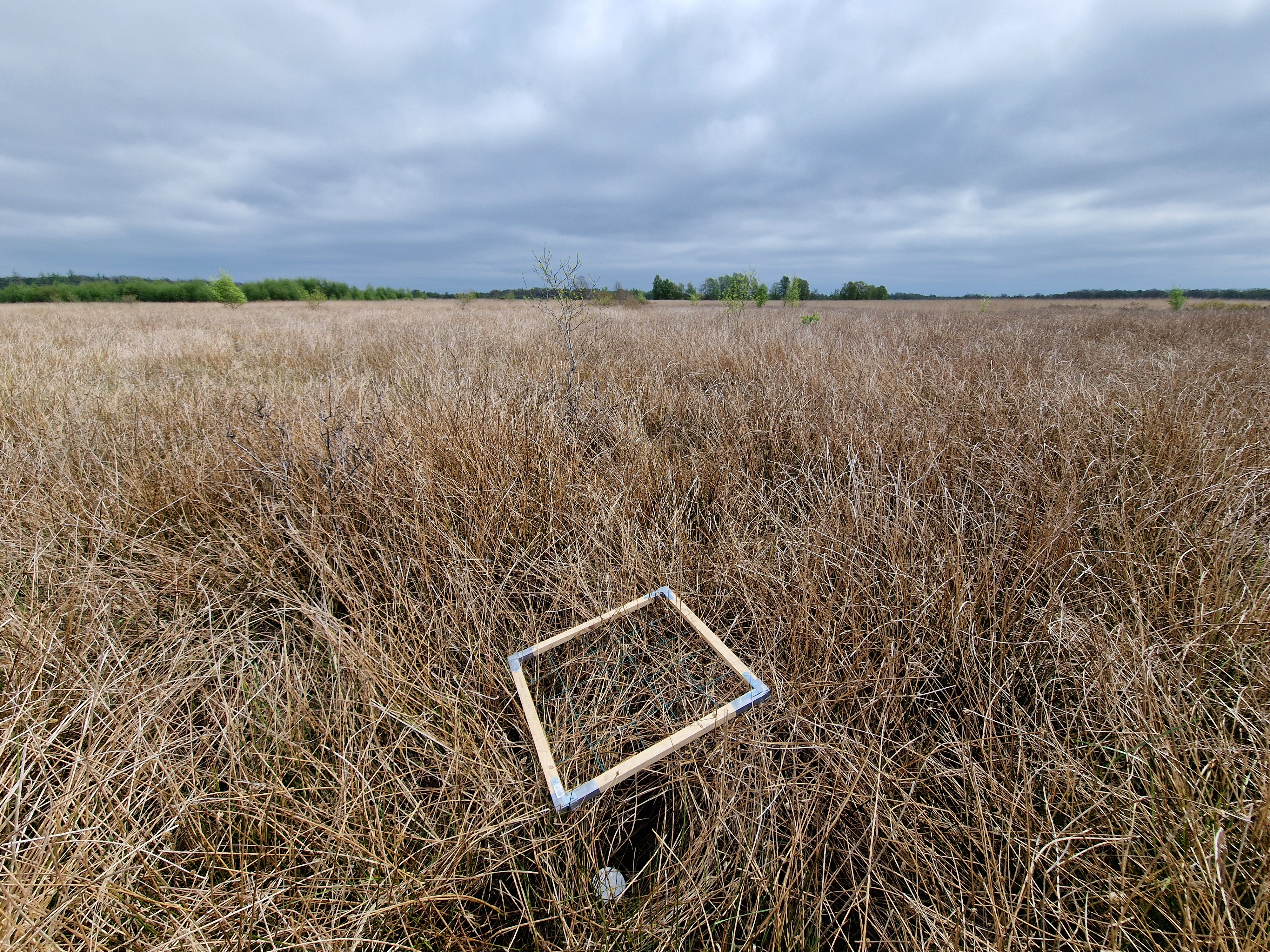
EcoFracNet vegetation monitoring in an sea of rushes, with not much else in sight

We visited this remarkable place in spring to set up a new EcoFracNet study site, focusing on biodiversity and ecosystem variation across a fine-scale moisture gradient, from boot-deep mud to dry sandy ridges dotted with pines. This is one more piece in our ongoing effort to cover all major Dutch habitat types with EcoFracNet. But there’s another reason this site deserves a closer look.

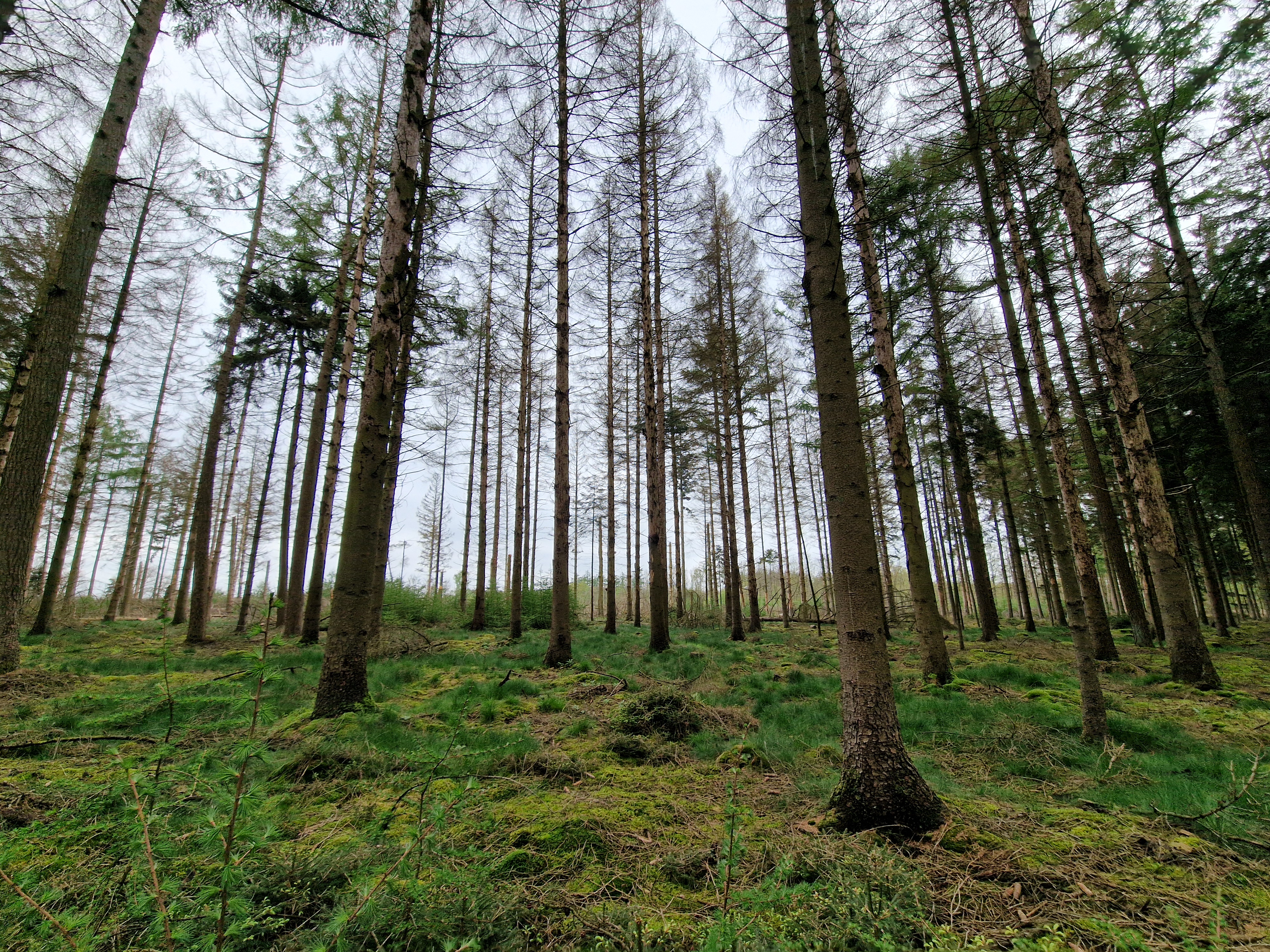
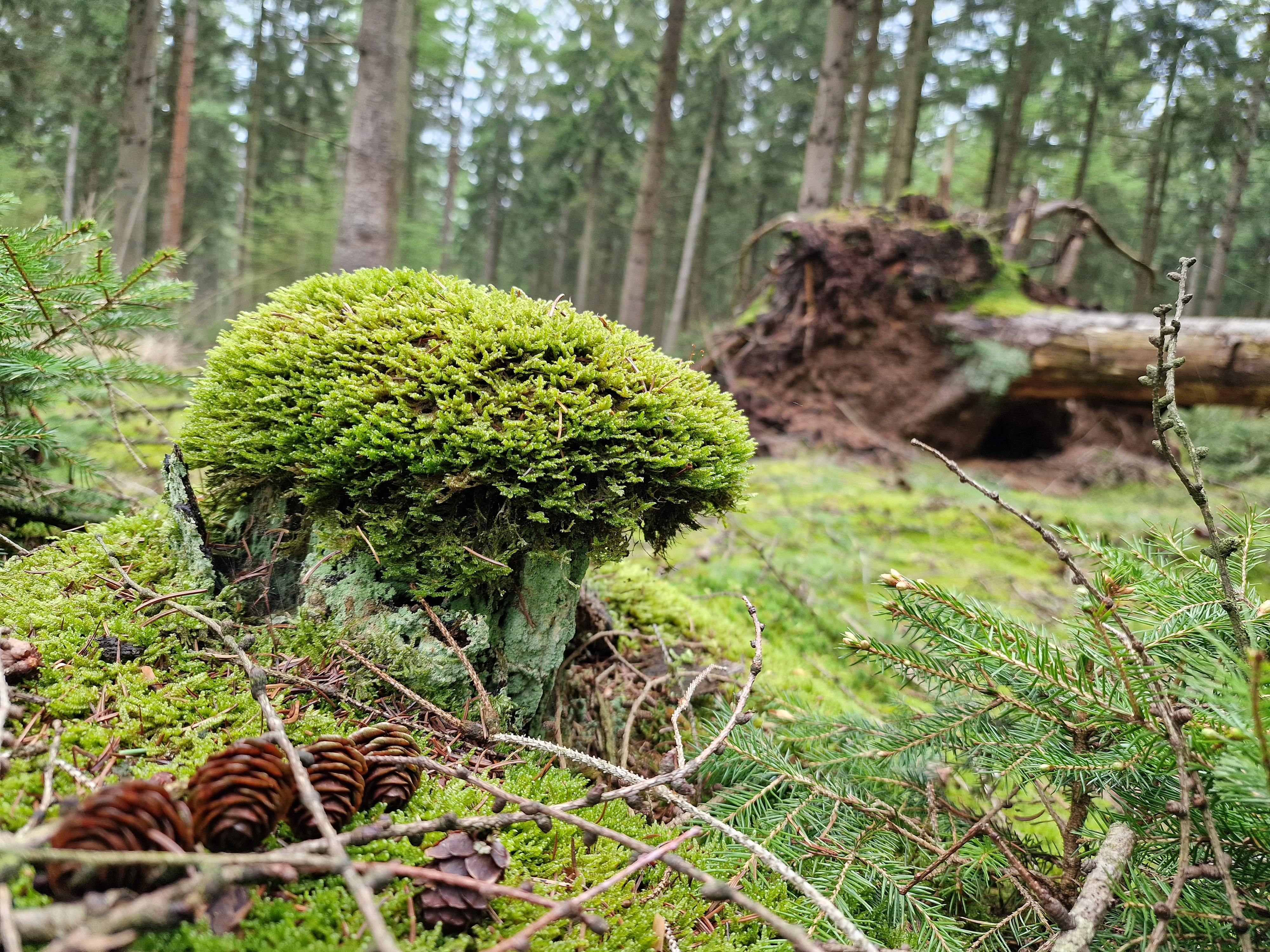
The area hosts forest understory that feels like it has remained undisturbed and untouched for a truly long time, slowly growing into beautiful perfection

To protect its rare biodiversity, park managers Natuurmonumenten and Staatsbosbeheer are continuously refining their management. Most recently, they’ve expanded the role of large grazers in the landscape, with a striking herd of Exmoor Ponies now roaming the area. These shifting grazing dynamics are likely to reshape local patterns of heterogeneity – and with them, the scales at which biodiversity varies. That’s exactly what EcoFracNet is built to study: teasing apart the spatial fingerprints of ecological variation, from the patch to the landscape level.

The brave and kind Exmoor ponies keep vegetation short where needed

We’re also looking below the surface. Together with colleagues from the group, we’re analyzing belowground biodiversity and ecosystem functioning, to explore whether patterns beneath our feet mirror those we see aboveground, or tell a different story entirely.

That’s all we’ve got for now. Our students are digging into the data (as they did into the mud), and we’re looking forward to seeing what they uncover. In the meantime, this post is really just a nod to this uniquely strange and beautiful landscape that so captivates you when roaming through it.

Posted in Netherlands | Tagged , , , , | Leave a comment

EcoFracNet at the farm

Our EcoFracNet project aims to uncover patterns of biodiversity across all kinds of landscapes — including those where biodiversity isn’t necessary a priority, like agricultural areas.

Even these landscapes can host a surprising variety of life: along field edges, in fallow patches, or even hidden within the rows of monocultures. By monitoring that plant biodiversity in exactly the same way as we do in forests, grasslands, or peatlands, we can put it into context. How much does it contribute? At what scales does it vary? And ultimately – what role does it play, and could it play, in the biodiversity of the future?

Given the central role agriculture plays in our landscapes, that perspective is essential – guiding us from understanding what’s there now to exploring how we can best make use of this space for biodiversity.

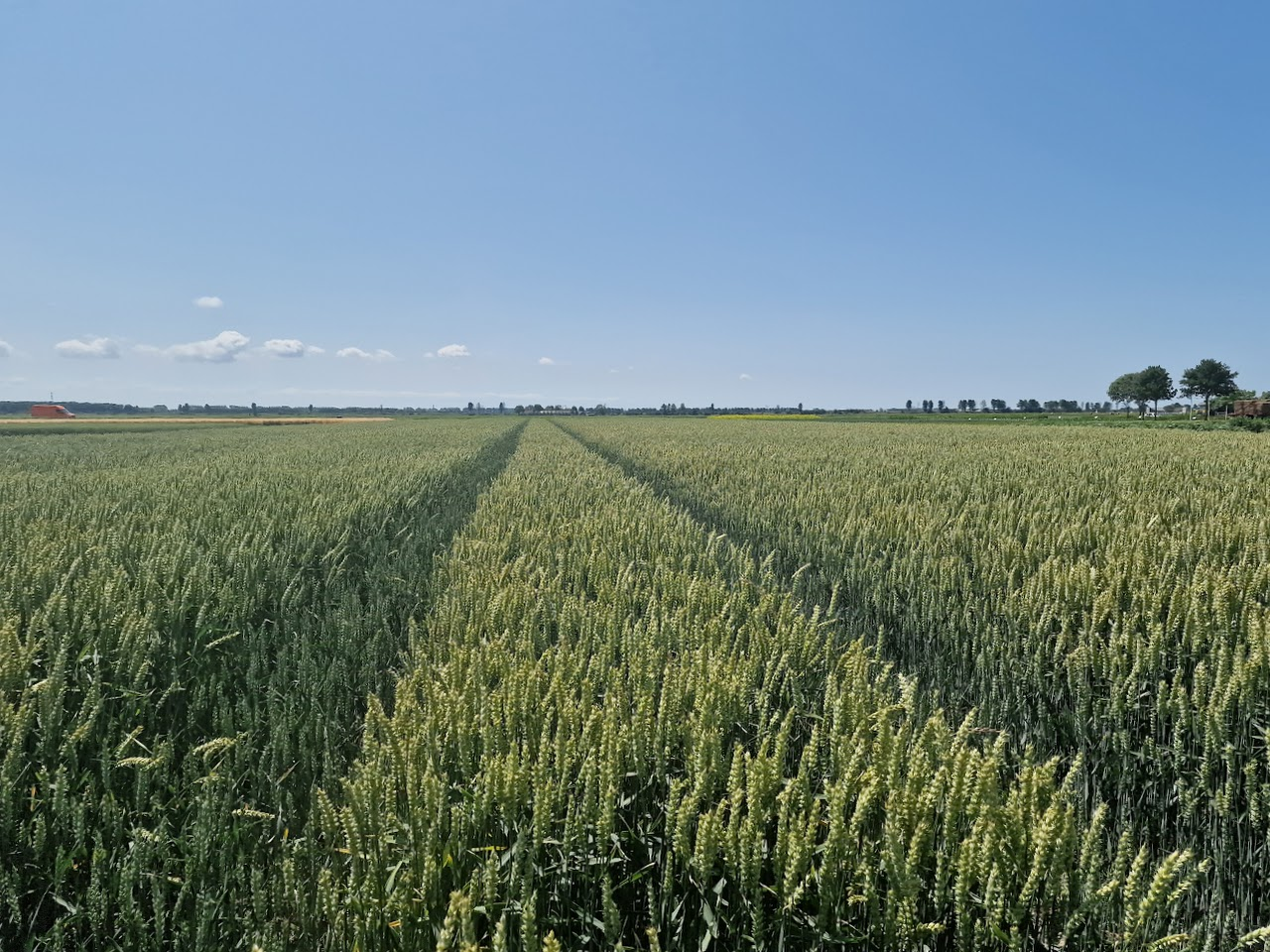
A sea of winter wheat – a monoculture for sure. But how does its diversity compare with those in the understory of our Dutch forests? And what’s still hiding out in the field edges or quickly colonizing the space after the harvest? We’ll find out!

We’ll explore these questions at De Rusthoeve, an experimental farm in Zeeland, the Netherlands. With its long history of working with scientists and sensors, it’s an ideal place to study biodiversity and environmental heterogeneity in an agricultural setting, without feeling too much like a bother to the general functioning of the farm!

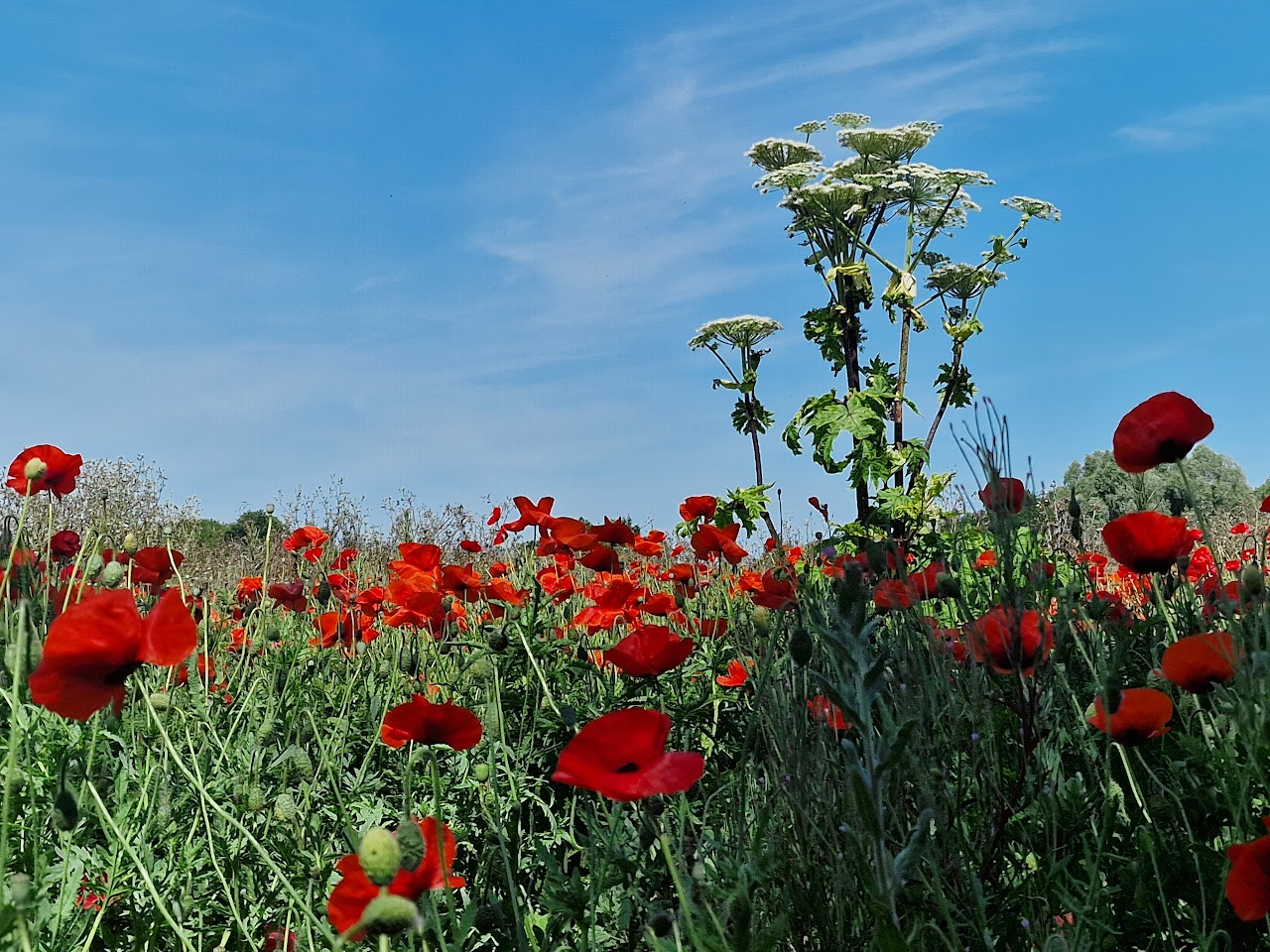
Giant hogweed dominating the view in a field of poppies elsewhere in Zeeland

Last week, under a perfectly blue Zeeland sky, I visited the farm for the first time. Looking forward to returning soon and getting everything set up!

Posted in Netherlands | Tagged , | Leave a comment

An army of scientists

This year, I had the joy (and challenge) of teaching Ecology to first-year biology students at Utrecht University for the very first time. Nearly 400 students, fresh into their academic journey, dipping their toes into the fascinating, complex, and urgently important world of ecological research.

We wanted that first encounter to be more than just theory. We wanted it to be memorable, meaningful, and fun – a hands-on experience that brings global challenges close to home.

So, we launched a campus-wide Bioblitz.
A biodiversity sweep search through the Utrecht Science Park, designed to kill a whole bunch of birds with one stone – and it worked better than we imagined.

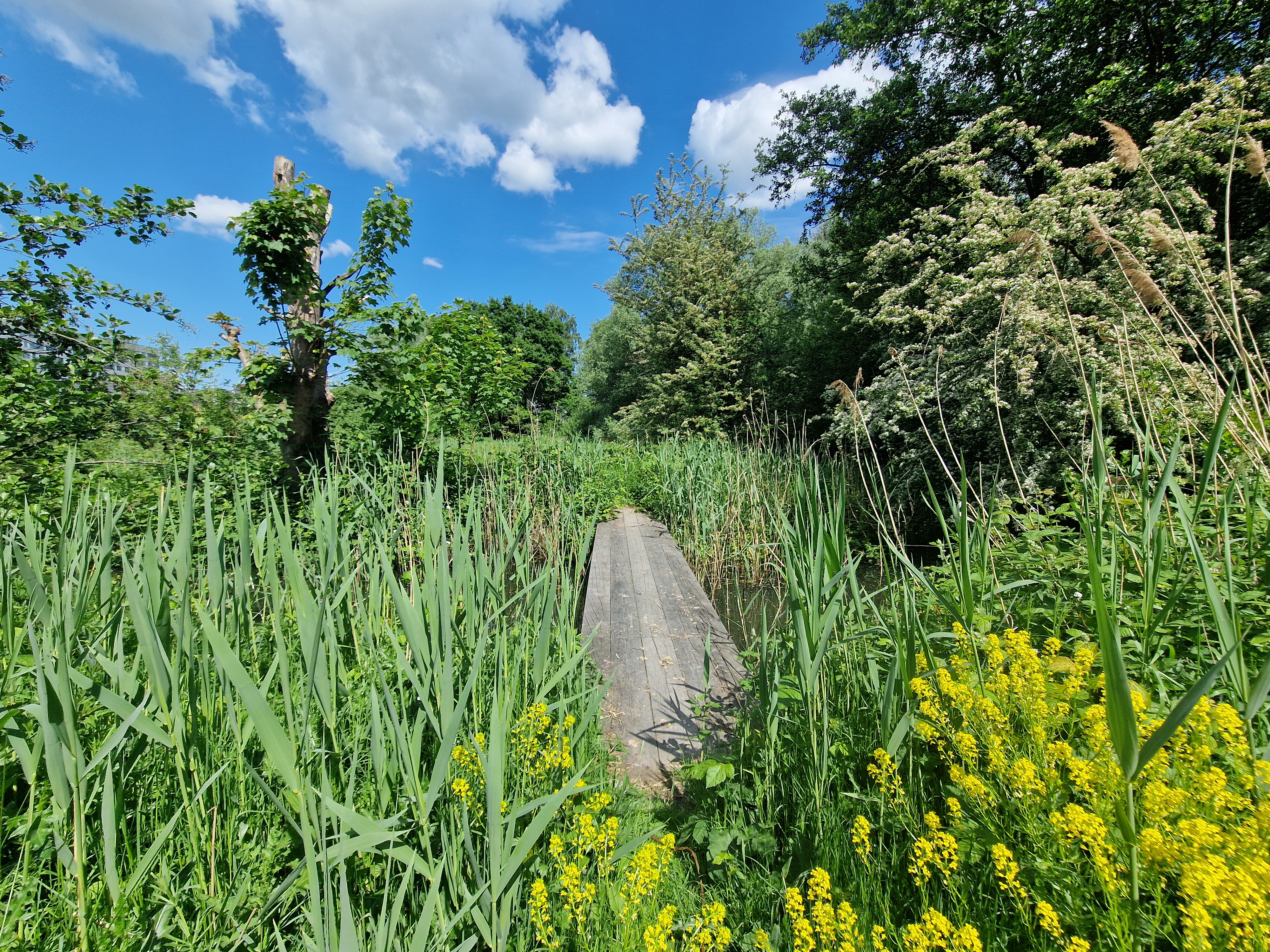
Utrecht Science Park is much more than aulas and research labs. One of my favourite spots: the little protected area of ‘De Driehoek’

Here’s why we think it was awesome:

Real fieldwork, real biodiversity
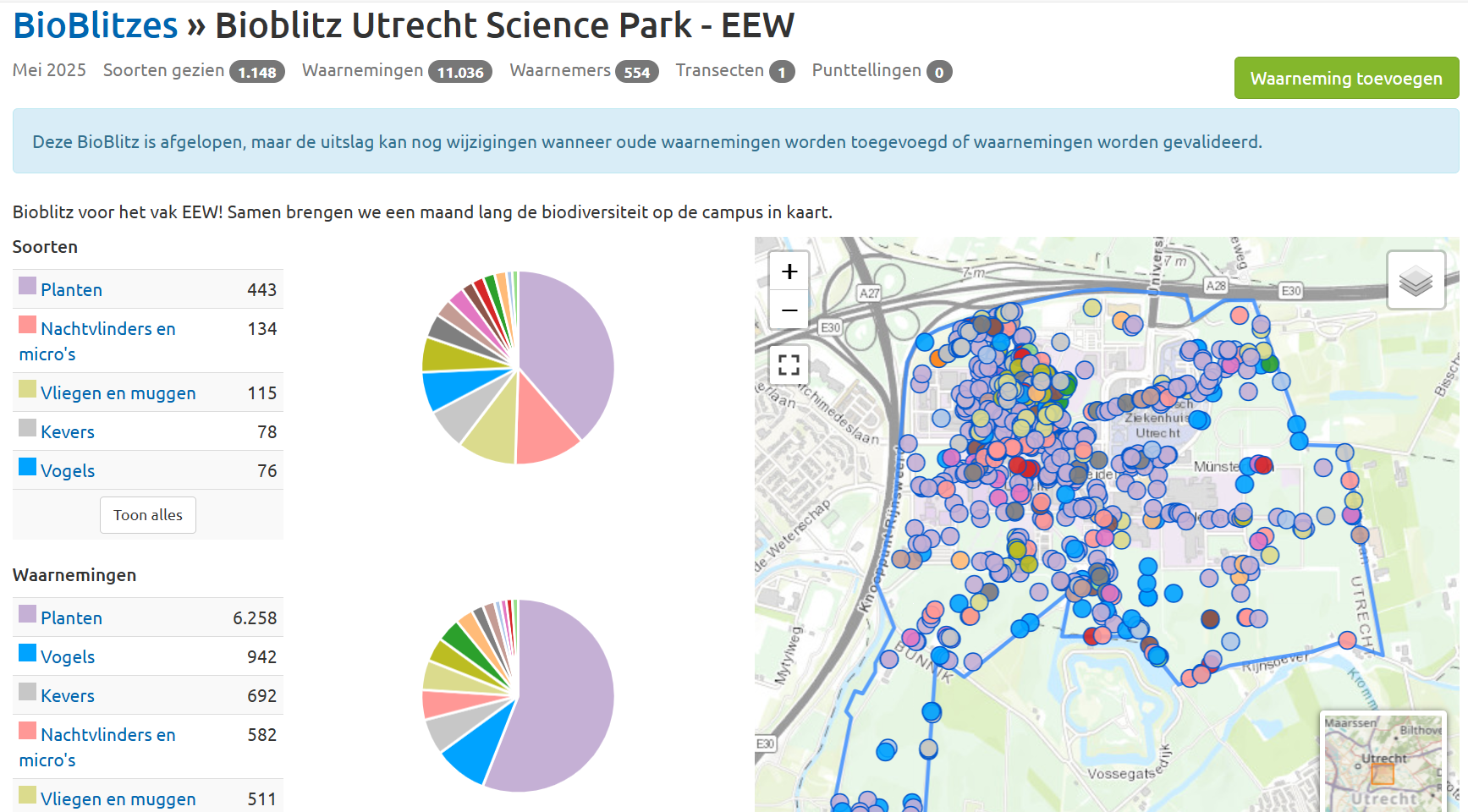
Students headed outdoors, explored patches of green around their classrooms, and surveyed the life blooming right under their noses. They were encouraged to contribute observations throughout May (much appreciated by the aspiring ecologists), with one full day of fieldwork required for everyone. No escape for that one day – even the future microbiologists were sent outside. The result? Over 1000 species of plants, animals, and fungi identified. An eye-opener, we hope, to the wildness still hiding on the doorstep.

A whopping 1148 species on our campus, as found by our 400 students and other enthusiastic campus dwellers.

Ecology made personal
By investigating biodiversity on their own campus, students saw up close why conservation matters – and how much there still is to discover and protect. From birds and beetles to mushrooms and mosses, the Science Park proved a microcosm of ecological diversity.

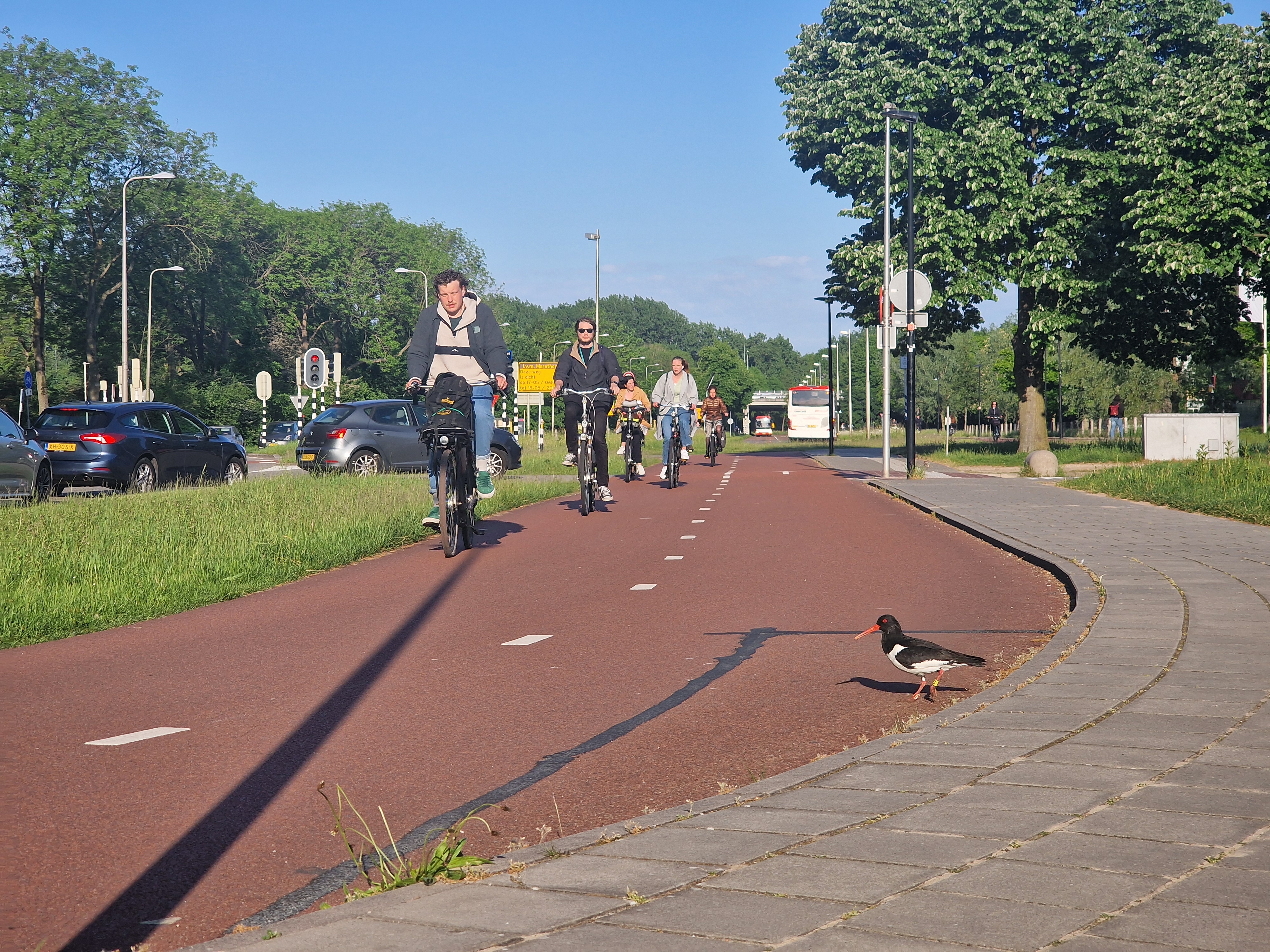
Oystercatcher on the bike path – the kind of surprises that can make one very enthusiastic about ecology!

Linking science to action
Students also learned about the efforts already underway to conserve and restore biodiversity on campus – complex work, considering the competing pressures of research labs, student housing, and other infrastructure. We explored the messy realities of conservation in the real world: how it’s often under-prioritized, but still possible and worth fighting for. And perhaps even better: they could contribute to those conservation efforts. Thanks to all of them, we could scan the campus much more thoroughly, including corners where the usual ‘Bioblitzers’ wouldn’t go.

Theory meets the real world
A key course goal was helping students see how ecological theory underpins what we observe in nature. With the data from the Bioblitz, we discussed concepts like alpha, beta, and gamma diversity, and asked students to look for real examples of species interactions – predation, facilitation, mutualism, commensalism – right here on campus. We even tied this to the theories of conservation science, such as ecological corridor design linking green areas north, east, and south of the Science Park.

All in all, this Bioblitz turned out to be a brilliant all-in-one: fieldwork, biodiversity awareness, ecological insight, and local conservation impact, and an army of 400 scientists helping to gather data. Importantly as well: a perfect way to get that many students to do something meaningful, without having to spend a lot of resources on it.

Next year, we’re levelling up.
We plan to expand to soil biodiversity, moths, and aquatic life for those students who like a challenge. Stay tuned. Or better: join us with your own Bioblitz!

Posted in Netherlands | Tagged , , , , | 1 Comment

We just love hearing the sound of nature

In a region like Flanders – dense, busy, and full of human activities of all shapes and sizes – the problem of noise pollution is increasingly recognized. We often think of that noise as something we can measure in decibels. But what if we’ve been asking the wrong question all along? Its impact on our health and well-being might actually have less to do with how much sound there is, and much more with what we hear.

That’s where the concept of the soundscape comes in: the landscape of sounds that surrounds us. It’s not just about volume. It’s about character, texture, and context. And so we wondered – what makes a soundscape feel peaceful? What makes it feel overwhelming? Instead of guessing, we asked the people themselves.

Image: De Morgen

At the start of De Oorzaak, our citizen science project on environmental noise, we launched a simple yet remarkably powerful questionnaire. We had the idea to invite people to step outside, take a little walk, listen carefully, and tell us what they heard and how that made them feel. It was a modest little survey, but the response was anything but: 4,465 people from across Flanders joined in, giving us a rich tapestry of sound experiences from all across the region.

And their answers spoke volumes.

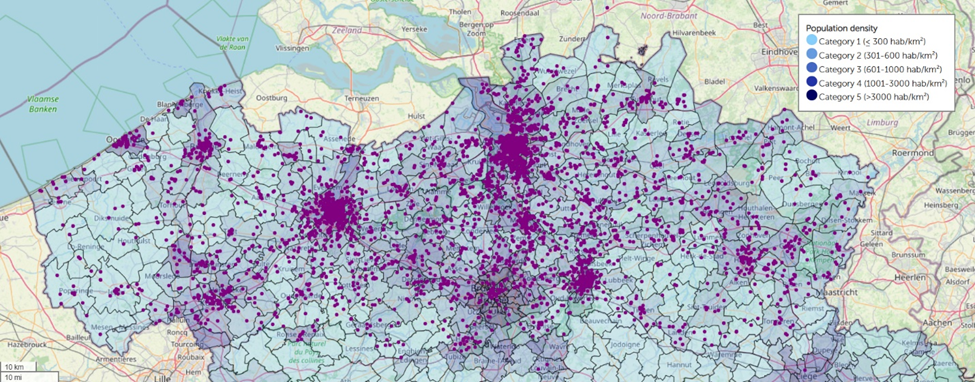
We gathered responses from soundwalkers from all across Flanders

In a new paper just published in Science of the Total Environment, led by Timothy Van Renterghem from UGhent, we present a first glimpse into that highly interesting dataset. What we looked at was the overwhelmingly strong role of natural sounds on the quality of the soundscape. And this was truly ‘make or break’: natural sounds — like birdsong, rustling leaves, or the whisper of the wind — significantly improved the quality of the soundscape. Even when traffic noise was present, hearing natural sounds alongside it made the experience notably more pleasant for our respondents.

Impact of the amount of natural sounds one hears (from blue = nothing to red = a lot on the soundscape experience, showing a clear shift from annoying and chaotic to vibrant, pleasant and calm

In the questionnaire, we deliberately left the definition of “natural sound” open to interpretation. And people responded with familiar favorites: birds, wind, trees. An earlier master thesis already showed that birds come first. If those aren’t there — for example in a highly urbanized area — the sound of wind takes over that soothing role. These aren’t just pleasant to hear — earlier studies have shown they reduce stress, improve mood, and enhance focus.

So, natural sounds aren’t just nice — they’re essential. They make life in noisy environments more livable and can help mask the negative effects of anthropogenic noises.

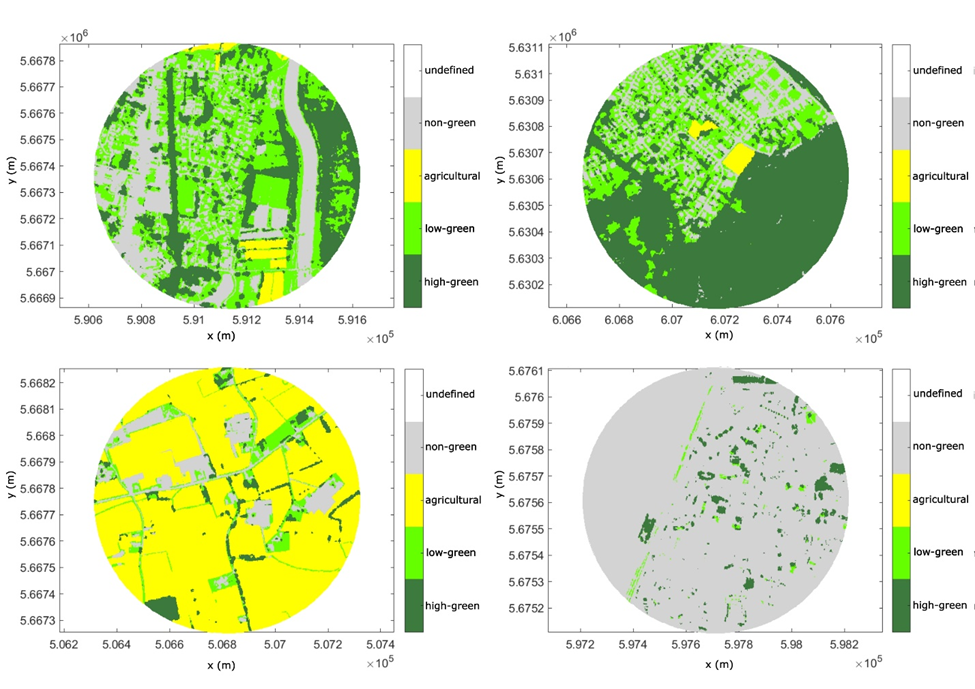
Examples of local land use around a measurement point, with either a high share of low greenery, high greenery, agricultural land and non-green surfaces. More green space in an area of 500 m around you results in a higher reporting of natural sounds. And more natural sounds results in a strongly improved soundscape experience.

Interestingly, we also found that it’s not just the trees or green space right next to you that matter. Green infrastructure within a 500-meter radius — including farmland and more distant vegetation — played a stronger role than greenery within just 125 meters. This suggests that it helps to have a ‘reservoir’ of natural sounds nearby. Birdsong, for example, travels far and shapes the sonic backdrop in a large area.

What surprised me most, though, was how consistent these finding were. Whether someone was in the city or the countryside, as soon as they reported hearing natural sounds, they also rated their environment as calmer, more enjoyable, and less disturbing. As such, our study adds important weight to the proven importance of nature to act as a mitigator of the negative impacts of sound. And this, the ecologist in me might say rather smugly, adds yet another critical ecosystem service to the long list of things that nature does for us, within and around our cities.

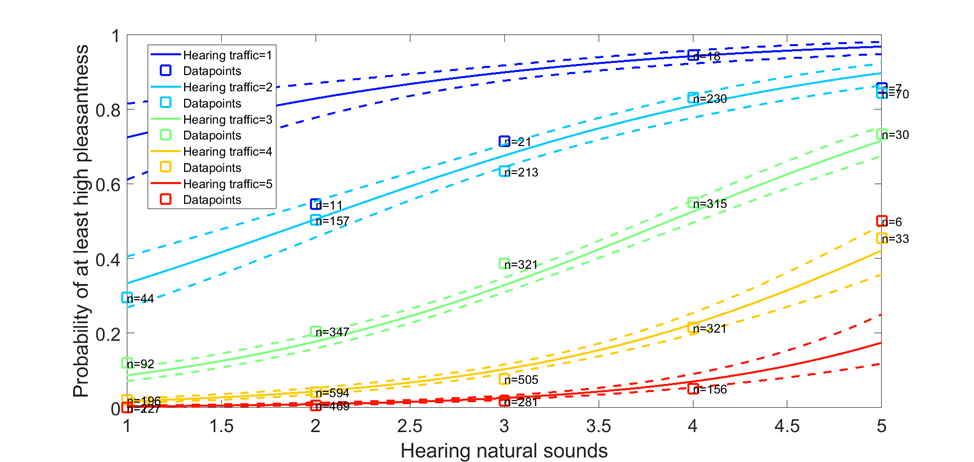
The probability of experiencing high pleasantness (y-axis) in your soundscape increased with the presence of natural sounds in it (x-axis). Of course, soundscapes were rated more pleasant when traffic noise was low (blue) than when it was high (red), but in all cases natural sounds resulted in an improvement.

And that, it turns out, really matters.

Reference:

Van Renterghem et al. (2025) Effectively hearing natural sounds is a robust contributor to positive outdoor sound perception in the everyday living environment. STOTEN

https://www.sciencedirect.com/science/article/abs/pii/S0048969725014500

Posted in Belgium, Science | 1 Comment