100 years of vegetation data

I find it of paramount importance that students learn how to communicate their research. Summarizing their ideas and findings for a broad audience challenges them to keep the ‘why’ in mind for their research, and reminds them they are part of a bigger effort to solve the remaining mysteries of our world. In this mini series, all master students of this academic year present their work in around 300 words. First up: Dymphna Wiegmans

Historical data over the past 100 years may reveal important climate and land-use change impacts on vegetation composition in the Scandinavian mountains.

With the looming presence of climate change, subarctic ecosystems are changing rapidly in vegetation composition. Plant species are either moving uphill or disappearing entirely, with dramatic repercussions for ecosystem health and stability.

Climate change is occurring twice as fast in subarctic regions than in most others, but this is not the only major disturbance, land-use change and tourism are two other common disturbances that may disrupt native vegetation and introduce new species to a region. Together, these pressures could lead to a shift in biodiversity and ecosystem functioning.

Our research focusses on the Abisko region – a village in Northern Sweden that lies approximately 250 km above the Arctic circle. Due to low mean annual temperatures, arctic permafrost occurs here and the region accommodates a unique biodiversity, with a lot of rare plant species. However, climate change, land-use change, and tourist activity increasingly impact this region. For instance, intense human activity and warmer temperatures lead to the introduction of ruderal species that are exploiting the warmer climate and increased disturbance. Due to their ecological needs, ruderal species may increase in numbers over time and will contribute to changes to the subarctic ecosystems in Abisko.

The Rallarvägen trail around Abisko, setting of more-than–a-century-old vegetation survey

In 1903 and 1913 botanist Nils Sylvén made vegetation surveys along the Rallarvägen trail: a trail established for the building of the railroad from Kiruna to Narvik. He started in Abisko and surveyed all the way up to Riksgränsen, at the border with Norway (40 km). In the following decades, a few other surveys were done in the region, resulting in a wealth of historical vegetation data that has up till now never been left unexplored. After Sylvén’s first survey, the railroad was built in 1904, paralleling the Rallarvägen trail, with a couple of intersecting train stations and settlements. Since then, the trail itself became popular amongst hikers. In the summer of 2021, almost 120 years after Sylvén, we revisited and resurveyed the trail. Together with climate data from the Abisko Scientific Research Station (ANS), available since 1913, and with additional plant distribution data from other trails ranging from the Rallarvägen into the adjacent mountains, we intent to investigate how climate and/or land-use change influences the vegetation composition and their migrations uphill in the Abisko region.

Posted in Sweden | Tagged , , , , , , , | 1 Comment

ME&B conference

Preparations are now in full swing for the first ever international microclimate ecology conference, which we’ll host here in Antwerp from the 28th-31st March 2022. The Microclimate Ecology & Biogeography conference is a joint collaboration between the microclimate labs from the Universities of Antwerp, Ghent and Leuven and is supported by our SoilTemp network. Both abstract submission and registration are now open, and can be found on our website!

This conference will be held in Antwerp over 4 days and will be an in-person and online event. It will cover a wide range of microclimate-related topics, from arctic ecosystems to tropical ones and all species and ecosystems in between, as well as from a tiny scale to a global scale.

We got interviewed by Flora Passfield from the BES Forest Ecology section about the what’s and why’s of our conference, very much worth checking out the story here!

Posted in Belgium | Tagged , , , , , , | Leave a comment

The rhododendron that can be tracked from space

In the alpine tundra of the Changbai Mountains in Northeast China, on the border with North Korea, climate has warmed significantly over the last few decades (at a rate of 0.28 °C/decade, from 1959 to 2017, to be precise). It’s a pity that we can’t go back in time to see how this has affected the mountain and its ecosystem! Or can we…?

A unique time series

In a new paper, led by Shengwei Zong and published just now in Remote Sensing and the Environment, we dug up an extraordinary time series of 54 (!) years of satellite data, starting with declassified KeyHole camera data from a US Defense satellite from 1963, and then all the way up to the most recent, high-resolution satellite imagery. The goal? Analyzing these images for changes in snow and vegetation cover on the mountain. For the latter, we focused specifically on a unique little shrub: Rhododendron aureum, an alpine shrub that conveniently stands out in autumn as it’s the only shrub in the region that keeps its green leaves when winter approaches.

Fig. 1
Changbai Mountains, on the border with North Korea, providing the back-drop for our study. Noteworthy is the top-right picture (A), where you can see patches of Rhododendron (in dark green) stand out from a brown autumn vegetation on the mountain.

Rhododendron in retreat

In short: we show that climate change has advanced the melting of snow in spring over the last 54 years of satellite data, while it resulted in a general upward retreat in the distribution of R. aureum over the last 30 years (of applicable satellite data). This makes sense, as the species needs a good spring snow cover to survive against cold temperatures! Take away the spring snow, and conditions get much harsher.

Fig. 10
We used our model – calibrated on the current modelled link between Rhododendron and snow cover (a), to predict its future distribution as climate keeps warming (b). While we already observe a small upward retreat now (not shown here), we expect significant further declines in area (c) and shifts in elevational optimum (d) in the future.

So, our study provides a good example of how climate change is actively affecting species distributions under our very own eyes (or at least those of our satellites), in this case through changes in snow cover. We can expect those changes to be happening all around us. However, as long-term biodiversity monitoring is still rare and far-between, these changes are often hard to proof.

Complexity abound

We here show that the increasingly long-term satellite record can provide a great alternative to long-term surveys on the ground to record such changes over decadal periods. However, and we can’t stress this enough, accurately reading satellite data and getting this information out of them is NOT easy. You’ll see this if you browse through the paper, which has an impressive methods section (cheers and applause for Shengwei Zong for persisting with the analyses), and has gone through a few rounds of deep peer review helping us to clean up loose ends and making the methodology more air-tight.

Fig. 2
Did I say complexity? This figure gives an overview of the methodological steps taken to extract Rhododendron aureum (RA) distribution data and link it to environmental data through species distribution models.

Just to give one example of the complexities: in the Changbai Mountains, we were pretty lucky to have fairly large patches of one specific species – the Rhododendron of interest – that stand out on satellite images in autumn, while the rest of the vegetation is green. And even then, it is far from straightforward to tell your algorithm which color of green represents your species of interest, and which is noise, as often enough there are other plants intermingled with the Rhododendron.

Fig. 4
Linking the ‘greenness value’ of the satellite images (here called ‘NDVI’) to distinguish between a large cover of herbs (brown line) or Rhododendron (green line) in autumn

And then I’m not even talking yet about the aligning of images from different satellite sources, which gets especially tricky when one dives back as deep in time as the KeyHole camera data from back in the days when accurately monitoring environmental change was most certainly not the main goal of the imagery.

In short, we hope this rather complex methodological paper holds lessons for ecologists and remote sensing specialists in the future, and can help put us further on track to use satellite data to analyze vegetation change in these times of increasingly rapid global changes.

More details:

Zong et al. (2021) Upward range shift of a dominant alpine shrub related to 50 years of snow cover change. Remote Sensing of Environment

Posted in China | Tagged , , , , , , , , | Leave a comment

Happy hunting

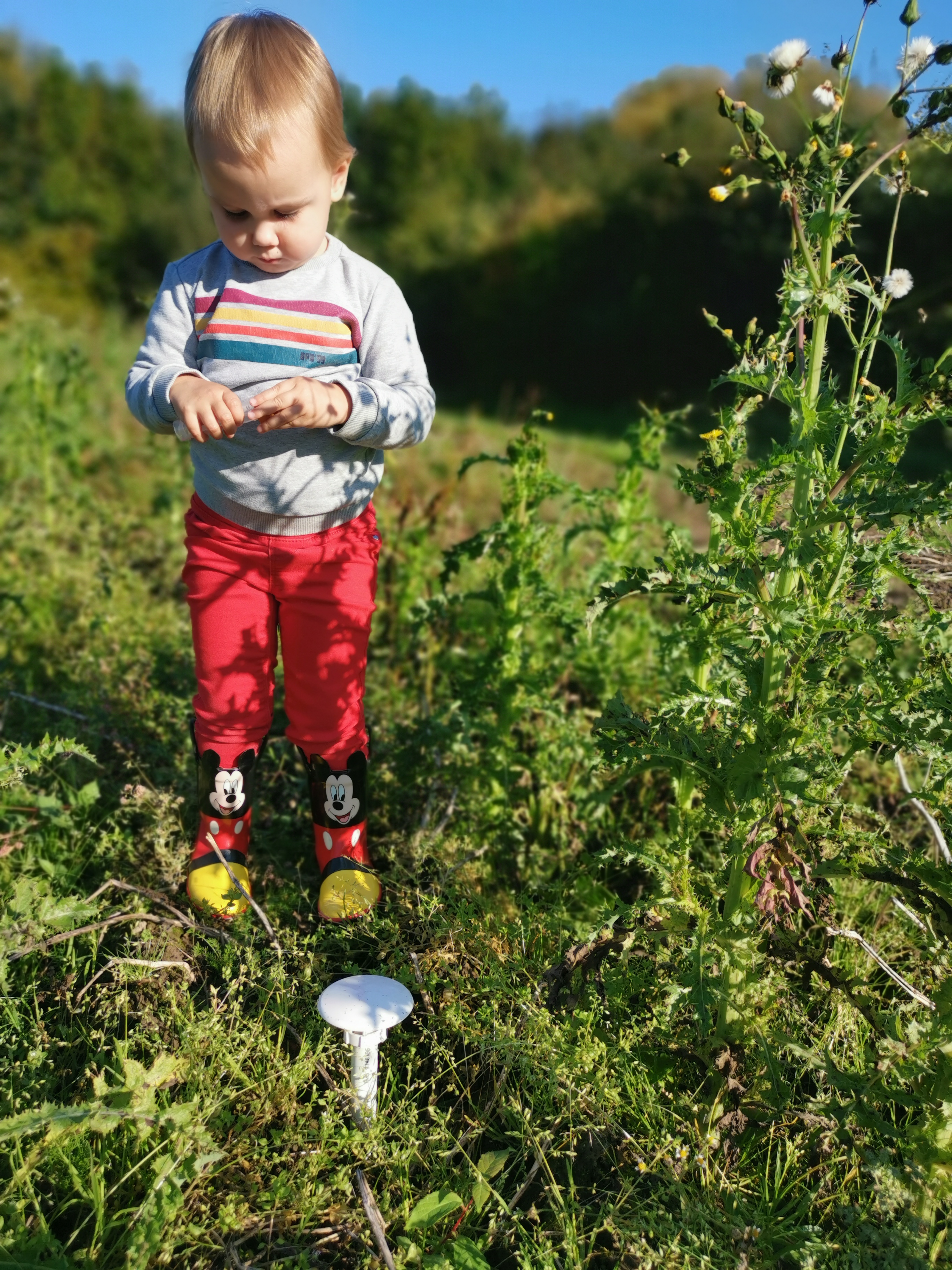
Finding ‘daddy’s little mushrooms’ has become one of the favourite activities of our oldest

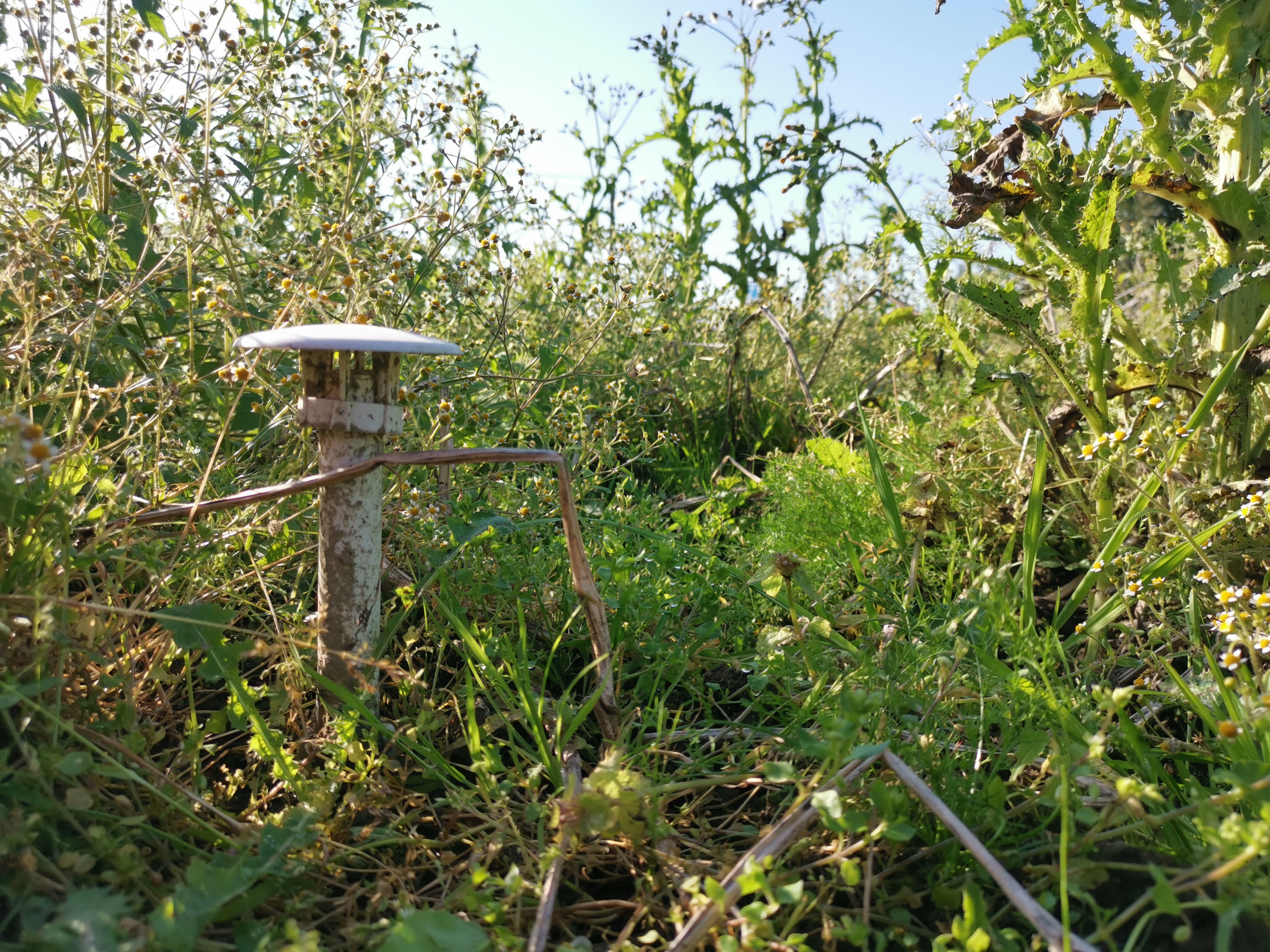
I spent a happy, sunny, warm autumn Saturday on the farm with my oldest. The goal? Finding back the microclimate sensors we installed there together in early spring, and taking soil samples for soil microbial analysis. And learning about farm life, of course!

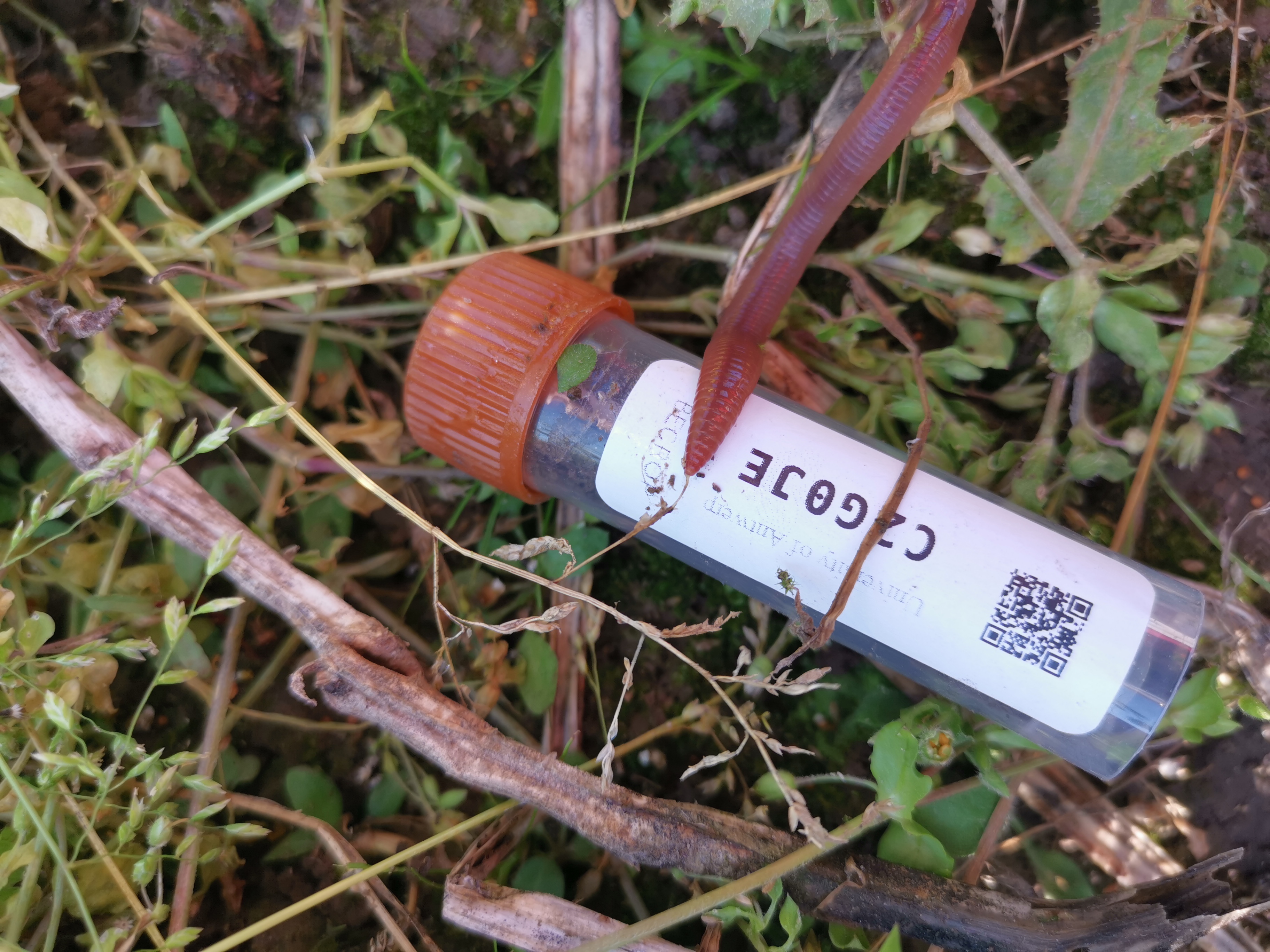
Taking a soil sample at the sensor location. Samples will be sent to ‘BiomeMakers’ in Spain, a company analyzing agricultural soils for their microbial diversity with which we partnered up

The fieldwork is part of our ‘CurieuzeNeuzen’ citizen science project, for which we also installed 500 sensors in potato fields and other farmlands all across Flanders. Goal is to see the spatial variability in microclimatic conditions across farmlands, and link these to the growth of the potato plants and the health of the soil.

This doesn’t look much like a potato field, but they are there – belowground! The diversity of plants (weeds, so you want) is the result of the organic farm methods used here.

We are participating with our community farm, where we weekly get our own vegetables. Across the farm, we installed ten sensors. The farm is small-scale and organic, so it will be especially interesting to compare with large-scale more industrial potato production we cover elsewhere.

The soil on the farm was beaming with life, perhaps thanks to the organic farming? We’ll take a look at the microbial communities and see if an organic footprint can be found back. In any case: plenty of little crawlers and creepers to show to the kid!

With that, another great day spend in nature, combining curiosity with science!

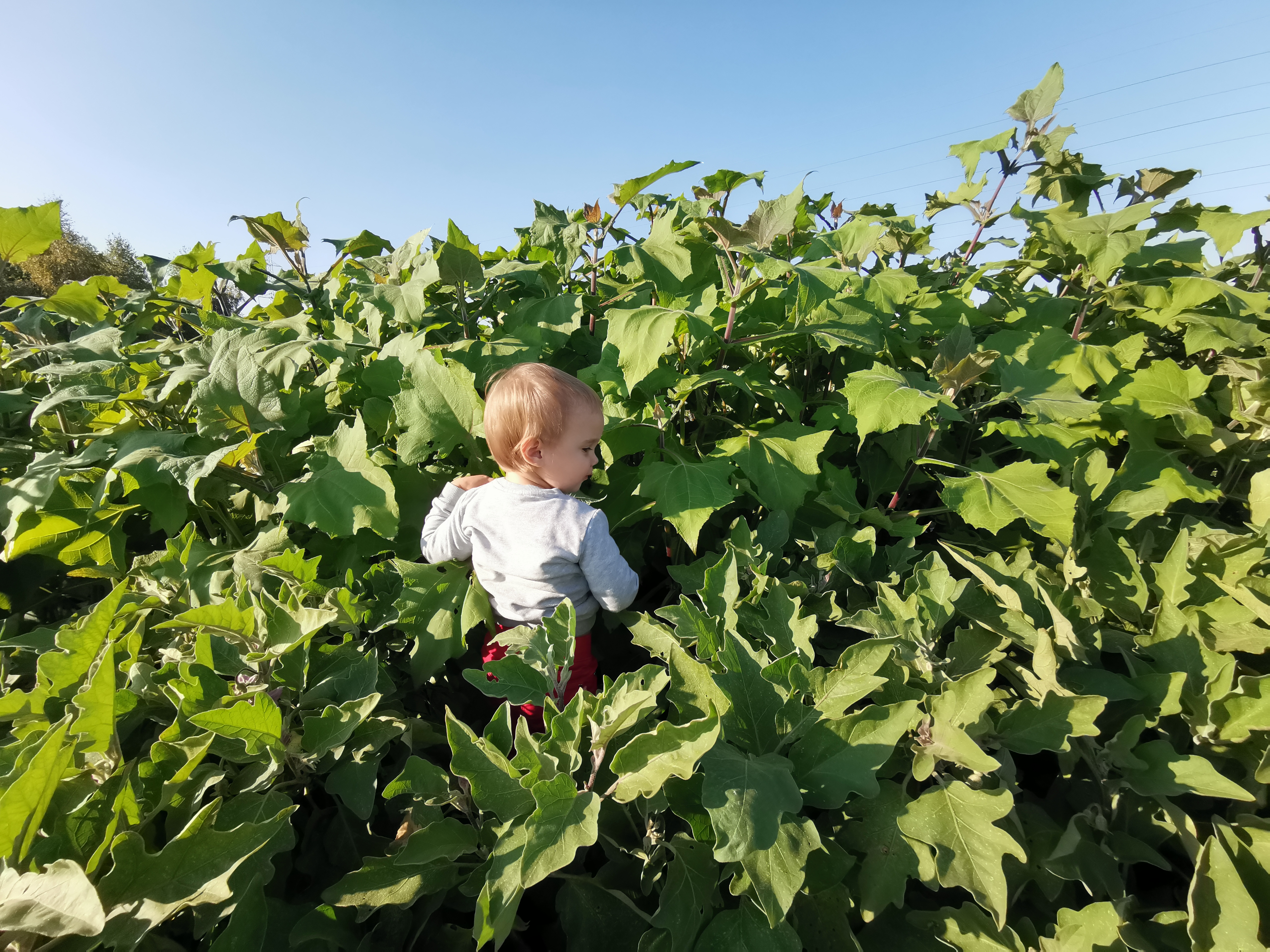
Searching sensors in a dense field of yacón
Microclimate in action: this tire is really warm, daddy!
Posted in Belgium | Tagged , , , , , , , | Leave a comment

Much-missed interactions

Oh, finally! Finally, after such a long time: a research visit!

The waterfront of Amiens, host town of this weeks’ research visit

I’m spending two very short days in Amiens, visiting the lab of friend and SoilTemp co-founder Jonathan Lenoir, and meeting up with two other partners in SoilTemp-crime while there. The main goal: real-life science discussions! No Teams, no Zoom, no Skype, just sitting in a room – at a safe distance from each other – and let the minds roam free.

I truly felt this was necessary to spark some fires, focus some thoughts, and solidify some research directions; things that are a lot harder to achieve in virtual meetings or over emails. I really wanted to get some priorities straight, as in my enthusiasm for the sciences it’s often tricky to see what should be done first and – perhaps more importantly – convince the funders of those priorities.

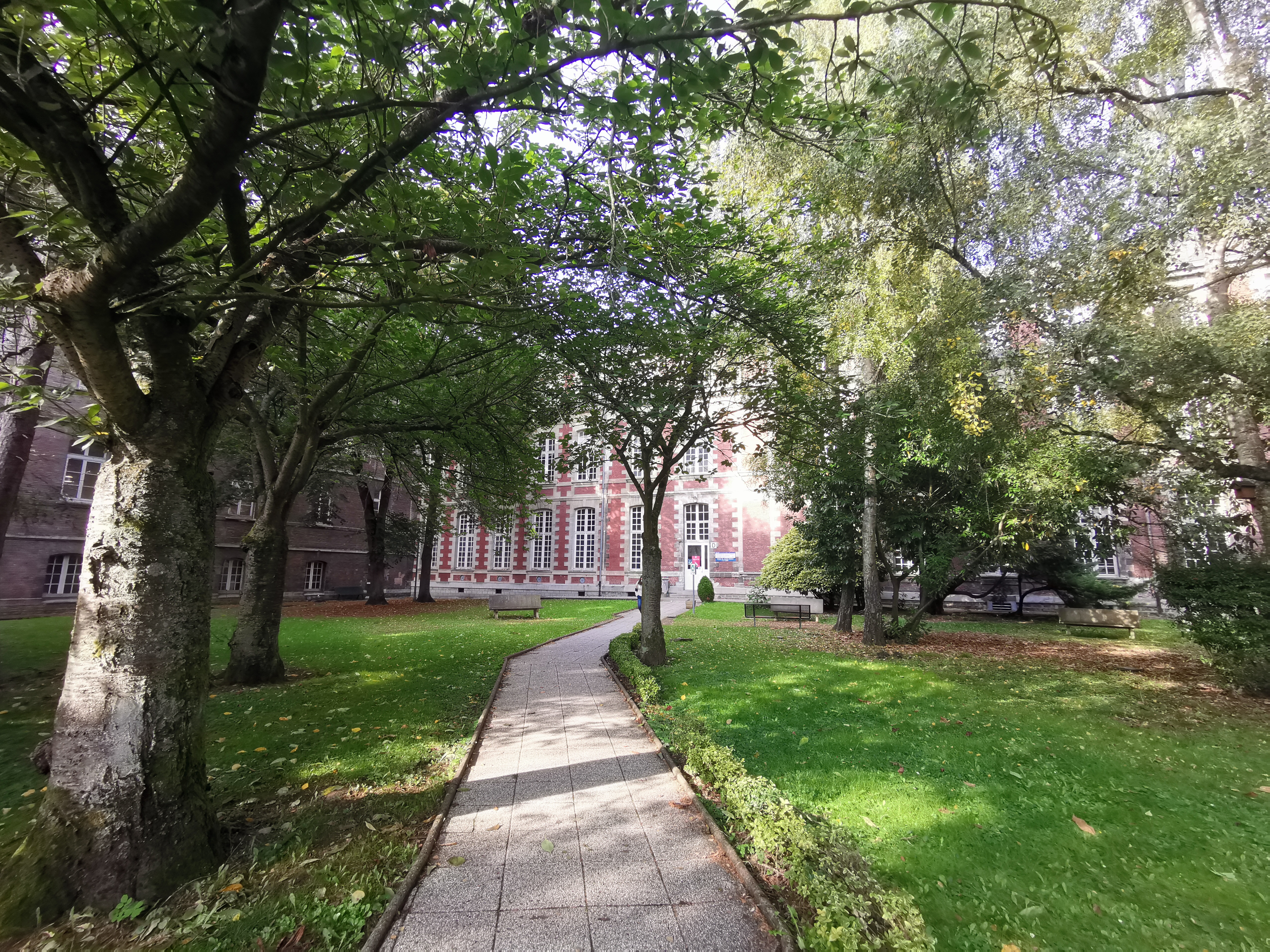
The campus of the Université de Picardie Jules Verne, an inspiring backdrop to think about science

And just the mere fact of being here has already made a massive difference: we established the backbone for my next research proposal, one that should keep me on the rails for again a little bit longer, and one that should – if the Gods of Money are Generous – allow us to turn our plans into reality.

We also had some great meandering discussions on the scientific topics of interest, those kind of creative jumps and bousts of inspiration that are so much easier to realize over a shared cup of tea than when staring at each others’ pixelated face over crappy webcams.

The cathedral of Amiens, a stony giant and a landmark all across the city

While staring up at Amiens cathedral, I realized: I am not that ambitious that I need to build such a stony monster for myself, but I do strongly feel that our world needs a ‘cathedral of science’ to tackle the ongoing climate and biodiversity crisis, and that we need it fast. And I think I have a few more crucial bricks that I could contribute to the pile, and would love to get that chance!

Posted in France | Tagged , , , , , , , | 1 Comment

The first map of the air-conditioning effect of European forests

Press release

Forest canopies cool summer temperatures with up to 10°C. An international team of scientists led by researchers from the KU Leuven in Belgium now mapped the temperature of all European forest patches to quantify the airco function of each and every one of them. You can explore how that looks for Flanders at https://www.sglobelab.com/forestairco/

Mini-weather stations on the forest floor

On a hot summer day, forests can feel a lot cooler than the surrounding area. Yet how much cooler a certain forest patch could be has been a lot harder to quantify for ecologists. Up till now, as an international team of researchers, led by PhD student Stef Haesen and Prof. Koenraad Van Meerbeek from the KU Leuven, Belgium, has now quantified the temperature of each and every European forest at a resolution of 25 meters, a resolution much finer than any of the 1-km resolution datasets that were currently available.

Using a unique dataset of more than 1200 mini-weather stations across all of Europe’s forests, the 52 researchers from more than 10 European countries quantified the difference in temperature between the forest understory and the existing weather station network. “This network of sensors on the forest floor is unique,” explains Stef Haesen, lead author from the study, “as it accurately captures the true temperature under the forest canopy, for forests big and small.”

Forests as thermal insulation

The data show that the maximum summer temperature in forests across Europe are on average 2°C (and up to 10 degrees) lower than outside forests. Similarly, minimum temperatures in winter can be 2°C (up to 12 degrees) higher than outside forests.

“With their foliage and branches in the canopy, trees create a thermal insulating layer above the forest floor”, explains Haesen. “For this reason, summer maximum temperatures are much lower inside forests than outside. Summer heat waves are thus strongly moderated below the tree canopy.” Forest canopies provide as such an effective air conditioning, increasingly important in a warming climate.

“Now this is the first time we have such a map at such a high resolution and over such a large spatial extent,” says Haesen. “This is a real scientific and technical breakthrough that will undoubtedly improve predictions from distribution models for forest species,” he adds. As the researchers worked at a higher resolution than ever before, their analyses also revealed never seen differences between and within forests: no two forests are the same, and differences in canopy cover, topography or tree species composition create significant variation in temperatures.

The new high-resolution forest temperature maps thus provide crucial information for researchers to analyse impacts of climate on and in forests across Europe. Haesen summarizes: “If we want to know why certain forest species grow where they are growing, we cannot use climate data from weather stations outside forests, we need the information from the location where the organisms live. These maps here are a real revolution in terms of information accuracy to know, but also to manage, the temperatures as felt by the tree saplings that constitute the forests of tomorrow.” That information becomes more important every year, as this protective shield is weakened by climate change and the increased frequency of extreme weather events (droughts and storms) that threaten the integrity of the canopy.

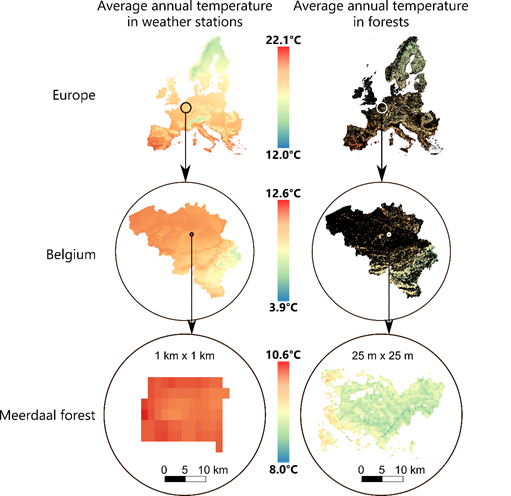
Unique high-resolution predictions of forest temperatures of all European forests reveal the significant temperature buffering caused by the forest canopy. Here shown for the ‘Meerdaalwoud’ close to Leuven in the centre of Belgium. On the left, you see the existing temperature data based on weather stations, on the right the new high-resolution temperature data product for all of Europe’s forests.

More information

The paper in Global Change Biology: https://onlinelibrary.wiley.com/doi/full/10.1111/gcb.15892

Posted in Belgium, Science | Tagged , , , , , , | Leave a comment