New paper published: Lembrechts, Milbau and Nijs (2015) AoB Plants.
Disturbance is important in ecology. It disrupts the status quo, improves the diversity, adds to the possibilities. It creates opportunities and disables others. As such, it is a driver of dynamics that is impossible to ignore.
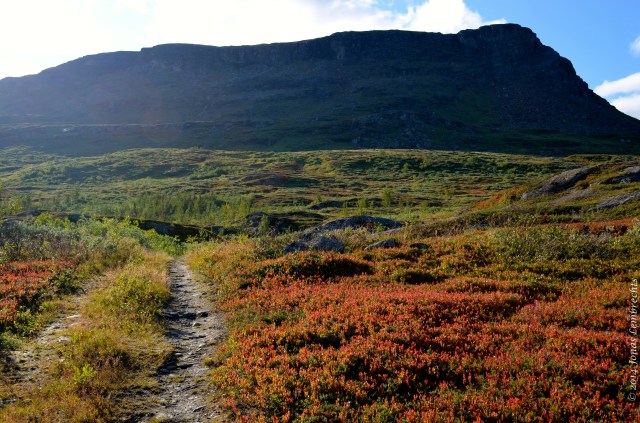
Human disturbance in the mountains, Swedish Lapland
In most research, disturbance events are studied as a yes or no: the vegetation is either disturbed, or it is not. The origin and size of these disturbance events are then often varied (are we talking about grazing or complete vegetation removal, did the disturbance create gaps of a few centimeters or several meters, etc.). However, often neglected in these discussions is the fact that conditions within one such a disturbance event can vary considerably.
We argue in a recent paper in AoB Plants that vegetation gaps form a micro-ecosystem on their own, with large variation in conditions over not more than a few tens of centimeters. This variation occurs across the known variation on a macro-scale. We also argue that this small scale matters. It matters a lot, because plants colonising such gaps only experience the environment that is in their immediate surroundings, and they do not sense the conditions within the whole gap.
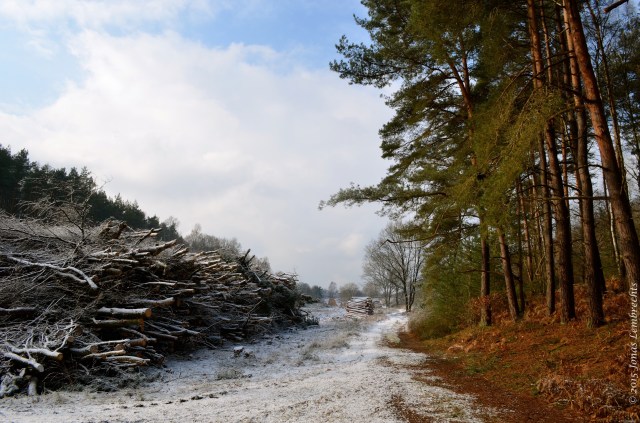
Temperature variation within disturbance events can vary over a scale of centimeters (National Park Hoge Kempen, Belgium)
Let us look at this concept with the help of a thought experiment. We travel to the mountains in a cold climate, where we will find a cold temperature gradient from ‘pretty fine’ in the lowlands to ‘unbearably cold’ at the highest elevations. We are lucky to have the Stress Gradient Hypothesis, a stronghold of ecology, to explain what will normally happen along such a gradient.
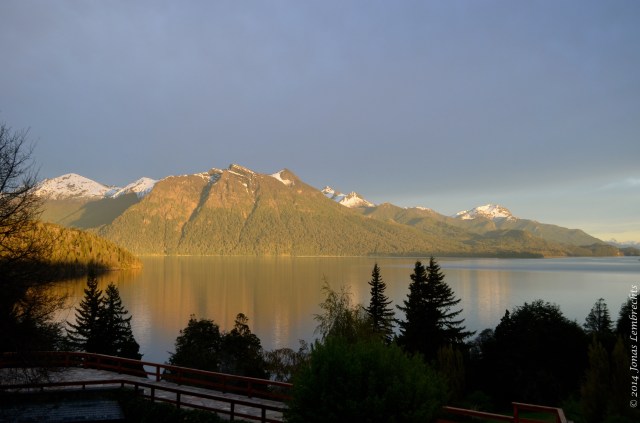
In a control system (without any disturbance), the interactions between species in the lowlands will be dominated by competition, a constant struggle to overthrown one’s neighbour and get (or maintain) access to life-defining resources. Towards higher elevations, on the other hand, there is another interaction that slowly gains importance: facilitation. The more stressful an environment becomes – in this case the colder it gets – the more a plant will benefit from a nearby colleague that can make this stress more bearable.
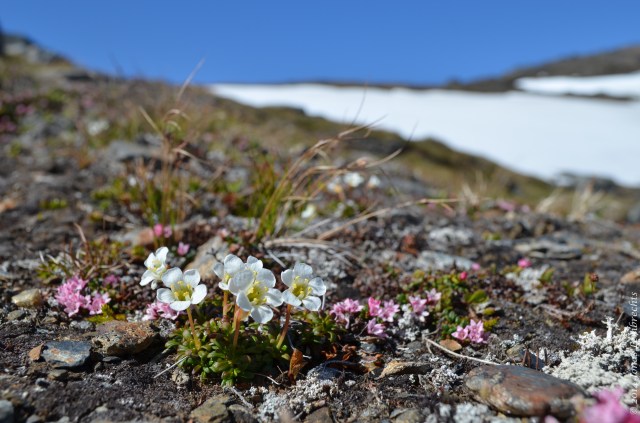
In stressful alpine environments, neighbours are often a blessing, Swedish Lapland
Vegetation is known to soften temperature extremes, providing important protection against freezing temperatures in a mountain environment, especially in the vulnerable early seedling stage.
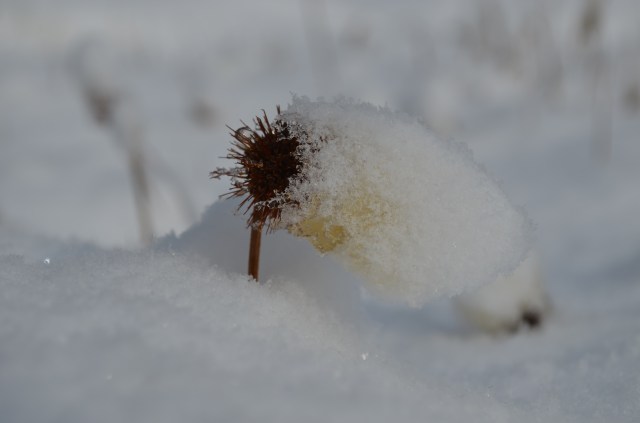
Vegetation alters abiotic conditions on a small scale, Punta Arenas, Chile.
We can however imagine humans entering our peacefully imagined disturbance-free mountain ecosystems. They trample, they disturb, they create gaps. Open space, bare ground, fields of possibilities. But if we keep in mind the previously described Stress Gradient Hypothesis, we can imagine that our gap colonisers will now face a difficult dilemma: do they want to be close to the gap edge and their neighbours, or as far away from them as possible.
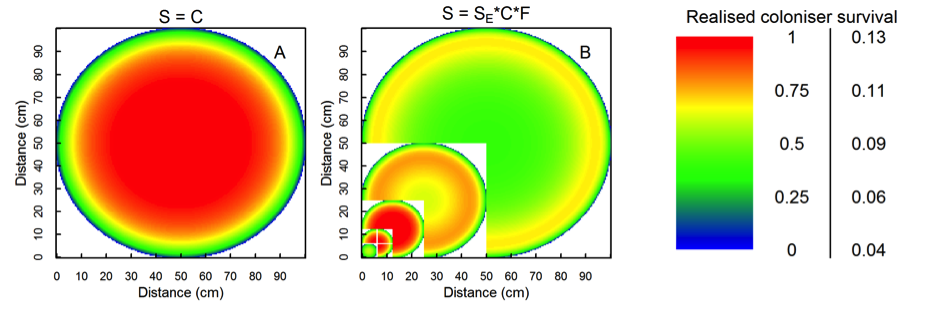
In the mild climate of the lowlands, the decision is easily made: there is not much good to be expected from the surrounding vegetation, they will just compete for light and nutrients and reduce your survival chances. The closer to the centre of the gap, the higher your chances get.
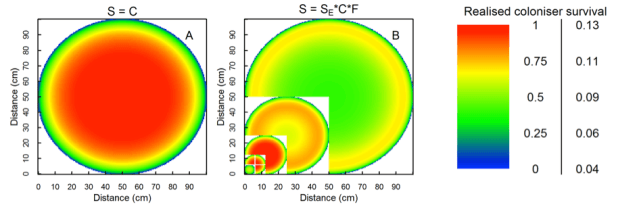
Predicted gap coloniser survival in mild (left) and stressful (right) environments, based on competition and facilitation
In the cold environment at high elevations, the dilemma gets a bit more complicated. Chances of surviving without help of a protective vegetation cover get lower, so the ideal location shifts towards the gap edge. Competition however keeps playing a role, so too close will still get you into trouble. The colder it gets, the more the balance will however shift towards the gap edge.
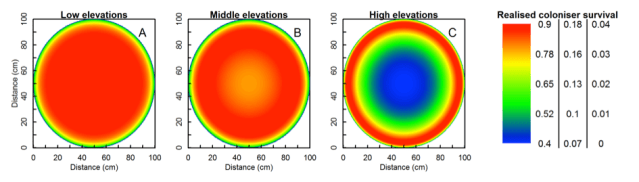
Final modeled coloniser survival in gaps along an elevation gradient, with a clear shift in the optimum (red) from the center of the gap to the gap edges
And all of this, my friends, is why the smallest scale matters: there is a strong gradient over which these biotic interactions weaken, and a coloniser will have the highest survival chance there were the trade-off results in an optimum.
On a mountain gradient, there are several factors that promote this gradual shift from gap center to gap edges. With increasing elevation, not only the temperature will get lower, the vegetation will also get smaller, shortening the distance over which competition and facilitation will be felt. The importance of facilitation will also increase, even more widening the difference in survival chances between gap edge and gap center.
But what does this mean? It means that at high elevations, gap colonisation will be strongly limited, as the only possible locations to colonise will be close to the gap edge, or in small gaps, while colonisers at low elevations will need larger gaps to stand a chance.
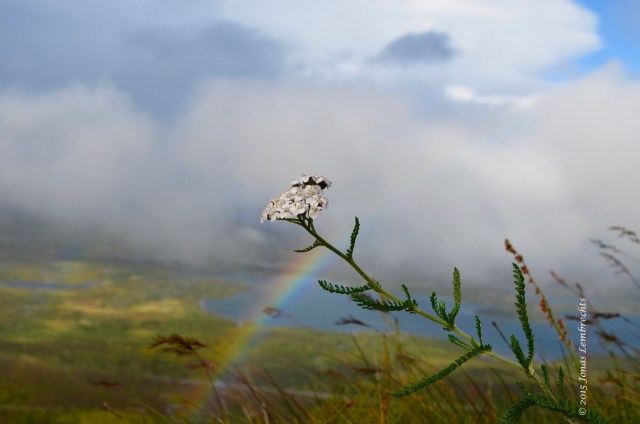
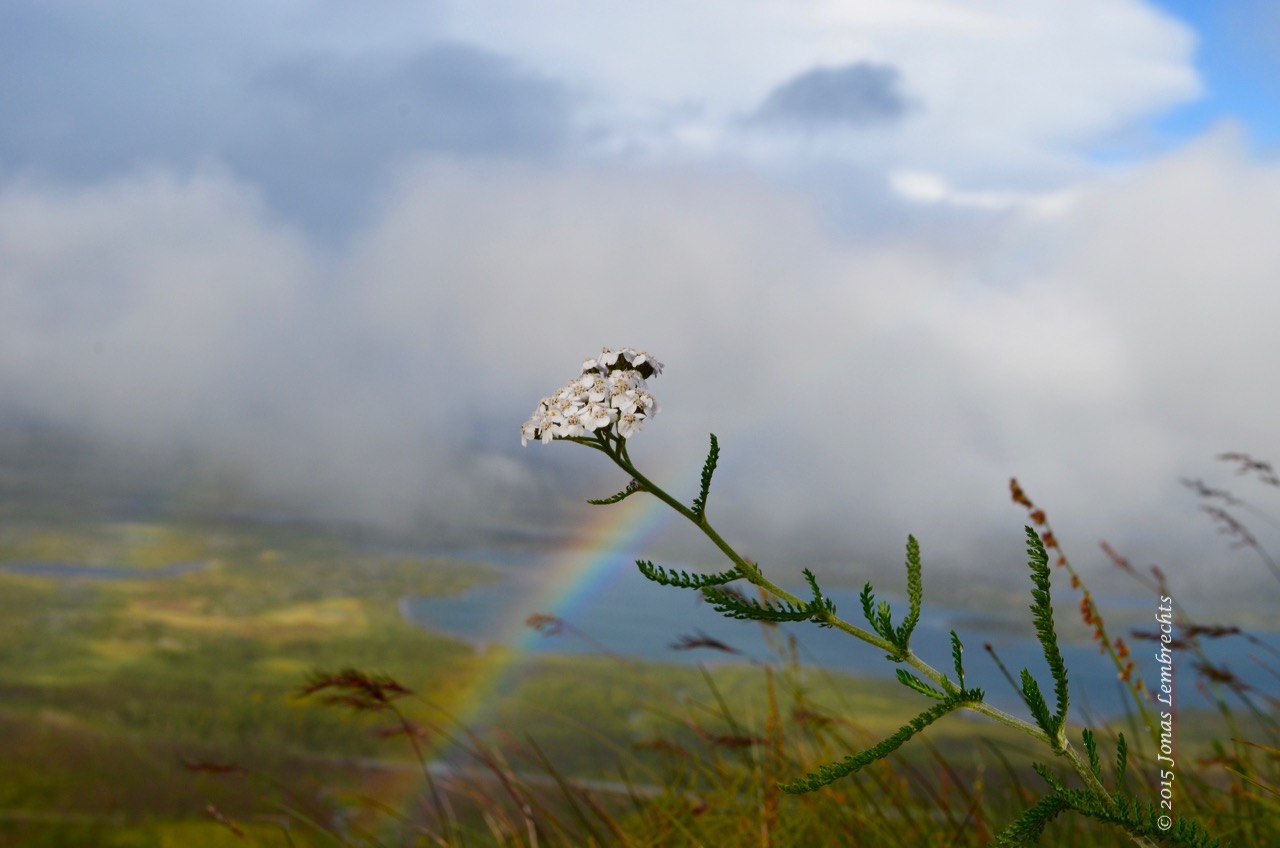
Non-native Achillea millefolium in the northern Scandes, Swedish Lapland
It will be important to keep this theory in mind and acknowledge the importance of the variation within disturbances when looking at several global change problems in mountains. For plant invasions in mountains, for example, disturbances have proven to be from major importance, as they are strongly connected to roads, paths, mountain huts etc. When they reach high elevations, however, this connection with anthropogenic disturbances might get lost, and the invaders might shift from roadsides to the natural vegetation. This shift from a limited number of locations of high disturbance to the vast area of less disturbed nature in mountains might make invasion management more challenging.
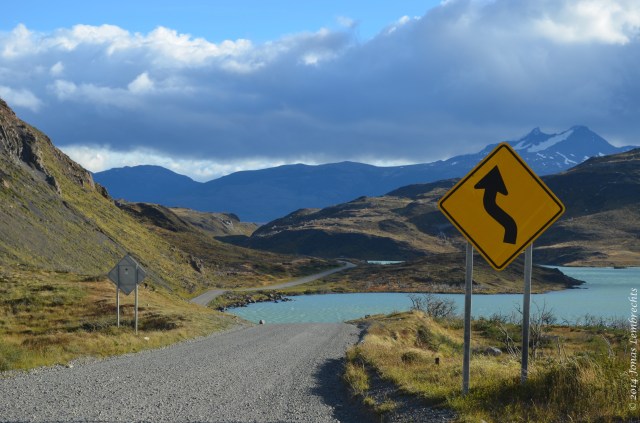
Disturbances like mountain roads serve as vectors for invading plants, Torres del Paine, Chile
From another perspective, the strong warming in alpine environments resulting from climate change will decrease the importance of facilitation at the expense of competition. Gap colonisers will then get opportunities to use a larger portion of gap surfaces, increasing the efficiency of gap regeneration and the succession rate in disturbed alpine environments. Increasing anthropogenic disturbance in mountains, in combination with climate change, might as such accelerate the observed upward movement of several species.
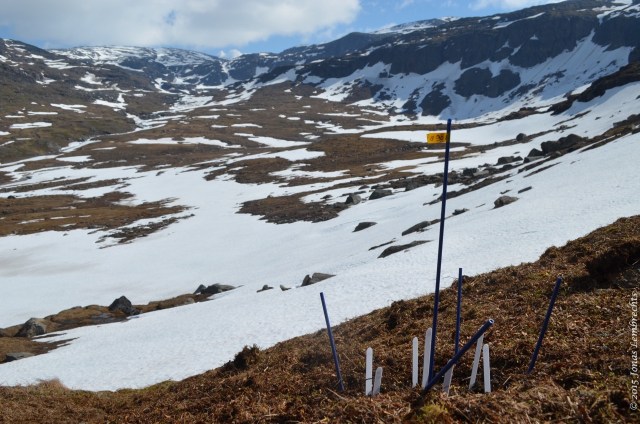
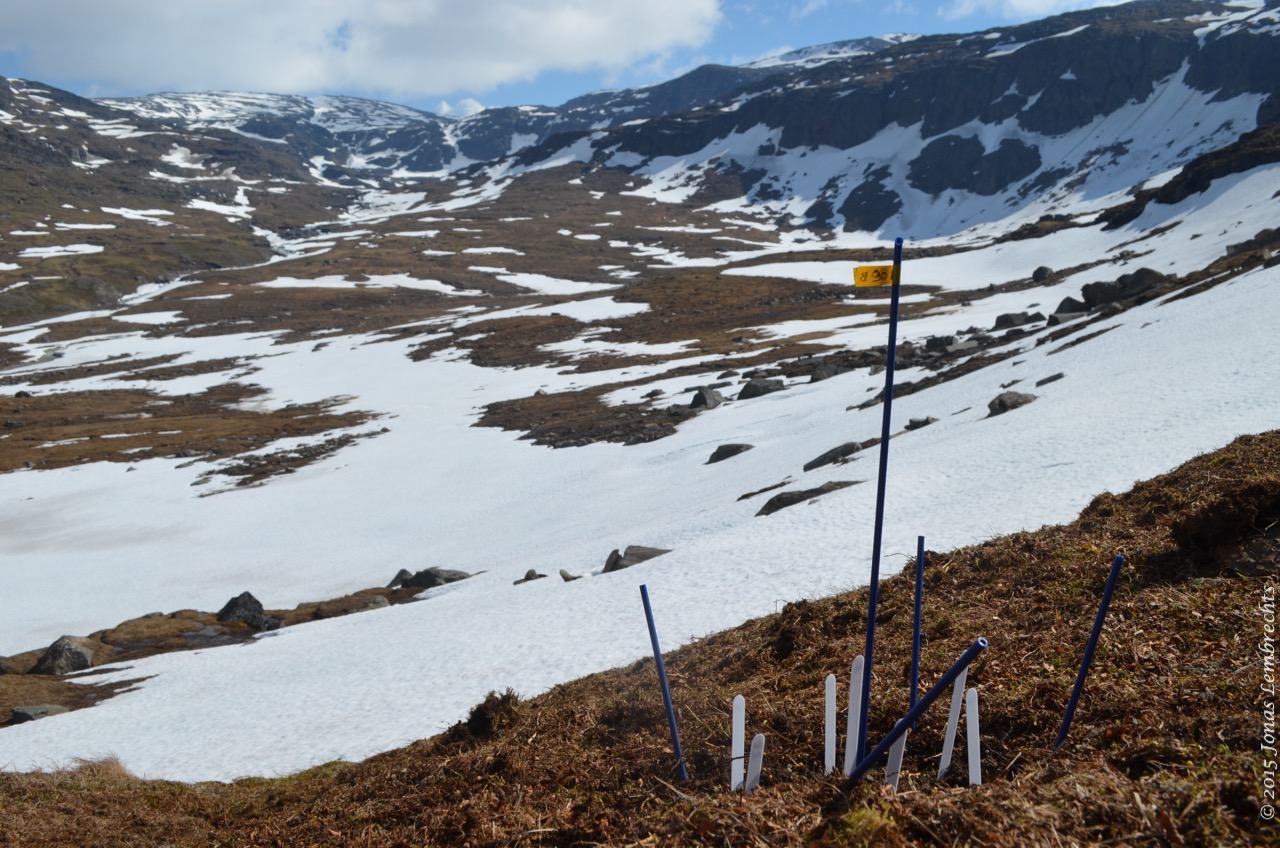
Experiments with small-scale disturbance in the mountains can shed light on the proposed patterns, Swedish Lapland
To summarise: as ecologists, we will need to dig deeper and look closer to find answers, even on the large scale of species distributions and movement. We will be surprised to find out how big our error has been until now.
Reference:
Lembrechts JJ, Milbau A, Nijs I (2015): Trade-off between competition and facilitation defines gap colonisation in mountains. AoB Plants doi: 10.1093/aobpla/plv128.








 The 3D lab