That damn snow again

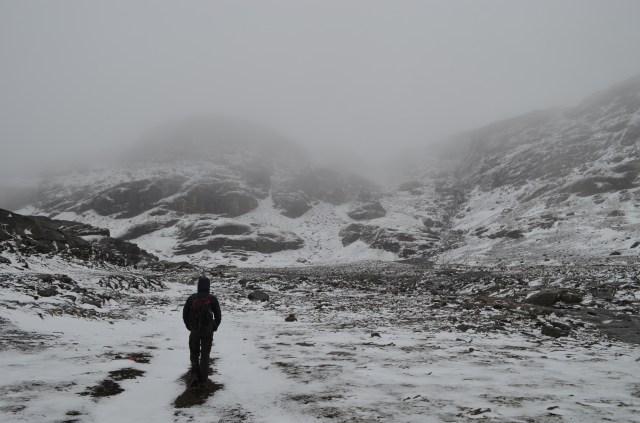
During last year’s field trip to Sweden, at the very end of August, an early autumn snowstorm threw us of the mountain. You can (re)read the account of that humbling hike here. We were beaten. Defeated. Nature’s powers were too strong. We managed to hike up, yes, but trying to identify plants under a growing pile of snow turned out close to impossible.
3

Last year’s snow storm covering the landscape in grey and white.

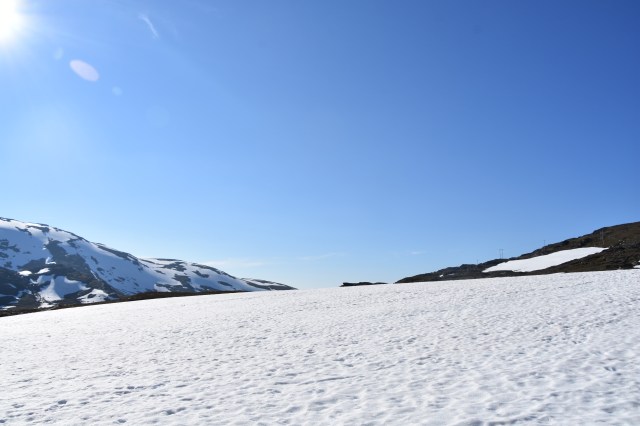
This year we came earlier to that damned valley, determined to win and find back the sensors we had hidden there when days were better and slopes uncovered.  But again, the valley would only reluctantly reveal its secrets. Oh yes, the weather was great, we made sure we waited for the best day of our whole trip. But there was snow. Again. Tons of it.
36153744885_688be1bce6_o

Turned out the valley was holding on to every inch of snow it accumulated over that surprisingly long Arctic winter. And thus, even now, the 20th of July, two weeks later than we usually manage to reach the top, we found massive snowpacks on our path.
36010397981_aed598dc9c_o

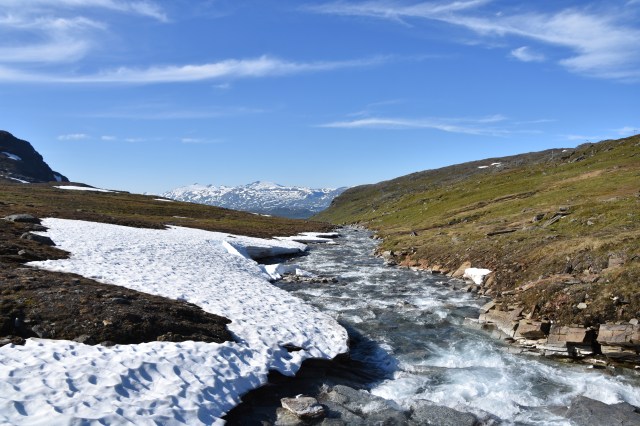
Low in the valley, the shadowy sides of the river were still covered with snow.

Too early for spring!? Yes, this is the subarctic, where spring has to hurry up as soon as winter finally releases it, before autumn catches up with it again only a few weeks later. This is the subarctic, where the summer suns are plentifull, yet life is living on the edge.

36022491471_aa1684c8c5_o

Early spring at the edge of a snowpack gives for beautiful flowers of Arctic willows

The snow started low enough to make us worry about getting anywhere at all, as we had to rely on a ‘summer bridge’, which only gets installed when snow is melted. Yet we were lucky in that regard, and we could continue our conquest of this amazingly wild valley.

36114835046_744e356c7d_o

Tiny flowers of Rhododendron lapponicum at the edge of a snowpatch

Unlike last year, luck now stayed at our side for most of the hike. While a few plots were buried under a thick pack of white softness, most of our plots balanced on the edge of the snowpacks. A bit of digging, a bit of luck, and in all but one plots at least one of the two sensors could be dug up.

35346891213_148db90d03_o

The trail marks appearing above the snow pack, helping us finding back our plots

That damn snow, yes, but it ensured the most beautiful views ever. We felt like true explorers, fighting the rough elements, and being rewarded with the best what nature has to offer.
35986670942_484e33f2e5_o

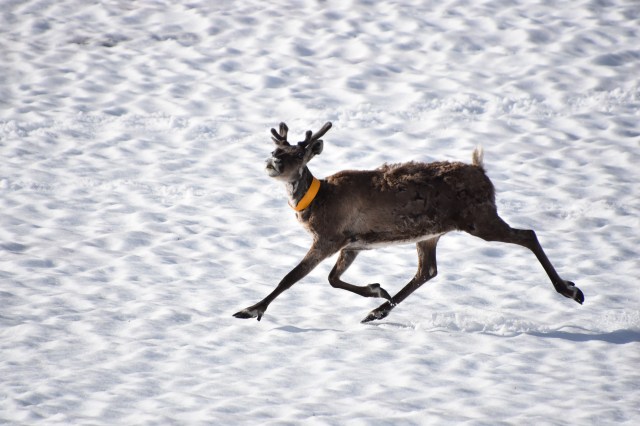
Reindeers enjoying the snow, and reluctantly accepting us in the tough world of their Arctic valley

35315635684_1c6853fd45_o

Reindeer in the middle of a frozen world

Posted in Sweden | Tagged , , , , , , , , , | Leave a comment

On a hunt for mountain plants

DSC_4775

Valerian flower in a Norwegian valley

We are at the height of our 2017 resurvey of the vegetation along Norwegian mountain roads, and the fieldwork has been highly successfull. It has been great revisiting the plots and discovering the changes – and often the highly interesting lack of it – in the last 5 years.

DSC_4958.JPG

Harebell flowers on the side of a fjord

The fieldwork brought some annoying bits of rain, yet mostly plenty of sun. It included beautiful flowers and breathtaking views, but also tons of sample bags and hours bending over in roadsides. We climbed rocks, jumped rivers and swam in an Arctic fjord, yet also spent hours in the lab, weighing leaves and sifting roots. An intense ten days, collecting data that can easily keep us busy for a few more years.

DSC_4838.JPG

Cottongrass in a species-poor mountain marsh

And the first results indeed look very promising, even though a lot of data still has to come in before we can get to any conclusions. Luckily, I can again count on an awesome fieldwork team, this year with three highly dedicated master students who use this extremely interesting study system for their master theses. With their help, the data will soon reveal all its secrets.


Posted in Norway | Tagged , , , , , , , , , , , | Leave a comment

A story of hotspots and stepping stones

Predicting the faith of exotic plant species in cold-climate mountains: our new paper is out now in early view! You can find it here.

Abisko, a small village north of the polar circle in Swedish Lapland. The origin of several mountain trails, winding through the pristine subarctic vegetation towards the breathtaking views at the top. A vegetation mostly consisting of slow-growing mosses and dwarf shrubs that seem to have been there forever. Yet during the last few years or decades, changes in this vegetation increasingly start to become apparent: several new species that are traditionally not a part of the subarctic vegetation are popping up along the trails. Clovers, common yarrow, sweetgrass or annual meadow grass, species that are typical residents of the milder parts of Europe, are now getting a foothold even here, in the high north. They border the trails, grow in the roadsides, line the buildings at the ski resorts and seem to follow humans with every step they take.

19921482181_f2a78ec182_o

A typical subarctic mountain trail, winding through a blueberry field (Vaccinium myrtillus).

The higher up you go in the mountains, the less common these new species become. At some point, often close to the treeline, they disappear entirely. Why do they stop there? Are these elevations finally too cold for exotic species to survive, or is it just a matter of time till they find their way to higher elevations? What drives their distribution and, most importantly, where will we find them in the future?

19146261819_b6ed3eb987_o

The subarctic mountain vegetation is dominated by sturdy sedges, tiny mosses and small flowers, like this mountain avens (Dryas octopetala).

To find out what the chances of these non-native species are in the coldest and highest mountains, an international team of ecologists set up an experiment high above the current elevational limit of these species. This was done at 400 meter above the local treeline, in an area where spring and autumn are almost back to back, and the full growing season lasts only a little more than two months. In this harsh environment, dominated by sturdy sedges and tiny mosses, they tested the potential of six non-native species, which have their origins in the mild climate of Western Europe. They simulated different human stressors (e.g., disturbance and soil enrichment) and planted seeds of the six focal species along a temperature gradient. Expectations were low: for a species used to the mild winters and relatively long summers of Western Europe, the high alpine zone of subarctic Lapland was unlikely to be hospitable.

19697075030_1e895529f1_o

Experimental plot in the mountains of Swedish Lapland

Yet the results were unsettling. Under ideal circumstances (e.g. warm, south-facing slopes and disturbed plots), the seeded plants managed to survive two growing seasons and a winter and they also produced significantly more biomass than in the control treatments. In undisturbed natural vegetation, on the other hand, success of the sown exotic species was negligible. Thus, only plots in which anthropogenic influences, such as fertilization and removal of the vegetationere combined with a sufficiently warm microclimate, resulted in establishment success for the exotic species. If, and only if, those two factors were present, the possibilities for exotic species to establish increased drastically, even at elevations far above where we find them now.

19733419758_b994ace726_o

Sweetgrass (Anthoxanthum odoratum) beating the odds in a disturbed plot on a south-facing slope.

Yet where to find warmth in these environments, you might ask? Surprisingly, the mountain climate is often drastically less harsh than one might expect when considering environmental heterogeneity occurring at very small spatial scales, even at high elevations. This is for a large part due to the complex topography of mountains: soils on south-facing slopes for example – which get a lot of direct sunlight all day long – can easily be 7 °C warmer than their surroundings. Yet humans themselves are creating such warm spots as well, by removing the alpine vegetation along trails, for example. The vegetation normally provides a buffer for extreme heat production at soil level during the summer, whereas removing it will increase the temperature. For tiny seedlings, these extra degrees might be lifesaving. In winter, on the other hand, a protective snow cover shelters the small plants from below-zero temperatures.

The surprisingly high success of exotic plants in warmer and more disturbed plots suggests that spread of exotic species into cold mountain regions is likely to increase significantly in the future, if climate keeps warming and anthropogenic disturbance of pristine alpine regions is not halted. But even now already, exotic species can make use of the warm spots in the landscape, either natural or augmented by humans, as stepping stones to reach higher elevations. The potential for exotic species invasion in cold environments is thus most likely heavily underestimated.


Posted in Sweden | Tagged , , , , , , , , , | Leave a comment

Live from the field

We are currently on a ten day fieldtrip to the beautiful Lapland, where we are monitoring the movement of plants along mountain roads.

DSC_3998.JPG

A job with a view, plenty of beautiful alpine and arctic plants, and a ton of great and interesting data coming in. More pictures and stories will follow, but now the field calls!

Posted in Norway | Tagged , , , , , , , | Leave a comment

Impatient

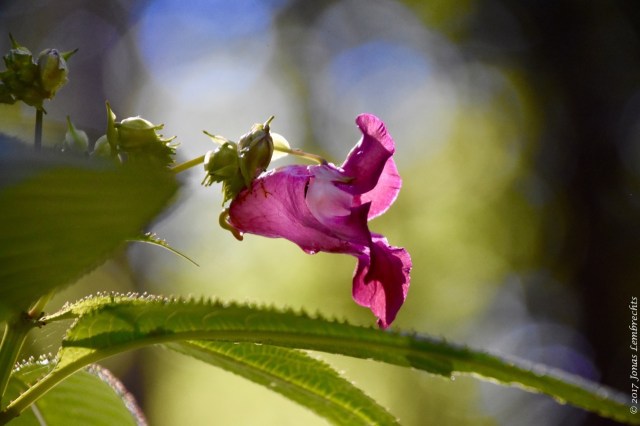
Impatiens - 2

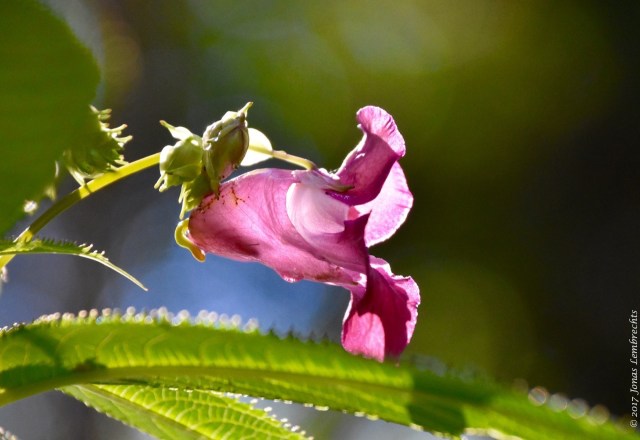
Time for a plant portrait of one of my favourite Belgian study species: Impatiens glandulifera, a tall herb with its origin on Himalayan mountain slopes, yet introduced all over the world by humans who fell in love with it.

Impatiens - 3

And what’s not to love about the Himalayan balsam? The flowers are beautifully original and shaped like a weird pink hat, earning the plant its common English names ‘Policeman’s Helmet’, ‘Bobby Tops’ and even ‘Gnome’s Hatstand’. 

Impatiens - 5

Yet when the delicate pink flowers disappear, the fun is all but over: the genus name Impatiens refers to the plant’s method of seed dispersal. When you touch the ripe seed pots, they ‘impatiently’ explode, scattering the seeds in all directions. I bet you this provided hours of fun as a child in my parent’s garden!

Impatiens - 1

Yet it is exactly this attractive but aggressive method of seed dispersal, coupled with a high nectar production that attracts countless pollinators, that makes the plant so successful. In many regions in Europe and North America, the plant easily outcompetes the native vegetation, especially along rivers.

Impatiens - 4

It is in that last environment that it provides the most trouble as well. Similar to that other invader, Japanese knotweed (Fallopia japonica), the Himalayan balsam dies off in winter dies off in winter, leaving the river banks bare and unprotected. Such an environment is much less protected against erosion by winter floods than a river bank covered with native reed (Phragmites australis) for example.

Posted in Belgium | Tagged , , , , , , , , , | Leave a comment

Science with doormats

35778155265_dbef6f4f56_o

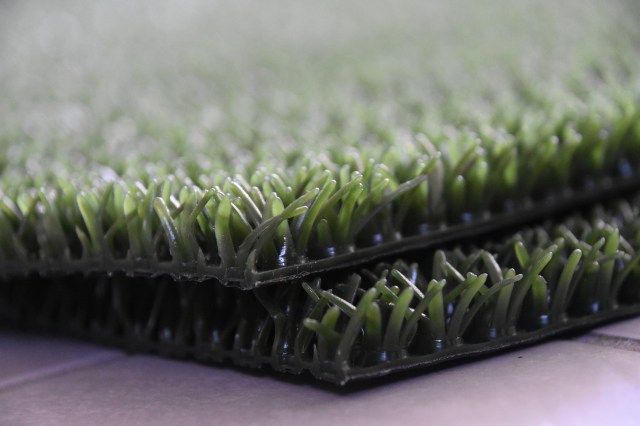
No, I am not investing in a soccer field, nor am I building an indoor garden for my cat (although the latter loves the idea).

35737365266_1e58ec0c72_o

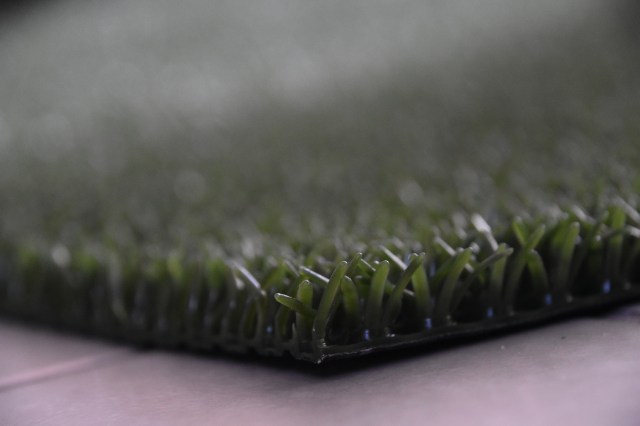
No, we are planning to dive deep into the study of the movement of plant species along mountain roads. Do I need a bunch of weird-looking doormats for that? Yes, as it is the ideal material to trap seeds falling on them.

34937436494_2cb3295ace_o

We will install these mats on strategic spots in in the landscape and then just wait. After the growing season, the mats will be taken to the lab and all seeds trapped in the hairs will be carefully collected and identified.

34937444614_a796c72368_o

Even more than just looking where the plants currently are, it will reveal their potential spread in the future. Hopefully more on that later.

And, oh yeah, do not laugh with my mats, they are a proven, published and peer-reviewed tool!


Posted in Norway | Tagged , , , , , , | Leave a comment