Dad in academia

On September 5th, my wife gave birth to a beautiful girl. On that day, our lifes went into a new, happier, fuller and much muore complicated phase: that of parenthood.

zoyla3.jpg

Me and the little thing that turned my life upside down

From one day to the next, I became a ‘dad in academia’. And from that day, the search was one: how to balance the sometimes more-than-full-time job that is being a postdoctoral researcher with the more-than-full-time job of being a loving dad. But there I am lucky, as my job as a postdoc – and my colleagues – allow me that one wonderful thing: flexibility.

Thanks to this, I could shift around my working hours, keeping in mind what the baby wanted, needed and deserved. That is a privilege, it truly is, but also one of the greatest things about a job in academia: most of the time it doesn’t matter too much when and where you work, as long as the work gets done.

So I dove into the data to see how that looks, the working life of a dad in academia.

Figure 1

My work schedule (minutiously tracked using the Timeular app) from September 5th, Zoyla’s birthday, till today, with each day a column. Pink colors indicate work that I did during working hours (of a ‘normal’ 9 to 5). The blue boxes are for work done outside these hours. Grey zones represent the weekends, horizontal black lines delineate the lunch break (often with colleagues).  Graph made with ggplot and (due to time limitations, I’m a working dad after all) some cheating in Inkscape. 

It looks like I did get the job done. Even though the first two weeks of her little life where spend in the hospital (she had to recover from a bacterial infection), the last two weeks were mostly spend moving into our own house, and I invested a great deal of time lowering the workload of the mother, I did still manage to be a fulltime scientist.

zoyla1.jpg

Explaining the magic of R to the baby. She prefers ArcGIS, it’s more colorfull.

It required quite some creativity, ranging from explaining the magic of R to a – relatively – interested 3-months-old to working standing straight with a sleeping baby in a sling. There was catching up of lost working hours in the evenings and the weekends, and profiting maximally from the early rising. There were moments of processing emails when nothing else could be done, like the boring times in the hospital when baby was kept in a different room, or in the darkest moments of the nights when the baby really really didn’t want to be in her bed.

zoyla2.jpg

Got the baby to sleep, so room for late night paper submission

In return, I got to experience so many precious moments of that baby growing up. Help ensuring that her mother doesn’t have to take the burden all alone, and being there with so many of the ‘firsts’ that make a parent happy.

Thanks to this academic flexibility, I never felt things getting out of control. Now, the new balance of life as a dad in academia has been found. What does remain challenging? The international travel that inevitably comes with my job. Leaving mum and baby alone for more than a day will every time tear me apart. For my next conference in Iceland, we’ll at least all go together, but many more heartbraking goodbyes will come.

Posted in Belgium, General | Tagged , , , , | 2 Comments

Microclimatic conditions anywhere at any time!

Earlier this month, the journal Global Change Biology asked me to write a little commentary about a recent paper . Well, that’s an offer one cannot refuse! First of all: that’s a tremendous honour; thanks GCB to think of me to write such a commentary. Secondly: the paper, from one of our SoilTemp-colleagues Ilya Maclean, is a beauty and more than worth the extra press.

So I got Jonathan Lenoir on board and wrote ‘Microclimatic conditions anywhere at any time!’

Conceptual figure.png

How we can get microclimatic conditions anywhere at any time, using the mechanistic models from Maclean (2019) in Global Change Biology, and microclimate measurements (for example from our SoilTemp-network)

That is indeed exactly what we are celebrating here with this commentary: thanks to the computer models made by Maclean and colleagues, we can now finally – finally! – calculate microclimatic conditions anywhere in the world, and for any moment in the past, present ànd future. And that is important, as it is these local climate conditions – overlooked by traditional weather stations – that do matter for all biodiversity on earth.

DSC_6633

Microclimate logger

So now, what is next in global change ecology research, given that we can now get the ‘real’ climatic conditions anywhere at any time? Well, we argue that the predictions should be matched with on-the-ground measurements from all over the world.

And that’s where our SoilTemp-database steps in. We would herewith like to renew our call to all researchers having microclimatic data records for a given location and microhabitat to share their data in a common and global geo-database: SoilTemp. More about that on soiltemp.weebly.com!

Reference

Lembrechts JJ, Lenoir J (2019). Microclimatic conditions anywhere at any time! Global Change Biology.

Posted in General, Science | Tagged , , , , , , , , , | Leave a comment

The hiking trail invasions

We like mountain trails. But we are not alone, it looks like: invasive plant species love them as well as a gateway to invade higher elevations areas.
What we always suspected, is now finally proven, thanks to the work of a tireless master student, spending a summer hiking up and down the slopes of the Chilean Andes.
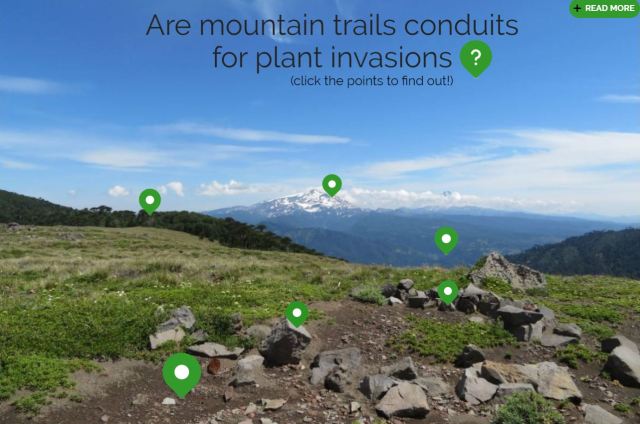
Click on the interactive image below to learn more about our results:
Captures
Thanks to Rebecca Liedtke and Jonas Lembrechts for pictures
Posted in Chile, General, Science | Tagged , , , , , , , , , , , | Leave a comment

Fluorescence

For years, I have been teaching a practical course on the measurement of plant stress to our master students. In that course, we introduce them to the magical ecological process called ‘fluorescence’ to investigate stress in their studied plant species. Now, finally, the ultimate field guide on how to measure this fluorescence is out, thanks to our ambitious ‘ClimEx’-handbook paper (see this earlier post).

PAM-2000 fluorescence measurement

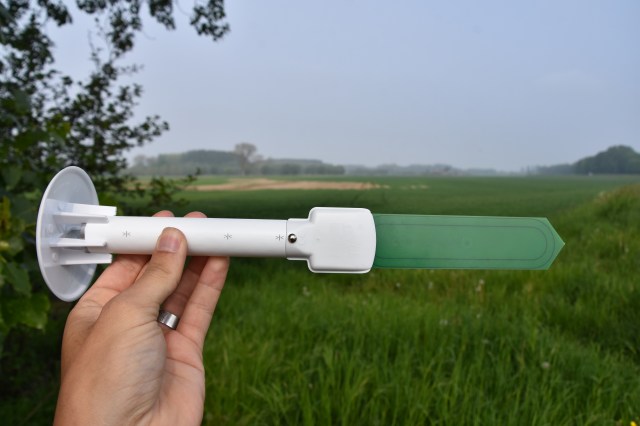
Chlorophyll fluorescence sensor

Yes, I am really talking about fluorescence, the physical process in which objects emit light, even when the light source is already gone. No, this does not result in leaves glooming like eyes of a cat in the dark, unfortunately. Leaves send out light at a wavelength invisible for the eye: infrared.

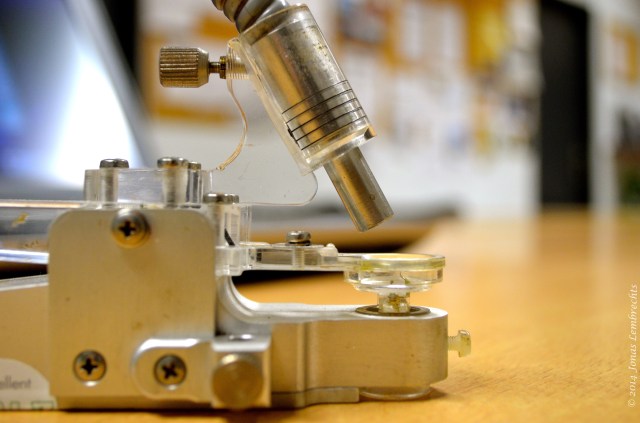
Dark adaption clip fluorescence

Clips for fluorescence measurement

In the practical course, students find out that the fluorescence of a leaf is the result of an excess of light in the plant: more that they can use for photosynthesis. It serves hence as an indirect way of measuring how much light energy the plants can use, which is then a measure for their ‘happiness’ level, as I tell the students.

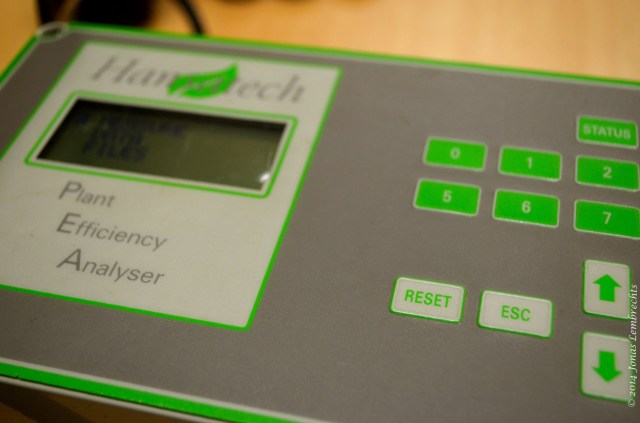
 Plant efficiency analyser fluorescence

With an ingenuous sequence of light pulses to activate and deactivate the photosynthesis apparatus of the leave, we can find out how much a plant is suffering.

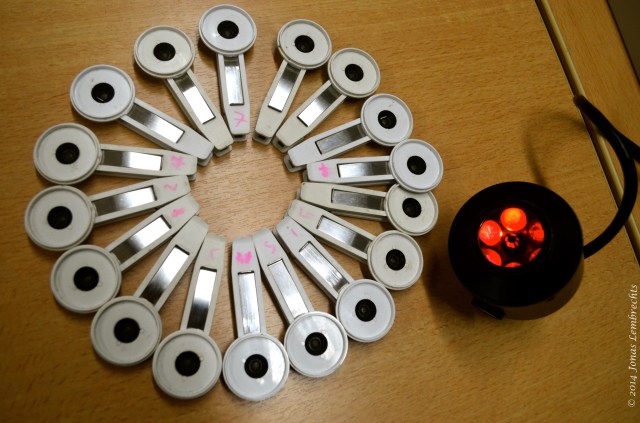
 Dark adaption clips and infrared light source

This years of teaching to the students now culminated in a whole chapter on ‘Chlorophyll fluorescence’ in the recent Handbook on Climate Change Experiments. It is a complicated procedure, but there is tens of thousands of scientific papers talking about it. Now, we provide the easy gateway into the complex science behind the fluorescence. From now on, the magic of fluorescence will have no mysteries anymore to both students and scientists using the technique and, hopefully, the results of the next tens of thousands of papers should be much more comparable.

Want to read more? Chapter 5.1 in ‘Halbritter et al. (2019) The handbook for standardised field and laboratory measurements in terrestrial climate-change experiments and observational studies (ClimEx). Methods in Ecology and Evolution.’

Posted in General, Science | Tagged , , , , , , , | Leave a comment

Welcoming Eduardo

Ecology is a global science, and one that can only be done together. Understanding our world’s nature indeed needs collaborations between ecologists from all over the world, each from their own environment and perspective.

33184999068_f6cb286530_o

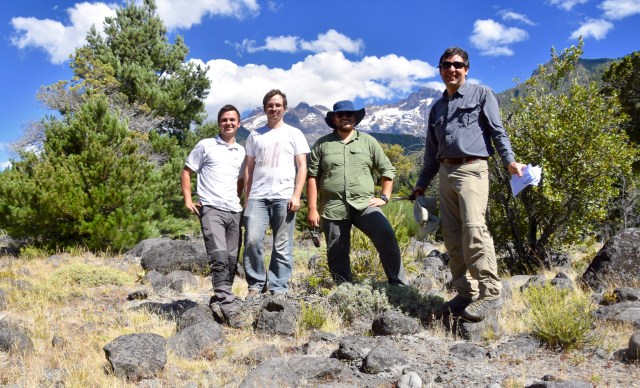
The Belgian team (Jonas and Jan on the left), visiting the Chilean team (Eduardo and Aníbal, on the right) in January

That is exactly why we are very happy to have Eduardo visiting our Antwerp lab for 3 months. Eduardo is a PhD-student from Concepcíon, Chile, and closely working with us within the Mountain Invasion Research Network.

33185001728_28cecb738b_o

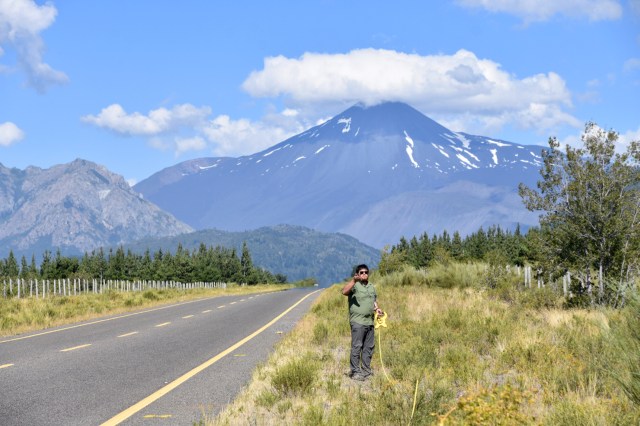
The fabulous landscape – with volcano in the background – where Eduardo studies the effect of mountain roads on invasive plant species

After we visited them in Chile, collecting data for our global project on mycorrhizal fungi in mountain roads, Eduardo is now returning the favour with a visit to Antwerp. Less pretty landscapes here, yet we hope to make up for that with fun science!

Plan is to work on papers together on the invasion of alien plant species along mountain roads, a topic close to all of our hearts.

Stay tuned for more!

Posted in Chile, General | Tagged , , , , , , , , | Leave a comment

The much-needed handbook

Let me tell you a little story. Imagine that you are an ambitious young PhD-student, worried about climate change and dedicated to spend the next 4 years performing an experiment that will answer critical questions on the future of our planet.

19697075030_1e895529f1_o

Climate change experiments, so crucial to understand the future of our rapidly changing world. Yet how to do them well?

You prepare your project thorougly, sitting together with your supervisors to decide which techniques to use, and browsing the literature for inspiration. You make important decisions that fit your specific case perfectly, setting up a unique and well-designed experiment that will answer your critical research question once and for all.

And then, results come in. And they are inconclusive. As in, climate change will have major implications for your study system, but results just don’t match up with what other people find. Bummer. Not only for you, when you try putting your results in perspective. Also for the whole scientific community, when trying to unify, summarize and synthesize results. But most importantly so for our whole society: how to communicate clearly about the impacts of climate change for the functioning of our planet if studies do not seem to hopelessly disagree with each other?

IMG_20190823_111535

Measuring photosynthesis using a LI-COR

But then you dig deeper into the literature. Turns out that experiment B had a different tactic of measuring leaf traits, while experiment C worked with an entirely different definition of what exactly ‘plant stress’ entails. Research group D on the other hand has a different measurement tool alltogether, explaining their different results. Finally, the results of experiment E turned out only to be valid for rainforests, and not for the Arctic tundra where you did your precious experiment.

31936266678_f6052c9e7f_o

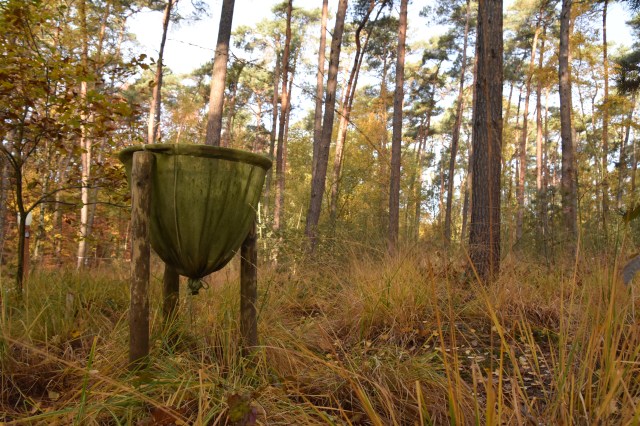
Did you measure leaf litter fall the same way as the other researchers in your field? 

What is lacking, clearly, is uniformity. Individual research projects invest considerable resources in collecting data for a number of environmental and biotic variables and in developing protocols for field measurements. This leads to a diversity of similar but not quite identical protocols, and hence to a diversity of ways to measure and quantify the same underlying effects and responses. While some of this variability may be due to good scientific reasons, protocol selection is often based on traditions and habits.

DSC_0183

Climate change experiments need to strive for uniformity, to make results comparable and easier to interpret between studies. 

And this issue, ladies and gentlemen, is exactly what we solved! With 115 experts in the field, we created a handbook for climate change experiments (found here) that brings best practices together. Incomparability should now forever be in the past, where it belongs.


Reference

Halbritter et al. (2019) The handbook for standardised field and laboratory measurements in terrestrial climate-change experiments and observational studies (ClimEx). Methods in Ecology and Evolution.

Posted in General, Science | Tagged , , , , , | Leave a comment