A new chapter: looking back, looking forward

Last year I wrote about a major milestone: moving The 3D Lab to Utrecht University and stepping into my role as assistant professor in ecological scaling. Today, I’m happy to share the next chapter in that story: as of November, I am officially tenured!

Tenure is often described as “academic job security,” and for anyone still navigating the postdoc world, I can confirm that the feeling is every bit as relieving as you imagine. It feels like finally having the space to breathe. The space to build. The space to think in decades instead of seasons, the way so many of us dream to be able to do science during the postdoc years.

And when I look back on the past few years, that shift in timescale is exactly what has brought me the greatest joy.


Building for the long term

What I’ve enjoyed most since coming to Utrecht is the ability to invest in long-term work. After years of living from grant to grant, I can finally dare to trust the foundations I was building for research that will grow, evolve, and mature far beyond the typical academic time horizon. I was doing that before, but always with the gnawing feeling that things might end prematurely.

Now also, many of the ideas that once existed only as half-finished notes in my drawer – ideas that were too slow to fit within a postdoc cycle – are finally taking shape. And more importantly: they’re taking shape with a team.

The 3D Lab is growing into a vibrant, cohesive group of people who support each other, learn from each other and build together. Watching that happen has been one of the most rewarding parts of this job. It’s a privilege to see ideas come alive not just through my own effort, but through shared enthusiasm.

And it’s of course still a struggle. Supporting that team requires more money, of course, so many projects are still slow and waiting for some stroke of luck to whip them up into action, but now the time and flexibility is there for patience.


Teaching as joy

Another (un)expected source of joy has been teaching. Having the room in my workday to help raise the next generation of scientists—from the more than 300 bachelor students to the many master thesis projects, and from the PhD students to the young scientists in the team—each bringing their curiosity and their questions—is something I value immensely.

There is something uniquely grounding about teaching. It reminds me why we do science in the first place. It keeps me accountable. And it pushes me to think carefully about what and how we teach, and what message we want them to receive.

There is, of course, a downside: it’s impossible to maintain the same amount of research output now that my teaching load has grown substantially. These are trade-offs we all face, and choices we all have to make. But I did decide I’m willing to pay the price – a few fewer scientific manuscripts – in exchange for creating opportunities for others to become the change we need.


From “My Science” to “Our Future”

One of the most profound shifts this assistant professor position brought me is the freedom to look beyond my own research papers and ask bigger questions. If I have thirty years of science ahead of me – give or take – what are the problems I want to contribute to solving? What will the world look like in 2055? And what role can ecology, microclimate science, and biodiversity research realistically play in guiding that future?
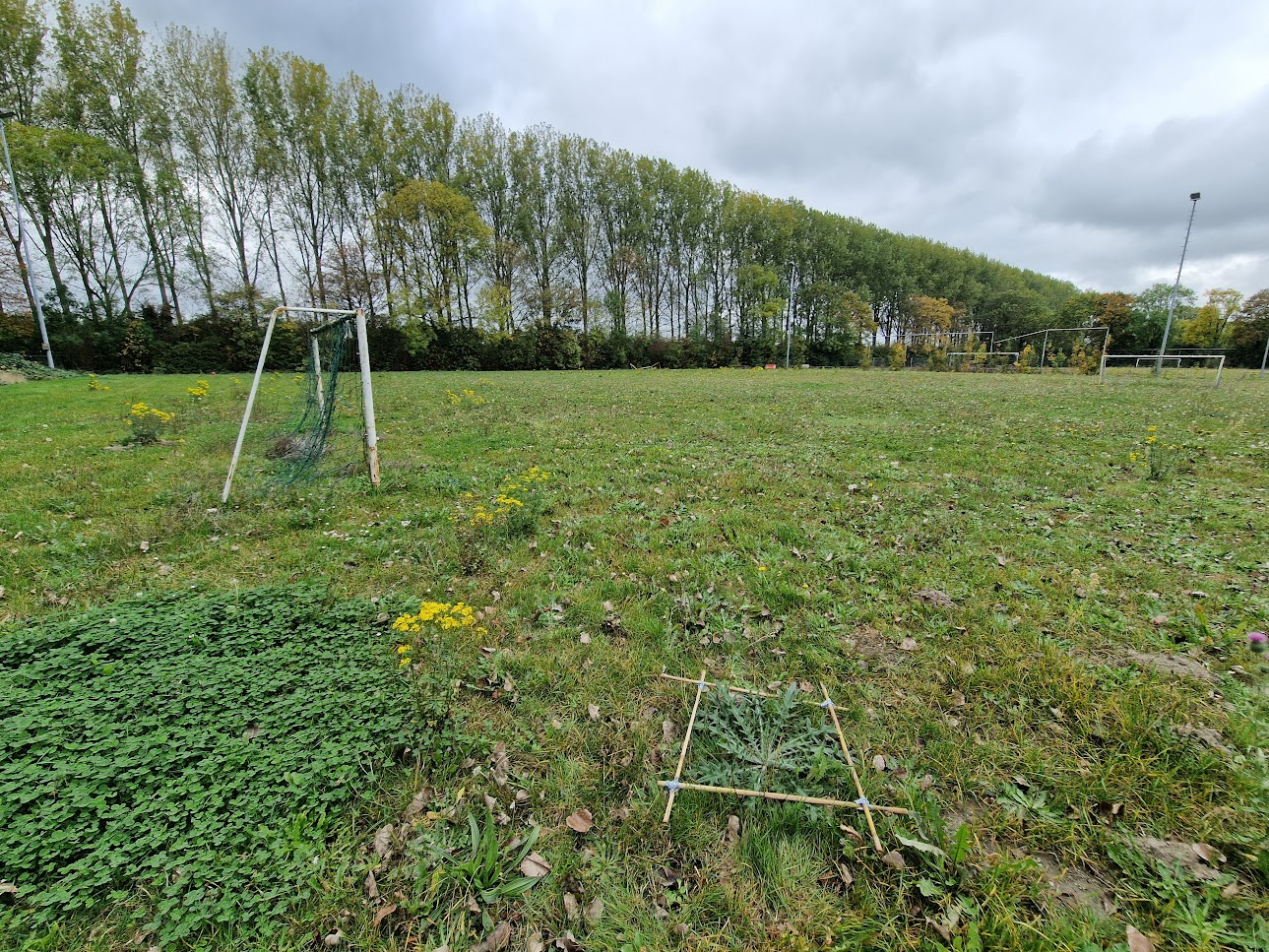
Ever since I first started doing science, my core question has been simple: why is that plant growing where it is?
Now, I want to go further. Not just understanding why plants are where they are, but asking: what do we need to do to help the right plants grow where we need them? And once they are there, what can those plants do for us – and for the rest of nature?

It’s a daunting line of thought, but also an energizing one. My ambition has grown – not in the sense of personal achievement, but in terms of impact. I want my science to matter not only within my field, but in the world beyond it. This also brought me back much closer again to the ecology where it all began for me. Especially my postdoc was a lot more methodological, but now I want to be talking a lot more about the nature we’re trying to save, and how to do that. That work will involve a lot of ‘a solution for nature’ and ‘nature as a solution’, two things that go nicely together.

Utrecht is the perfect environment for this. It is a university that not only allows but actively encourages its people to work across disciplines, to connect with societal partners, and to tackle the complex challenges facing our planet. I feel supported – and yes, sometimes gently pushed – to think bigger and collaborate wider. And for that, I’m truly grateful.

I don’t know about other places, but I like that in Utrecht the time to think, discuss and learn is build in to our job – officially 10% of my time, if I’m not mistaken – and that has thought me already a lot.


The honest part

Of course, there’s a darker side to ambition. When you start looking 30 years ahead, the horizon can feel impossibly far away. The problems we’re trying to address are complex, urgent, and often overwhelming. I know I won’t “save the world” – none of us will, individually, and when I think of that long-term vision, sometimes I worry about how much ‘world-saving’ will eventually fit into my day-to-day schedule.

But I do believe in the ripple effect.

I do believe that one of the most meaningful things I can do in the decades ahead is create opportunities for as many others as possible to contribute to those ripples. If I can help equip a generation of scientists, collaborators, and students to do world-saving work – together – that is impact.

That is enough.


Onward

So I’m really looking forward to this next chapter as a tenured scientist: to long-term vision, to interdisciplinary collaboration, to teaching with purpose, to scaling up ecology in every sense of the word, and to the remarkable people I get to work with every day.

And above all: to create the conditions for others to shine.

If any of this resonates – if you’re interested in joining the lab, collaborating, or thinking together about microclimate, species redistributions, or ecological scaling – my door (physical or virtual) is always open.

The journey continues.
And it’s only getting more exciting.

Posted in General | Tagged , , , , | 3 Comments

The night

[ENGLISH] A cold, dark autumn night. My alarm goes off at 1:15 a.m., and for a moment I wonder what on Earth I was thinking. Then it hits me: I had been invited for a night-time interview on NPO Radio 1, in the weekly programme The Night of NTR Science.
Ninety minutes of uninterrupted conversations about science—yes, that is exactly the sort of thing you can wake me up for.

And there is so much to talk about.
So much we have learned over the years that we urgently need to start applying.
So much work left if we want to protect this beautiful planet we call home.

During the interview, we explored the state of nature today—still far more fragile than many realise—and the enormous value it brings us in return. We talked about what smart, science-based nature management can do, and how nature-based solutions must become a central part of creating a healthier, more resilient world.

The full conversation is now available as a podcast (in Dutch).
Highly recommended for anyone who wants to dream along with me about how we can steer our world in a better direction.

You can listen to the programme via the Radio 1 website:
https://www.nporadio1.nl/fragmenten/de-nacht-van/019a9eb4-d2f8-72e9-8159-453f690c6735/2025-11-20-het-grootste-burgeronderzoek-naar-geluid-ooit-natuurgeluid-maakt-gezonder
(Don’t forget part 2, featuring sharp and surprisingly awake questions from the audience!)

Or listen to it as a podcast on any platform:
https://plinkhq.com/i/1603391400
Or directly on Spotify:
https://open.spotify.com/show/5Cp2lQfmbSOKrZ5b6VZZoJ


[NEDERLANDS] Een koude, donkere herfstavond. Mijn wekker gaat om 1u15, en heel even vraag ik me af waarom ik dit mezelf aandoe. Maar dan herinner ik het me: ik ben uitgenodigd voor een nachtelijk interview op NPO Radio 1, in het programma De Nacht van NTR Wetenschap.
Negentig minuten onafgebroken praten over wetenschap – daar mag je me nu eens altijd voor wakker maken.

Want er is zoveel om over te praten.
Zoveel inzichten die we intussen hebben maar dringend moeten beginnen toepassen.
Zoveel werk dat nog voor ons ligt als we onze prachtige planeet willen beschermen.

In het gesprek doken we in de staat van onze natuur – die helaas alsmaar meer zorgwekkend is – en in alles wat die natuur voor ons terugdoet. We spraken over de rol die slim, wetenschappelijk onderbouwd natuurbeheer kan en moet spelen. Over hoe nature-based solutions een sleutel zijn om onze wereld gezonder en veerkrachtiger te maken.

Het volledige interview is nu te beluisteren als podcast.
Warm aanbevolen voor iedereen die graag even wil meedromen over hoe het anders en beter kan.

Beluister het gesprek via de website van Radio 1:
https://www.nporadio1.nl/fragmenten/de-nacht-van/019a9eb4-d2f8-72e9-8159-453f690c6735/2025-11-20-het-grootste-burgeronderzoek-naar-geluid-ooit-natuurgeluid-maakt-gezonder
(En vergeet deel 2 niet, met een reeks scherpe vragen van een verrassend wakkere luisteraarsgroep! – scroll naar helemaal onderaan)

Je kunt het interview ook beluisteren als podcast, op alle platformen:
https://plinkhq.com/i/1603391400
Of gewoon via Spotify:
https://open.spotify.com/show/5Cp2lQfmbSOKrZ5b6VZZoJ

Posted in General | Tagged , , | Leave a comment

Shaping the future of environmental data sharing

Are you working with environmental or biodiversity data and willing to help us out?

At the Microclimate Ecology & Biogeography (MEB) network, we believe that open, reliable, and collaborative data exchange is the cornerstone of understanding and predicting biodiversity and microclimate dynamics.

As part of the Forest-Web 3.0 project (funded by Biodiversa+), we’re exploring new ways to make environmental data sharing more effective – and we’d love your input!

📋 Take our 15–20 minute survey here: https://nina.qualtrics.com/jfe/form/SV_ef9kxTazFW9a1Qq

We’re collecting insights from researchers working with environmental or biodiversity data to learn:

  • What works well in current data-sharing practices
  • What challenges you face
  • How we can make sharing easier, fairer, and more collaborative

Your anonymous responses will directly help us design new tools that support both FAIR (Findable, Accessible, Interoperable, Reusable) and CARE (Collective Benefit, Authority to Control, Responsibility, Ethics) data principles.

By participating, you’ll help us strengthen the open science foundation of the MEB community and shape the next generation of user-friendly data-sharing platforms.

👉 Take the survey now!

Together, let’s build a more connected, transparent, and equitable future for environmental data.

Posted in General | Leave a comment

How to not be swamped by your microclimate data

Microclimate data are finally finding their way more routineously into ecological models – and rightly so. Hooray for that! The growing availability of in-situ measurements is helping us bridge the gap between the coarse world of macroclimate and the fine-scale environments that organisms actually experience. But as more researchers start integrating these data into distribution models or other ecological questions, a new issue has arisen, and it’s one we have to deal with soon: what do we actually do with all this detail?

When faced with high-frequency microclimate time series, the temptation is often to reduce them to a familiar set of summary statistics – mean temperature, perhaps minimum and maximum values, or that so-familiar set of bioclimatic variables that we are so used to be using. Yet, those choices strip your microclimate data of its power. The real story lies in its variability, its seasonal contrasts, and the way it interacts with snow, vegetation, and topography. In other words: the fine-scale thermal landscape is more than a few summary statistics.

So, what do we do then?? A good starting point is to explore a broader range of summary statistics. Yes, this can feel like stepping into chaos – dozens of potential variables, each telling a slightly different story. Like trying to cook a soup with everything in your pantry — from chocolate chip cookies to bean sprouts.

But here comes our recent paper in Oikos – expertly led by Kryštof Chytrý – with a recipe to avoid disaster. As with the right tools, the complexity becomes manageable. A straightforward cluster analysis, for example, can help reveal sets of variables that move together. Rather than drowning in endless variation, you’ll see that many microclimate metrics are strongly correlated, allowing you to identify a few meaningful clusters that capture most of the relevant information.

Across the slopes of Mount Schrankogel – a mountain fast becoming a symbol for microclimate research, make sure you remember I warned you – more than 900 sensors and vegetation plots capture the microclimate of a unique ecosystem. With this unprecedented dataset, we took a stab at how microclimate variability translates into ecological meaning.

Depending on your study system, these clusters will likely make ecological sense. In snow-affected regions, for instance, winter and summer temperatures tend to form distinct groups, each shaping species distributions in opposite directions. Spring and autumn may emerge as their own transitional cluster, with temperature dynamics that reflect phenological shifts. Meanwhile, variables capturing variability — the day-to-day swings, or microclimate buffering capacity — form yet another cluster, particularly important when studying ecological stability or resilience.

The broader message here is one of balance. We shouldn’t oversimplify microclimate data into a handful of familiar metrics, but neither should we be paralysed by the complexity. Using our new summary statistics – even after reducing them through cluster analysis – consistently outperformed traditional bioclimatic variables in capturing ecological variation. There is a pattern in the noise, and finding it takes that extra analytical step, as we describe in this paper.

This is more than a technical issue; it’s a conceptual one. As microclimate data become increasingly available, the community needs to converge on best practices for summarising, selecting, and interpreting these variables. Our choices here will shape the next generation of distribution models, biodiversity forecasts, and ecosystem predictions.

I see this paper as a conversation starter, but a very important one. We now need similar analyses across diverse ecosystems to test whether these clustering patterns hold up, and if parameter simplification is achievable everywhere. But there’s reason for optimism: modelling species distributions with only a few climatic variables seems to be a viable strategy. It’s just that the most suitable variables may often be different from those that are commonly used nowadays.

Reference: Chytrý et al. (2025). Reconsidering climatic predictors for high-resolution niche models of alpine plants. Oikos. https://doi.org/10.1002/oik.11545

Posted in General | Tagged , , , | Leave a comment

A tale of homogenisation

I’ve always been intrigued by ecological scaling – it’s literally in my title: Assistant Professor in Ecological Scaling.

One of the main reasons we care so much about scaling is that ecological theories don’t always hold up when we change scales. What seems true in a single valley, forest plot, or mountain slope can fall apart when we zoom out to continents or the globe. That mismatch often gets us into trouble when trying to generalize from our favourite local case studies to something that has real global relevance.

A classic example: homogenisation

The theory goes like this: when ecosystems are invaded by non-native species, they start to look more and more alike. We call this biotic homogenisation – a reduction in beta diversity, meaning less variation among communities. It’s often linked to lower ecosystem functioning, and by extension, poorer ecosystem health.

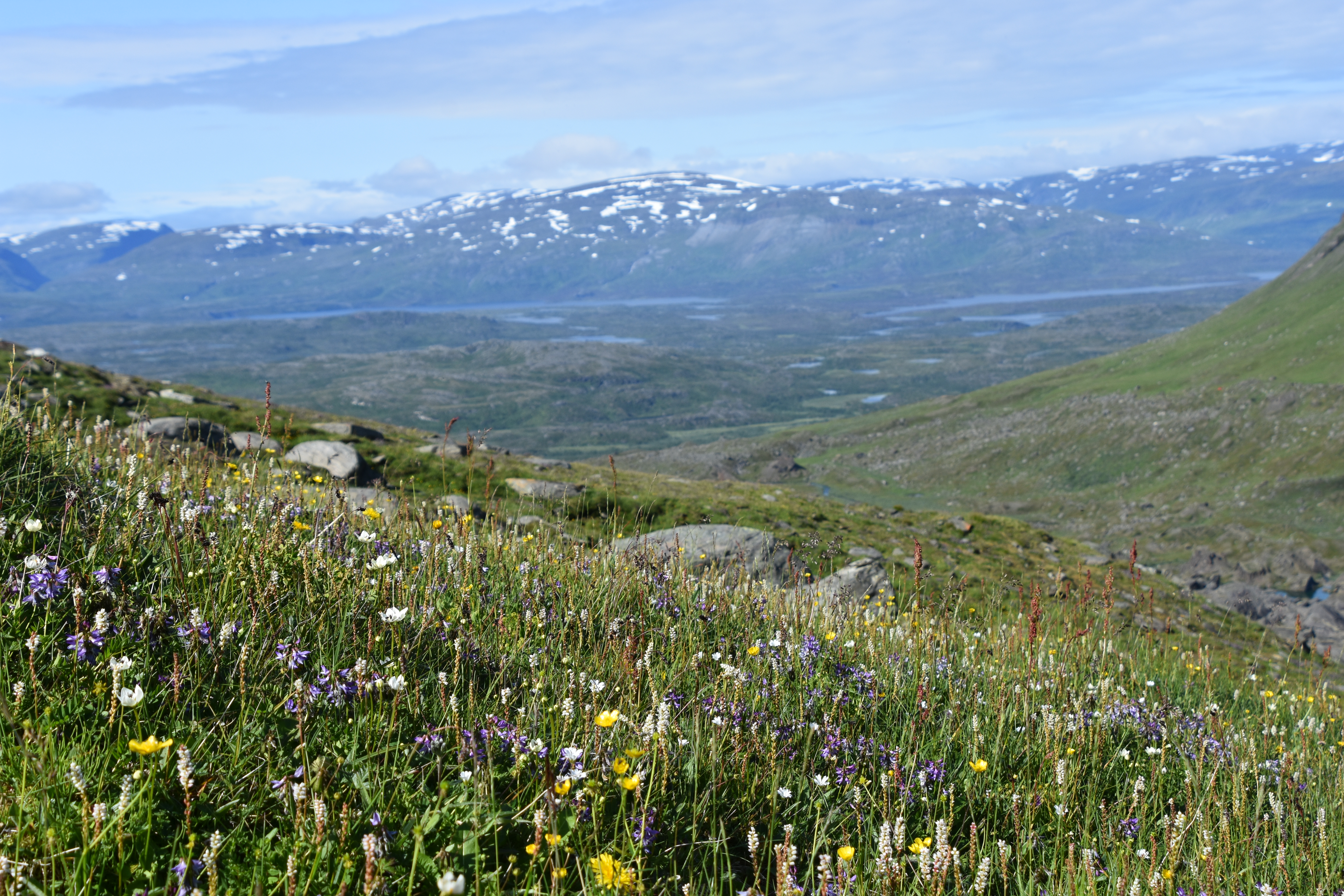
Native mountain vegetation tends to be highly distinctive, yet the introduction of non-native species is expected to erode that ecological uniqueness. Here, a highly biodiverse spring meadow in the Scandinavian mountains.

So far, so simple. Except the evidence is a little bit messy. Some studies find strong homogenisation, others don’t. We suspected that part of this inconsistency comes from differences in spatial scale – not all studies are asking the same question in the same “ecological zoom level.”

Scaling up with global replication

To test this idea, we turned to one of our favourite tools: globally replicated monitoring. Thanks to the Mountain Invasion Research Network (MIREN), we could explore patterns of homogenisation – and its opposite, differentiation – across 18 mountain regions worldwide. The findings of this exercise – led by Meike Buhaly – are now published in Global Ecology and Biogeography.

Our hypothesis (perhaps a bit naively in retrospect) was that homogenisation would dominate across all scales, though we expected it to weaken with elevation.

Study design, showing how we compared beta diversity within gradients (local), between mountains (regional), between regions on the same continents (continental), and between continents (global)

Yet that was, surprise surprise, not what we found. At the global scale, the classic theory held neatly: non-native species homogenized communities. Plant assemblages across continents became more similar (lower beta diversity) once non-natives were included. But when we zoomed in, the pattern fell apart. At local and regional scales, homogenisation and differentiation were almost evenly balanced. And even more intriguingly, the pattern split along continental lines:

  • In the New World (the Americas and Australia), homogenisation dominated.
  • In the Old World (Europe, Asia, Africa), differentiation was more common.
Patterns of homogenization and differentation across scales in our dataset.

The pattern depends on where (and how far) you look

In the New World, we found consistent homogenisation across local to continental scales, particularly in lowland plant communities. This likely reflects both the high number and shared history of non-native species: many are widespread across entire continents, occurring in more plots than native species.

At higher elevations, however, in some regions this pattern reversed. When non-native species became rare and patchy, this lead to community differentiation instead, especially in the Andes and Rocky Mountains.

The Eurasian mountains told a different story. There, non-native species actually caused differentiation at local and regional scales, even though some were shared across regions. At the continental scale, these same shared species produced a faint signature of homogenisation, but much weaker than in the New World.

The consistent differentiation we found in Eurasia might simply reflect an earlier invasion stage. With fewer non-native species and fewer widespread invaders, communities still differ strongly from one another. But as non-native species continue to spread, homogenisation may increase into conditions that mirror what we already see in the Americas and Australia.

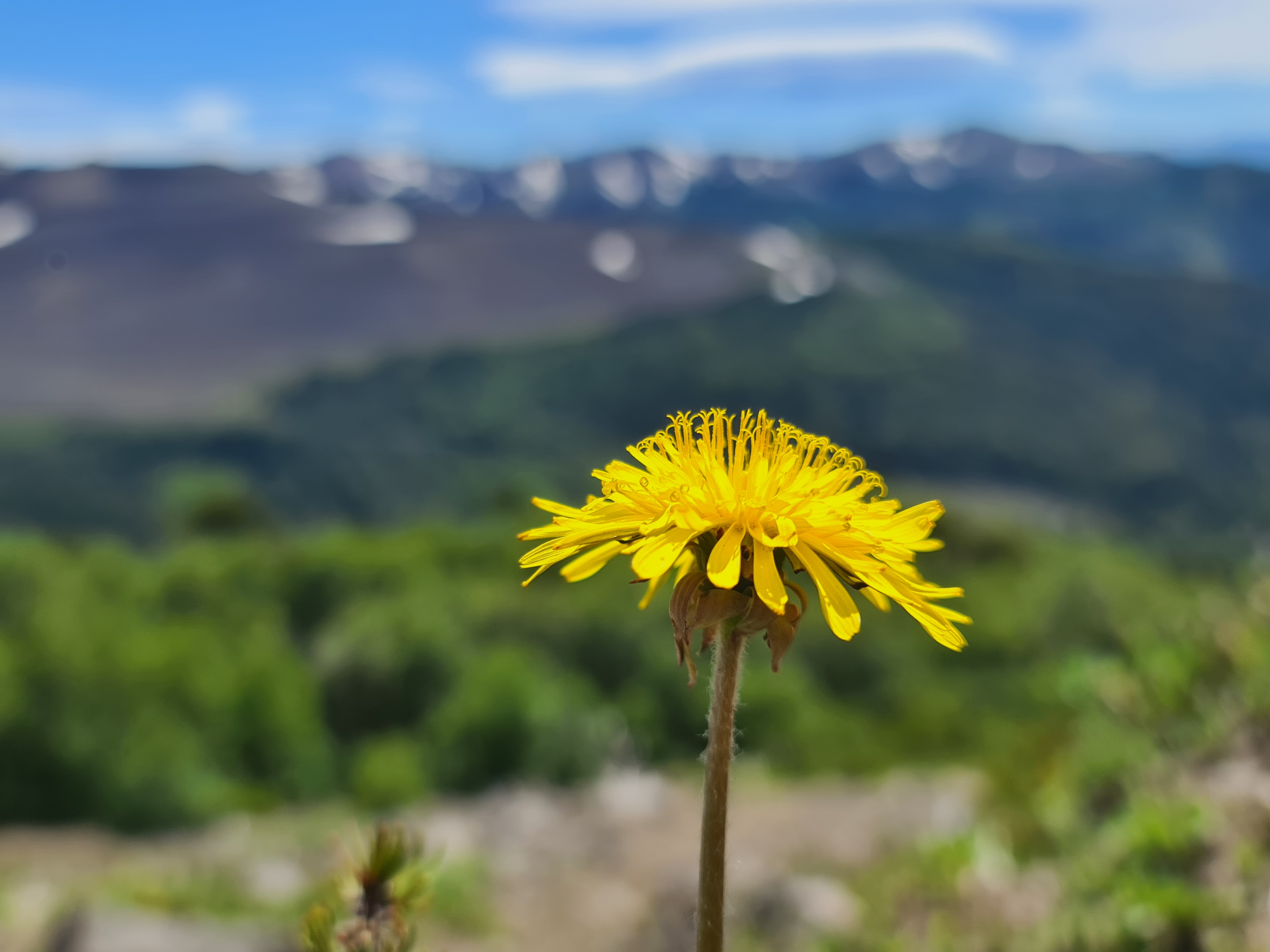
Dandelion in the Chilean Andes – a pretty common site in the Americas and one of the reasons we observed homogenisation in the New World.

Scaling reveals nuance – again

So, as so often in ecology, the story depends on scale.
At large, continental scales, non-native species clearly homogenize plant communities: ecosystems across continents begin to share the same species. But when you zoom in, that signal becomes patchy. Homogenisation dominates in regions with long invasion histories, while newer invasion fronts still show differentiation.

It’s a pattern that fits a familiar ecological theme:

a little change might be positive – but a lot can be profoundly transformative.

More information: Buhaly et al. (2025). Global Homogenisation of Plant Communities Along Mountain Roads by Non-Native Species Despite Mixed Effects at Smaller Scales. Global Ecology & Biogeography. https://doi.org/10.1111/geb.70137

Posted in Science | Tagged , , , , | Leave a comment

Cliffhanger: Am I, as a climber, a threat or a treasure for plant diversity on rock cliffs?

Translation of  the submission for the pop-sci writing competition ‘Vlaamse Scriptiepijs’ by team member Sarane Coen

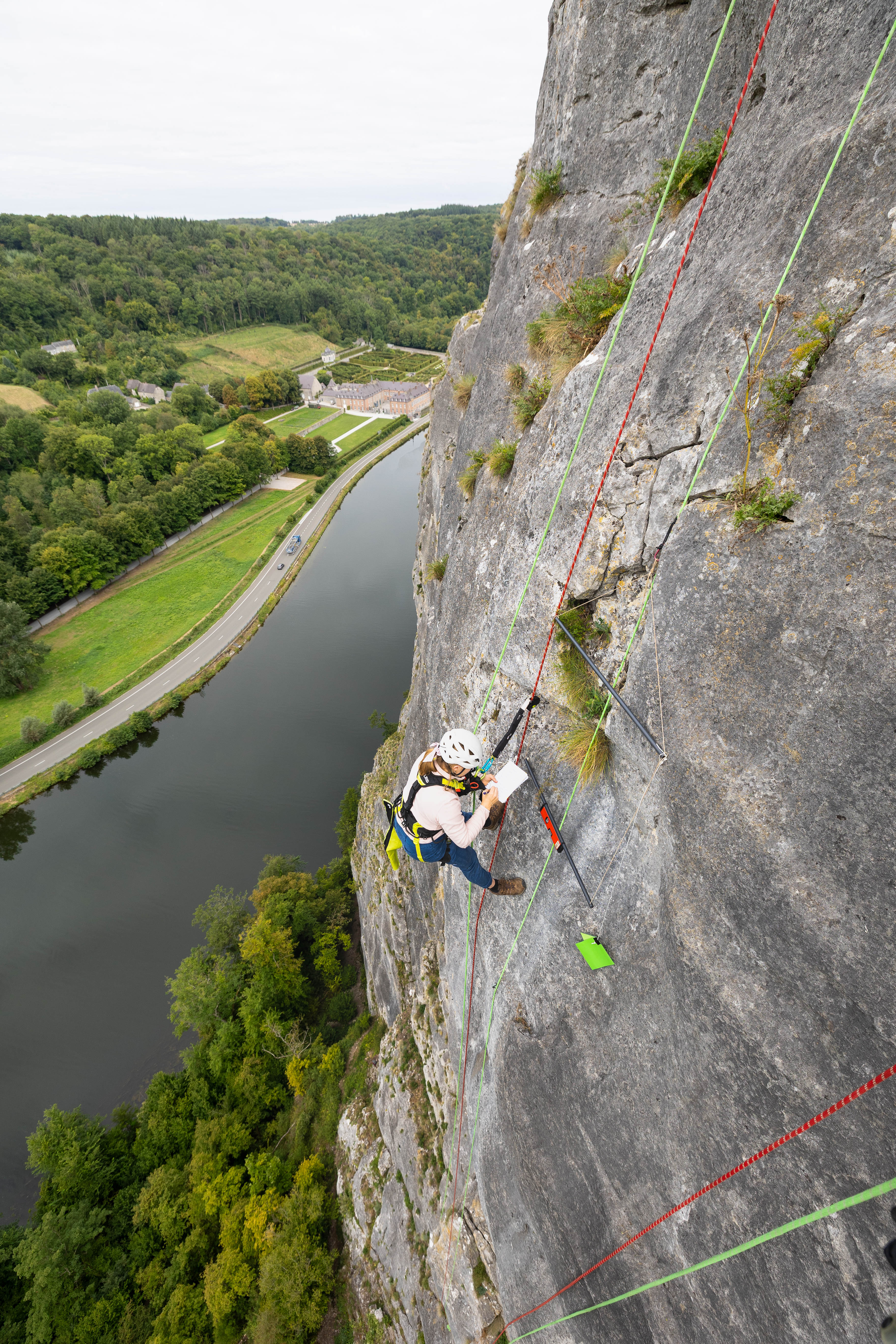
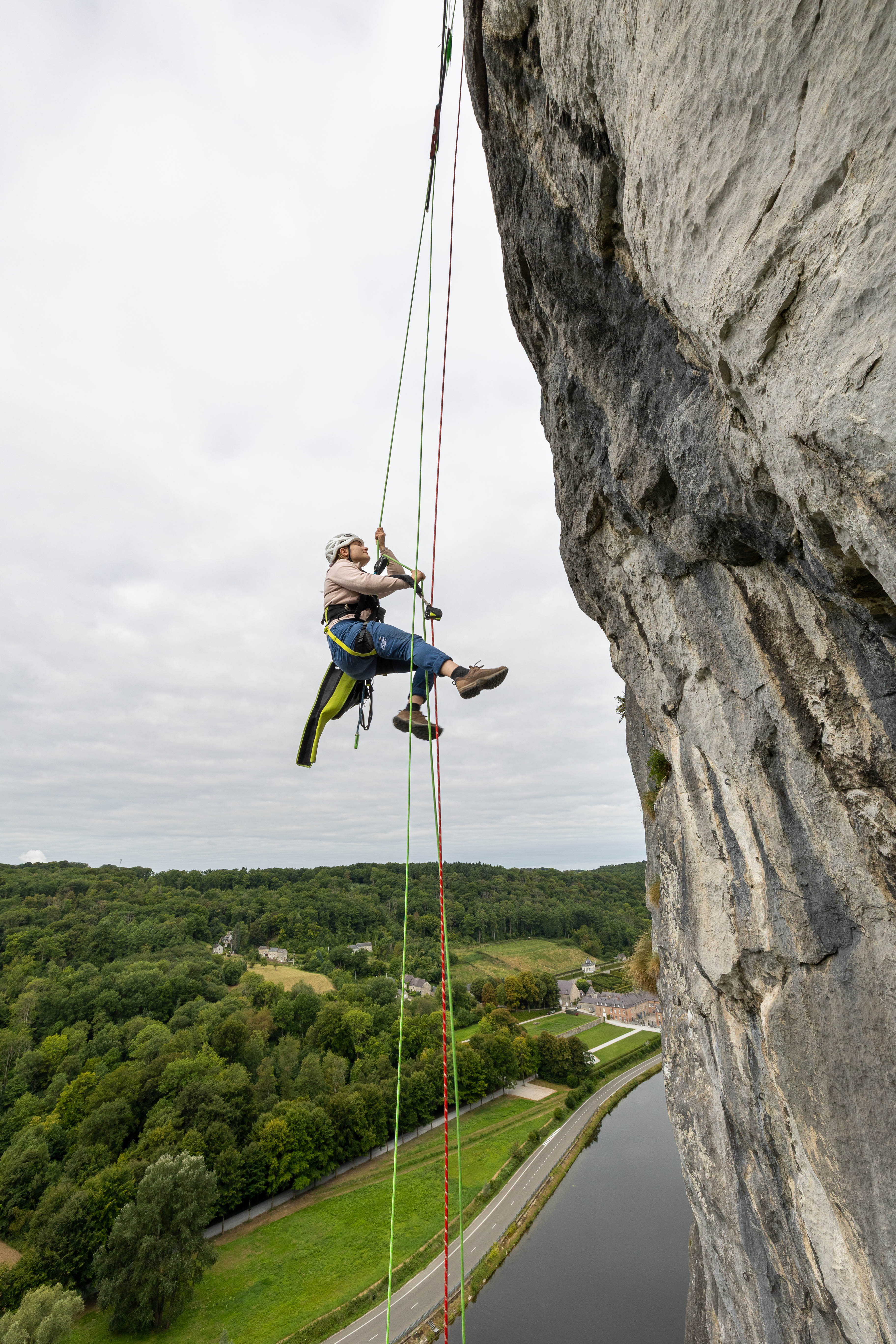
With the River Meuse flowing far below, I search for the way up to the top. With fingers and toes, I follow a route of small cracks and ridges in the rock wall. For me, these are holds; for plants, they are habitats. Where I grip, they fight to survive. That thought stuck with me.

Am I, as a rock climber, a threat or a treasure to the ecosystem I love so much?

With that question, my master’s thesis research began. I returned to the rocks. This time not only as a climber, but also as a scientist.

Bursting biodiversity

At first glance, cliffs may seem like barren walls. But in reality, they burst with life. Rocks are rich ecosystems full of rare species that endure extreme conditions: steep faces with almost no soil, nutrients, or water.

For me, these are holds; for plants, they are habitats.

Cliffs offer a wide range of living conditions because they vary greatly in height, structure, and orientation toward the sun. These differences create a diversity of microclimates. North-facing walls or deep, shaded crevices remain much cooler and moister than sunny south faces. Cliffs thus form a mosaic of tiny habitats where each species finds its ideal place to live.

Research on a high level

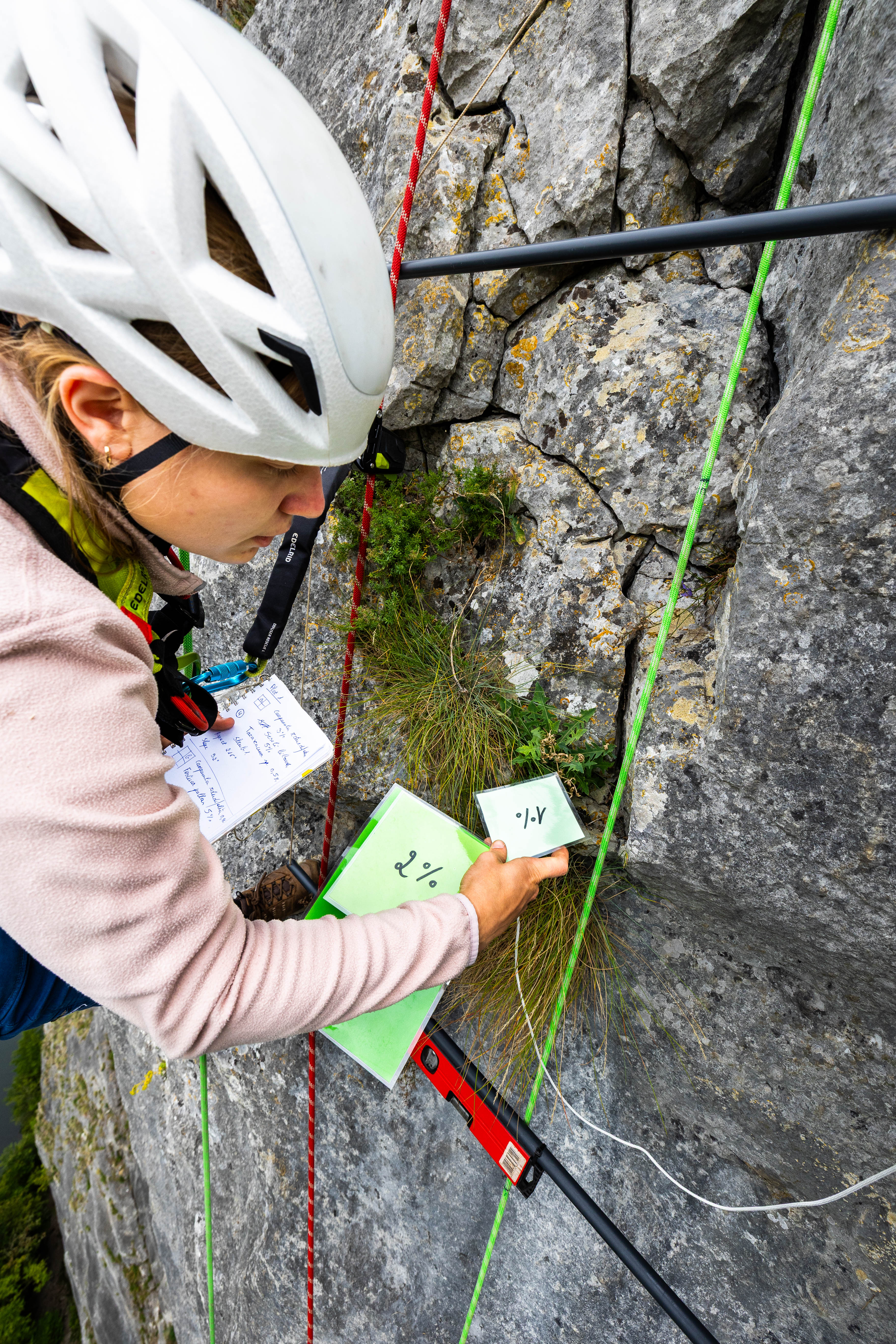
Helmet, harness, rope, check! One last look into the depths and ready to descent. With my research material,  I dangled along the steep rock walls on the banks of the River Meuse in the Belgian Ardennes to collect data.

To understand how climbing influences these ecosystems, I looked at the plants on unclimbed walls and lightly and heavily climbed walls. Within one-square-metre plots, I recorded which species were present and how much space they occupied. I also measured the characteristics of the rock itself: surface structure, slope, height, and sun orientation. In total, I conducted these measurements across 248 separate square meters, spread over multiple cliff faces. Bit by bit, I untangled not only my ropes, but also some ecological questions.

Climbers, unexpected buddies of biodiversity!

The structure of the rock surface turned out to be crucial. Smooth walls offer little opportunity for plants, no matter how often they are climbed. The more cracks, ridges, and holes a rock has, the more suitable microhabitats it provides — and the more plant species can find a place to grow.

A bit of disturbance can make space for more biodiversity.

And climbing? Moderate climbing intensity did not harm biodiversity — it even seemed to enhance it. Lightly climbed cliffs hosted the highest diversity compared with both unclimbed and heavily climbed sites.

The type of plants explained this pattern. On unclimbed cliffs, I mostly found dominant, competitive species that monopolise nutrients and water. On climbed cliffs, more disturbance-tolerant species appeared. Climbing partially reduced the dominance of the competitive species, giving others a chance to establish themselves. A bit of disturbance can make space for more biodiversity.

Safe spaces for the future

These results reassure me as a climber. Fortunately! Because these fragile cliff ecosystems may play a key role in the climate and biodiversity crises. Their variation in microhabitats with different temperatures makes them cool refuges for species that can no longer tolerate the heat elsewhere. At the same time, they serve as stepping stones for southern species expanding into the warmest niches beyond their usual range.

Further research can help us understand how cliffs buffer or amplify the effects of climate warming on biodiversity. Understanding the impact of human activities such as climbing is a first step. And the fact that certain human disturbances can sometimes be secretly beneficial makes it all the more fascinating.

So, both as scientist and a climber, I can contribute to biodiversity. And cliffs turn out to be a refuge,  for passionate climbers as well as for vulnerable plant species too.

Translation of  the submission for the pop-sci writing competition ‘Vlaamse Scriptiepijs’ by Sarane Coen

Original:

Posted in Belgium | Tagged , , , , , , , | Leave a comment