Database progress

Last week, we bid farewell to Amber, a bittersweet goodbye that marks the end of a successful chapter in our ‘SoilTemp’ project. Yet it also provides closure to a very good story, as you’ll see.

Amber joined us as a master’s student and wrote an outstanding thesis on the air conditioning effect of nature in gardens, in the framework of our ‘CurieuzeNeuzen’ citizen science project. She then joined us part-time as a database manager for the SoilTemp database, and our achievements together during that time were nothing short of fabulous.

So how did we get Amber on board? After getting a few grant rejections, I sent out a tweet in desperation, warning the community that our planned work with SoilTemp was in jeopardy. But as fate would have it, the community rallied around us! GEO Mountains, an initiative focused on global environmental monitoring in mountains, for example, offered a concrete solution that resulted in this part-time job for Amber. Our main goals were two-fold: to make significant strides towards open access publication of the SoilTemp database and to increase its coverage in mountain regions worldwide, particularly in those hard-to-reach areas where even weather stations are scarce.

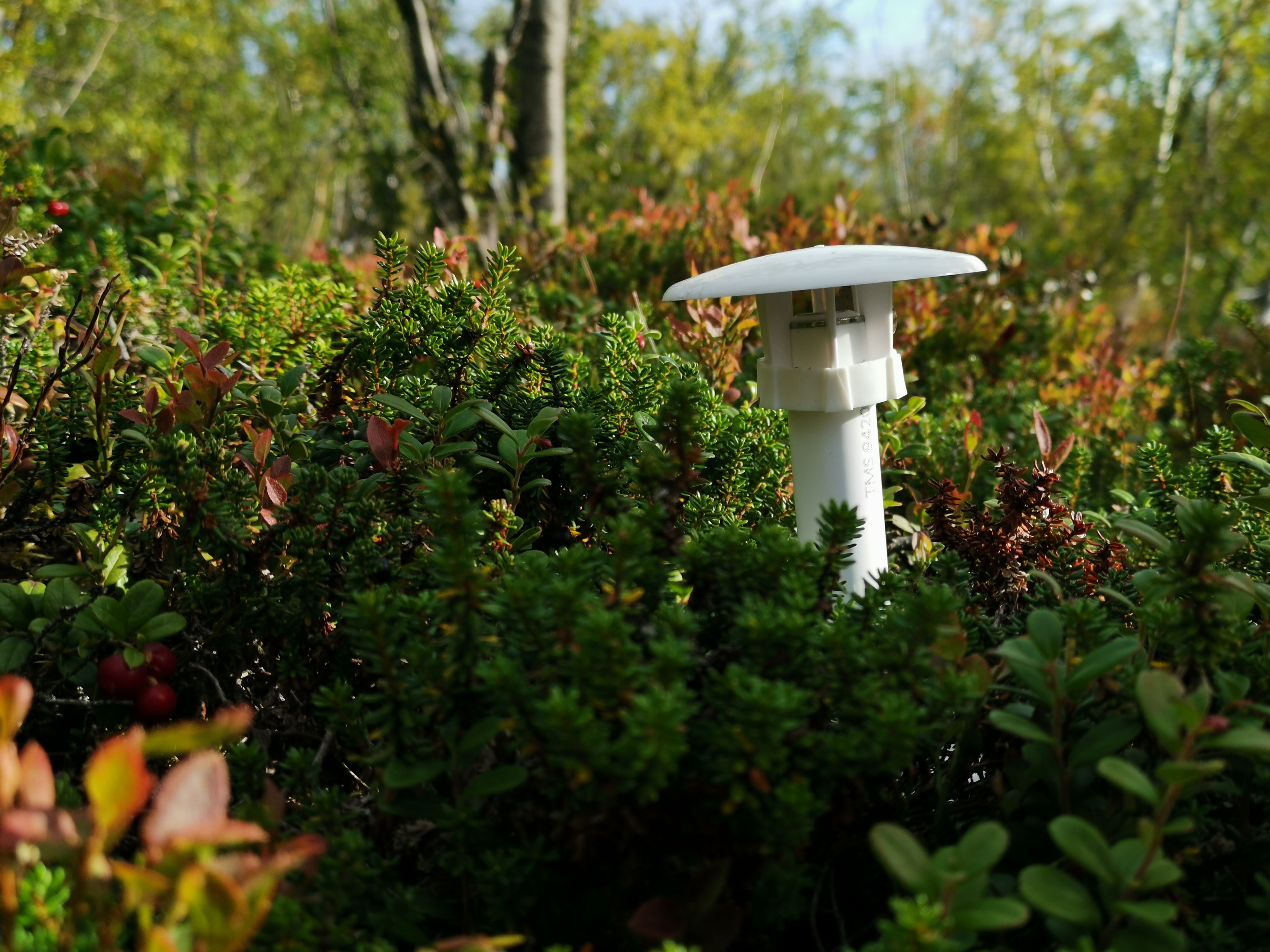
Sensor installed in my own favourite cold-climate mountain region in the northern Scandes, where it monitors birch forest understory temperature in a dense field of Empetrum and Vaccinium heathland

Amber sailed through the backlog of data submissions like a database diva and reprocessed all 35,000 time series in a format that will allow them to be entered into our upcoming relational database. The latter is being accomplished together with Rémy from iDiv (Germany), another epic story for another day. And our second goal? A mountain of success. We equipped a whole lot of regions participating in the Mountain Invasion Research Network (MIREN) with sensors, and we’re seeing increasing monitoring in many cold-climate mountains, tropical mountains, and especially African regions. The large white gaps on our map are shrinking fast!

So, thanks Amber, and thanks GEO-Mountains, we definitely made the best of it!

Posted in Science | Tagged , , , , , | Leave a comment

Battling my emails

I started tracking my time at work in detail at the start of my postdoc in 2018, using the amazing app ‘Timeular’. This series of stories provides some insights into postdoc life using that data.

A traumatizing aspect of academia to many post-PhD scientists, perhaps: the inbox! Throughout my postdoc career, I noticed soon enough that the tide of emails was swelling, especially from the moment – in 2019 – that I put myself at the steering wheel of SoilTemp, a network of several hundred scientists. An increasingly international network with increasingly many collaborations, and you can imagine how many emails would come in! Yet, how much of my time was actually going into emailing?

Numbers, please!

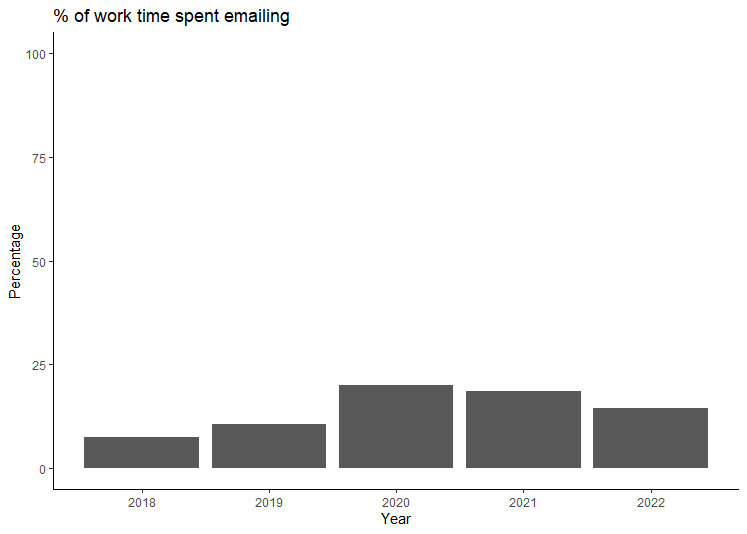
Percentage of my time spent emailing since the start of my postdoc in 2018, tracked minutiously using the Timeular tracking software.

At the start of my postdoc, the mailbox (and its fancy relatives like Slack, Microsoft Teams, or even Facebook Messenger for some colleagues) only ate up a blissful 7% of my time. By 2020, with SoilTemp in full swing, I rounded the magical number of 20%. In a 5-day week, that’s one full day of emailing… Daunting! And no wonder I started to consider my efficacy.

If that amount of emailing is truly problematic, that’s a different story, of course. Not only was I managing this large network with its seas of useful and important emails, a lot of my other tasks were also increasingly replaced by an advisory role. Statistical analyses and paper writing as done in my PhD and at the start of my postdoc was now turning into assisting students or colleagues to do just that. Many of their questions could often be answered in a short – or longer – email, and them taking over lead authorship on many papers implied that my own time spent on these papers was reducing.

Nevertheless, I was realizing that I needed to be smart and efficient to keep that tide of emails at bay. I decided to step away from the immediate answering that I was used to from back in the days and delineated specific moments in which I would email. Now, I’m starting my Monday, Wednesday and Friday by working through my inbox and putting it back to zero. I answer emails that only take me up to 10 minutes of work, and schedule more demanding ones for different times, depending on their deadline.

This way, I am usually relatively fast with my response (2 days maximum), while still keeping a significant chunk of my week email-free. I do make an exception for my students, of course: their questions, thoughts, musings, or whatever they feel the need to share, will usually get a much quicker, if not immediate, response (as long as I can answer in less than 5 minutes).

Is this strategy paying off? I bet you it is! I regained some sanity, I am still on top of my inbox, and I turned the tide of emails: in 2022, the percentage was down to 14.5%, a more than 5% drop since 2020! Very happy the numbers support that decision!

Microsoft Teams – and the IT support team asleep next to it
Posted in Belgium | Tagged , , , , , , | 1 Comment

Hitchhiking mountain roads and trails

The Mountain Invasion Research Network (MIREN) has made itself ‘world famous’ through its protocol for the long-term monitoring of vegetation along mountain roads. We even got a recent publication dedicated in its entirety to that protocol! However, mountains – and the rest of our increasingly connected world, for that matter – are crisscrossed by a whole bunch of other ‘linear disturbances’. An obvious question thus arose: are the vegetation patterns we see along roads mirrored along these other linear disturbances, such as trails?

How problematic to nature are mountain trails – linear disturbances that protrude deep into our most precious protected nature.

To answer that question, we set up a second global vegetation monitoring protocol, yet now focussed on mountain trailsides. While our roadside protocol has been adopted in more than twenty regions worldwide, the tally for the trail protocol is currently at six. So a tad more humble in its scope, yet still more than enough to satisfactorily answer a first important general question – at the core of our MIREN business: are patterns in non-native species richness along mountain trails a mirror of those found along mountain roads?

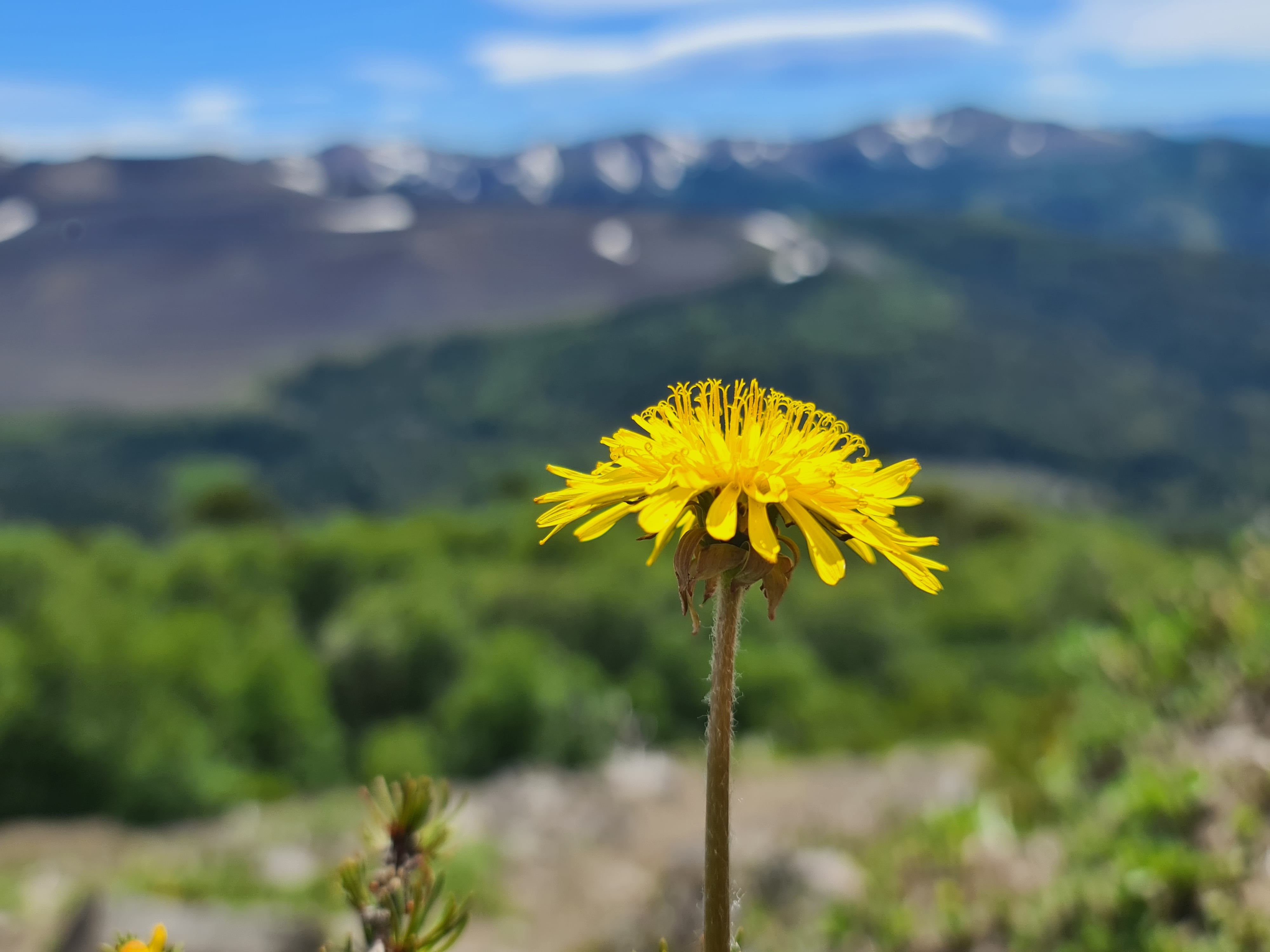
Hiking along mountain trails can bring non-native species to surprisingly high elevations. In this stony desert above the treeline in the Chilean Andes, we found some European Taraxacum flowers!

The answer can be found in a recent publication – part of a new book on the role of tourism and recreation as drivers of biological invasions.

So how do our trails compare? Observed levels of plant invasion were substantially lower along trails than along roads, adding up to only about 20% of the species numbers. Nevertheless, the same decline in richness with elevation is found that is so characteristic of mountain roadsides across the globe, and many of the most common non-native plant species along roads are also found along trails.

Most striking, however, is the lack of decline in non-native species richness with distance to the disturbance. Along roads, we see worldwide the same characteristic pattern, with high numbers of non-natives in roadsides and then a more or less steep drop in species close to the road in the interior vegetation. Along trails, this pattern is virtually not there, which implies that levels of invasion are largely the same in trailsides and the interior vegetation.

Non-native species richness along mountain trails (red line) and in the adjacent natural vegetation (turquoise line) across six mountain regions (see map). Yellow-to-brown ‘smudges’ on the map depict the global mountain regions.

The latter has some worrisome implications, as it shows that the resistance to invasion of the interior vegetation close to trails is much lower than along roads. This could be due to the sparser vegetation (most studied trails were at higher elevations in the mountains than the roads), but most likely also to the differences in disturbance dynamics: while roadsides are often highly disturbed close to the road, trailsides are less disturbed in general, yet the ‘disturbers’ often wander off the trail more, spreading its impact further into the interior vegetation.

European dandelion in the alpine zone of the Chilean Andes

The results of our first global comparative analysis of roads and trails are thus both encouraging and worrying. Encouraging for our trailside managers is the fact that levels of invasion are lower here than along roads. Nevertheless, the lower resistance against invasion of the surroundings asks for strong preventive action to limit the impact of invasions along mountain trails, especially those in vulnerable protected areas.

Reference

Barros et al. (2022). The Role of Roads and Trails for Facilitating Mountain Plant Invasions. https://doi.org/10.1079/9781800620544.000. Full text here!

Posted in Science | Tagged , , , , , , , | Leave a comment

Long-term reporting

A big chunk of my work focuses on long-term monitoring, of vegetation and (micro)climate. It highlights the importance of this continuity, and many of the most important conclusions we are taking – and especially will take in the near future – depend on this persistence in the field.

Yet persistence is far from easy. Repeating your fieldwork year after year, finding the necessary funds, time, people and expertise to keep going, it is time and again a challenge. It is also very hard to plan for, as who knows where one will be five years from now? Especially in the highly volatile conditions of an early career in science in the 21st century (but that’s a whole different story).

And yet, we persist. What also persisted, is this website. So dear to me since the very start of my PhD, I managed to keep going the stories here year after year, despite the waining interest in ‘macroblogs’ in favour of microblog platforms like Twitter. What’s even better: my audience is steady. I saw a continuous increase in visitors throughout my PhD up till 2018, when I defended. Then, as time availability for writing reduced, yet content got perhaps more interesting (I was publishing more papers, for one), the audience has kept popping by.

Yearly visitors to http://www.the3dlab.org, formerly called lembrechtsjonas.wordpress.com

In one of the first posts I wrote on this blog, I warned the reader that climate and land use change were awakening a sleeping dragon in the Arctic.

It is my job to warn the world for this sleeping dragon.
It is my job to find a way to preserve his night’s rest.
It is my job to predict his next move, so we are not unexpectedly catched by his swirling tail.

I still find that beautiful. And I do believe that 2013-me would be very proud of the job I did since then.

Stay tuned in 2023, for more!

Majestic view over the mountains in northern Norway, the land of the sleeping dragon.
Posted in General | Tagged , , , , | Leave a comment

Microclimate symposium

Truth be told, we just had a little pot of money that needed spending. That pot of money came from a successful application to the University of Antwerp to enhance communication between universities.

Now, communication between universities, that’s my kind of thing, and we realized we had just the set-up at hand: the high density of microclimate research groups in Belgium and beyond. A quick invitation to our friends in Leuven, Ghent, Liège and Amiens (also basically Flanders, no?) immediately gave a positive response: we all agreed that it would be great to sit together for a few days and learn from each others successes, deep dives and mistakes.

To make things even more attractive, we lured in some big names from abroad, and soon we had a workshop programme buzzying with potential. This, combined with a perfect location and host lab (the ForNaLab at Ghent University, embedded in its own research forest, and the workshop was destined to be successful.

Outdoor forest heating experiment – basically just two steps from the offices of the lucky ForNaLab-scientists!

And I know, we had a fantastic microclimate conference only recently, but we felt there was room for something else: a smaller group of people, with more room to go in-depth on the tricky stuff. Especially the younger members of the labs could benefit from a bit more time to explain their work, their goals and dreams, and the things they struggle with. Together, we might have some answers that could propel their work forward.

The research tower in the forest is positioned just in between a few different species of trees, for optimal monitoring.

So that’s how we got to spend two days in a forested environment outside of Ghent, and how I got another notebook full of great ideas and suggestions for the future.

Thinking, planning, dreaming and scheming

But that’ll be news for another day – and another year most likely!

Host professor Pieter De Frenne explaining their ‘open top chambers’ – climate warming experiments
Posted in Belgium, General | Tagged , , , , , , , , | Leave a comment

MIREN meets in Chile

A few hundred kilometers south of Santiago de Chile, nestled in a green valley at the foot of a string of snow-clad volcanoes, lies the ‘Suisandina lodge’, a place that breaths hospitality, with all facilities a mountain ecologist needs to spark a good scientific discussion. It is there, between the chickens, lama, and friendly-but-sad-looking dogs, that our latest MIREN Steering Committee meeting took place.

The native Araucaria and Nothofagus forests in the region are simply breathtaking

MIREN, that is the Mountain Invasion Research Network, the network in which I have been involved since my master’s thesis in 2012 (a loooooong time ago, mind you!). Since 2007 (and I thus since 2012), the network has been maintaining long-term (every 5 years) vegetation monitoring along mountain roads and trails in mountain regions across the globe, with already 17 global regions in 2018 and a whole bunch of new ones being added now in 2022.

Alpine violin species flowering delicately

Such a global network needs an occasional global meeting to put all noses in the same direction. While we have all been working very hard with our survey data from our respective field sites and offices, getting a bunch of people in the same – inspiring – environment for a few days is what is needed for true momentum building.

The team at this years’ MIREN meeting, in a beautiful setting of Araucaria trees and volcanoes. We brought in the MIREN Steering Committee and invited some ‘fresh blood’ to spice up discussions. Picture by Aníbal Pauchard

As you can imagine, this was thus an inspiring week! Discussions on new paper ideas, group coding sessions on long-awaited analyses, and inspirational dreaming about future plans and project ideas, we had it all, dressed with a delicious sauce of Araucaria forests and Andean volcanoes.

The main conclusion of this all was clear: there aren’t many networks out there like our precious MIREN. Global long-term vegetation monitoring in mountains is – to the best of our knowledge – limited to us and our good friends over at GLORIA, who focus on vegetation surveys on mountaintops. That we managed to maintain this monitoring effort for 15 years already despite the lack of any significant funding for the network is a wonderful achievement. Seeing the enthusiasm of existing regions to resurvey, and new regions to establish their own gradients, we are definitely still on the rise!

Refreshing the mind on the young slopes of a volcano

Interested to join the fun? Check out all information on how to do a MIREN survey on our website!

Posted in Chile | Tagged , , , , , , , , , | Leave a comment