How to set up your own microclimate network

Back in 2021, we had an important thought: maybe we should start treating microclimate the same way we treat macroclimate. Weather and climate are monitored by national governments through organized, standardized networks – so why not microclimate too?

We wrote a short note to get that idea out into the world. Nice, said the reviewer, but tell me more about the ‘how’! And so we did. We developed some R code to help people figure out where to place those sensors. Nice, said the reviewer again – and in the end, the paper became mostly about that.

Nice, said the readers, but what if we want to do this locally, not at the country level? We still have questions! We got talking, and soon a new idea was born:

👉 How do you set up your own microclimate network, even if you have as little as two sensors?

And that brings us to our new paper, just published in Ecological Informatics.

A flexible workflow for anyone

This new paper brings everything together. It includes:

  • Even more flexible R code for site selection. You can work with a fixed budget, or let the code tell you exactly how many sensors are needed to cover your region.
  • Guidance on project design from start to finish, so you don’t just know where to put sensors, but also how to structure the entire monitoring effort.
  • A nice workflow diagram to guide you through all the steps — from defining your questions, to engaging the community, to placing sensors, analyzing data, and communicating results.
A visual guide to setting up your own microclimate network. From defining your questions and teaming up with the community, to picking sites with smart R code, testing the setup, heading into the field, crunching the data, and finally sharing results – the workflow takes you from first idea to real-world impact.

Why microclimate is different

Microclimate monitoring comes with some unique challenges. Covering the full variation in a landscape often means crossing human-made boundaries, which in turn means involving many landowners.

Take our large project in Flemish gardens: here, citizen science became essential. Thousands of people installed sensors in their own gardens, creating a network far beyond what we could have done alone.

To make things more concrete, the paper also walks you through three case studies from our own work:, from the forests of Madagascar, over the deserts of Oman, to the urban gardens of Belgium

Each shows, step by step, how specific microclimate questions shaped our decisions.

Overview figure of the three case studies discussed in the paper

The toolbox

Of course, there is a reason this paper is in Ecological Informatics: the code. The heart of the paper is a set of tools that let you:

  • Visualize variation in your landscape for key microclimate drivers.
  • Identify optimal sensor locations to capture that variation.

The beauty is that landscapes differ wildly – but the decision-making process is the same everywhere. That’s what the workflow makes reproducible.

Take our case-study in Madagascar as an example. The region has two main plateaus, one at ~500 m and another at ~1100 m, connected by a steep slope. That slope, though small in area, is microclimatically quite important – so we had to oversample it. By contrast, the broad lowlands required fewer sensors, despite covering more space.

Left: sensor location selection (red) in the landscape, plotted as a function of elevation and slope. The black dots are all combinations present in the landscape, with the shape of the point cloud typical for two plateaus connected by a steeper slope. On the right: annual temperature range as a function of canopy cover, and coloured by land use type.

Then there’s canopy cover: ranging from 0 to nearly 90%. To capture that gradient properly, we spread sensors across both topographic and canopy variation.

This kind of exercise inevitably landed us in rice paddies and farmland – places with microclimates very different from forests (albeit surprisingly not so on this annual temperature range graph above). And that meant bringing farmers on board, motivating and involving them as part of the project.

In short, this paper is a step-by-step guide plus flexible R functions for anyone who wants to build a local microclimate network. Whether you have 2 sensors or 200, the workflow helps you design your network systematically, transparently, and with local context in mind.

We’d love to see this become a go-to resource for the growing community of microclimate enthusiasts. And of course—we’d be thrilled if the data from these networks feeds into the global Microclimate Database.

As for those nationwide microclimate networks? Governments haven’t yet picked up the urgency. But now you know about it too. And one day, we’ll make it happen.

References:

Klinges, D. H., Lembrechts, J. J., Van de Vondel, S., Greenlee, E. J., Hayles-Cotton, K., & Senior, R. A. (2025). A workflow for microclimate sensor networks: integrating geographic tools, statistics, and local knowledge. Ecological Informatics, 103376.

Lembrechts, J. J., Lenoir, J., R Scheffers, B., & De Frenne, P. (2021). Designing countrywide and regional microclimate networks. Global Ecology and Biogeography30(6), 1168-1174.

Posted in General | Tagged , , , , , | Leave a comment

Fijnstofpluim uit Canada live gedetecteerd door burgers rond Nationaal Park Brabantse Wouden

Het Nationaal Park Brabantse Wouden is gestart met het nieuwe burgerwetenschapsproject Groene Longen, dat het positieve effect van bos – en natuur in brede zin – op de luchtkwaliteit in kaart wil brengen. In totaal nemen 35 burgers in en rond het nationaal park deel, elk met een eigen luchtkwaliteitsensor die data in real time doorstuurt naar een interactief dashboard. Het onderzoek loopt drie maanden en gebeurt in samenwerking met dr. Jonas Lembrechts (Universiteit Utrecht & Antwerpen), trekker van eerdere burgerwetenschapsprojecten CurieuzeNeuzen en De Oorzaak.

Afgelopen weekend leverde het project meteen een sprekend voorbeeld van de kracht van real-time data: de sensoren detecteerden een pluim fijn stof afkomstig van bosbranden in Canada. Zowel in stedelijk gebied als daarbuiten werden duidelijke pieken gemeten.

“Een van de doelen uit ons masterplan is om het slimste nationaal park van België te worden,” zegt Julie Blanjean, projectleider burgerwetenschap van Nationaal Park Brabantse Wouden. “Met toegankelijke projecten zoals Groene Longen brengen we wetenschap en natuurbeleving dichter bij de mensen.”

Fijnstofmetingen in Tervuren, aan de rand van de Brabantse Wouden, lieten vrijdag vanaf 14 uur een duidelijke stijging zien. Waar de luchtkwaliteit hier normaal uitstekend is, bleef het fijnstofgehalte verhoogd tot zaterdag rond 9 uur. Deze piek, die overal in Vlaanderen zichtbaar was, kon duidelijk worden gelinkt aan een rookpluim uit Canada, afkomstig van grootschalige bosbranden daar.

Real-time data voor iedereen
Elke deelnemer heeft toegang tot een persoonlijk dashboard, en alle metingen zijn ook live te volgen via de wereldkaart van het internationale luchtkwaliteitsnetwerk AirGradient: link naar kaart.

“Real-time monitoring brengt de wetenschap letterlijk tot bij de mensen,” legt dr. Lembrechts uit. “Deze Canadese rookpluim is daar het perfecte voorbeeld van: binnen enkele uren na aankomst in België konden we de impact meten. Het laat zien hoe sterk lokale luchtkwaliteit verbonden is met gebeurtenissen duizenden kilometers verderop.”

Betrokken burgernetwerk

Groene Longen sluit aan bij eerdere burgerwetenschapsinitiatieven van het nationaal park, zoals de Klimaattrappers die het verkoelende effect van bossen onderzochten met sensoren op fietsen. Zo bouwt het Nationaal Park Brabantse Wouden verder aan een slim en betrokken netwerk van burgers en onderzoekers. Groene Longen loopt nog tot en met november en ook daarna zal het nationaal park geïnteresseerde burgers blijven betrekken.

Meer informatie:

Jonas Lembrechts – j.j.lembrechts@uu.nl – 0471475321
Julie Blanjean – julie.blanjean@brabantsewouden.be

Posted in General | 1 Comment

Monocultures

Our EcoFracNet biodiversity monitoring project is gathering momentum. Over the past months, we’ve been roaming the Netherlands, clipboards in hand, from endless heathlands to city parks, to record plant diversity in hundreds of 1 m² plots. With several hundred plots under our belt, we’re starting to get a sense of what’s out there.

And one thing is clear: we’ve met a lot of monocultures.

A monoculture of Lolium perenne (perennial ryegrass)

Sometimes it’s a square meter with just one or maybe two plant species in them. Sometimes those monocultures stretch as far as the eye can see. But even a monoculture isn’t always what it seems.

We’ve seen Lolium perenne carpets dominating farmland.
We’ve waded through dense stands of Juncus effusus in heathlands.
We’ve recorded forest floors so acidic that no understory species survives.
We’ve found stubborn patches of Poa annua pushing through cracks in concrete jungles.

EcoFracNet sample site in a sea of Juncus effusus (soft rush) in the Fochteloerveen.

When low diversity hides a surprise

However, not all monocultures tell the same ecological story.

One of my all-time favourite plots was a dense Juncus field in the Fochteloërveen. Just one boring square meter of Juncus in a see of Juncus, surrounded by Juncus… But then, in that montoneous sea, we spotted a small, bright-green jewel among the rushes – a tree frog, a rare amphibian I had simply never seen before, and right there inside our plot.

European tree frog – as surprised as we were to find him in our plot!

That encounter was a good reminder: low plant diversity doesn’t always mean a lifeless ecosystem. In the Fochteloërveen, the oftentimes poor vegetation still hosts a rich community of animals and soil microbes. But in other places – like in the middle of an intensively managed farmland – a monoculture might be the symptom of an ecosystem stripped of complexity from top to bottom.

Looking beyond the plants

At this stage, we don’t yet know which is which in most of our sites, as any site can surprise you in both directions. That’s why the next steps in EcoFracNet are so important. Future field seasons will expand beyond plants to include animal monitoring, soil biodiversity sampling, and measures of ecosystem functioning. That way, we can piece together how biodiversity at different scales contributes to the way ecosystems work — or don’t.

A virtual monoculture of pines in the ‘Utrechtse Heuvelrug’

A question for you

All these monocultures made us curious: where in the Netherlands would we find the highest plant diversity?

We’d love your suggestions – especially if you know great spots in Zeeland or Utrecht.

And if all this sounds intriguing, you can still join EcoFracNet and help monitor your favourite patch of nature. Whether your site is a botanical treasure trove or a stubborn monoculture, every plot adds a valuable piece to the puzzle!

Not entirely devoid of species – but pretty close to it!
Posted in General, Netherlands | Tagged , , , , | Leave a comment

Soil microbes care little about your climate gradients

We had a hunch: the biogeography of soil microbial communities was going to be messy. Even less than plants or animals, microbes aren’t paying attention to the broad-brush macroclimatic gradients that ecologists often use to explain species distributions. They live and die by local conditions – the pH, the nutrients, the temperature fluctuations, the root exudates – exactly where they are.

That’s the theory, at least. But testing it has been hard. Soils are notoriously tricky – both to sample and to analyze – especially at the scale needed to disentangle regional and local drivers across landscapes.

Now, a new study led by Kunwei Wang and a team from Northeast Normal University in China has taken a solid stab at this challenge. By collecting soil samples from across seven mountain transects spanning much of China’s vast climatic range, we set out to explore the spatial variation in soil microbial communities across a broad biogeographic scale – but with the resolution to zoom in on what’s happening locally.

Sampled mountains across China (left), and the fine-scale elevational sampling scheme on each mountain (right).

One of the clearest findings? A surprisingly relatively consistent hump-shaped pattern in microbial biomass. Across all mountains, microbial biomass peaked at or around the treeline. That’s fascinating – it suggests that the treeline isn’t just a conspicuous boundary for aboveground vegetation, but a key ecological transition belowground as well.

Patterns of soil microbial biomass (SMB), microbial biomass carbon (MBC), and microbial biomass nitrogen (MBN) relative to the treeline. Peaks occur relatively consistently around the treeline, followed by a decline into alpine tundra.

Microbial communities care most about the here and now

But the most revealing result came from the drivers of microbial variation. Above the treeline, local environmental variables (like soil pH, nutrients, and local temperature) explained far more of the variation in microbial biomass, carbon, and nitrogen than regional climate did.

In other words: macroclimate matters less than micro-conditions once you’re in the alpine zone.

Parameter estimates of key environmental drivers for SMB, MBC, and MBN. Bottom row: Explained variance grouped by factor type (climate, soil, etc.), split between areas above and below the treeline.

This finding supports what many microbial ecologists have of course long known – that microbes live in a world of fine-scale variation, and that their distributions are far more tightly coupled to immediate environmental conditions than to broader climatic envelopes.

Why does this matter?

There are a few reasons why this matters – and why we need more of this kind of research.

First, it reinforces that understanding microbial biogeography means getting dirty, quite literally. We need high-resolution, site-level data on soils and microclimates to predict how microbial communities vary across space and respond to change. Macroclimate alone won’t cut it.

Second, and perhaps more implicative, it suggests that the effects of climate warming on soil microbes may be buffered by local environmental filters. If you want to know how a microbial community will respond to a changing climate, you need to know what’s happening in the top few centimeters of soil, not just what the nearest weather station is reporting.

This also implies that other anthropogenic drivers, like pollution, land use change, and physical disturbance, may become even more critical in shaping soil microbial dynamics in alpine ecosystems, as these often mess strongly with these local soil conditions that are so critical for soil microbes,


The take-home message?

Soil microbial biogeography is messy — beautifully, chaotically, locally messy. And that’s not a bad thing. But it does mean we need to shift our perspective if we want to understand or model belowground ecosystems. The fine print of the soil matters.

And the treeline? It’s not just a line in the landscape. It’s a biogeographical boundary that shapes life above and below the surface.

Find the paper here: Kunwei Wang et al. (2025) Biogeographic Patterns of Soil Microbial Biomass in Alpine
Ecosystems Depend on Local Rather Than Regional Drivers. Global ecology and biogeography.

Posted in China | Tagged , , , | Leave a comment

Extremes

I’ve just returned from a field visit to northern Sweden – above the Arctic Circle. It was close to thirty degrees Celsius this week. We nearly got burned off the mountain.

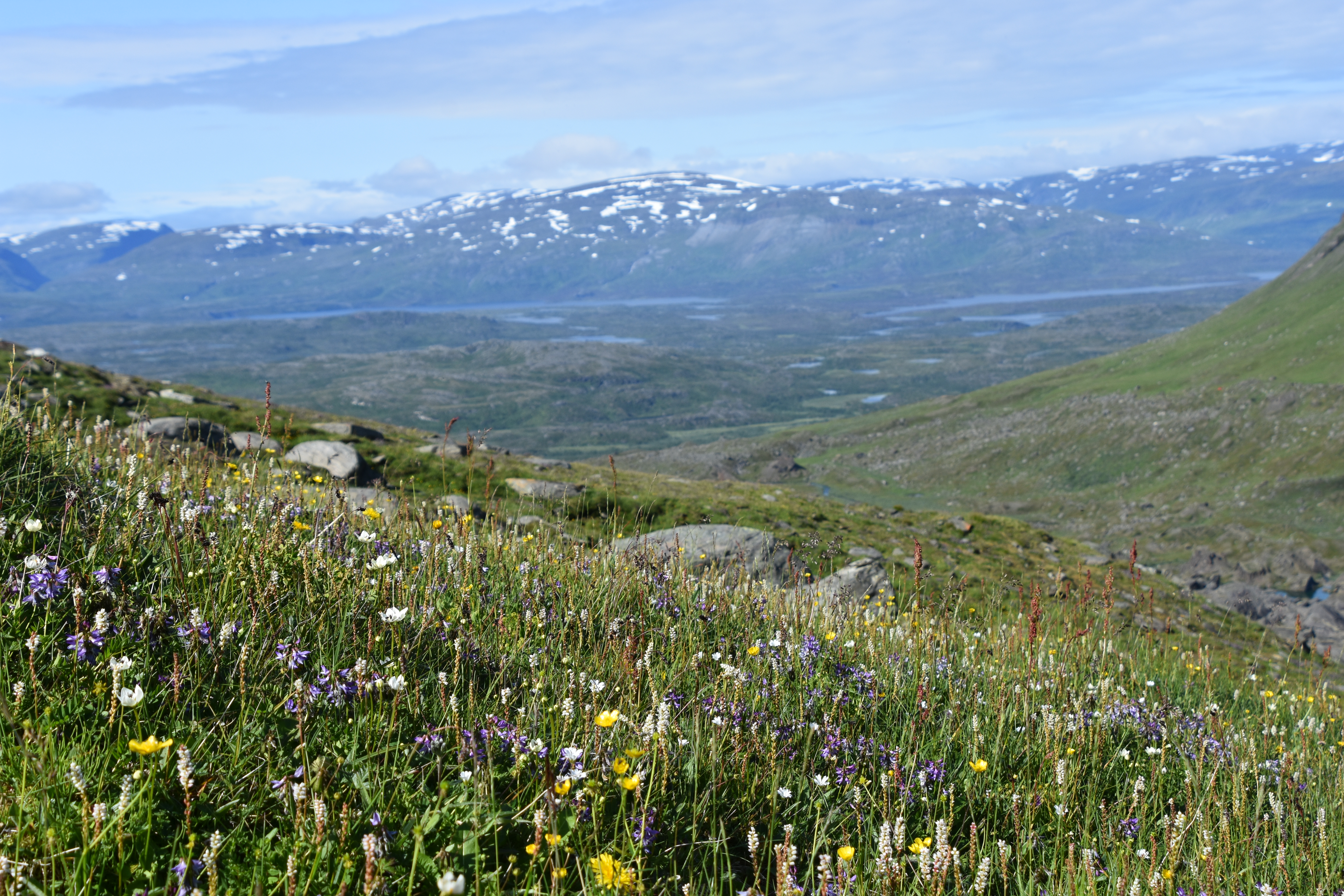
This kind of heat is no longer unusual. It followed a strange winter, where most of the snow had melted away by February – only to be replaced by a late-season snow event that buried the mountain under snow well into spring. These abrupt shifts are exactly what we’re tracking in our Fingerprints of Change project on mount Nuolja, close to Abisko: how increasingly erratic weather affects plants, bumblebees, and the ecosystems they hold together.

Lots of snow on our Fingerprints of change project still late in spring, substantially delaying phenology even when temperatures are high.

It’s too early to say what the full impact of this year’s extremes will be, but we already see it’s substantial. And more importantly: this isn’t a fluke. These kinds of events are happening more frequently – in this system, and in every system.

Because climate change doesn’t play out like a slow, steady dial toward 1.5°C. It comes in jolts. It hits us with heatwaves, droughts, late snows, floods, storms. Shocks that used to be “once-in-a-lifetime,” but now seem to happen all the time. These Extreme Weather and Climate Events (EWCEs) are no longer exceptions. They’re part of the story, and in many cases, the main driver of change.

Yet in ecology, we’ve barely started paying them serious attention.

In our new paper, just published in Trends in Ecology and Evolution (TREE), we argue that this lack of focus isn’t because extreme events don’t matter. It’s because the data hasn’t let us see them properly.

How gradual climate change and extreme events shape species’ range shifts
(A) In the classic view, climate warming drives a slow reshuffling of species. Populations gradually expand into newly suitable areas at the leading edge – typically toward higher latitudes, elevations, or ocean depths – while slowly disappearing from the trailing edge where conditions become too harsh. The result: a steady drift of ranges over time.
(B) But extreme weather can disrupt this smooth story. Sudden droughts, heatwaves, or cold snaps at the trailing edge can wipe out populations entirely, triggering abrupt contractions. These losses might be temporary (recovery is possible if conditions improve) but they can also leave lasting gaps. At the leading edge, storms or other extremes can fling seeds, spores, or individuals far ahead of the current range, sparking rapid expansions. Yet here too, the next extreme could push them right back.

What’s missing?

First: climate data. Most biodiversity studies still rely on coarse, long-term averages or climate station data far away from where organisms actually live. But extreme events are short-lived and highly local – meaning we need fine-scale data in both space and time to catch them. But what is more: as we don’t know where and when the most extreme events will happen, that fine-scaled data needs large spatial and temporal extents, and is that that is hardest to find.

Second: biodiversity data. Most monitoring efforts rely on just a few time points, maybe two or three surveys across several decades. That’s not enough to pick up the biological fingerprints of rapid, transient shocks.

This paper emerged from discussions at the Species on the Move conference in Florida. We highlight how extreme events can accelerate or limit species’ range shifts. For example:

  • Storms can blow seeds or insects far beyond current range limits.
  • Droughts and floods can wipe out entire local populations.
  • Cold snaps can halt the northward spread of warm-adapted species.

So, while background warming may drive slow and steady shifts, extreme events can spark sudden advances or abrupt setbacks.

Extreme events can result in extremely far propagule dispersal, as visualized here by the dispersal kernel.

Where do we go from here?

To understand these dynamics, we need better tools. Microclimate models at the necessary resolution are demanding, but increasingly feasible. Long-term, standardized monitoring – like what we’re doing with the Fingerprints of Change-project in Abisko and through global collaborations like in the MIREN network – is helping us fill the gaps.

And it’s not just about research. Conservation planning must also start factoring in extreme events. That means short-term interventions, like shading turtle nests during heatwaves. But more importantly: long-term strategies, like ensuring connectivity so disturbed populations can recover through recolonization.

The Dickcissel is used as an example in the paper: extreme events at the core of its range are reducing its abundance there, while warmer temperatures at the edges might promote range changes.

A call to think differently

As ecologists, we’re trained to look for trends. We love linearity, averages, gradual change in our data. But extremes defy those expectations. They’re noisy. They’re messy. It’s time we shift our perspective.

In this paper, we call for a different lens: from “microclimate” to “microweather.” From gradual trends to abrupt shocks. From averages to outliers.

Because it’s in the extremes where much of the future will unfold.

Posted in General | Tagged , , , , | Leave a comment

Join EcoFracNet – we’ve got sensors!

Whether you’re already knee-deep in site planning for EcoFracNet or MicroFracnet, or just hearing about it for the first time, we’ve got some exciting news to share—and maybe even a little incentive to get involved.

Wait, what is EcoFracNet again?

Great question. EcoFracNet is a growing international network of field ecologists working together to explore how biodiversity varies across spatial scales using a fractal monitoring design. Alongside it runs MicroFracNet, its microscale-focused sibling, adding more hierarchical levels into the mix. You can read more and see the recent call for participation here: MicroFracNet | The 3D lab.

We’re doing this all bottom-up: no big funding yet, just shared enthusiasm and a commitment to doing robust, comparable science across diverse ecosystems.

A bonus for current and future collaborators

Although we’re still running both networks without external funding, you may be lucky. We’ve secured a batch of second-hand TOMST TMS4 sensors – those awesome little mushrooms that log soil temperature, moisture, and air temp just above the ground. And we’d love to share them with you.

We can lend up to 7 sensors per participating region, free of charge (until we run out, of course). Whether you’ve already joined the network or are still deciding, this could be a perfect way to get started.

A few important notes:

  • No TMD adapters included – We don’t have spares, so you’ll either need to buy one from TOMST for data download or send the sensors back to us after a year so we can extract the data for you.
  • Shipping – We can ship the sensors to you, but depending on where you are, it might be easier to coordinate through someone traveling to and from Belgium or the Netherlands. We’ll do our best to make it work!
  • Sensor quality – These are second-hand but should still have a couple of good years left. We can’t promise anything beyond that – but hey, free sensors.
  • Site setup map required – Before we send anything, we’ll need a clear map of your EcoFracNet setup (e.g., using Google My Maps). Use this example format:
    Blue = vegetation monitoring only
    Green = vegetation + sensor installation
    Red = no monitoring
    (Example Map from an agricultural field site in the Netherlands)
  • Timeline – With summer holidays and slow logistics, shipping will take a little time.
TOMST sensor in our EcoFracNet-site at Fochteloerveen in the Netherlands

Long-term vision

Remember, this isn’t just a one-off field season. EcoFracNet and MicroFracNet are being designed as long-term monitoring projects, with hopes of regular resurveys and extra measurements added in over time. The more consistent we are across sites, the more powerful the dataset becomes.

Ready to join in?

If you’re interested in borrowing sensors (or joining the network in general), please send us:

  • Your overview map (see above)
  • Your full shipping address
  • Your email + phone number

And yes, feel free to forward this to colleagues who might be curious or looking for an excuse to set up some long-term plots.

Haven’t signed up to the network yet? Do so here!

Me happy distributing sensors

Looking forward to hearing from you!

Jonas and Will – for the EcoFracNet team

Posted in General | Leave a comment