A tale of homogenisation

I’ve always been intrigued by ecological scaling – it’s literally in my title: Assistant Professor in Ecological Scaling.

One of the main reasons we care so much about scaling is that ecological theories don’t always hold up when we change scales. What seems true in a single valley, forest plot, or mountain slope can fall apart when we zoom out to continents or the globe. That mismatch often gets us into trouble when trying to generalize from our favourite local case studies to something that has real global relevance.

A classic example: homogenisation

The theory goes like this: when ecosystems are invaded by non-native species, they start to look more and more alike. We call this biotic homogenisation – a reduction in beta diversity, meaning less variation among communities. It’s often linked to lower ecosystem functioning, and by extension, poorer ecosystem health.

Native mountain vegetation tends to be highly distinctive, yet the introduction of non-native species is expected to erode that ecological uniqueness. Here, a highly biodiverse spring meadow in the Scandinavian mountains.

So far, so simple. Except the evidence is a little bit messy. Some studies find strong homogenisation, others don’t. We suspected that part of this inconsistency comes from differences in spatial scale – not all studies are asking the same question in the same “ecological zoom level.”

Scaling up with global replication

To test this idea, we turned to one of our favourite tools: globally replicated monitoring. Thanks to the Mountain Invasion Research Network (MIREN), we could explore patterns of homogenisation – and its opposite, differentiation – across 18 mountain regions worldwide. The findings of this exercise – led by Meike Buhaly – are now published in Global Ecology and Biogeography.

Our hypothesis (perhaps a bit naively in retrospect) was that homogenisation would dominate across all scales, though we expected it to weaken with elevation.

Study design, showing how we compared beta diversity within gradients (local), between mountains (regional), between regions on the same continents (continental), and between continents (global)

Yet that was, surprise surprise, not what we found. At the global scale, the classic theory held neatly: non-native species homogenized communities. Plant assemblages across continents became more similar (lower beta diversity) once non-natives were included. But when we zoomed in, the pattern fell apart. At local and regional scales, homogenisation and differentiation were almost evenly balanced. And even more intriguingly, the pattern split along continental lines:

  • In the New World (the Americas and Australia), homogenisation dominated.
  • In the Old World (Europe, Asia, Africa), differentiation was more common.
Patterns of homogenization and differentation across scales in our dataset.

The pattern depends on where (and how far) you look

In the New World, we found consistent homogenisation across local to continental scales, particularly in lowland plant communities. This likely reflects both the high number and shared history of non-native species: many are widespread across entire continents, occurring in more plots than native species.

At higher elevations, however, in some regions this pattern reversed. When non-native species became rare and patchy, this lead to community differentiation instead, especially in the Andes and Rocky Mountains.

The Eurasian mountains told a different story. There, non-native species actually caused differentiation at local and regional scales, even though some were shared across regions. At the continental scale, these same shared species produced a faint signature of homogenisation, but much weaker than in the New World.

The consistent differentiation we found in Eurasia might simply reflect an earlier invasion stage. With fewer non-native species and fewer widespread invaders, communities still differ strongly from one another. But as non-native species continue to spread, homogenisation may increase into conditions that mirror what we already see in the Americas and Australia.

Dandelion in the Chilean Andes – a pretty common site in the Americas and one of the reasons we observed homogenisation in the New World.

Scaling reveals nuance – again

So, as so often in ecology, the story depends on scale.
At large, continental scales, non-native species clearly homogenize plant communities: ecosystems across continents begin to share the same species. But when you zoom in, that signal becomes patchy. Homogenisation dominates in regions with long invasion histories, while newer invasion fronts still show differentiation.

It’s a pattern that fits a familiar ecological theme:

a little change might be positive – but a lot can be profoundly transformative.

More information: Buhaly et al. (2025). Global Homogenisation of Plant Communities Along Mountain Roads by Non-Native Species Despite Mixed Effects at Smaller Scales. Global Ecology & Biogeography. https://doi.org/10.1111/geb.70137

Posted in Science | Tagged , , , , | Leave a comment

Cliffhanger: Am I, as a climber, a threat or a treasure for plant diversity on rock cliffs?

Translation of  the submission for the pop-sci writing competition ‘Vlaamse Scriptiepijs’ by team member Sarane Coen

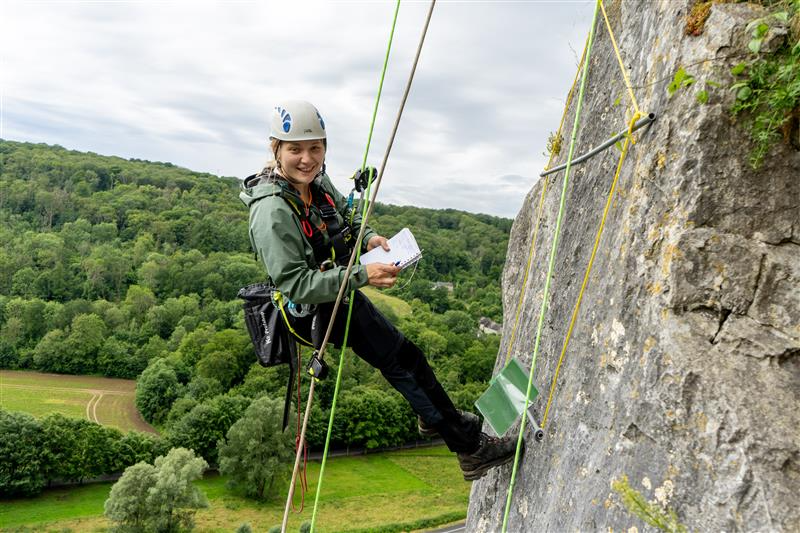
With the River Meuse flowing far below, I search for the way up to the top. With fingers and toes, I follow a route of small cracks and ridges in the rock wall. For me, these are holds; for plants, they are habitats. Where I grip, they fight to survive. That thought stuck with me.

Am I, as a rock climber, a threat or a treasure to the ecosystem I love so much?

With that question, my master’s thesis research began. I returned to the rocks. This time not only as a climber, but also as a scientist.

Bursting biodiversity

At first glance, cliffs may seem like barren walls. But in reality, they burst with life. Rocks are rich ecosystems full of rare species that endure extreme conditions: steep faces with almost no soil, nutrients, or water.

For me, these are holds; for plants, they are habitats.

Cliffs offer a wide range of living conditions because they vary greatly in height, structure, and orientation toward the sun. These differences create a diversity of microclimates. North-facing walls or deep, shaded crevices remain much cooler and moister than sunny south faces. Cliffs thus form a mosaic of tiny habitats where each species finds its ideal place to live.

Research on a high level

Helmet, harness, rope, check! One last look into the depths and ready to descent. With my research material,  I dangled along the steep rock walls on the banks of the River Meuse in the Belgian Ardennes to collect data.

To understand how climbing influences these ecosystems, I looked at the plants on unclimbed walls and lightly and heavily climbed walls. Within one-square-metre plots, I recorded which species were present and how much space they occupied. I also measured the characteristics of the rock itself: surface structure, slope, height, and sun orientation. In total, I conducted these measurements across 248 separate square meters, spread over multiple cliff faces. Bit by bit, I untangled not only my ropes, but also some ecological questions.

Climbers, unexpected buddies of biodiversity!

The structure of the rock surface turned out to be crucial. Smooth walls offer little opportunity for plants, no matter how often they are climbed. The more cracks, ridges, and holes a rock has, the more suitable microhabitats it provides — and the more plant species can find a place to grow.

A bit of disturbance can make space for more biodiversity.

And climbing? Moderate climbing intensity did not harm biodiversity — it even seemed to enhance it. Lightly climbed cliffs hosted the highest diversity compared with both unclimbed and heavily climbed sites.

The type of plants explained this pattern. On unclimbed cliffs, I mostly found dominant, competitive species that monopolise nutrients and water. On climbed cliffs, more disturbance-tolerant species appeared. Climbing partially reduced the dominance of the competitive species, giving others a chance to establish themselves. A bit of disturbance can make space for more biodiversity.

Safe spaces for the future

These results reassure me as a climber. Fortunately! Because these fragile cliff ecosystems may play a key role in the climate and biodiversity crises. Their variation in microhabitats with different temperatures makes them cool refuges for species that can no longer tolerate the heat elsewhere. At the same time, they serve as stepping stones for southern species expanding into the warmest niches beyond their usual range.

Further research can help us understand how cliffs buffer or amplify the effects of climate warming on biodiversity. Understanding the impact of human activities such as climbing is a first step. And the fact that certain human disturbances can sometimes be secretly beneficial makes it all the more fascinating.

So, both as scientist and a climber, I can contribute to biodiversity. And cliffs turn out to be a refuge,  for passionate climbers as well as for vulnerable plant species too.

Translation of  the submission for the pop-sci writing competition ‘Vlaamse Scriptiepijs’ by Sarane Coen

Original:

Posted in Belgium | Tagged , , , , , , , | Leave a comment

De Oorzaak – on tour

Last week, we wrapped up De Oorzaak with nothing less than a bang. With in-depth stories featured in De Morgen, striking results on the table, and a “tour across Flanders” that brought us to Antwerp, Ghent, and Leuven, the project ended on a high note. The closing events weren’t just symposia – they were the grand finale of a citizen science project that has kept us occupied for the better part of two years. Each evening was a meeting point between science, citizens, and policymakers, weaving data and lived experience into one story about noise in our cities.

The full team on stage, accepting flowers for two years of intensive work with and for the whole of Flanders

Noise is more than just an irritation – it shapes how we live, sleep, and feel.
The results from De Oorzaak make this crystal clear: almost half of all measurement points were, on average, above 60 dB during the day – a level already higher than the World Health Organization recommends. Unsurprisingly, traffic was the worst culprit across the board. But we also saw how local noise sources – like tourist boats or tram rails – can have gigantic impacts on daily life in specific neighborhoods.

And those numbers are only part of the story. Behind them are the voices and experiences of people who live with noise every day. At the symposium, participants shared endless varieties of stories – some tragic, some creative, all deeply personal. They showed just how differently noise can affect lives, and how much effort it takes to raise awareness.

The consequences are clear, as shown by our data: the more noise we are exposed to, the more annoyed we become. Annoyance spills into reduced sleep quality, and ultimately into a diminished quality of life.

Browse the beautiful visual stories from media partner De Morgen here: https://www.demorgen.be/redactie/2025/oorzaak-resultaten/index.html

🗺️ If you don’t have a subscription to De Morgen, you can explore this beautiful interactive map of Lden values and noise events at each measurement point, including AI-detected sources binned by the peak noise level per event, as made by our data wizard Ablenya Barros: https://ablenya.github.io/Oorzaak/Sensors_noise_events.html.

Yet there is also hope – and it’s green. Across the data, one message stood out: nature helps. Green spaces and natural sounds soften the harsh edges of our urban soundscapes. Even when the decibel levels are not lower, the presence of rustling leaves, birdsong, or flowing water transforms how we experience sound. Nature doesn’t necessarily quiet our environment – it restores us.

The next question is: what will we do with this knowledge? At each evening of the symposium, policymakers were confronted with that exact challenge. The most striking message came from the city counsillor of environment in Leuven, who put it simply: this is the new normal: citizens now have the data to show there is a problem – giving them a lot more power again. But solutions will not be easy, and they never have been.

Power to the people – giving them the data to contextualize their environment.

So where do we go from here? The evidence is clear, the stories are real, and the momentum is growing. If we want healthier cities and better lives, the answer is again clear: we need more green in our cities.

There is much much more depth and nuance to this story than I can tell here and now, but we hope we can get back to you about all that! For now, check out this first post here: https://www.uantwerpen.be/nl/projecten/de-oorzaak/nieuws/.

Posted in Belgium | Leave a comment

Mapping the past to predict the future

Long-term followers of this blog know I’ve always been fascinated by species distribution changes. We’ve tracked non-native species moving into mountains and cities, studied how mountain plants travel up and down slopes along roads, and explored how microclimate – and changes in it – affects all of this.

But all of that focuses on recent changes, what we call contemporary climate change. What we often forget is that the world has been dynamic for millions of years, and species have been moving up and down, and left and right for just as long. So, we asked ourselves: could we learn from these past dynamics to better predict the future?

https://www.sciencedirect.com/science/article/abs/pii/S0006320725005361That’s exactly what Yuheng Chen tackled in his master thesis – now expanded into a full paper in Biological Conservation. Yuheng, now a PhD student in our group at Utrecht University, has with this paper completed quite a journey on a topic that has kept my head spinning: looking far back in time to understand the forces shaping species today. And let me tell you, looking that far back is not easy.

The core question was simple enough: are species used to climate change or not? Species that evolved in regions with strong past climate fluctuations might be better at coping with future change, whereas those from historically stable climates might be more vulnerable. In other words, a species’ history shapes its present ecological niche, which in turn affects its future range size.

To explore this, we went (well, virtually, for me) to China. We identified 2,933 plant species endemic to China, which conveniently avoids issues of artificial borders and inconsistent data across countries, while still benefitting from the huge variety of climates and ecosystems across the country. Using species distribution models, we mapped their current ranges, measured their sensitivity to climate, and predicted how those ranges might change by the 2070s under two climate scenarios.

Next came the exciting part: comparing regions where species diverged long ago (‘divergence hotspots’) with areas that have experienced big climate swings since the Last Glacial Maximum (‘paleoclimate-change hotspots’). Museums are regions where species diverged a long time ago – they’re ancient centers of diversity, like living archives. Cradles are regions where species divergence is more recent – they’re hotspots of new evolutionary activity.

Here’s what we found:

  • Species from stable, long-term refuges (‘museum areas’) are projected to lose range under future warming.
  • Species from climate-fluctuating regions might actually expand their ranges.
Figure 1. The divergence and paleoclimate change hotspots of Chinese endemic higher plants. Figure 4A recognizes museum (ancient divergence center) and cradle (recent divergence center) based on species divergence time using null-model test. Figure 4B and 4C recognize refuge (stable precipitation and temperature center) and exposure (precipitation and temperature change center) based on paleo precipitation change since LGM, respectively. The provinces corresponding to the hotspots are also marked in the map.

Interestingly, there was no difference in predicted change rates between species from old (museum) versus new (cradle) divergence hotspots, but paleoclimate exposure mattered a lot: species from areas that experienced strong past climate change are predicted to do better than those from stable refuges.

Figure 2: predicted changes in future ranges for species with different origins. There was no difference in predicted change rates for species from old (museum) versus new (cradle) divergence hotspots, but there was a clear difference for species exposed to either a lot (exposure) versus very little (refuge) paleoclimatic change.

These findings highlight how evolutionary history and past climate experiences shape both current distributions and future responses. They also give us a clue about the winners and losers under rapid climate change, and stress the importance of identifying areas that are long-term refuges versus regions accustomed to taking a punch. While mostly exciting from a theoretical perspective, this knowledge is also important for designing future-proof protected areas.

Reference

Chen et al. (2025). Identifying divergence time and paleoclimate change hotspots for better conservation under future climate change. Biological Conservation. https://doi.org/10.1016/j.biocon.2025.111499.

Posted in China | Tagged , , , , | Leave a comment

How to set up your own microclimate network

Back in 2021, we had an important thought: maybe we should start treating microclimate the same way we treat macroclimate. Weather and climate are monitored by national governments through organized, standardized networks – so why not microclimate too?

We wrote a short note to get that idea out into the world. Nice, said the reviewer, but tell me more about the ‘how’! And so we did. We developed some R code to help people figure out where to place those sensors. Nice, said the reviewer again – and in the end, the paper became mostly about that.

Nice, said the readers, but what if we want to do this locally, not at the country level? We still have questions! We got talking, and soon a new idea was born:

👉 How do you set up your own microclimate network, even if you have as little as two sensors?

And that brings us to our new paper, just published in Ecological Informatics.

A flexible workflow for anyone

This new paper brings everything together. It includes:

  • Even more flexible R code for site selection. You can work with a fixed budget, or let the code tell you exactly how many sensors are needed to cover your region.
  • Guidance on project design from start to finish, so you don’t just know where to put sensors, but also how to structure the entire monitoring effort.
  • A nice workflow diagram to guide you through all the steps — from defining your questions, to engaging the community, to placing sensors, analyzing data, and communicating results.
A visual guide to setting up your own microclimate network. From defining your questions and teaming up with the community, to picking sites with smart R code, testing the setup, heading into the field, crunching the data, and finally sharing results – the workflow takes you from first idea to real-world impact.

Why microclimate is different

Microclimate monitoring comes with some unique challenges. Covering the full variation in a landscape often means crossing human-made boundaries, which in turn means involving many landowners.

Take our large project in Flemish gardens: here, citizen science became essential. Thousands of people installed sensors in their own gardens, creating a network far beyond what we could have done alone.

To make things more concrete, the paper also walks you through three case studies from our own work:, from the forests of Madagascar, over the deserts of Oman, to the urban gardens of Belgium

Each shows, step by step, how specific microclimate questions shaped our decisions.

Overview figure of the three case studies discussed in the paper

The toolbox

Of course, there is a reason this paper is in Ecological Informatics: the code. The heart of the paper is a set of tools that let you:

  • Visualize variation in your landscape for key microclimate drivers.
  • Identify optimal sensor locations to capture that variation.

The beauty is that landscapes differ wildly – but the decision-making process is the same everywhere. That’s what the workflow makes reproducible.

Take our case-study in Madagascar as an example. The region has two main plateaus, one at ~500 m and another at ~1100 m, connected by a steep slope. That slope, though small in area, is microclimatically quite important – so we had to oversample it. By contrast, the broad lowlands required fewer sensors, despite covering more space.

Left: sensor location selection (red) in the landscape, plotted as a function of elevation and slope. The black dots are all combinations present in the landscape, with the shape of the point cloud typical for two plateaus connected by a steeper slope. On the right: annual temperature range as a function of canopy cover, and coloured by land use type.

Then there’s canopy cover: ranging from 0 to nearly 90%. To capture that gradient properly, we spread sensors across both topographic and canopy variation.

This kind of exercise inevitably landed us in rice paddies and farmland – places with microclimates very different from forests (albeit surprisingly not so on this annual temperature range graph above). And that meant bringing farmers on board, motivating and involving them as part of the project.

In short, this paper is a step-by-step guide plus flexible R functions for anyone who wants to build a local microclimate network. Whether you have 2 sensors or 200, the workflow helps you design your network systematically, transparently, and with local context in mind.

We’d love to see this become a go-to resource for the growing community of microclimate enthusiasts. And of course—we’d be thrilled if the data from these networks feeds into the global Microclimate Database.

As for those nationwide microclimate networks? Governments haven’t yet picked up the urgency. But now you know about it too. And one day, we’ll make it happen.

References:

Klinges, D. H., Lembrechts, J. J., Van de Vondel, S., Greenlee, E. J., Hayles-Cotton, K., & Senior, R. A. (2025). A workflow for microclimate sensor networks: integrating geographic tools, statistics, and local knowledge. Ecological Informatics, 103376.

Lembrechts, J. J., Lenoir, J., R Scheffers, B., & De Frenne, P. (2021). Designing countrywide and regional microclimate networks. Global Ecology and Biogeography30(6), 1168-1174.

Posted in General | Tagged , , , , , | Leave a comment

Fijnstofpluim uit Canada live gedetecteerd door burgers rond Nationaal Park Brabantse Wouden

Het Nationaal Park Brabantse Wouden is gestart met het nieuwe burgerwetenschapsproject Groene Longen, dat het positieve effect van bos – en natuur in brede zin – op de luchtkwaliteit in kaart wil brengen. In totaal nemen 35 burgers in en rond het nationaal park deel, elk met een eigen luchtkwaliteitsensor die data in real time doorstuurt naar een interactief dashboard. Het onderzoek loopt drie maanden en gebeurt in samenwerking met dr. Jonas Lembrechts (Universiteit Utrecht & Antwerpen), trekker van eerdere burgerwetenschapsprojecten CurieuzeNeuzen en De Oorzaak.

Afgelopen weekend leverde het project meteen een sprekend voorbeeld van de kracht van real-time data: de sensoren detecteerden een pluim fijn stof afkomstig van bosbranden in Canada. Zowel in stedelijk gebied als daarbuiten werden duidelijke pieken gemeten.

“Een van de doelen uit ons masterplan is om het slimste nationaal park van België te worden,” zegt Julie Blanjean, projectleider burgerwetenschap van Nationaal Park Brabantse Wouden. “Met toegankelijke projecten zoals Groene Longen brengen we wetenschap en natuurbeleving dichter bij de mensen.”

Fijnstofmetingen in Tervuren, aan de rand van de Brabantse Wouden, lieten vrijdag vanaf 14 uur een duidelijke stijging zien. Waar de luchtkwaliteit hier normaal uitstekend is, bleef het fijnstofgehalte verhoogd tot zaterdag rond 9 uur. Deze piek, die overal in Vlaanderen zichtbaar was, kon duidelijk worden gelinkt aan een rookpluim uit Canada, afkomstig van grootschalige bosbranden daar.

Real-time data voor iedereen
Elke deelnemer heeft toegang tot een persoonlijk dashboard, en alle metingen zijn ook live te volgen via de wereldkaart van het internationale luchtkwaliteitsnetwerk AirGradient: link naar kaart.

“Real-time monitoring brengt de wetenschap letterlijk tot bij de mensen,” legt dr. Lembrechts uit. “Deze Canadese rookpluim is daar het perfecte voorbeeld van: binnen enkele uren na aankomst in België konden we de impact meten. Het laat zien hoe sterk lokale luchtkwaliteit verbonden is met gebeurtenissen duizenden kilometers verderop.”

Betrokken burgernetwerk

Groene Longen sluit aan bij eerdere burgerwetenschapsinitiatieven van het nationaal park, zoals de Klimaattrappers die het verkoelende effect van bossen onderzochten met sensoren op fietsen. Zo bouwt het Nationaal Park Brabantse Wouden verder aan een slim en betrokken netwerk van burgers en onderzoekers. Groene Longen loopt nog tot en met november en ook daarna zal het nationaal park geïnteresseerde burgers blijven betrekken.

Meer informatie:

Jonas Lembrechts – j.j.lembrechts@uu.nl – 0471475321
Julie Blanjean – julie.blanjean@brabantsewouden.be

Posted in General | 1 Comment