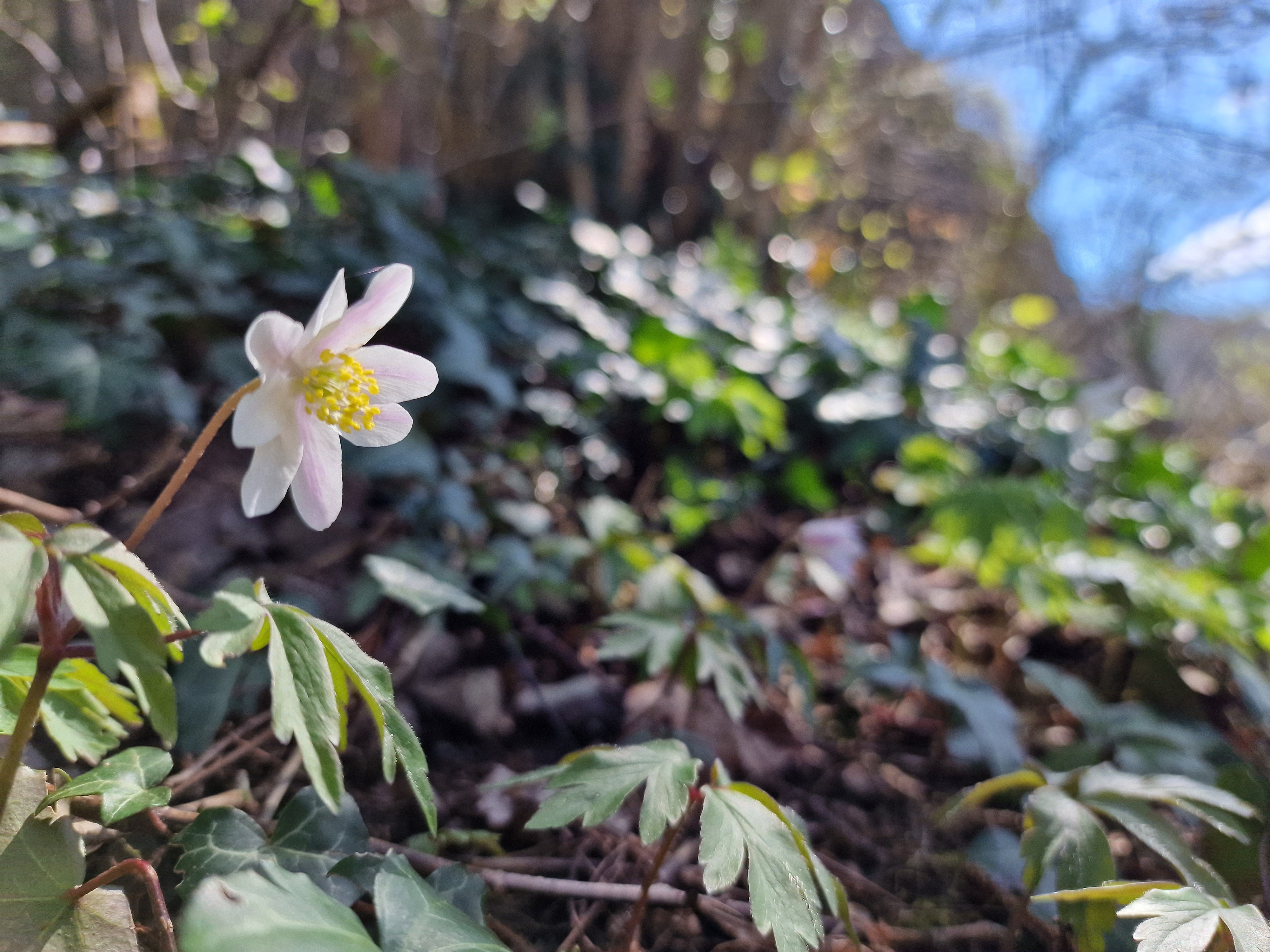
One could wonder if the microclimate-based models of Haesen et al. would have predicted such a wealth of wildflowers in the garden of our new home!
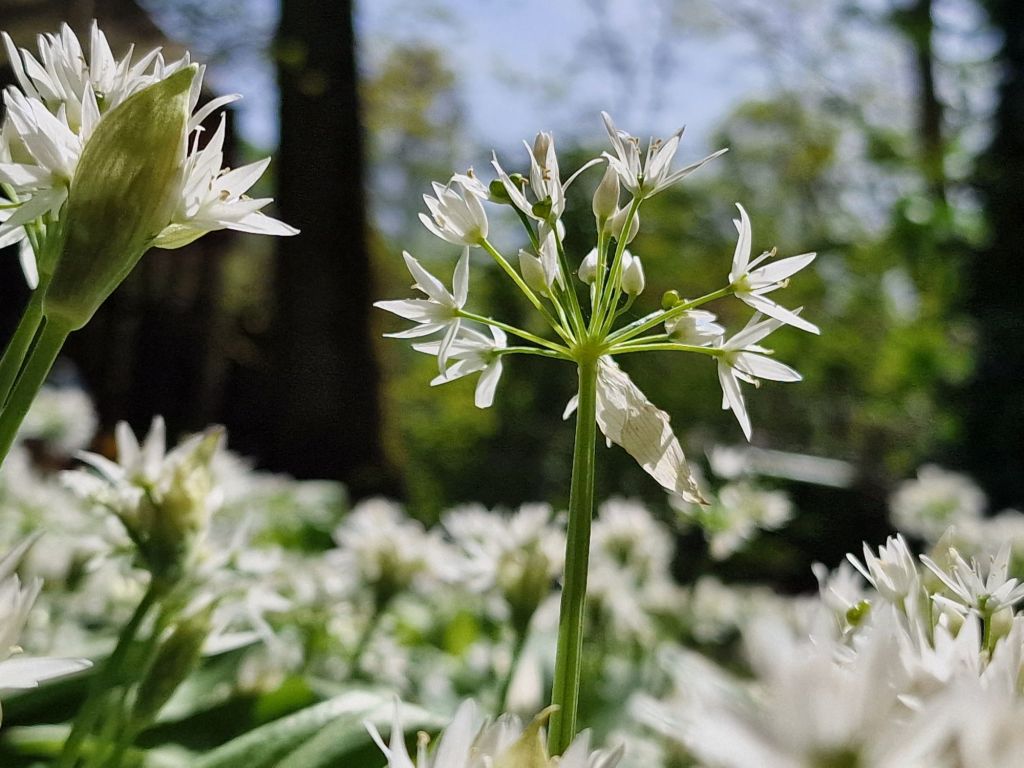
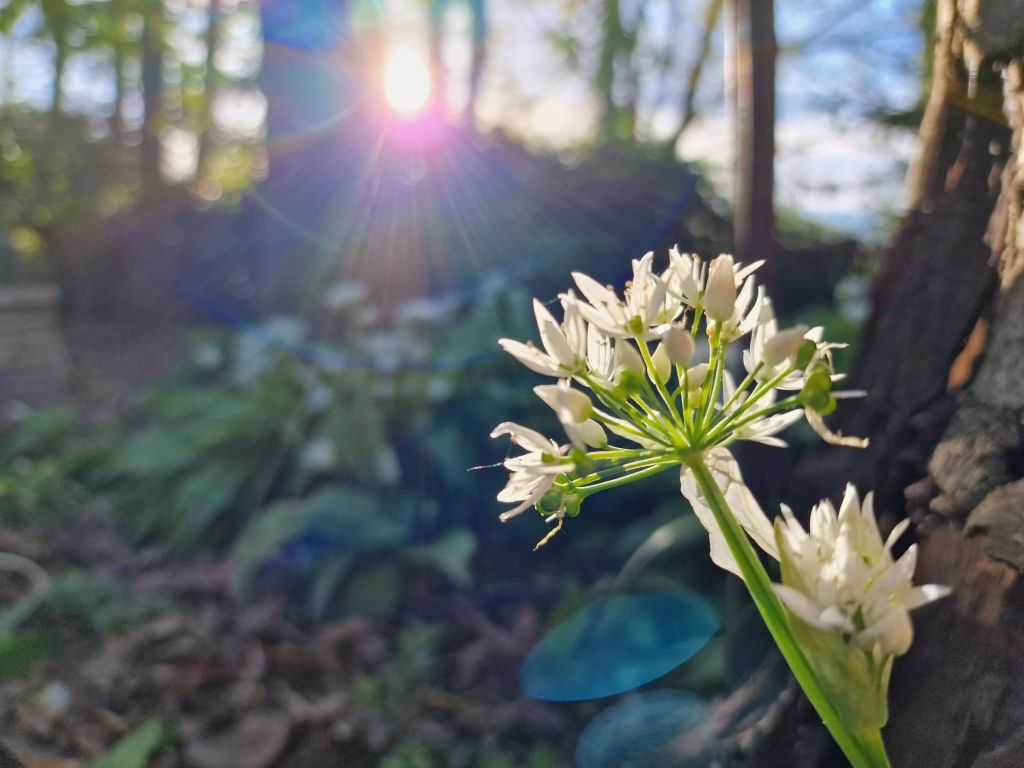
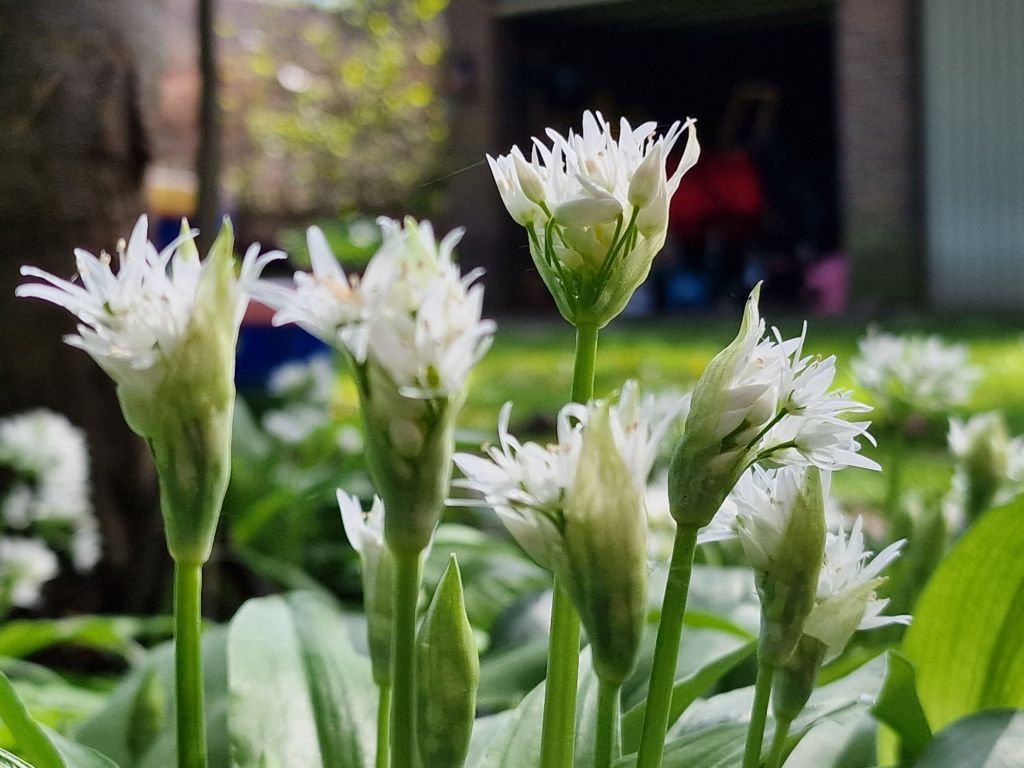
Wild garlic
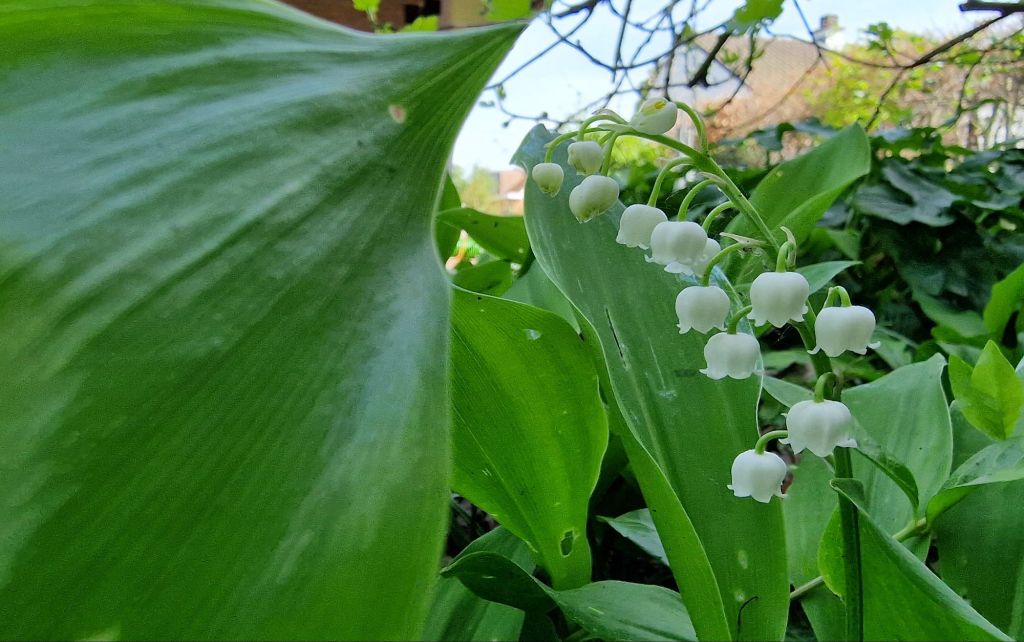
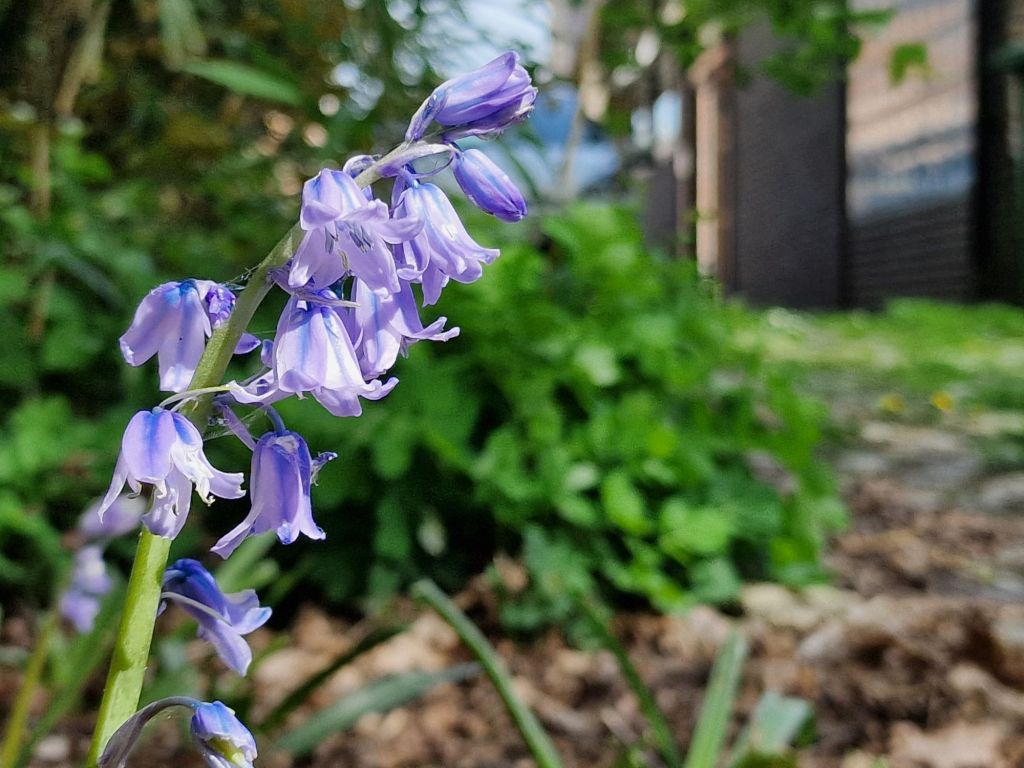
This is our first spring in our new garden, and we could thus have hardly foreseen that so many beautiful decorations would spring up in our little patch of forest!
Lily of the valley
Of course, that is if our distribution models would not have said so. In this recent paper in Ecology Letters, we used our high resolution (5 x 5 m) maps of forest microclimate to improve distribution models of forest understory plants.
5 x5 m might just be enough to give our garden its own little pixel on the maps, so it could be worthy to investigate…
Of course, I should not tell you that all that greenery was one of the reasons why we bought the place, so I am beyond excited that the garden is rewarding our decision so handsomely!
One of the key findings of the Mountain Invasion Research Network (MIREN) is that mountain roads have a MASSIVE impact on their surrounding vegetation. Whole communities are changing, non-native species are moving in, and all kinds of species are moving hundreds of meters up and down along them.
Now (in this paper), we add a new and intriguing component to that story: belowground communities are changing fundamentally as well, and these changes are surprisingly consistent across the globe. In a first attempt to include the dynamics of belowground communities into our global MIREN storyline, we looked at the dominant mycorrhizal associations of plant communities along mountain roads.
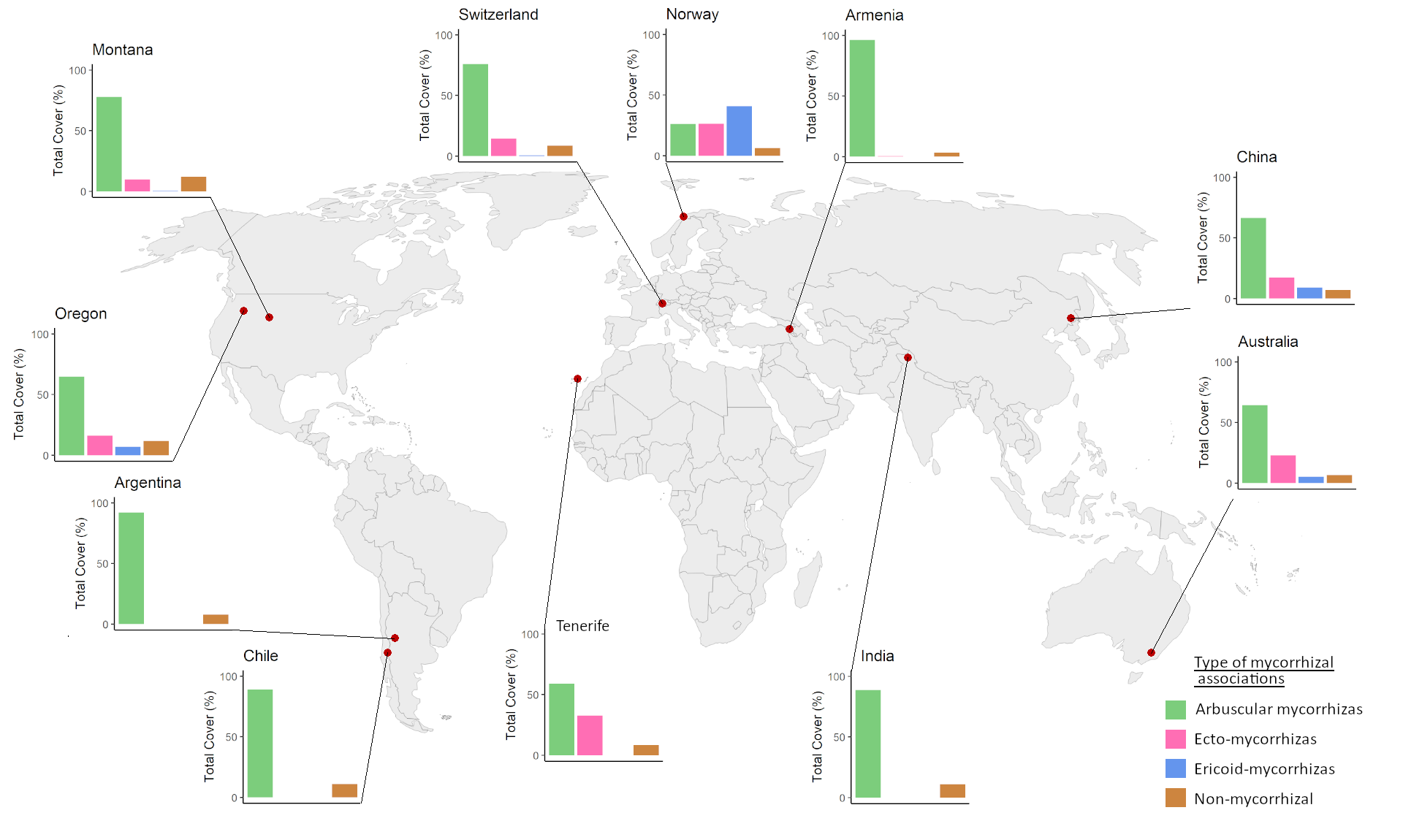
We estimated the percentage of plant species in each of our MIREN plots from mountain regions across the globe that was associated with a certain mycorrhizal type, and analyzed trends in the dominance of each of these types along climatic gradients, contrasting disturbed roadsides with (semi-)natural interior vegetation.
Studied mountain regions and their mycorrhizal associations
Conclusions were surprisingly clear: while changes in vegetation are often relatively murky and contradictory between regions, trends in the dominant mycorrhizal type were relatively straightforward: roadsides overwhelmingly facilitate the establishment of communities associated with arbuscular mycorrhizal fungi (AMF), to the detriment of ericoid and ectomycorrhizal species. Even more, that beneficial effect on arbuscular mycorrhizae was especially strong in regions traditionally dominated by ecto- and ericoid mycorrhizal communities – often those with colder climates, such as our own northern Scandinavian research site.
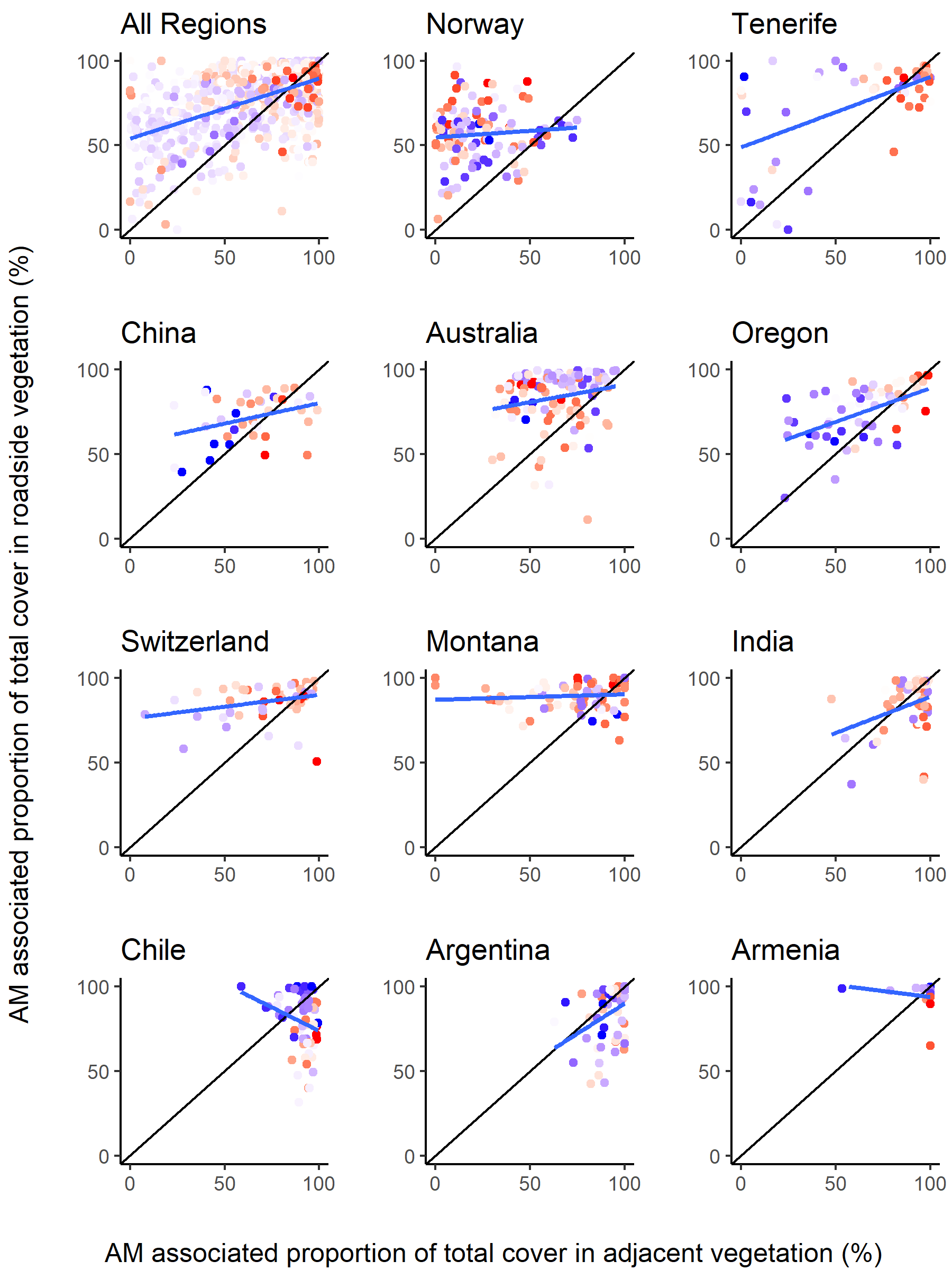
A complex figure, perhaps, but the key story of the paper: the lower the proportion of AM associated plants in the adjacent vegetation (x-axis), the stronger the increase in AM-associated plants in the roadside (blue line above the 1/1-line). This pattern was especially strong in Norway, a region traditionally relatively poor in AM-associated species.
This ‘power to the AMF’ we see along mountain roads is very much in line with the known traits and preferences of these fungi and their associated plants. Indeed, roads tend to favour ruderal species, commonly AM or non-mycorrhizal (NM) plants, to the detriment of more perennial and woody plants, more likely to be associated with EcM and ErM fungi. We thus expected road disturbance to correlate with increased AM and NM representation and decreased EcM and ErM, yet were pleasantly surprised with the generality of that pattern.
MIREN surveys cover an impressively wide variety of mountain roads, yet observed patterns were surprisingly consistent among them. a) High elevation gravel roads in the Argentinian Andes b) Lowland gravel service road in the Norwegian Scandes c) High elevation asphalt road in Yellowstone, USA d) Lowland asphalt road in Chile with strongly invaded roadside vegetation e) High elevation gravel road in Tenerife f) Lowland snowed-in gravel road in the Norwegian Scandes.
A possible hypothesis behind our – for now unfortunately only observational – correlation would be that roadside disturbance leads to increased soil nutrient mineralization and/or reduced soil acidity, which AM-fungi are more apt at taking advantage of. Indeed, it is no coincidence that most ruderal plant species are associated with AM-fungi, with their relatively rapid colonization strategies, generalist nature, lower level of specialization for specific soil conditions, and preference for dynamic, disturbed habitats. The fact that these ruderal AM plant species are generally faster growing and more disturbance tolerant due to their ability to take advantage of vegetation gaps, thus could begin to explain the patterns we observed: increased nutrient availability, less extreme pH, more dynamic conditions, and reduced competition in roadsides all act in favor of AM plant species.
These intriguing patterns raised an obvious next question to us at the Mountain Invasion Research Network: what would the impact be on non-native species? Surprisingly perhaps, virtually all non-native species in all our studied mountain regions are AM- (or some NM-)associated. This does make sense, however, if one thinks about how strongly they are associated with roadsides; which we now showed to be the ultimate heaven for AM-associated plant species. Yet we went one step further: we also showed that these AM-associated non-native species can now also much more easily escape from the roadside into the adjacent vegetation if the latter is more AM-dominated. Another reason why invasion levels in our ericoid and ectomycorrhizal vegetation in northern Scandinavia are virtually zero?
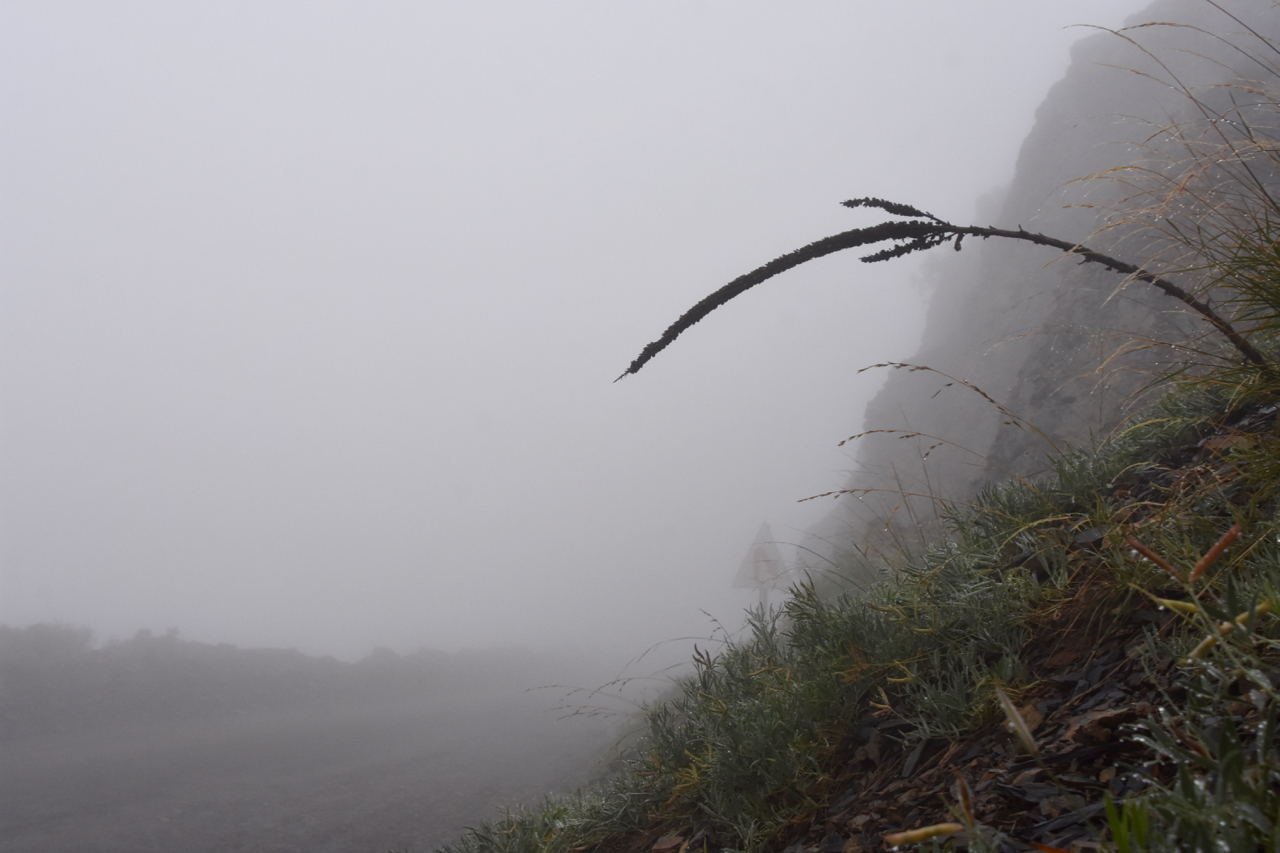
Misty mountain road in the Argentinian Andes
Our results represent an important first global study of the role of anthropogenic disturbances in shaping mountain plant communities through the mycorrhizal fungi they associate with. While these findings might sound theoretical, they have important implications for vegetation restoration worldwide, as they suggest that roadside disturbance can change the fundamental make-up of EcM- and ErM-dominated plant communities, potentially shifting communities between alternative stable states of mycorrhizal dominance that could be very difficult to reverse.
From the first days of SoilTemp, we had the ambition to turn this project into more than ‘just a database’. SoilTemp could become the much-needed glue to stick together microclimate ecologists and biogeographers from across the globe, and give them an opportunity to learn from each other and jointly move the field forward.
It was time for such a community, we believed, as microclimate research was rapidly evolving into a booming scientific discipline and, after several decades of crucial fundamental work, the field was finally truly turning global.
This vision for a collaborative future saw its first, and perhaps most important, pinnacle in 2022, when we managed to bring together more than a hundred microclimate enthusiasts at the first Microclimate Ecology & Biogeography (ME&B) conference in Antwerp. For a week, the spacious rooms of our beautifully old conference facility was buzzing with microclimate research from all across the globe.
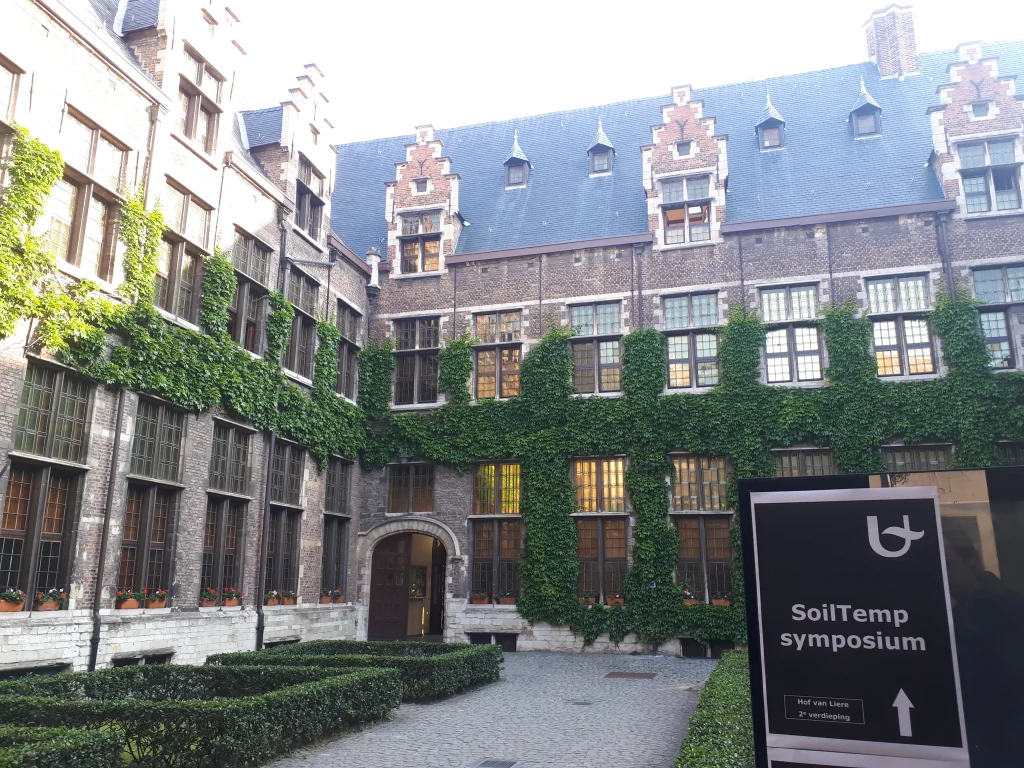
The conference facility at the University of Antwerp in Belgium
So inspiring was the atmosphere, that we decided to write down what we learned at that conference and inform the world about the major strides forward that our field has taken and, importantly, where we believe the field is and should be heading next.
Thanks to a gigantic effort by 97 conference participants, the output of that story now got published: a perspective piece called ‘Microclimate, an important part of ecology and biogeography’. The main message of that paper got nicely summarized by lead author Julia Kemppinen on X.
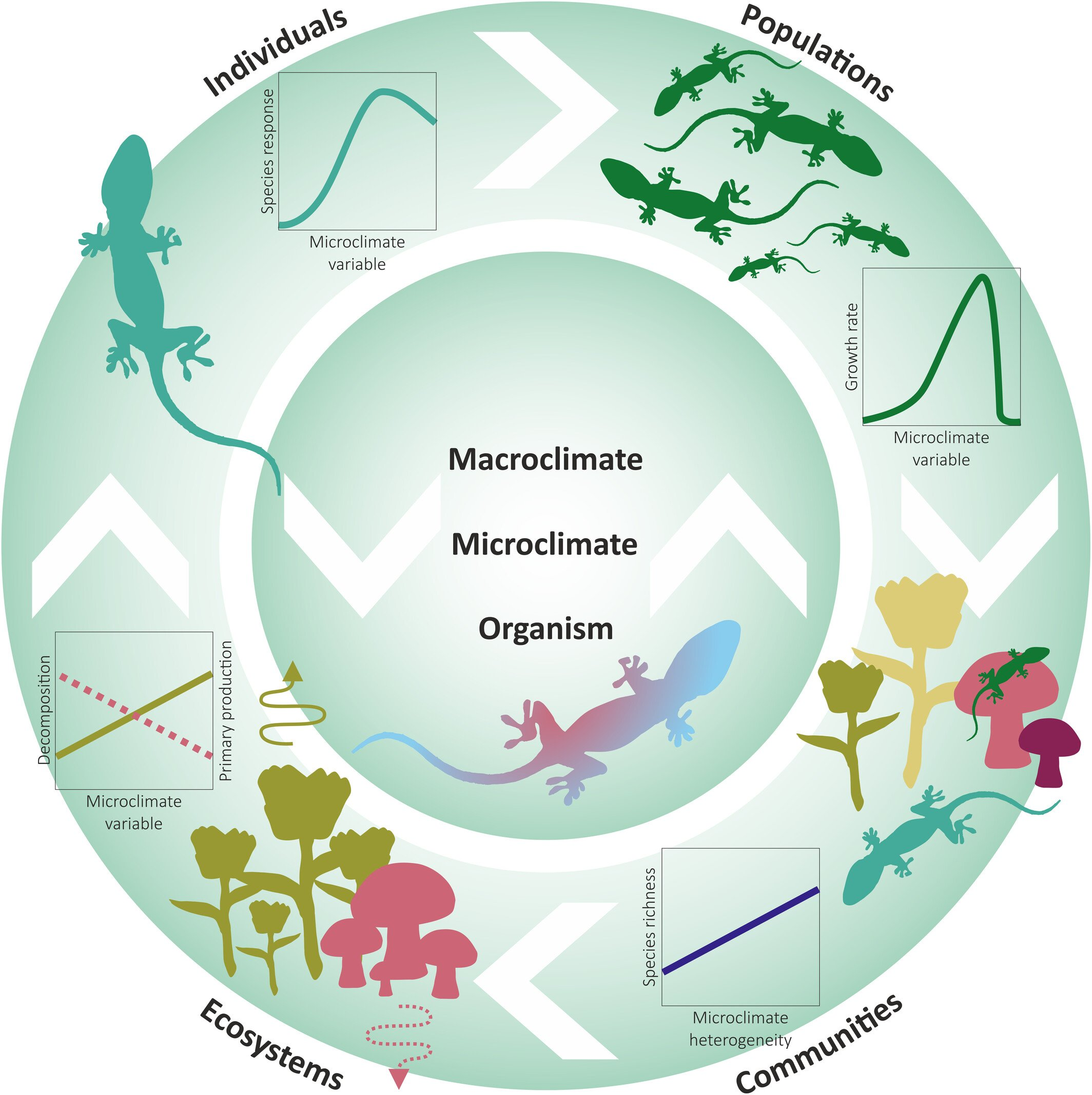
In the article, we summarize the current status of microclimate ecology and biogeography as its own scientific discipline. First, we highlight the latest research on interactions between microclimates and organisms, including how microclimates influence individuals, and through them populations, communities, and entire ecosystems. We show how this is increasingly being studied from the tropics to the poles.
We discuss the importance of microclimates in ecosystem management under climate change. We showcase new research in microclimate management with examples from biodiversity conservation, forestry, and urban ecology.
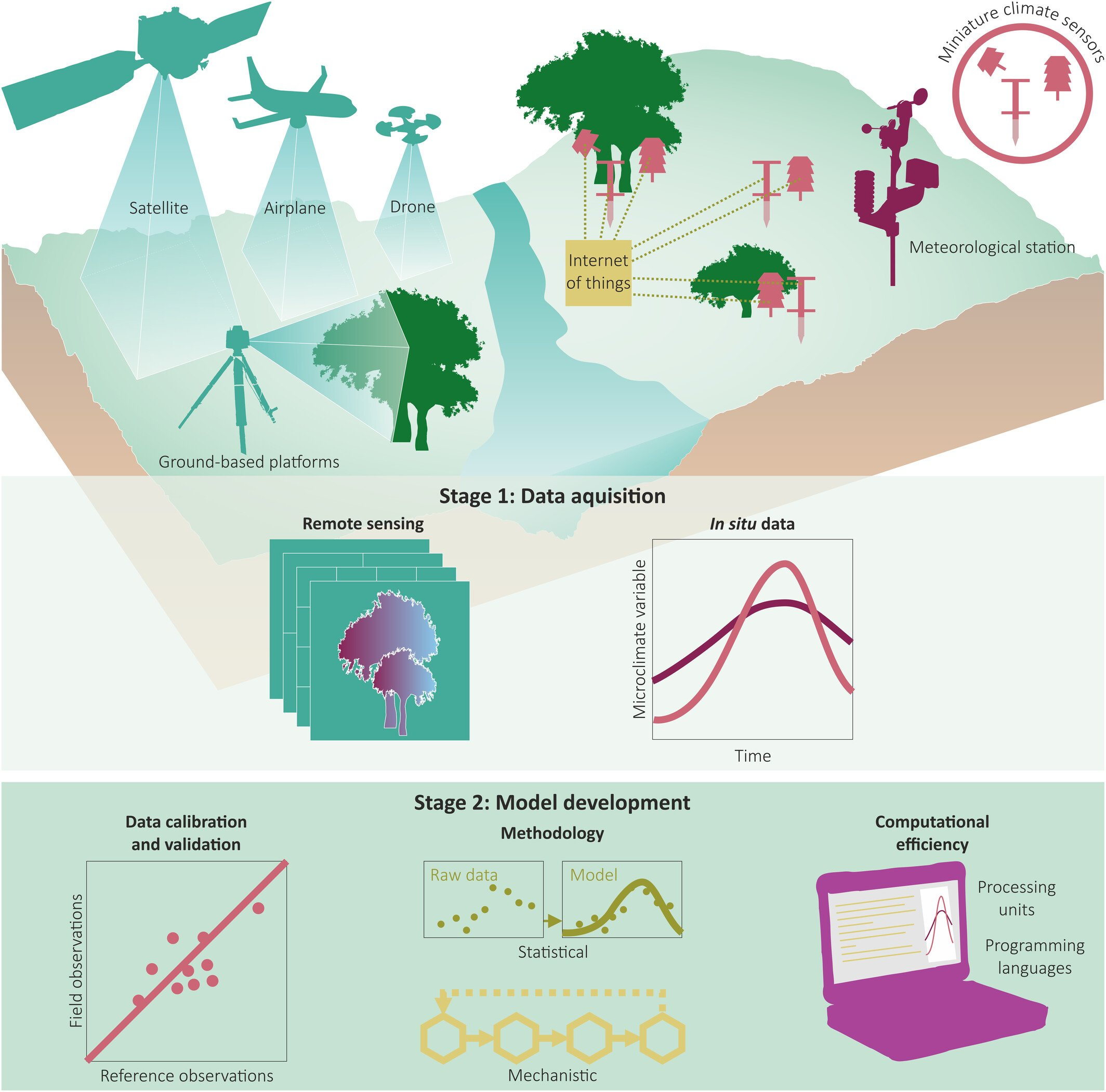
Finally, we summarize the recent advances in data acquisition, such as novel field sensors and remote sensing methods. We discuss microclimate modelling, mapping and data processing, including the accessibility of modelling tools & advantages of different modelling approaches.
Most importantly, we thus ask the question: what is next for microclimate ecology and biogeography? We identify major knowledge gaps that need to be filled for further advancing microclimate investigations, applications, and methods in the fields of ecology and biogeography. First of all, global microclimate research should be conscious of its biases. For instance, forest and tundra biomes are well represented in the microclimate literature, while microclimates matter to many terrestrial organisms across all terrestrial biomes. Second, it is also important to note that in the English-written scientific literature, microclimate ecology and biogeography are largely represented by studies, researchers and institutions of European, North American and Australian origin. We emphasize that these knowledge gaps and biases are important to consider in all future research that aims for a genuinely global coverage in microclimate investigations. This is key for making ecology and biogeography a more global endeavour.
That said, our most urgent research gaps include 1) spatiotemporal scaling of microclimate data, 2) quantifying and understanding the mismatches between macroclimate and microclimate in predicting responses of organisms to climate change, and 3) the need for more evidence on the outcomes of microclimate management.
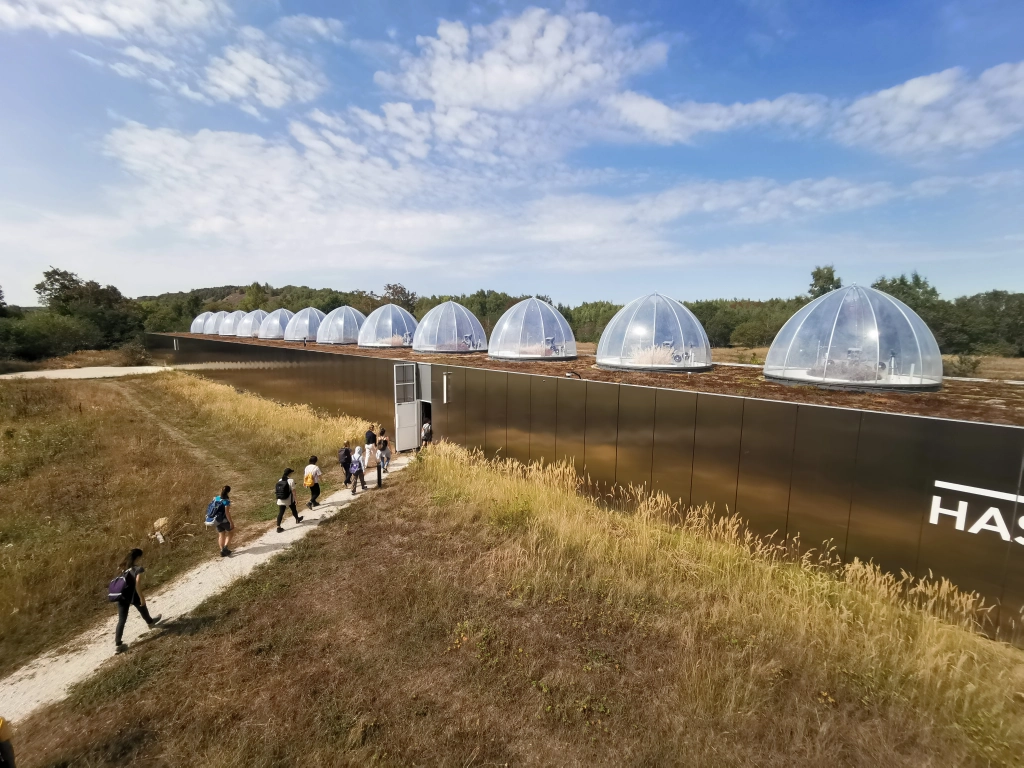
The ME&B-excursion brought us to the gigantic Ecotron experimental facilities of the University of Hasselt. A more mechanistic understanding of microclimate and its role in ecosystem functioning is high on the list for ‘what’s next’ in microclimate science
With all that in mind, this is clearly an optimistic paper: we show how we can come together with our own expertise and background, from all over the world, and rapidly move a field of research forward. Who would have thought, ten years ago, that microclimate would have become such a crucial parameter in all of ecological research? Who would have thought that so many of us would now routinely incorporate a microclimate perspective in their research? We haven’t saved the world just yet, but at least we brought a global community together with that goal in mind.
As such, the ME&B-conference was indeed truly a pinnacle of our work at SoilTemp. However, mind you, this was just the beginning of microclimate science as a global discipline. Now, our ‘snowball’ is rolling downhill, and increasingly gaining momentum. Wanna jump on? A perfect opportunity would be the néxt ME&B-conference, happening this August in Helsinki.
You wouldn’t want to miss it, as there is still so much more to learn!
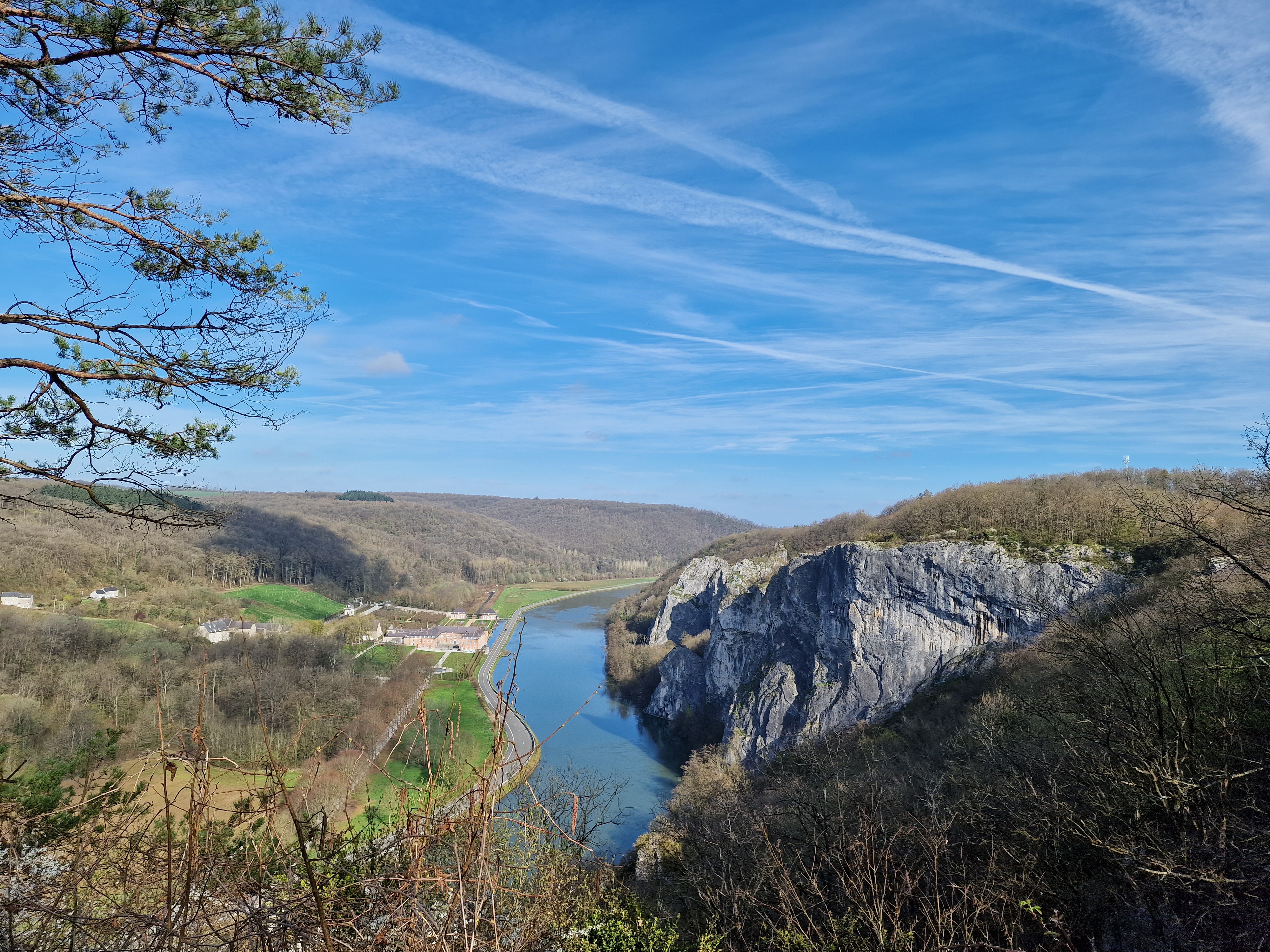
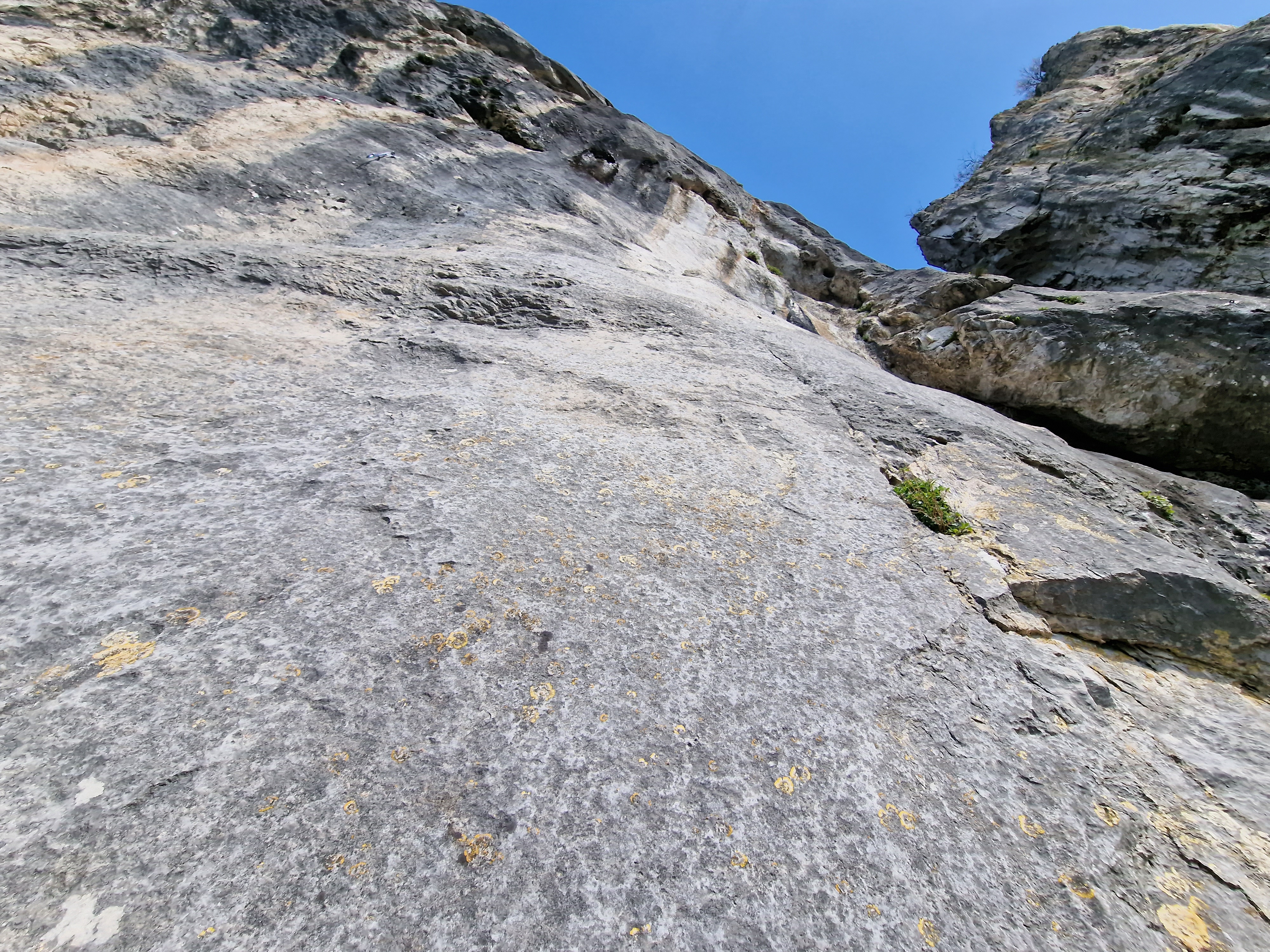
On a sunny day in early spring, our team took the car to one of the most monumental locations in Belgium: the cliffs of Freÿr. These beautiful slabs of ‘naked’ limestone of up to 120 meter, overlooking the river Meuse, provide one of the most – if not the absolute most – favourite rock climbing locations in the whole of Belgium.
Overview of ‘les Rochers de Freÿr’ towering over the river Meuse.
With easily a 1000 climbing routes, ranging from the easiest to the hardest, the rock is legendary in Belgium rock climbing milieus. It is there that we headed to for the final scouting for a new – and extremely exciting – global survey: ‘MIREN Rocks’ (more on that – and how to join – here!).
Scouting the area for the perfect survey sites with local guide David
Indeed, as we speak, we finalized the protocol for MIRENs’ global rock survey, using our experience from the cliffs of Freÿr as an example. We checked for routes to sample, estimated variability in orientation, difficulty and botanical diversity and, most importantly, tested out ways to install microclimate sensors on a cliff face.
Microclimate monitoring on the cliffs with the TOMST thermologgers
It’s the latter that perhaps makes me most excited: we can now plug in one of our trusted TOMST loggers – the simpler thermologger one – in a gap in the cliff face, and as such start measuring the true temperatures our cliff plants are experiencing. The ultimate cross-over between my two favourite networks, MIREN and SoilTemp.
The three-layered shield helps reduce the error resulting from direct solar radiation. Nevertheless, it will be hard to get accurate reads of the local temperature due to the extreme radiation absorbed, reflected and emitted by sunbathing cliffs
Now, that protocol is ready for action, also thanks to the extensive contributions by experts from across the globe. As such, the protocol has grown into a true community effort, and we hope it will be a resource for many climbers and ecologists to help us track rock cliff vegetation and the implications of rock climbing on it.
Selecting the optimal climbing routes for our upcoming monitoring
So, take this as a wake-up call: are you an ecologists, botanist or the like, and do you like to climb rocks? Then please join MIREN Rocks! All information can be found here.
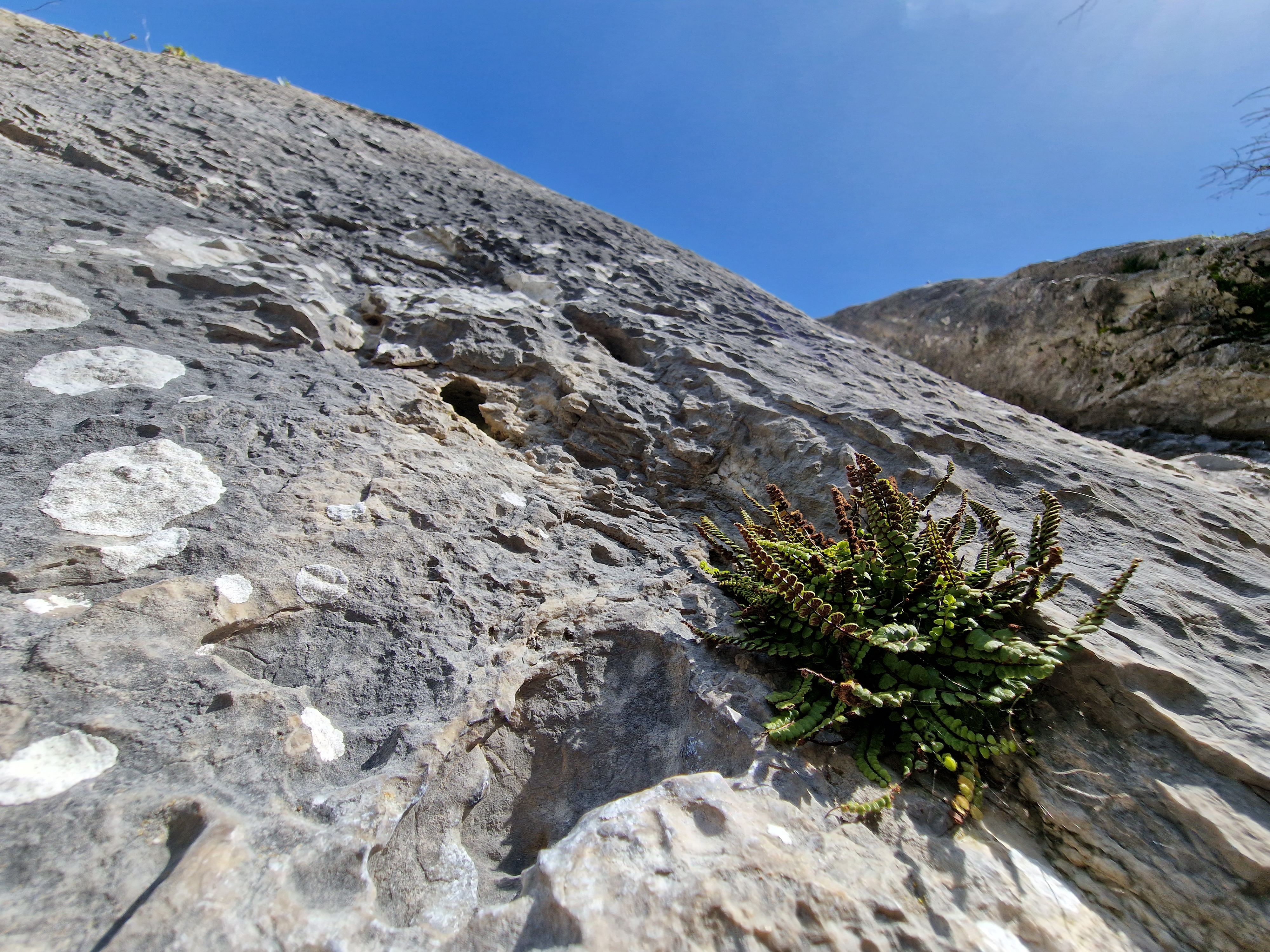
Cliff surveys would go fast in some places if you count the number of plants on them – where it not for the issues related with getting up there!Asplenium sp. – lover of cliffsIn some spots, the cliffs drop directly into the MeuseThe surrounding Natura 2000-forests were starting to be covered in beautiful spring flowers – here Anemone nemorosa
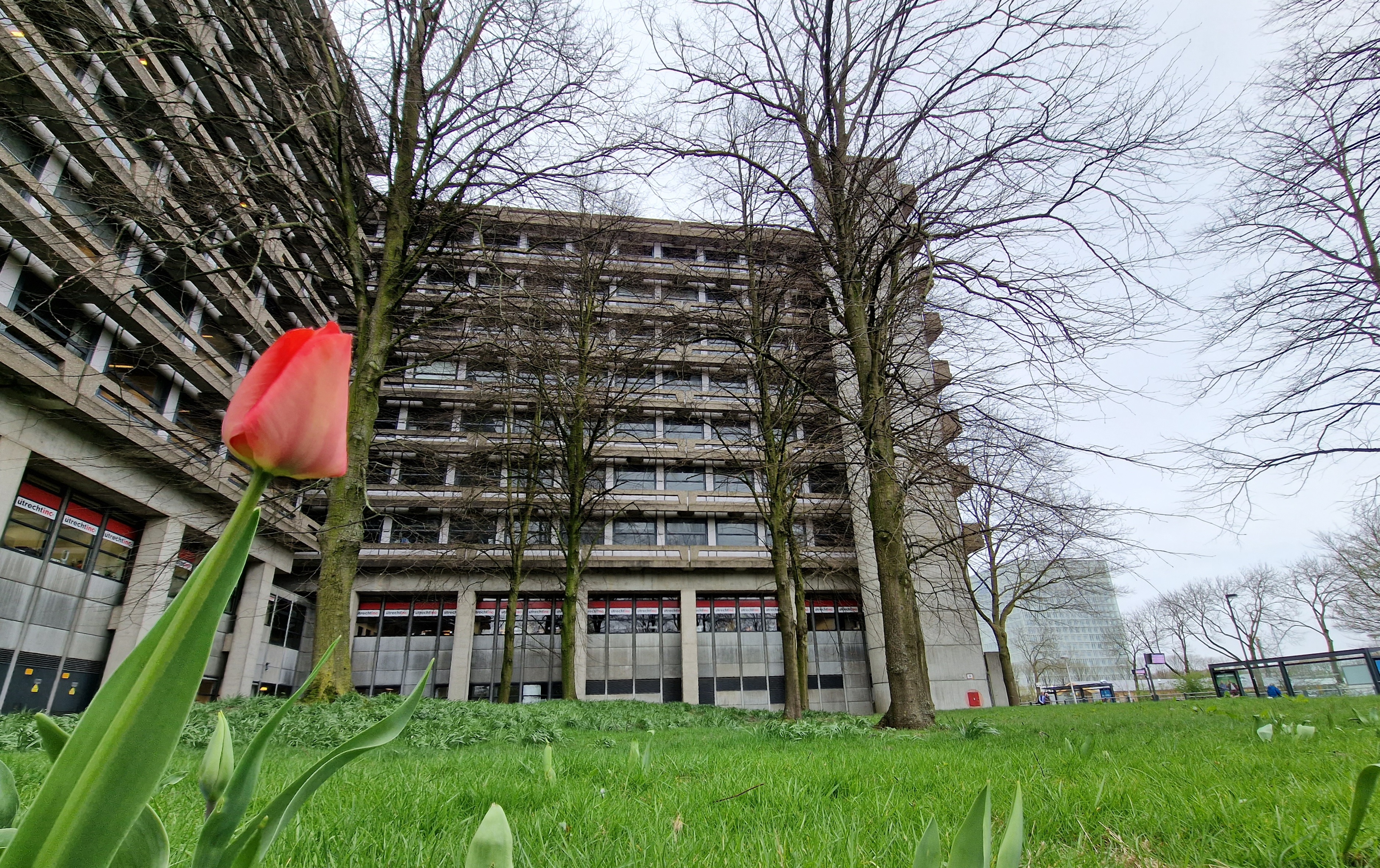
Last week, I spent a delightful day at my soon-to-be new home university in Utrecht. A day packed with discussions on scientific ambitions, teaching plans, and meeting new colleagues and ongoing research in the group. The first tulip of the year made it all feel like an official new beginning.
The real start will have to wait till May 1st, but you bet that I’m already making plenty of exciting new plans in advance!
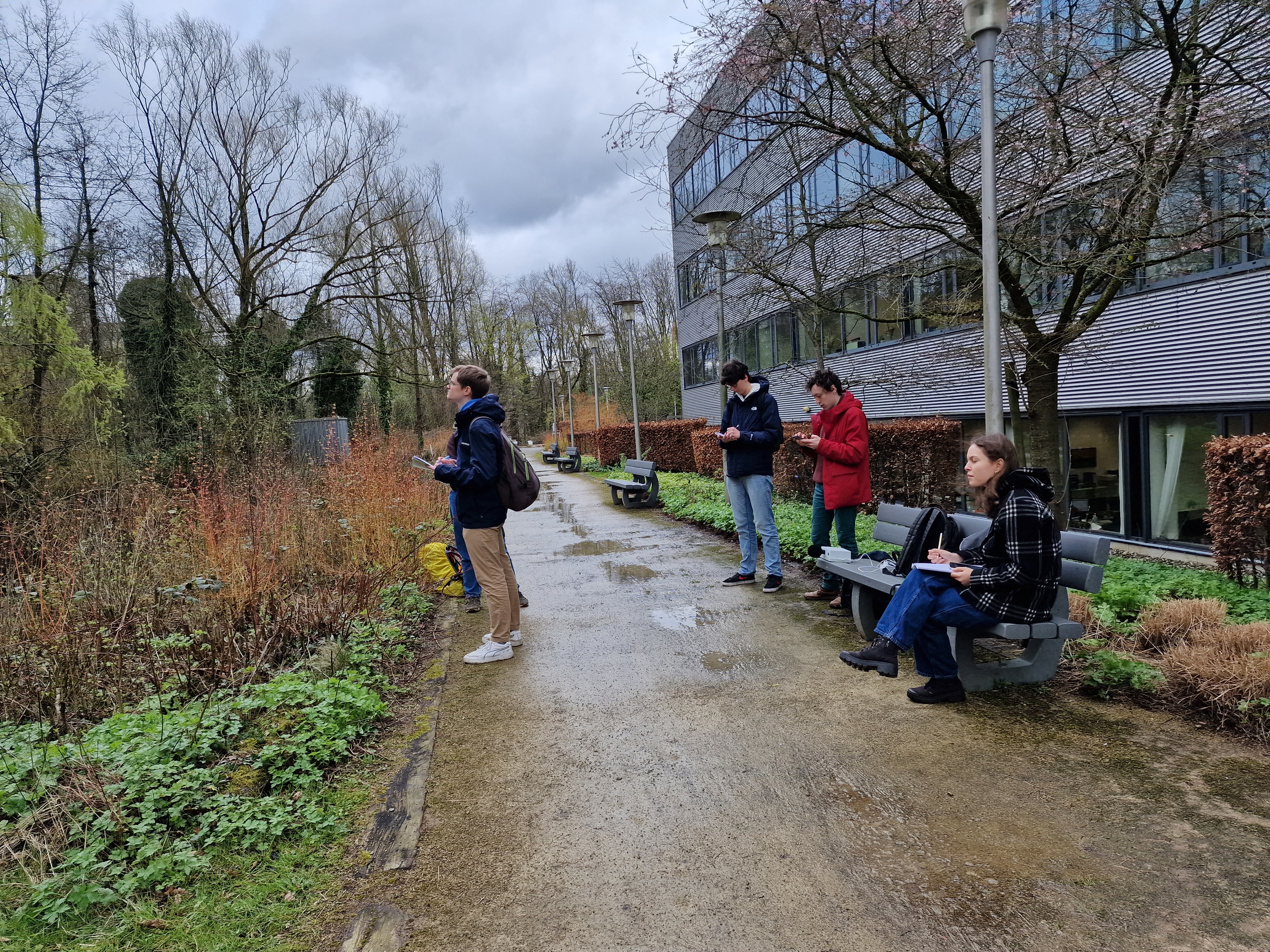
Last week, you could find an enthusiastic subset of our team hanging around suspiciously on the campus of the University Hospital in Antwerp, booklets in hand and an ominous device close by.
Ten minutes of just listening and nothing else – science can be highly therapeutic as well
This was the kick-off of a new measurement campaign in the framework of ‘De Oorzaak’, our ongoing large-scale citizen science project on urban soundscapes. Our trip to the hospital allowed us to catch multiple birds with one stone.
First of all, we’re out in the real world capturing sounds. We need a whole lot of different sounds, from all kind of sources, to feed in the AI-models that will automatically detect sound sources in our upcoming large-scale measuring campaign. We listen, the sensor records, and we write down exactly what we hear, greatly facilitating manual labelling of the soundbites afterwards.
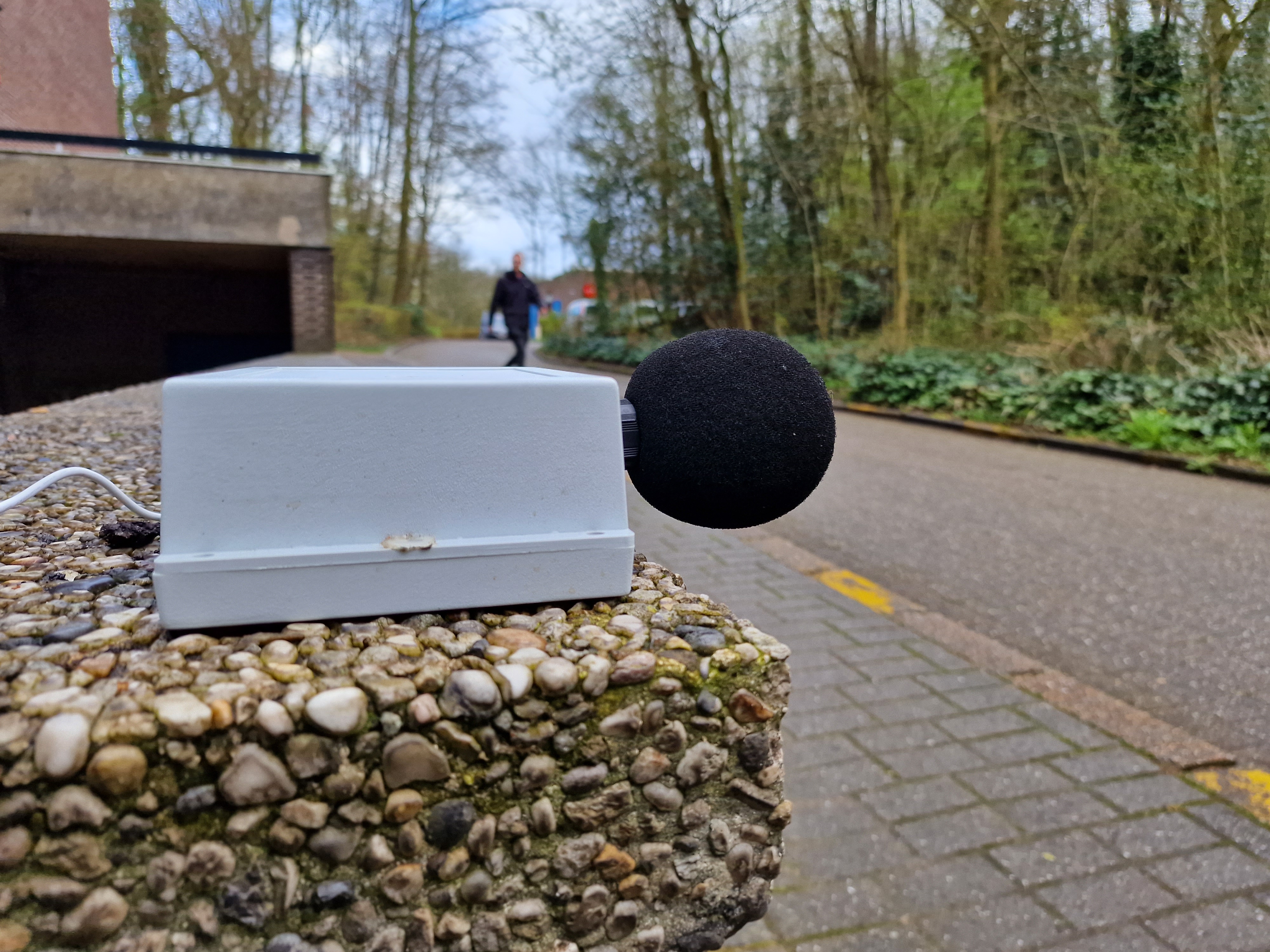
This box-with-a-microphone is doing most of the legwork for the project. It has sufficient battery to survive a day without an energy source, allowing us to take it onto a walk into the city.
Second, we are interest in the soundscape on the campus of the university hospital itself. We want to know what sounds patients residing on campus experience, and how that affects their health. And, as we are ecologists at hard, we want to figure out what role a greener hospital campus can play in that regard.
Third, we made use of this trip to start recording bird sounds. We hope to use our extensive sensor network to make a unique spatiotemporal assessment of the distribution of bird sounds in the city. For that, we of course again need to listen to a lot of birds ourselves. Luckily, those were starting to wake up for spring: great tits, blue tits, robins, wrens, ducks, moorhens, even a long-tailed tit: our bird sound dataset is starting to grow!
Finally, we can provide a subjective assessment of that soundscape: how nice was it, how lively, how chaotic? Following standardized terminology, we can create a dataset that links objective sound measurements to our experience of that sound.
Glad this is on a role again, and much more to come!
Lake Törnetrask, Abisko Research Station, Abisko, Sweden
Luscinia svecica
Diapensia lapponica in one of our plots
Lake Torneträsk, Abisko, Sweden
Laktatjakka valley
Oenanthe oenanthe, alpine tundra Abisko, Sweden
Norway
Narvik, Northern Scandes, Norway
Lake Törnetrask, Abisko Research Station, Abisko, Sweden
Summer in the Skjomen valley, northern Norway
Common heather
Lake Torneträsk, Abisko, Sweden
Narvik, Norway
Skjomen valley, northern Norway
Pinus sylvestris, Narvik, Norway
Norway
Trifolium repens
Narvik, Norway
Eriophorum vaginatum
Saxifraga aizoides, Narvik, Norway
Little red-and-white lighthouse
Lake Torneträsk, Abisko, Sweden
Skjomen valley, northern Norway
Lake Torneträsk
Phyllodoce caerulea
Narvik, Norway
Angelica archangelica along mountain road in the northern Scandes, Norway
Lake Torneträsk, Abisko, Sweden
Seen from Nuolja, Abisko
Hallerbos 2017
Young bluebell (Hyacinthoides non-scripta) surrounded by flowers of yellow archangel (Lamium galeobdolon)
The common bluebell (Hyacinthoides non-scripta), the signature flower of the Hallerbos
Single bluebell flower surviving on a wetter spot, as indicated by the field of wild garlic (Allium ursinum)
A really wet patch of forest, with giant horsetail (Equisetum telmateia) in a field of wild garlic (Allium ursinum)
Wild garlic (Allium ursinum) in the Hallerbos flowers a bit later than the bluebells, yet this one was already in full bloom
A bumblebee visiting yellow archangel (Lamium galeobdolon)
A bumblebee visiting yellow archangel (Lamium galeobdolon)
Wild garlic (Allium ursinum)
Wild garlic (Allium ursinum)
Weirdly beautiful, the inflorescence of pendulous sedge (Carex pendula), typical for the wettest spots in the forest
Weirdly beautiful, the inflorescence of pendulous sedge (Carex pendula), typical for the wettest spots in the forest
A little stream in the Hallerbos, surrounded by endless fields of wild garlic (Allium ursinum)
The herb-paris (Paris quadrifolia), less common in the forest
Wild garlic (Allium ursinum)
Bluebells (Hyacinthoides non-scripta)
Weirdly beautiful, the inflorescence of pendulous sedge (Carex pendula), typical for the wettest spots in the forest
Another one from the wet plots: large bitter-cress (Cardamine amara)
Another one from the wet plots: large bitter-cress (Cardamine amara)
Young beech leaves, as soon as they are fully grown, spring in the understory is over
A beech forest without understory, most likely too dry and too acid for any survivors
A young beech seedling (Fagus sylvatica), looking nothing like a beech, yet everything like a tiny dancer
Young beech seedling (Fagus sylvatica)
Bluebells (Hyacinthoides non-scripta)
Bluebells (Hyacinthoides non-scripta)
Bluebells (Hyacinthoides non-scripta)
Mountain melick (Melica nutans), a grass in the most amazing green
Bluebells (Hyacinthoides non-scripta) in a rare patch of mountain melick (Melica nutans), a grass in the most amazing green
Bluebells (Hyacinthoides non-scripta)
Bluebells (Hyacinthoides non-scripta)
Montpellier 2017
The entrance to the cathedral of Montpellier
The cathedral of Montpellier
The entrance to the cathedral of Montpellier
The cathedral of Montpellier
Narcissus poetics
The cathedral of Montpellier
The botanical garden of Montpellier
The botanical garden of Montpellier
The botanical garden of Montpellier
Brackish Camargue vegetation
Brackish Camargue vegetation
Brackish Camargue vegetation
A typical lagune
Brackish Camargue vegetation
Camargue horses
Camargue horses
Camargue horses
Brackish Camargue vegetation
Brackish Camargue vegetation
Brackish Camargue vegetation
Camargue horses
Brackish Camargue vegetation
Little egret in the evening sun
Flamingo’s in the evening sun
A typical lagune
Dandelion fuzz
Grass lily
Grass lily
Dandelion fuzz
Veronica in a sea of poplar fluff
Euphorbia in a sea of poplar fluff
Poplar
Gare du Midi, Brussels
Gare du Midi, Brussels
Gare du Midi, Brussels
Gare du Midi, Brussels
Sweden autumn 2016
Autumn in Abisko
Yellow leaves of mountain birch, with lake Torneträsk in the background.
Lapporten, the gate to Lapland, in Abisko
Rain blowing over the Abisko National Park
The colours of the north: red fireweed and yellow mountain birches, with lake Torneträsk on the background
Yellow leaves of mountain birch, with lake Torneträsk in the background.
Rain on the background, the ski lift in Abisko on the foreground
The steep slope of mount Nuolja on a dramatic looking morning
The beautiful colors of lake Torneträsk in Abisko
A little stream on top of the mountain, with a view on Lapporten, the gate to Lapland
Well, that is a beautiful table with a nice view on lake Torneträsk in Abisko
Our little experiment on top of the mountain in Abisko, with a view on Lapporten
Autumn in Abisko is extremely colorfull
The ski lift with a view on Abisko National Park and Lapporten
Hiking dowhill towards lake Torneträsk
This green is greener than the greenest green: moss on top of mount Nuolja
Well, that is a beautiful table with a nice view on lake Torneträsk in Abisko
The ski lift with a view on Abisko National Park and Lapporten
The ski lift with a view on Abisko National Park and Lapporten
The most beautiful hiking trail of the world: Nuolja in Abisko
Angelica archangelica, often the biggest plant of the Arctic
The most beautiful hiking trail of the world: Nuolja in Abisko
Cirsium helenioides, the melancholy thistle
Hiking down mount Nuolja
The steep slope of mount Nuolja on a dramatic looking morning
The colours of the north: red fireweed and yellow mountain birches, with lake Torneträsk on the background
The prettiest yellow and blue: autumn in Abisko
Fireweed, Epilobium angustifolium
Campanula or bellflower, I think ‘uniflora’
Vaccinium myrtillus
Cornus suecica, the prettiest red of the world
Hieracium alpinum, alpine hawkweed
Carex atrata, one of my favourite sedges
Alpine clubmoss, Diphasiastrum alpinum
Agrostis capillaris, bentgrass
Common yarrow (Achillea millefolium)
Anthoxanthum odoratum, sweet vernal grass, fully grown and mature
Snow scooter trail
Our plot in the mids of a field of horsetails (Equisetum pratense)
Equisetum pratense
Cliff overlooking the valley with the road to Norway
Seedling of Taraxacum officinale, the dandelion, after two years of growing in bad conditions
Poa alpina, the alpine meadow-grass, with its viviparous seeds
Massive flowerhead of Angelica archangelica
Angelica archangelica
Blueberry (Vaccinium myrtillus) in autumn
A lowland marsh in Abisko in autumn
Installing the plots of our trail observations on top of mount Nuolja
Installing the plots of our trail observations on top of mount Nuolja
Tanacetum vulgare (Tansy), non-native for the high north
Autumn forest down in the valley
The valley of Nuolja to Björkliden
Summer on the Nuolja-side
A full rainbow behind mount Nuolja in Abisko
It’s raining in the west, clouds trapped behind the mountains
A strong wind blowing rain from behind the mountains to our side
A strong wind blowing rain from behind the mountains to our side
Betula nana, the dwarf birch, mini autumn forest
Betula nana, the dwarf birch, mini autumn forest
The valley of Björkliden in autumn
The valley of Björkliden in autumn
The valley of Björkliden in autumn
The valley of Björkliden in autumn
Sweden spring 2016
Melting snowpatch on a lake
Rubus arcticus
A rainy hike
Trifolium pratense
Silene suecica
Oxyria digyna
Dryas octopetala
Ranunculus glacialis
Silene acaulis
Although the alpine zone has been harder for invasives to access than most places, human structures like trails are often an easy gateway for the invaders to get up there. Picture from Abisko, Swedish Lapland.
Salix reticulata
Eriophorum vaginatum
Western European species like the red clover (Trifolium pratense) here are often listed as non-native species in mountain regions.
Cornus suecica
Overlooking the valley of Laktajakka
Ranunculus glacialis
Bartsia alpina
Trifolium repens
The valley of the lakes
Amiens
Sun rising above the water
View from my office window
The southern side
Maria without a shirt
Cathedral at night
Frozen to the bone
Sunny but cold, the Quai Bélu
Cathedral with a glimpse of spring
Winter sun on the Place du Don
Sunny but cold, the Quai Bélu
View from my office window
Cathedral at night
Cathedral seen from the frozen Parc Saint-Pierre
Gargoyle planning to eat the cathedral
Colourful mirror
House on the square before the cathedral
Cathedral at night
Cold!
The museum behind the beautiful gates
Nice architectural curve
Just outside of Amiens
Cathedral at night
Le Club d’Aviron in winter weather
Amiens is filled with cute little houses
Almost cold enough for ice-skating
Frozen mirror
Enjoying silence and the morning sun
Sweden autumn 2015
Lichen
Sweden summer 2015
View on the 1000 meter plots
Doing research on a cold Arctic morning
Plots flooded by the snowmelt
Flooded by the snowmelt
Meltwater river, racing down the mountain
After a hike, even the most basic house looks cosy. Little hut in the mountains, open for everybody
Snowbridge, maybe don’t cross…
Snowbridge
View from a cliff
Silene acaulis or cushion pink, cutest plant of the Arctic
Two seasons in one image
Steep slope
Hiking down
Narvik Kirche, church of the subarctic
Narvik Kirche
Reindeer on top of the mountain
Narvik Kirche
Summer at the church
Summer flowers
Massive waterfall
Young willow catkins
View from Narvik’s hospital, with lilac flowers
Building a bridge over the fjord will gain al drivers at least an hour
Norwegian fjord
Posing with the water, getting soaked
Minimalistic mountains
Insect investigating our reindeer antler
Catching mosquitoes with our license plate, harvest of the year!
Posing with the plot
Fieldwork on the most beautiful spot of the world
Fieldwork on the most beautiful spot of the world
Summer bridge – still next to the sadly impassable river
Rhinanthus flower in the mountains
Plateau in the valley, beautiful brown
Experimental view from my favourite plot
Salix catkins
Extremely old Betula tree
Waterfall from a cliff
Buttercup is the earliest in spring, here
Rocks!
Alpine views
Views!
Fieldwork
Jumping over rivers
Plot
Golden plover
Angry lemming
Green, the whole north is green!
Snow, so much snow left!
Minimalistic mountain moments
Fieldwork
The research center
Red clover – focal invader
Look at this tiny cute snail!
Massive floods of melting water
Bartsia alpina
Hooray, a toilet!
Dryas octopetala
Lowest elevation plots
Butterball!
That’s a lot of water
Midnight sun is the best
At the lakeside
Beautiful Bistorta vivipara
Don’t fall in the water
Midnight sun
Wild river
Art – made by ages of wild rivers
Baby firework for America’s independence day
Midnight sun at the lake
The Abisko canyon was wilder than ever
That’s a crazy amount of water!
The Abisko canyon was wilder than ever
The Abisko canyon was wilder than ever
Black and white
Stone-man overlooking Abisko
Nothing as soft as a willow catkin
Label and soil temperature sensor attached
I’d drive to the top every day
Reflections
Rocks and clouds
Brave little birch
Brewing our camping poison
Basic camping stuff
Camping in Norway
Home-made temperature houses
Roadside research at its best
Norway is crazy
Horsetail is so funny
Little creek in magical forest
Birches, birches everywhere
Beautiful rock, a gift from the river
Another roadside fellow
Lichen
Ready to rock the summer
Collecting mosses
That’s a crazy old lichen
Tiny tiny piny trees, but old, so old!
Ready to jump into the fjord?
Ready to jump into the fjord?
That’s a spiky stone!
Views on Norwegian fjords
Silene in the mountains
Cute little orchid
Skua
Attacking skua, mind your heads!
Watch out for the attack of the fierce skua!
Black snail
New plot!
Still a lot of snow to melt, but this spot was free for a new plot
Reindeer are better than people
Two seasons in one picture
Let’s see what is happening to the balance in mountains! Is this a starting avalanche, or will it last a bit longer?
Cute little hut
Climbing mountains by car
Softest moss in history
Drosera in the marsh
Hiking in no-man’s land
The clouds are coming
Abisko valley
‘Butterball’
Fieldwork in the tundra
Abisko valley
Little plot
Clouds and sun and mountains
Making soup on a campfire with a view
Little creek on high elevations
Skua on the look-out
Melting snow in a river
Rhodiola rosea and the Törnetrask lake
Beginning of spring
Flooded plots, melting snow, impassible wetness
Ferns and horsetails
Chile 2015
Trips to the field sites were sometimes a real adventure, especially right after snowmelt
Lunch made by our local colleague, with funny bread (tasty as well!)