Roads help us to get from point A to point B. They are extremely useful structures for doing exactly that, which is why mankind has spend considerable amounts of energy to create a network of them that spans the whole globe, with tentacles reaching to the furthest desert and highest mountain region.
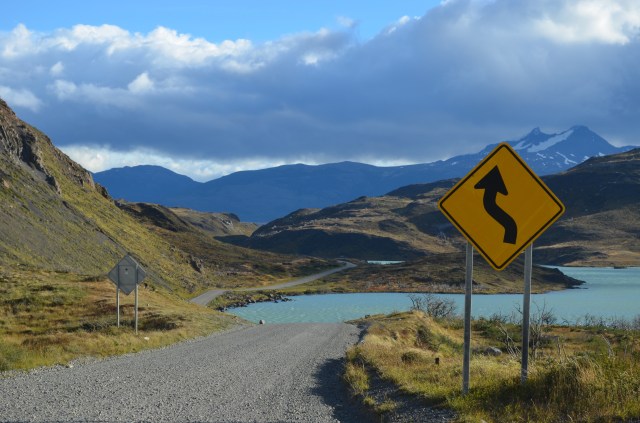
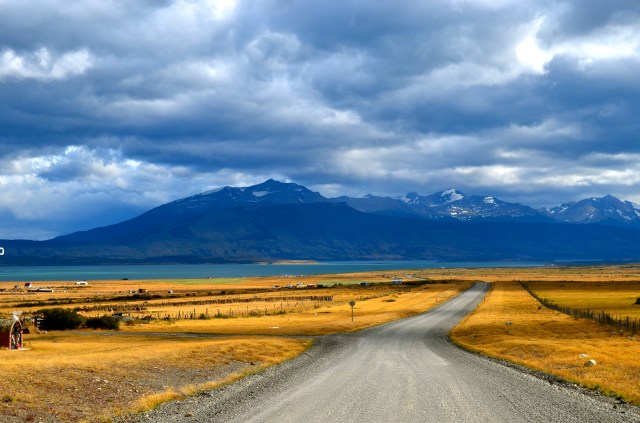
Gravel road through Torres del Paine National Park in the Chilean Andes
But it is not only us humans who love these roads. Several species can use them to travel far and wide. Yes, even plants are not too proud to hitchhike a ride to discover new horizons. A new paper from the Mountain Invasion Research Network (MIREN, www.mountaininvasions.org) in Ecography shows that mountain roads all over the world indeed host busy plant traffic. With the help of thorough plant surveys along roads in eight mountain regions, they show how the elevational ranges of a wide variety of plant species change along these roads.
In short: the elevation range at which these species occur, differs significantly between roadsides and adjacent vegetation. Some species grow at higher elevations in the roadsides than in the surroundings, while others reside at lower elevations. In general, most of them have distributions spanning larger elevational ranges in the roadsides than next to them.
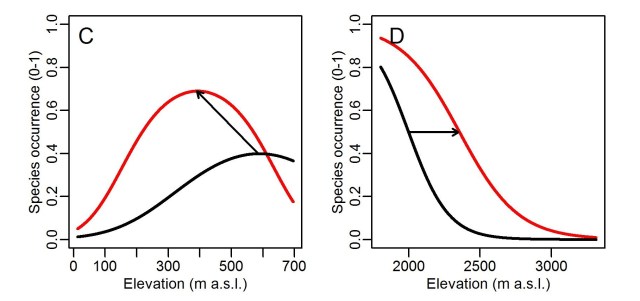
Examples of different elevational niches in roadsides (red) and the adjacent vegetation (black) for Pinguicula vulgaris in Norway (left), and Tragopogon dubius in Montana (right).
That non-native species would use the mountain roads to expand their ranges towards higher elevations in the mountains does not come as a surprise anymore. These species have the reputation of being fast at following humans wherever they go. Expanding their ever-growing ranges into high mountain areas is just as predicted. This new study however expands on this by showing how several native species mimick this behaviour of upward movement and occur at higher elevations in mountains along roads than they do in the natural vegetation. Even more surprisingly, a group of high elevation species expands its range in the opposite direction, towards lower elevations.
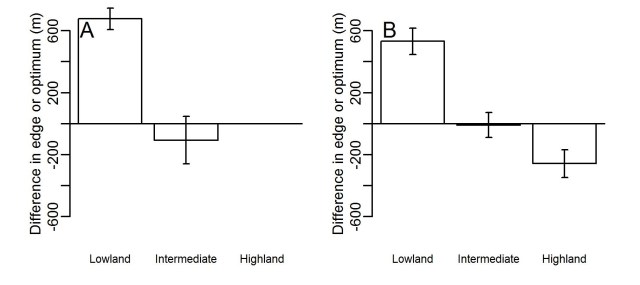
Average differences in elevation optimum for non-native (left) and native (right) species. Most non-native species are introduced in the lowlands, but their roadside distribution is more than 600 meters higher in elevation than their achieved distribution in the natural vegetation. Native species with a lowland origin follow the same pattern, highland species on the contrary have on average elevation optima of more than 200 meters lower in the roadsides than in the adjacent vegetation.
Roads thus play a much more significant role as drivers of range changes than always assumed, and for a wider range of species. They can provide important facilitation for climate-induced upward range shifts, for both native and non-native plant species, and they could serve as corridors to allow the exchange of alpine species between adjacent mountain sites.

Mountain roads can span steep environmental gradients and as such facilitate transportation of species from one system to the other.
We have to keep in mind though that roadside systems in mountains, as everywhere, will be highly sensitive to short-term instability. It is however clear now that for various groups of plant species, these roadsides can serve as a way to go from one place to another, invade new areas and connect distant populations.

Global invaders like white clover (Trifolium repens) make use of roadsides to invade mountain ranges.
From a species perspective, that might be a good thing. These processes will however also facilitate the reshuffling of the original species composition, and as always there will be winners and losers. The large set of non-native species shows the danger in this: roadsides might play an important role in the global homogenisation of the vegetation, with the same few species being successful in human-influenced ecosystems all over the world. From an ecosystem perspective, that is definitely a bad thing.
Reference
Lembrechts JJ et al. (2016). Mountain roads shift native and non-native plant species ranges. Ecography, doi: [10.1111/ecog.02200].









 The 3D lab