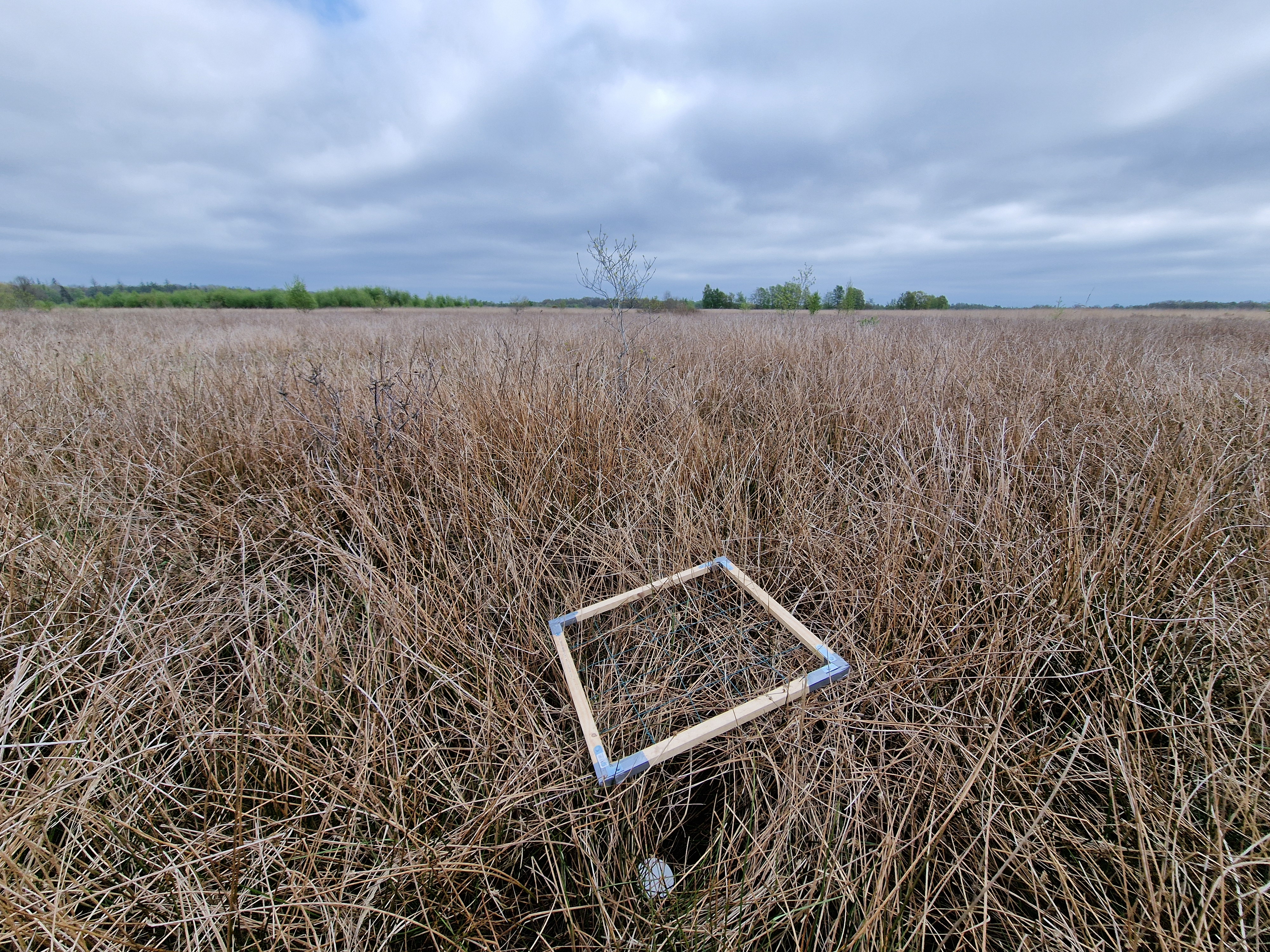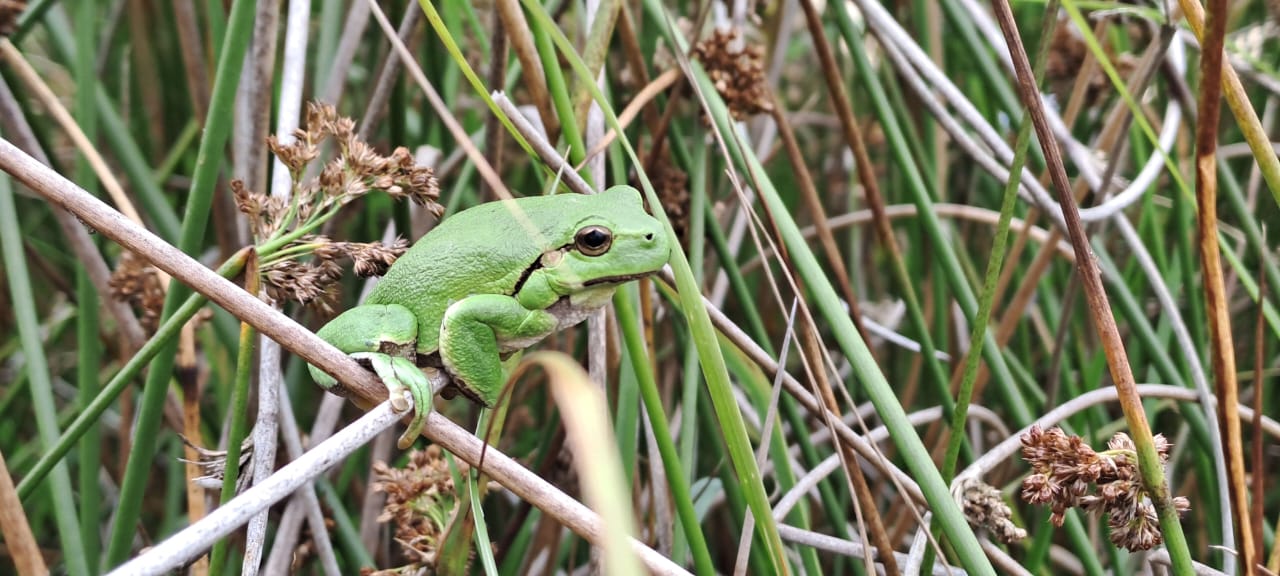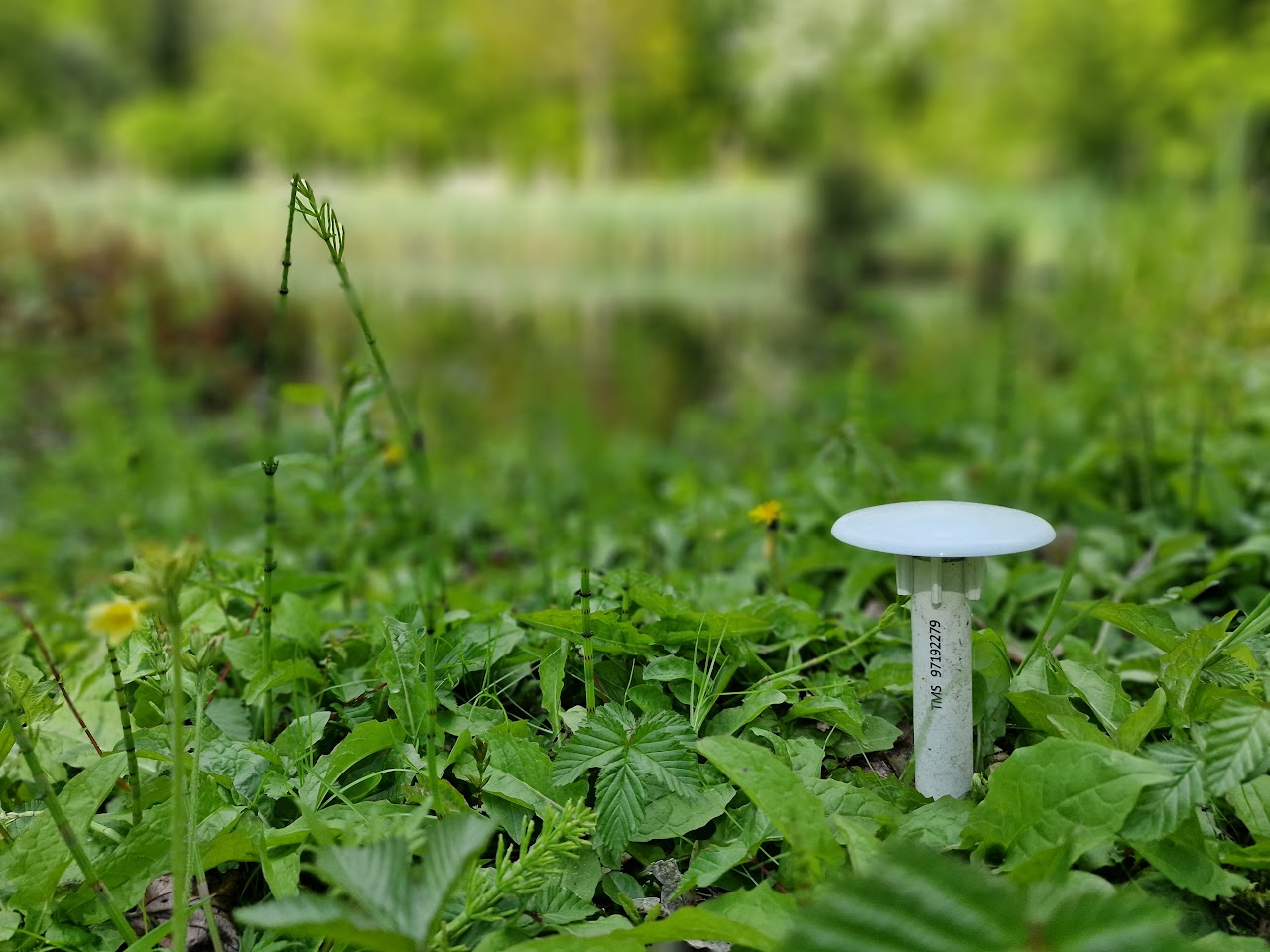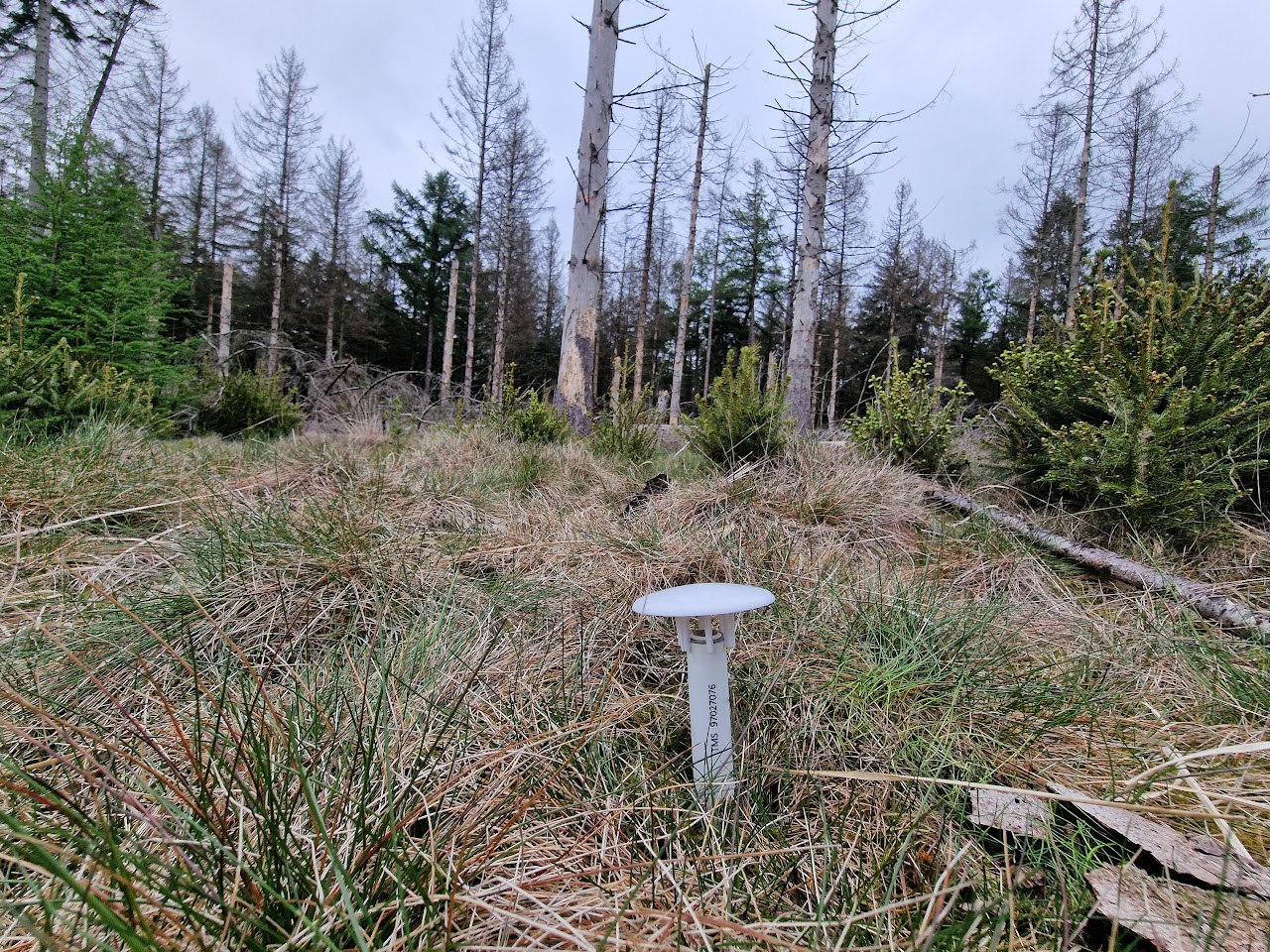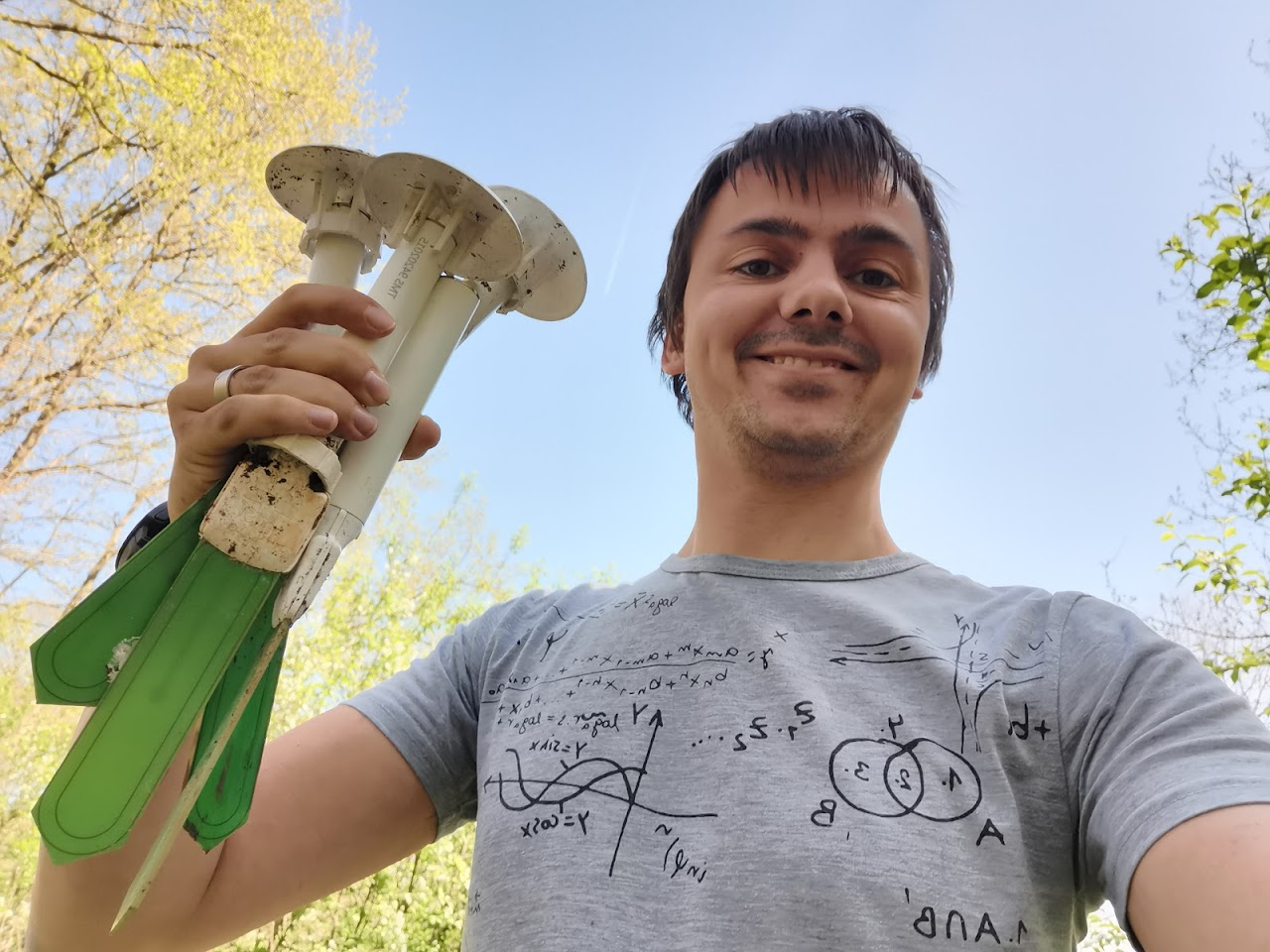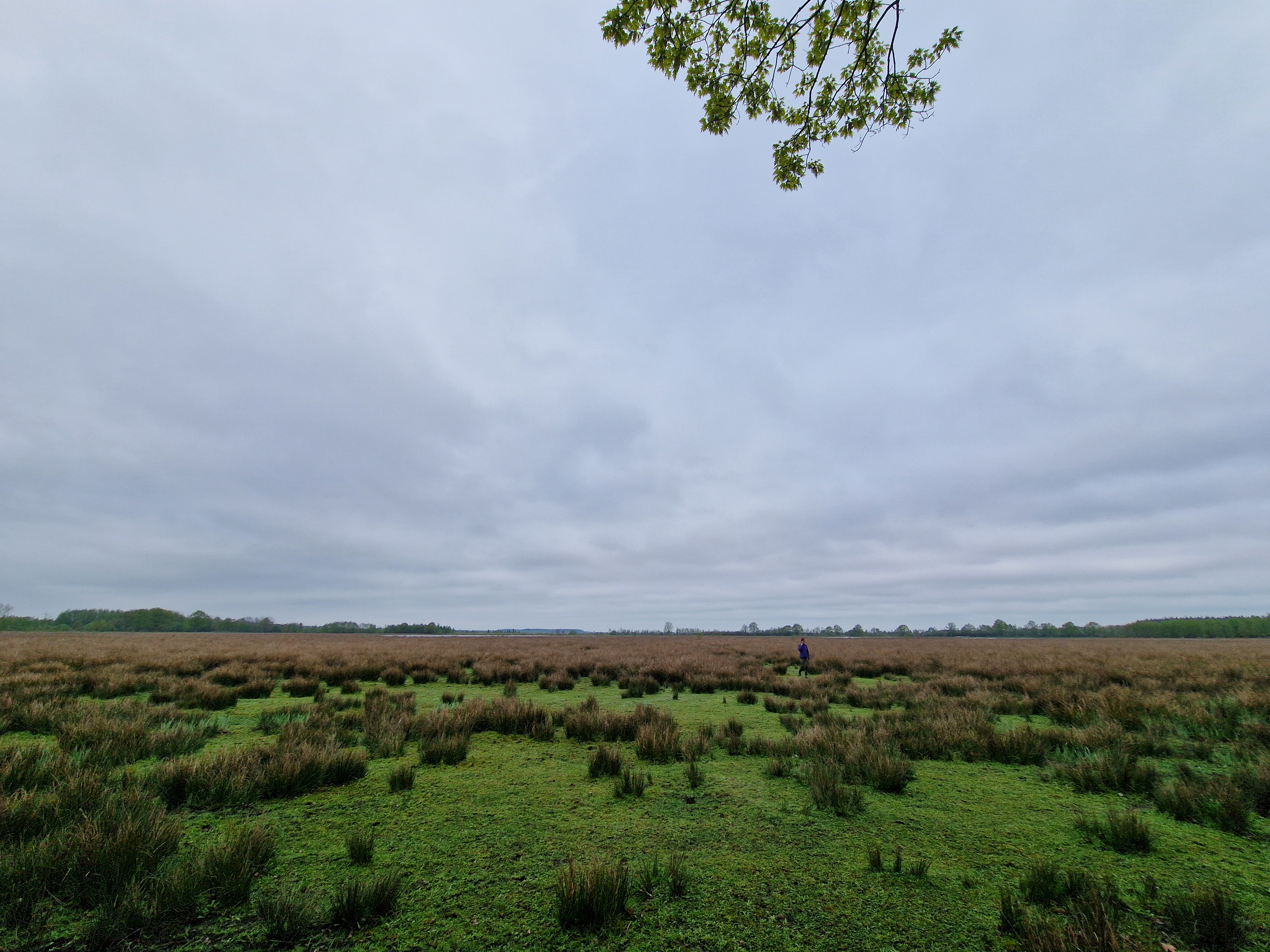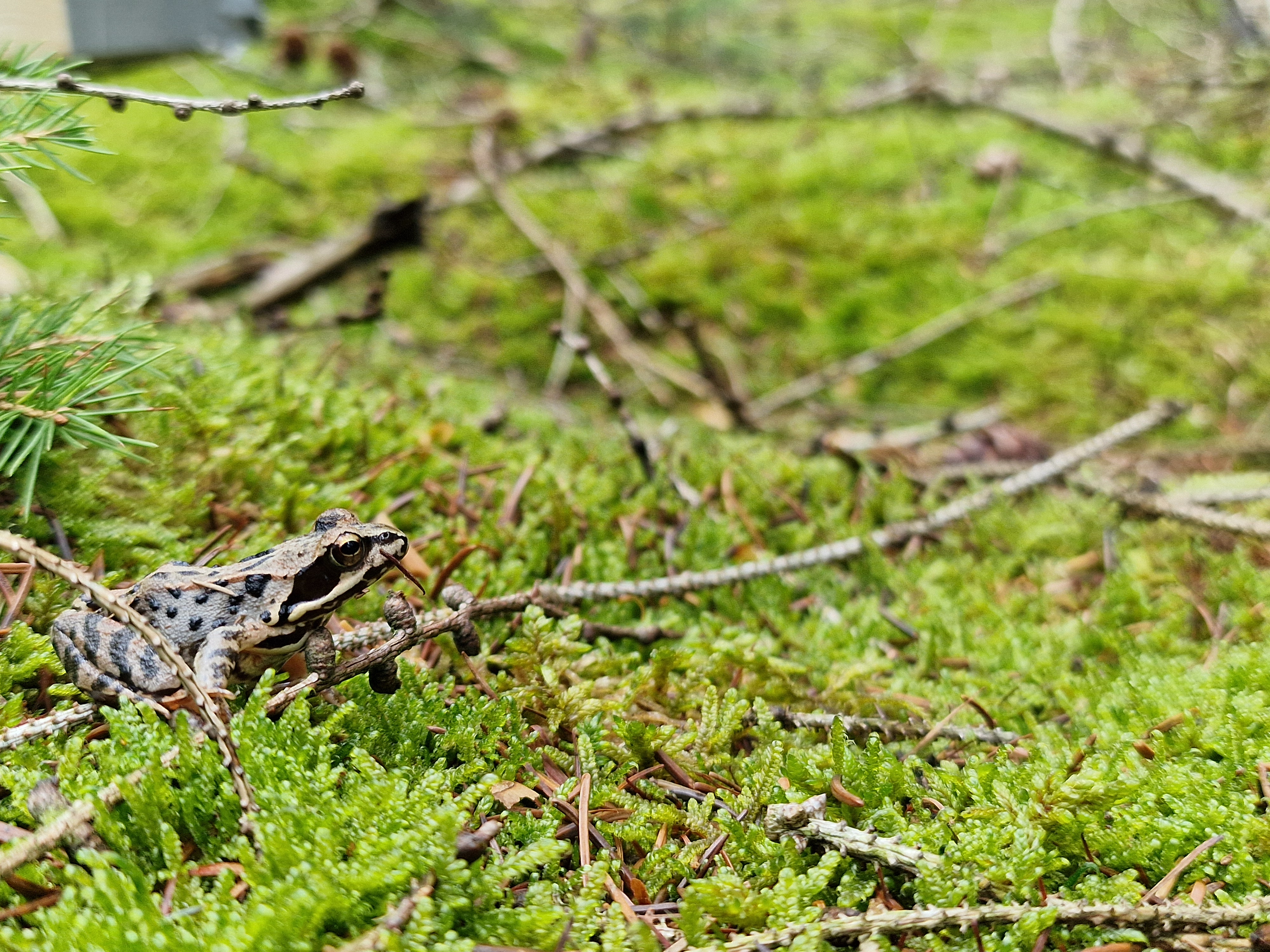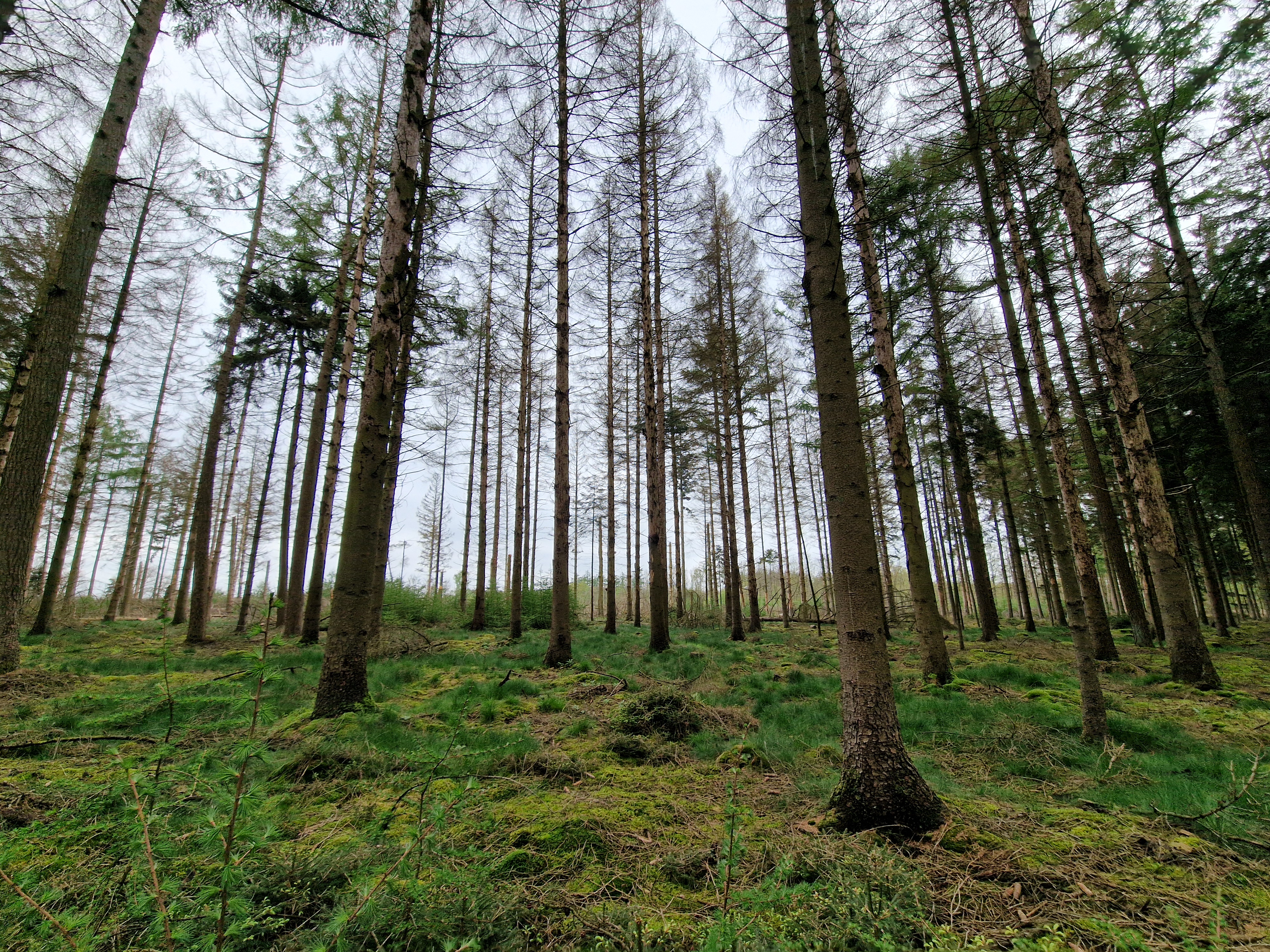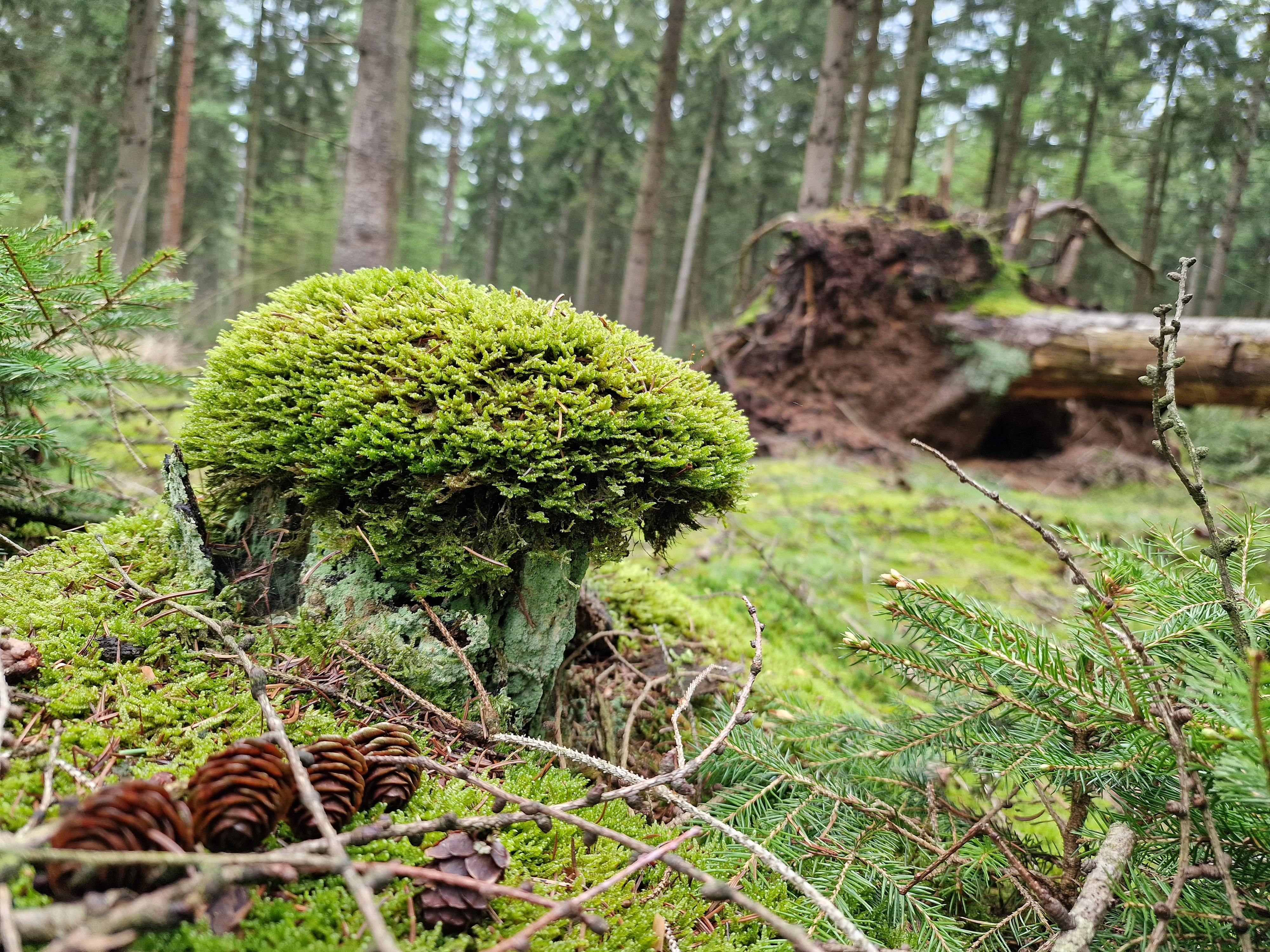
Far in the north of the Netherlands, on the border of Friesland and Drenthe, lies an endless sea of moor-grass, heather, and rushes – spread out across one of the last active raised bogs in the country: the Fochteloerveen.
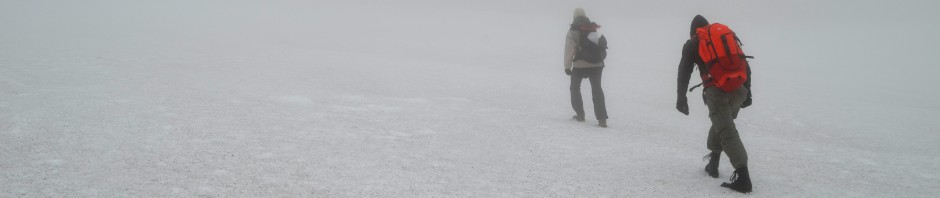
Throwback pictures of our first fieldwork trip to Fochteloerveen two months ago, when summer was still far away
A raised bog is something truly special. Formed over thousands of years, it’s a living landscape built entirely from rainwater and sphagnum moss. Layer by layer, the mosses grow, die, and decay, creating a domed blanket of peat that rises above the surrounding land. These bogs are wet, acidic, and nutrient-poor, yet support a unique and fragile web of life. Carnivorous sundews, rare dragonflies, and strange fungi find their niche here. And underneath it all, the peat holds centuries of carbon, making these bogs some of the most effective natural carbon stores on Earth.
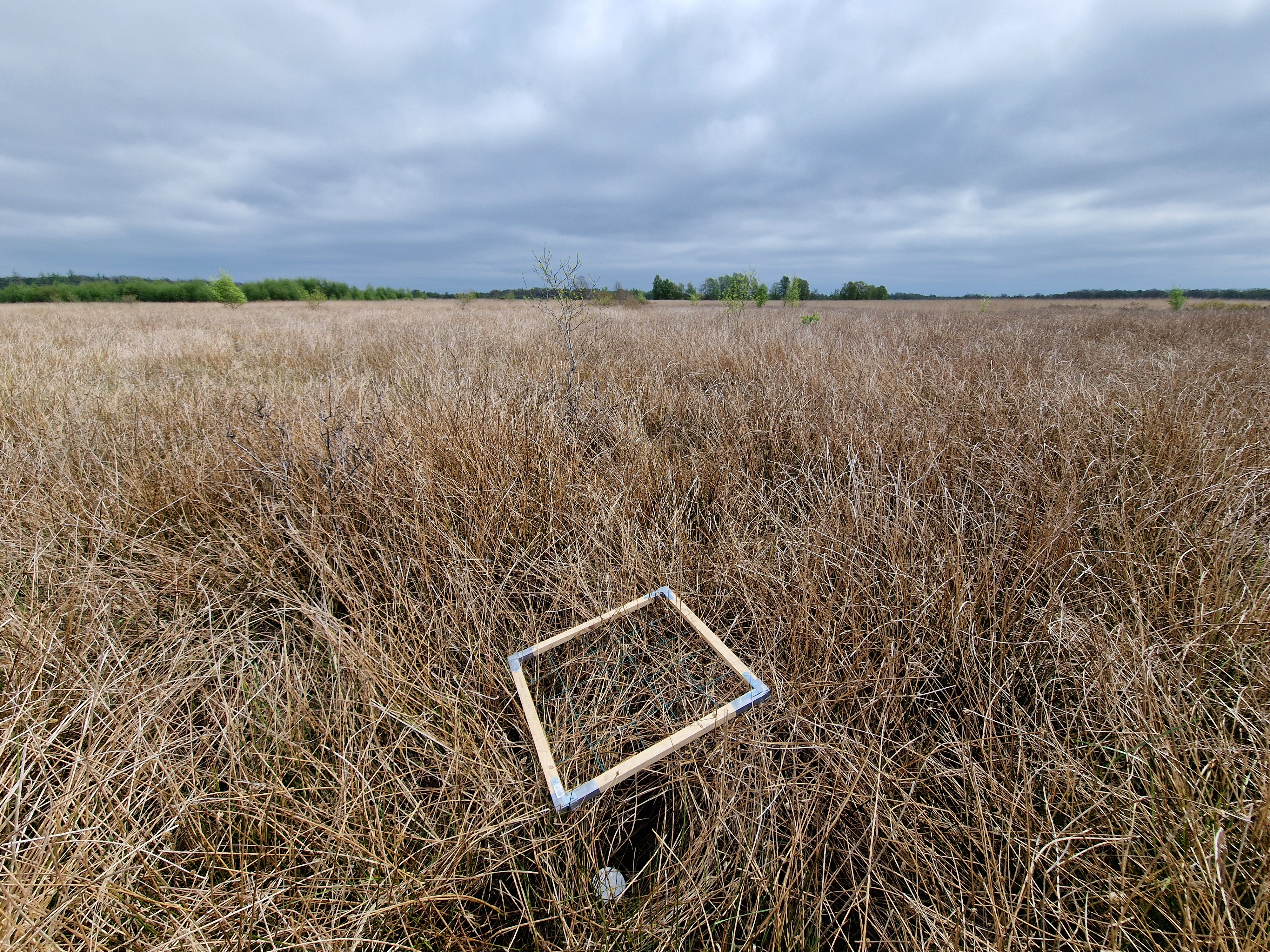
EcoFracNet vegetation monitoring in an sea of rushes, with not much else in sight
We visited this remarkable place in spring to set up a new EcoFracNet study site, focusing on biodiversity and ecosystem variation across a fine-scale moisture gradient, from boot-deep mud to dry sandy ridges dotted with pines. This is one more piece in our ongoing effort to cover all major Dutch habitat types with EcoFracNet. But there’s another reason this site deserves a closer look.
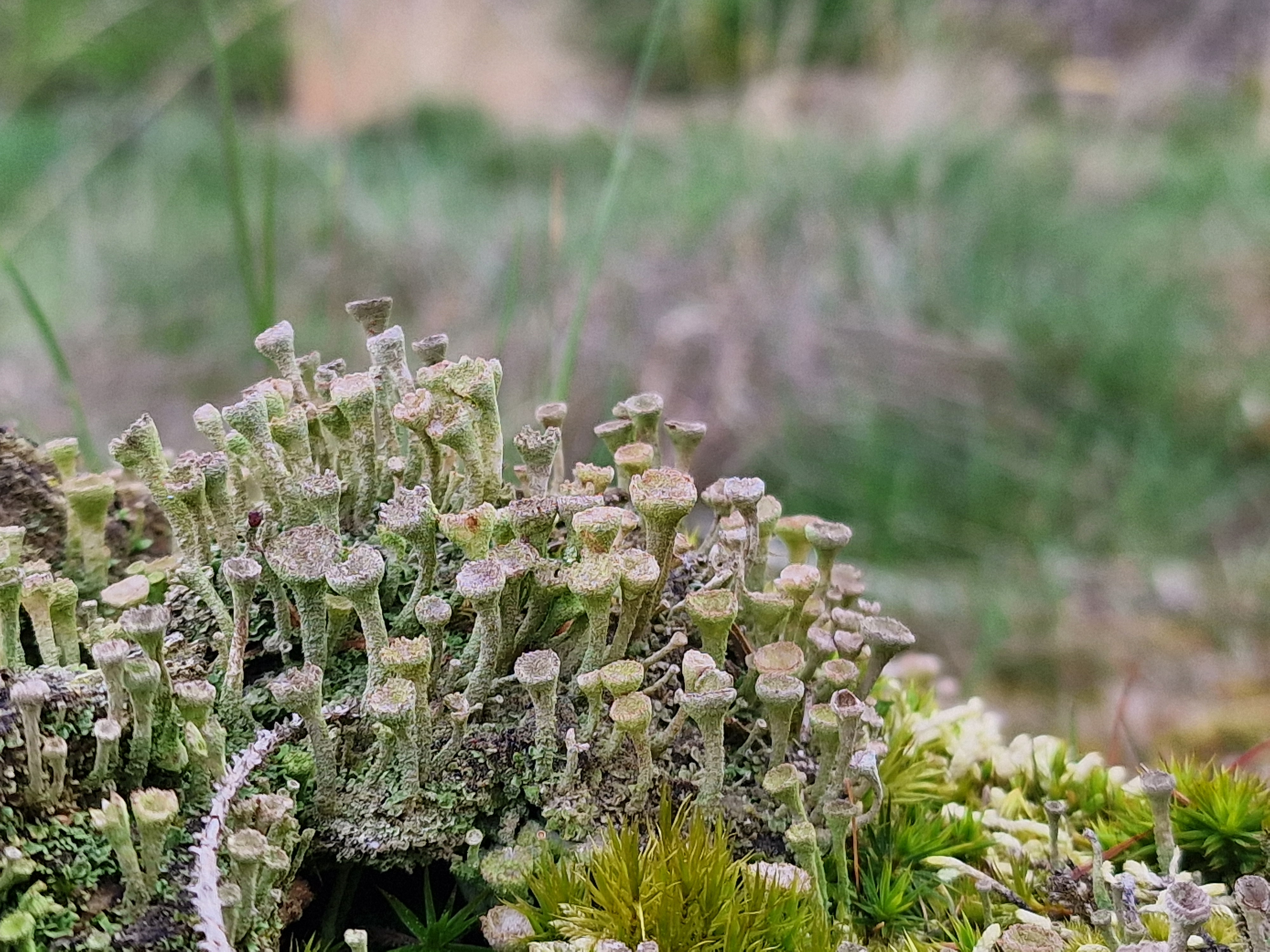
The area hosts forest understory that feels like it has remained undisturbed and untouched for a truly long time, slowly growing into beautiful perfection
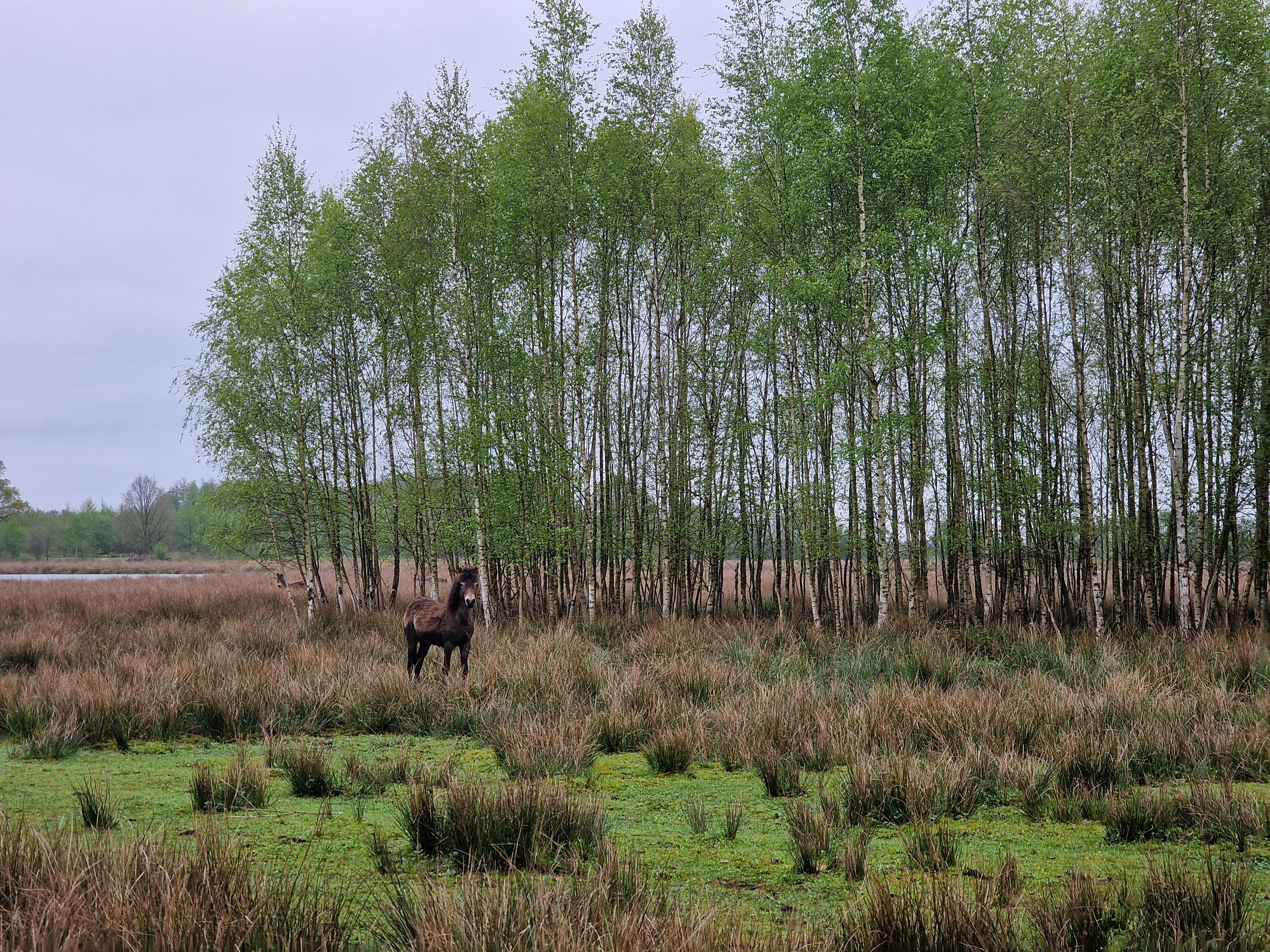
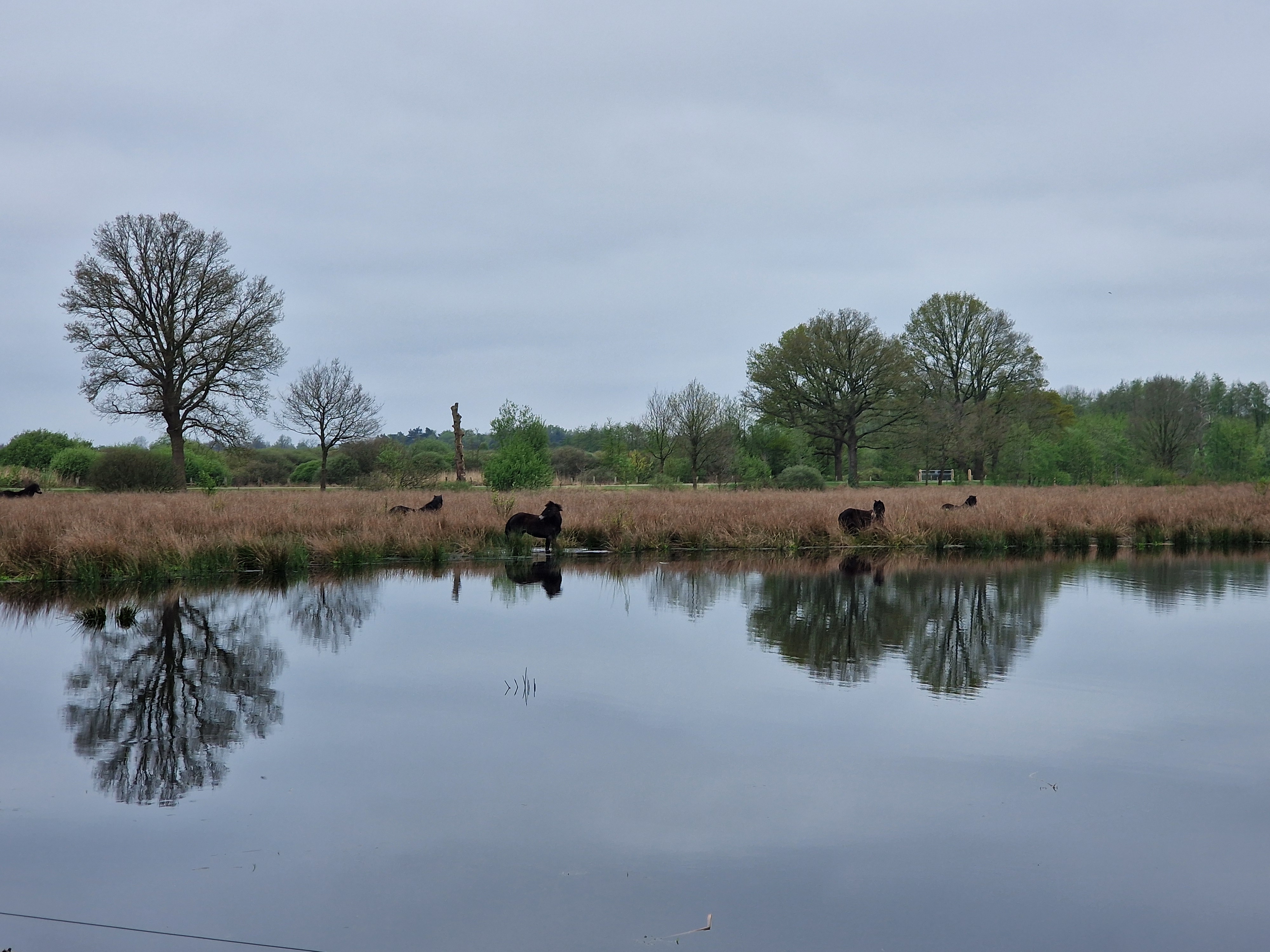
To protect its rare biodiversity, park managers Natuurmonumenten and Staatsbosbeheer are continuously refining their management. Most recently, they’ve expanded the role of large grazers in the landscape, with a striking herd of Exmoor Ponies now roaming the area. These shifting grazing dynamics are likely to reshape local patterns of heterogeneity – and with them, the scales at which biodiversity varies. That’s exactly what EcoFracNet is built to study: teasing apart the spatial fingerprints of ecological variation, from the patch to the landscape level.
The brave and kind Exmoor ponies keep vegetation short where needed
We’re also looking below the surface. Together with colleagues from the group, we’re analyzing belowground biodiversity and ecosystem functioning, to explore whether patterns beneath our feet mirror those we see aboveground, or tell a different story entirely.
That’s all we’ve got for now. Our students are digging into the data (as they did into the mud), and we’re looking forward to seeing what they uncover. In the meantime, this post is really just a nod to this uniquely strange and beautiful landscape that so captivates you when roaming through it.
Our EcoFracNet project aims to uncover patterns of biodiversity across all kinds of landscapes — including those where biodiversity isn’t necessary a priority, like agricultural areas.
Even these landscapes can host a surprising variety of life: along field edges, in fallow patches, or even hidden within the rows of monocultures. By monitoring that plant biodiversity in exactly the same way as we do in forests, grasslands, or peatlands, we can put it into context. How much does it contribute? At what scales does it vary? And ultimately – what role does it play, and could it play, in the biodiversity of the future?
Given the central role agriculture plays in our landscapes, that perspective is essential – guiding us from understanding what’s there now to exploring how we can best make use of this space for biodiversity.
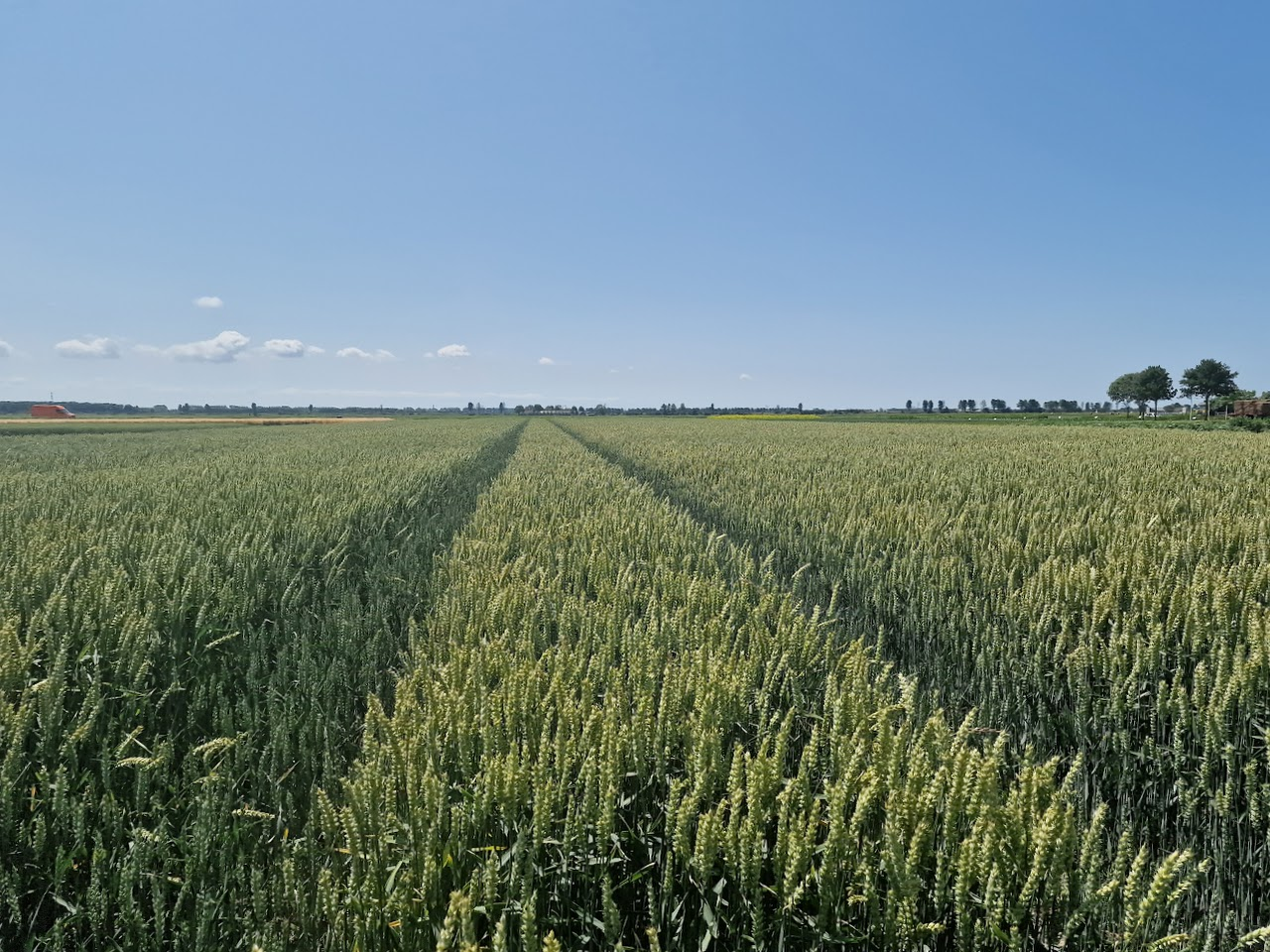
A sea of winter wheat – a monoculture for sure. But how does its diversity compare with those in the understory of our Dutch forests? And what’s still hiding out in the field edges or quickly colonizing the space after the harvest? We’ll find out!
We’ll explore these questions at De Rusthoeve, an experimental farm in Zeeland, the Netherlands. With its long history of working with scientists and sensors, it’s an ideal place to study biodiversity and environmental heterogeneity in an agricultural setting, without feeling too much like a bother to the general functioning of the farm!
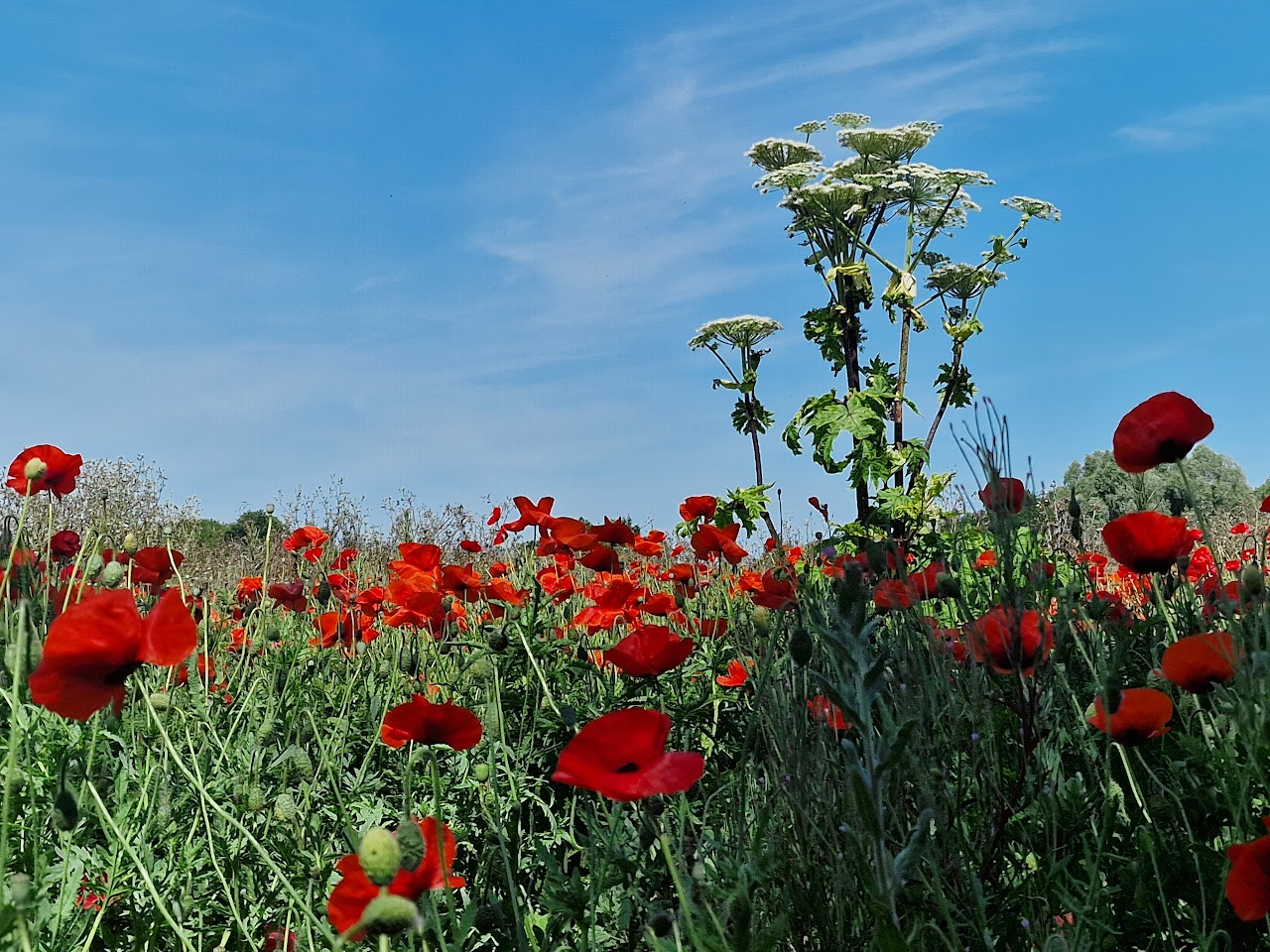
Giant hogweed dominating the view in a field of poppies elsewhere in Zeeland
Last week, under a perfectly blue Zeeland sky, I visited the farm for the first time. Looking forward to returning soon and getting everything set up!
This year, I had the joy (and challenge) of teaching Ecology to first-year biology students at Utrecht University for the very first time. Nearly 400 students, fresh into their academic journey, dipping their toes into the fascinating, complex, and urgently important world of ecological research.
We wanted that first encounter to be more than just theory. We wanted it to be memorable, meaningful, and fun – a hands-on experience that brings global challenges close to home.
So, we launched a campus-wide Bioblitz. A biodiversity sweep search through the Utrecht Science Park, designed to kill a whole bunch of birds with one stone – and it worked better than we imagined.
Utrecht Science Park is much more than aulas and research labs. One of my favourite spots: the little protected area of ‘De Driehoek’
Here’s why we think it was awesome:
Real fieldwork, real biodiversity Students headed outdoors, explored patches of green around their classrooms, and surveyed the life blooming right under their noses. They were encouraged to contribute observations throughout May (much appreciated by the aspiring ecologists), with one full day of fieldwork required for everyone. No escape for that one day – even the future microbiologists were sent outside. The result? Over 1000 species of plants, animals, and fungi identified. An eye-opener, we hope, to the wildness still hiding on the doorstep.
A whopping 1148 species on our campus, as found by our 400 students and other enthusiastic campus dwellers.
Ecology made personal By investigating biodiversity on their own campus, students saw up close why conservation matters – and how much there still is to discover and protect. From birds and beetles to mushrooms and mosses, the Science Park proved a microcosm of ecological diversity.
Oystercatcher on the bike path – the kind of surprises that can make one very enthusiastic about ecology!
Linking science to action Students also learned about the efforts already underway to conserve and restore biodiversity on campus – complex work, considering the competing pressures of research labs, student housing, and other infrastructure. We explored the messy realities of conservation in the real world: how it’s often under-prioritized, but still possible and worth fighting for. And perhaps even better: they could contribute to those conservation efforts. Thanks to all of them, we could scan the campus much more thoroughly, including corners where the usual ‘Bioblitzers’ wouldn’t go.
Theory meets the real world A key course goal was helping students see how ecological theory underpins what we observe in nature. With the data from the Bioblitz, we discussed concepts like alpha, beta, and gamma diversity, and asked students to look for real examples of species interactions – predation, facilitation, mutualism, commensalism – right here on campus. We even tied this to the theories of conservation science, such as ecological corridor design linking green areas north, east, and south of the Science Park.
All in all, this Bioblitz turned out to be a brilliant all-in-one: fieldwork, biodiversity awareness, ecological insight, and local conservation impact, and an army of 400 scientists helping to gather data. Importantly as well: a perfect way to get that many students to do something meaningful, without having to spend a lot of resources on it.
Next year, we’re levelling up. We plan to expand to soil biodiversity, moths, and aquatic life for those students who like a challenge. Stay tuned. Or better: join us with your own Bioblitz!
In a region like Flanders – dense, busy, and full of human activities of all shapes and sizes – the problem of noise pollution is increasingly recognized. We often think of that noise as something we can measure in decibels. But what if we’ve been asking the wrong question all along? Its impact on our health and well-being might actually have less to do with how much sound there is, and much more with what we hear.
That’s where the concept of the soundscape comes in: the landscape of sounds that surrounds us. It’s not just about volume. It’s about character, texture, and context. And so we wondered – what makes a soundscape feel peaceful? What makes it feel overwhelming? Instead of guessing, we asked the people themselves.
Image: De Morgen
At the start of De Oorzaak, our citizen science project on environmental noise, we launched a simple yet remarkably powerful questionnaire. We had the idea to invite people to step outside, take a little walk, listen carefully, and tell us what they heard and how that made them feel. It was a modest little survey, but the response was anything but: 4,465 people from across Flanders joined in, giving us a rich tapestry of sound experiences from all across the region.
And their answers spoke volumes.
We gathered responses from soundwalkers from all across Flanders
In a new paper just published in Science of the Total Environment, led by Timothy Van Renterghem from UGhent, we present a first glimpse into that highly interesting dataset. What we looked at was the overwhelmingly strong role of natural sounds on the quality of the soundscape. And this was truly ‘make or break’: natural sounds — like birdsong, rustling leaves, or the whisper of the wind — significantly improved the quality of the soundscape. Even when traffic noise was present, hearing natural sounds alongside it made the experience notably more pleasant for our respondents.
Impact of the amount of natural sounds one hears (from blue = nothing to red = a lot on the soundscape experience, showing a clear shift from annoying and chaotic to vibrant, pleasant and calm
In the questionnaire, we deliberately left the definition of “natural sound” open to interpretation. And people responded with familiar favorites: birds, wind, trees. An earlier master thesis already showed that birds come first. If those aren’t there — for example in a highly urbanized area — the sound of wind takes over that soothing role. These aren’t just pleasant to hear — earlier studies have shown they reduce stress, improve mood, and enhance focus.
So, natural sounds aren’t just nice — they’re essential. They make life in noisy environments more livable and can help mask the negative effects of anthropogenic noises.
Examples of local land use around a measurement point, with either a high share of low greenery, high greenery, agricultural land and non-green surfaces. More green space in an area of 500 m around you results in a higher reporting of natural sounds. And more natural sounds results in a strongly improved soundscape experience.
Interestingly, we also found that it’s not just the trees or green space right next to you that matter. Green infrastructure within a 500-meter radius — including farmland and more distant vegetation — played a stronger role than greenery within just 125 meters. This suggests that it helps to have a ‘reservoir’ of natural sounds nearby. Birdsong, for example, travels far and shapes the sonic backdrop in a large area.
What surprised me most, though, was how consistent these finding were. Whether someone was in the city or the countryside, as soon as they reported hearing natural sounds, they also rated their environment as calmer, more enjoyable, and less disturbing. As such, our study adds important weight to the proven importance of nature to act as a mitigator of the negative impacts of sound. And this, the ecologist in me might say rather smugly, adds yet another critical ecosystem service to the long list of things that nature does for us, within and around our cities.
The probability of experiencing high pleasantness (y-axis) in your soundscape increased with the presence of natural sounds in it (x-axis). Of course, soundscapes were rated more pleasant when traffic noise was low (blue) than when it was high (red), but in all cases natural sounds resulted in an improvement.
And that, it turns out, really matters.
Reference:
Van Renterghem et al. (2025) Effectively hearing natural sounds is a robust contributor to positive outdoor sound perception in the everyday living environment. STOTEN
We had been studying the role of mountain roads as drivers of non-native plant invasions in mountains all the way back till 2007. Heck, we just published a first manuscript on the decadal dynamics in those (Iseli et al. 2024)! Hiking through the worlds’ beautiful mountains, however, we soon started to wonder: do the same principles hold up along trails as well?
Already back in 2007, we started studying how mountain roads act as highways for non-native plants to invade pristine alpine ecosystems. Heck, we just published a first manuscript on the decadal dynamics in those (Iseli et al. 2025)! Hiking through our beloved mountains all over the world, however, a new question soon emerged:
What about trails?
Trails, like roads, are linear disturbances. They connect valleys with remote mountaintops, they carry humans (and their gear, boots, and seed-laden socks), and they alter local conditions in ways that could favor non-native species – opening up vegetation, increasing nutrient availability, and creating new microhabitats.
But trails are very clearly not roads – I don’t have to tell you that! The disturbance is softer. The infrastructure is minimal – often no gravel, no salt, no foreign materials. Hikers often wander off trail. There’s less edge, less management, and often fewer people. So, we suspected the same mechanisms would play out, but at a lower intensity. Fewer non-natives, lower cover, and smaller contrasts between trail edges and adjacent vegetation.
And so, an idea was born: take the MIREN road survey protocol and adapt it for trails.
Trails as linear disturbances in the mountains – hikers as vectors for non-native seeds
In 2016, without any dedicated funding – just shared enthusiasm and a love for mountains – we began surveying trails worldwide. Today, thanks to a remarkable effort relentlessly led by Agustina Barros and Eduardo Fuentes Lillo, we’ve surveyed 55 trails across 9 regions, and the first results are now published in Global Ecology and Biogeography.
So, what did we find?
At the global scale, climate (especially temperature) explained most of the variation in non-native plant richness. Biotic factors – like the diversity of native vegetation – best predicted presence and cover. Human-related factors (trail use intensity, grazing, distance to the trail) also played a role, but less consistently.
Importantly, the patterns were strikingly similar to those we’ve seen along roads:
Fewer non-natives at higher elevations and latitudes
Fewer non-natives farther from the trail edge
Trends in non-native richness as a function of climate (top) and native biotic interactions (bottom), showcasing also the subtle but significant differences with distance to the trail (different lines).
This supports the idea of a “double filter” for non-native plants:
Climate limits which species can survive as you go higher and colder.
Distance from disturbance limits where they can establish, as native communities become more resilient, and propagule availability lower.
As expected, however, the impact of trails was indeed less intense than that of roads!
Especially at high elevations, trails are often barely distinguishable from the surrounding vegetation, resulting in smaller differences in non-native communities as well. Combined with a harsh climate and often substantially reduced human presence, in many sites – for example here in northern Sweden – the number of non-natives is simply close to zero.
What’s also fascinating is that the same few non-native species – often hardy European forbs like Taraxacum officinale, Trifolium repens, and Rumex acetosella – pop up again and again, regardless of continent. These generalist species are good at exploiting disturbed habitats and are likely part of the global alpine invasion front.
Taraxacum officinale – the common dandelion – flowering at the top of a steep mountain trail in the Chilean Andes
So, should we worry?
Most of the non-native species we observed are not yet invasive. And we certainly recognize the many benefits of trails – for people, for recreation, and even for biodiversity in some contexts.
Trails can have positive effects on biodiversity as well! This trail in northern Sweden highlights how this may work, through the creation of microtopographical variation and variable levels of disturbance, they create a myriad of available niches.
But education matters. Encouraging hikers to stay on marked trails, limiting the expansion of trail networks, and raising awareness about their role in shaping ecosystems can help reduce further spread. Most of all, we need to focus on prevention – especially since the coldest, highest-elevation areas still remain relatively free of non-native species.
And while we may not stop every seed from catching a ride up the trail, this work shows we can still limit where it lands, and whether it takes root.
Reference: Barros et al. (2025). Beyond the Trail—Understanding Non-Native Plant Invasions in Mountain Ecosystems. Global Ecology and Biogeography. http://dx.doi.org/10.1111/geb.70060
Over the past six years, I’ve poured my heart into SoilTemp. What started as a vision for a global soil temperature database quickly grew into something much more: a living, breathing community of researchers passionate about microclimate ecology.
From the beginning, we dreamed of SoilTemp as more than a dataset. It was meant to be a hub – a place where scientists from around the world could come together, share data, collaborate on methods, and push the field of global microclimate ecology forward.
We’ve come a long way. Together, we’ve consolidated methodological advances (think De Frenne et al.), launched workshops and conferences (the MEB-conference series!), and created a vibrant series of subgroups tackling diverse topics from cold-climate regions to peatlands. And recently, we’ve felt the shift – this is no longer just a project or a database. It’s a full-fledged network.
So today – as we shared by email to the whole network already before – I’m beyond excited to share a major milestone in this journey: SoilTemp is now MEB – the Microclimate Ecology & Biogeography network.
Our new logo!
This new name is more than just a name. It’s mostly a broader vision and a renewed commitment to collaboration, inclusivity, and openness. After months of discussion and feedback, we’ve redesigned the network to give people more ways to engage, contribute, and connect – wherever you are in your microclimate journey.
What’s new?
The ‘mycorrhizal mycelium’ of our new MEB-network, with all its branches that together support the ecosystem that is the global microclimate community
– A new name: MEB – Microclimate Ecology & Biogeography
We have long grown beyond soil temperature. MEB captures the full range of what we now study together: microclimate across ecosystems, across scales, and around the globe.
– A new database identity: MDB – the Microclimate Database
Our database is evolving too. MDB reflects the diversity of in-situ microclimate measurements we now host – from air to soil, from forests to tundra. We’re always welcoming new contributors. If you’ve got data, we’d love to include it!
– A fully integrated conference series
The MEB Conference series – always already explicitly part of SoilTemp – is now officially part of the network! After a fantastic launch in Antwerp (2022) and an exciting follow-up in Helsinki (2024), we’re thrilled to welcome you all at the next edition in Montpellier (1–5 June 2026). These events are about more than just presentations – they’re where we take the pulse of global microclimate research, and foster new collaborations.
Explore our new digital home for updates on the database, network activities, and upcoming events. You’ll also find our new visual identity here – inspired by the MEB conference series. Still some work to do to get all microclimate information in the same place, but we’ll continue updating it!
– New contact info
You can now reach us at MEB-network@outlook.com. Don’t worry – the old SoilTemp email is still monitored during the transition.
How to join?
And then, very importantly: we have created many more ways in which anyone from the community can get involved! One of the core values of MEB is openness. We want this to be a network for the community, by the community. Here’s how you can now get involved (in addition to submitting data to the database, that is):
Annual online general assembly – your chance to connect, share feedback, and help steer the network. If you’re in our mailing list, you’ll automatically receive the invite for this
MEB Scientific Committee – open to everyone who wants to get more deeply involved into strategic planning, scientific priorities and moving the field forward scientifically.
MDB Database Committee – help shape the future of our data infrastructure. This committee aims to be a balanced set of representative data contributors from all continents, as well as data users – who see most clearly what the database needs.
Tools & workshops – we’re building a resource hub with guidelines, webinars, and online workshops (coming in late 2025).
Topical subgroups – passionate about a specific environment or region? Join or start a subgroup! Current active ones include: 1. Arctic/Antarctic & Above Treeline (AAAT) 2. Drylands 3. Peatlands
Want to start something new? Let us know – we’re here to support you.
We’re planning our first MEB celebratory general assembly for later this year – an open, online gathering for everyone in the network. It’ll be a chance to reflect, plan, and celebrate all we’ve built together. We hope to see many of you there!
To all of you who’ve contributed data, ideas, time, or support: thank you. This network exists because of you – and it’s only just getting started.
Let’s keep building the future of microclimate research. Together.
Lake Törnetrask, Abisko Research Station, Abisko, Sweden
Seen from Nuolja, Abisko
Laktatjakka valley
Norway
Summer in the Skjomen valley, northern Norway
Norway
Epilobium angustifolium
Norway
Skjomen valley, northern Norway
Laktatjakka valley
Skjomen valley, northern Norway
Narvik, Northern Scandes, Norway
Oenanthe oenanthe, alpine tundra Abisko, Sweden
Pinus sylvestris, Narvik, Norway
Lake Torneträsk, Abisko, Sweden
Skjomen valley, northern Norway
Luscinia svecica, Abisko, Sweden
Hallerbos 2017
Young bluebell (Hyacinthoides non-scripta) surrounded by flowers of yellow archangel (Lamium galeobdolon)
The common bluebell (Hyacinthoides non-scripta), the signature flower of the Hallerbos
Single bluebell flower surviving on a wetter spot, as indicated by the field of wild garlic (Allium ursinum)
A really wet patch of forest, with giant horsetail (Equisetum telmateia) in a field of wild garlic (Allium ursinum)
Wild garlic (Allium ursinum) in the Hallerbos flowers a bit later than the bluebells, yet this one was already in full bloom
A bumblebee visiting yellow archangel (Lamium galeobdolon)
Wild garlic (Allium ursinum)
Weirdly beautiful, the inflorescence of pendulous sedge (Carex pendula), typical for the wettest spots in the forest
A little stream in the Hallerbos, surrounded by endless fields of wild garlic (Allium ursinum)
The herb-paris (Paris quadrifolia), less common in the forest
Wild garlic (Allium ursinum)
Bluebells (Hyacinthoides non-scripta)
Weirdly beautiful, the inflorescence of pendulous sedge (Carex pendula), typical for the wettest spots in the forest
Another one from the wet plots: large bitter-cress (Cardamine amara)
Young beech leaves, as soon as they are fully grown, spring in the understory is over
A beech forest without understory, most likely too dry and too acid for any survivors
A young beech seedling (Fagus sylvatica), looking nothing like a beech, yet everything like a tiny dancer
Young beech seedling (Fagus sylvatica)
Bluebells (Hyacinthoides non-scripta)
Mountain melick (Melica nutans), a grass in the most amazing green
Bluebells (Hyacinthoides non-scripta) in a rare patch of mountain melick (Melica nutans), a grass in the most amazing green
Bluebells (Hyacinthoides non-scripta)
Montpellier 2017
The entrance to the cathedral of Montpellier
The cathedral of Montpellier
The entrance to the cathedral of Montpellier
The cathedral of Montpellier
Narcissus poetics
The cathedral of Montpellier
The botanical garden of Montpellier
Brackish Camargue vegetation
A typical lagune
Brackish Camargue vegetation
Camargue horses
Camargue horses
Camargue horses
Brackish Camargue vegetation
Camargue horses
Brackish Camargue vegetation
Little egret in the evening sun
Flamingo’s in the evening sun
A typical lagune
Dandelion fuzz
Grass lily
Grass lily
Dandelion fuzz
Veronica in a sea of poplar fluff
Euphorbia in a sea of poplar fluff
Poplar
Gare du Midi, Brussels
Sweden autumn 2016
Autumn in Abisko
Yellow leaves of mountain birch, with lake Torneträsk in the background.
Lapporten, the gate to Lapland, in Abisko
Rain blowing over the Abisko National Park
The colours of the north: red fireweed and yellow mountain birches, with lake Torneträsk on the background
Yellow leaves of mountain birch, with lake Torneträsk in the background.
Rain on the background, the ski lift in Abisko on the foreground
The steep slope of mount Nuolja on a dramatic looking morning
The beautiful colors of lake Torneträsk in Abisko
A little stream on top of the mountain, with a view on Lapporten, the gate to Lapland
Well, that is a beautiful table with a nice view on lake Torneträsk in Abisko
Our little experiment on top of the mountain in Abisko, with a view on Lapporten
Autumn in Abisko is extremely colorfull
The ski lift with a view on Abisko National Park and Lapporten
Hiking dowhill towards lake Torneträsk
This green is greener than the greenest green: moss on top of mount Nuolja
Well, that is a beautiful table with a nice view on lake Torneträsk in Abisko
The ski lift with a view on Abisko National Park and Lapporten
The most beautiful hiking trail of the world: Nuolja in Abisko
Angelica archangelica, often the biggest plant of the Arctic
The most beautiful hiking trail of the world: Nuolja in Abisko
Cirsium helenioides, the melancholy thistle
Hiking down mount Nuolja
The steep slope of mount Nuolja on a dramatic looking morning
The colours of the north: red fireweed and yellow mountain birches, with lake Torneträsk on the background
The prettiest yellow and blue: autumn in Abisko
Fireweed, Epilobium angustifolium
Campanula or bellflower, I think ‘uniflora’
Vaccinium myrtillus
Cornus suecica, the prettiest red of the world
Hieracium alpinum, alpine hawkweed
Carex atrata, one of my favourite sedges
Alpine clubmoss, Diphasiastrum alpinum
Agrostis capillaris, bentgrass
Common yarrow (Achillea millefolium)
Anthoxanthum odoratum, sweet vernal grass, fully grown and mature
Snow scooter trail
Our plot in the mids of a field of horsetails (Equisetum pratense)
Equisetum pratense
Cliff overlooking the valley with the road to Norway
Seedling of Taraxacum officinale, the dandelion, after two years of growing in bad conditions
Poa alpina, the alpine meadow-grass, with its viviparous seeds
Massive flowerhead of Angelica archangelica
Angelica archangelica
Blueberry (Vaccinium myrtillus) in autumn
A lowland marsh in Abisko in autumn
Installing the plots of our trail observations on top of mount Nuolja
Tanacetum vulgare (Tansy), non-native for the high north
Autumn forest down in the valley
The valley of Nuolja to Björkliden
Summer on the Nuolja-side
A full rainbow behind mount Nuolja in Abisko
It’s raining in the west, clouds trapped behind the mountains
A strong wind blowing rain from behind the mountains to our side
Betula nana, the dwarf birch, mini autumn forest
The valley of Björkliden in autumn
Sweden spring 2016
Silene acaulis
Although the alpine zone has been harder for invasives to access than most places, human structures like trails are often an easy gateway for the invaders to get up there. Picture from Abisko, Swedish Lapland.
Eriophorum vaginatum
Trifolium pratense
A rainy hike
Ranunculus glacialis
Western European species like the red clover (Trifolium pratense) here are often listed as non-native species in mountain regions.
Cornus suecica
Trifolium repens
Overlooking the valley of Laktajakka
Melting snowpatch on a lake
Rubus arcticus
Salix reticulata
Ranunculus glacialis
The valley of the lakes
Bartsia alpina
Dryas octopetala
Oxyria digyna
Silene suecica
Amiens
The museum behind the beautiful gates
View from my office window
The southern side
Amiens is filled with cute little houses
Sunny but cold, the Quai Bélu
Cathedral at night
Nice architectural curve
Almost cold enough for ice-skating
Maria without a shirt
Frozen to the bone
Le Club d’Aviron in winter weather
Cathedral seen from the frozen Parc Saint-Pierre
Gargoyle planning to eat the cathedral
House on the square before the cathedral
Frozen mirror
Cathedral at night
Just outside of Amiens
Colourful mirror
Cathedral with a glimpse of spring
Cathedral at night
Cold!
View from my office window
Winter sun on the Place du Don
Cathedral at night
Enjoying silence and the morning sun
Sunny but cold, the Quai Bélu
Sun rising above the water
Sweden autumn 2015
Lichen
Sweden summer 2015
View on the 1000 meter plots
Doing research on a cold Arctic morning
Plots flooded by the snowmelt
Flooded by the snowmelt
Meltwater river, racing down the mountain
After a hike, even the most basic house looks cosy. Little hut in the mountains, open for everybody
Snowbridge, maybe don’t cross…
Snowbridge
View from a cliff
Silene acaulis or cushion pink, cutest plant of the Arctic
Two seasons in one image
Steep slope
Hiking down
Narvik Kirche, church of the subarctic
Narvik Kirche
Reindeer on top of the mountain
Narvik Kirche
Summer at the church
Summer flowers
Massive waterfall
Young willow catkins
View from Narvik’s hospital, with lilac flowers
Building a bridge over the fjord will gain al drivers at least an hour
Norwegian fjord
Posing with the water, getting soaked
Minimalistic mountains
Insect investigating our reindeer antler
Catching mosquitoes with our license plate, harvest of the year!
Posing with the plot
Fieldwork on the most beautiful spot of the world
Summer bridge – still next to the sadly impassable river
Rhinanthus flower in the mountains
Plateau in the valley, beautiful brown
Experimental view from my favourite plot
Salix catkins
Extremely old Betula tree
Waterfall from a cliff
Buttercup is the earliest in spring, here
Rocks!
Alpine views
Views!
Fieldwork
Jumping over rivers
Plot
Golden plover
Angry lemming
Green, the whole north is green!
Snow, so much snow left!
Minimalistic mountain moments
Fieldwork
The research center
Red clover – focal invader
Look at this tiny cute snail!
Massive floods of melting water
Bartsia alpina
Hooray, a toilet!
Dryas octopetala
Lowest elevation plots
Butterball!
That’s a lot of water
Midnight sun is the best
At the lakeside
Beautiful Bistorta vivipara
Don’t fall in the water
Midnight sun
Wild river
Art – made by ages of wild rivers
Baby firework for America’s independence day
Midnight sun at the lake
The Abisko canyon was wilder than ever
That’s a crazy amount of water!
The Abisko canyon was wilder than ever
Black and white
Stone-man overlooking Abisko
Nothing as soft as a willow catkin
Label and soil temperature sensor attached
I’d drive to the top every day
Reflections
Rocks and clouds
Brave little birch
Brewing our camping poison
Basic camping stuff
Camping in Norway
Home-made temperature houses
Roadside research at its best
Norway is crazy
Horsetail is so funny
Little creek in magical forest
Birches, birches everywhere
Beautiful rock, a gift from the river
Another roadside fellow
Lichen
Ready to rock the summer
Collecting mosses
That’s a crazy old lichen
Tiny tiny piny trees, but old, so old!
Ready to jump into the fjord?
That’s a spiky stone!
Views on Norwegian fjords
Silene in the mountains
Cute little orchid
Skua
Attacking skua, mind your heads!
Watch out for the attack of the fierce skua!
Black snail
New plot!
Still a lot of snow to melt, but this spot was free for a new plot
Reindeer are better than people
Two seasons in one picture
Let’s see what is happening to the balance in mountains! Is this a starting avalanche, or will it last a bit longer?
Cute little hut
Climbing mountains by car
Softest moss in history
Drosera in the marsh
Hiking in no-man’s land
The clouds are coming
Abisko valley
‘Butterball’
Fieldwork in the tundra
Abisko valley
Little plot
Clouds and sun and mountains
Making soup on a campfire with a view
Little creek on high elevations
Skua on the look-out
Melting snow in a river
Rhodiola rosea and the Törnetrask lake
Beginning of spring
Flooded plots, melting snow, impassible wetness
Ferns and horsetails
Chile 2015
Lunch made by our local colleague, with funny bread (tasty as well!)
Trips to the field sites were sometimes a real adventure, especially right after snowmelt