BioTime 2.0

If we want to understand how biodiversity is shifting in this rapidly changing climate, we need two critical ingredients: microclimate time series and biodiversity time series. (And yes, let’s not forget good soil data – but let’s keep it simple for now).

For now, let’s celebrate a massive step forward for one side of that equation: the species. The long-anticipated release of BioTIME 2.0 is finally here – and it’s a game-changer.

BioTIME is the world’s largest database of biodiversity time series – carefully curated records tracking how species communities change through time across the globe. It spans nearly 150 years of observations, from the Arctic tundra to the Amazon rainforest, from 1874 right up to 2023. That’s 12 million records from over half a million unique locations, tracking more than 56,000 species across marine, freshwater, and terrestrial ecosystems.

This isn’t just a database – it’s the fingerprint of biodiversity change turned into numbers.

Unlike single-species records, BioTIME focuses on assemblages: communities of species living and interacting in the same place. That’s what makes it so powerful. Assemblage-level data lets us ask rich questions about species turnover, diversity, ecosystem function, and the often-surprising ways nature reshuffles itself in response to human pressure, climate shifts, and land use change.

Set up of the database, with repeated community surveys at the same location grouped per study, gathered from across the globe.

The new version – BioTIME 2.0 – massively expands both the taxonomic and geographic breadth of the database, and it wouldn’t exist without the collaboration of 485 co-authors from over 400 institutions across 40 countries. It’s beautiful open science in action, global cooperation and collective vision.

The mindboggling global coverage of BioTIME 2.0

And this isn’t just academic. BioTIME has already changed how we think about biodiversity change. It’s helped move the conversation beyond simplistic narratives of universal decline, showing instead the messy, complex, local realities of species redistribution, community reshuffling, and ecological reassembly. Exactly what we have been anticipating here on The 3D Lab due to the complexities of local microclimate and other environmental conditions. As such, BioTIME 2.0 is the tool we needed for thinking deeper about how the world is going to change in all its glorious chaos.

So what’s next? More data, of course. BioTIME is alive – actively growing, with new studies still being added. But also, the database is freely available for anyone to explore, and it’s already fueling everything from local conservation planning to global policy discussions. And then, there is my dream: easy integration of that database with the microclimate data (in-situ or modelled) we are generating in the Microclimate Ecology & Biogeography-community.

Indeed, for those of us in the world of species on the move, this new database can be a game changer. With high-resolution environmental data becoming more available, and now with BioTIME 2.0 in our toolbox, we’re again one step closer to scaling biodiversity science – across time, across space, and across systems.

We added repeated vegetation surveys from our long-term monitoring sites in northern Scandinavia to the database. Hopefully soon, our EcoFracNet-project can also add data!

Posted in Science | Tagged , , , , | Leave a comment

Reimagining species on the move

I still remember those first groundshattering papers showing the impact of recent climate change on biodiversity. For decades, climate change had been looming in models and predictions — but suddenly, the evidence was real, visible in the field. Species weren’t just coping; they were moving. Polewards. Upslope. Earlier in the year. The fingerprints of a warming world were showing up in ecosystems across the globe.

What started as a trickle of evidence has grown into a flood. Today, the effects of climate change on biodiversity are so marked that even the simplest analyses can reveal them: species shifting uphill or toward the poles, flowering earlier, or altering migration schedules.

But here’s the catch: most research captures these shifts along only one axis – usually space (e.g. latitude or elevation) or time (e.g. phenology). The reality is far more complex. And we think it’s time to change that.

We – the participants of the wildly successful Species on the Move conference – came together to understand how species are responding to our rapidly changing world. The conference series has become a central hub for this kind of work, bringing together ecologists, biogeographers, and conservation scientists from around the globe. Two years ago, we gathered under the blazing Florida sun to take stock of where the field stood. (More on that memorable meeting here: https://the3dlab.org/2023/06/02/species-on-the-move-2/.)

Green anolis, one of the many animals around our Florida meeting reminding us vividly what we are fighting for

Following that conference, a focused workshop sparked a key realization: while we’ve long known species are on the move, we’ve vastly underappreciated how multidimensional that movement might be.

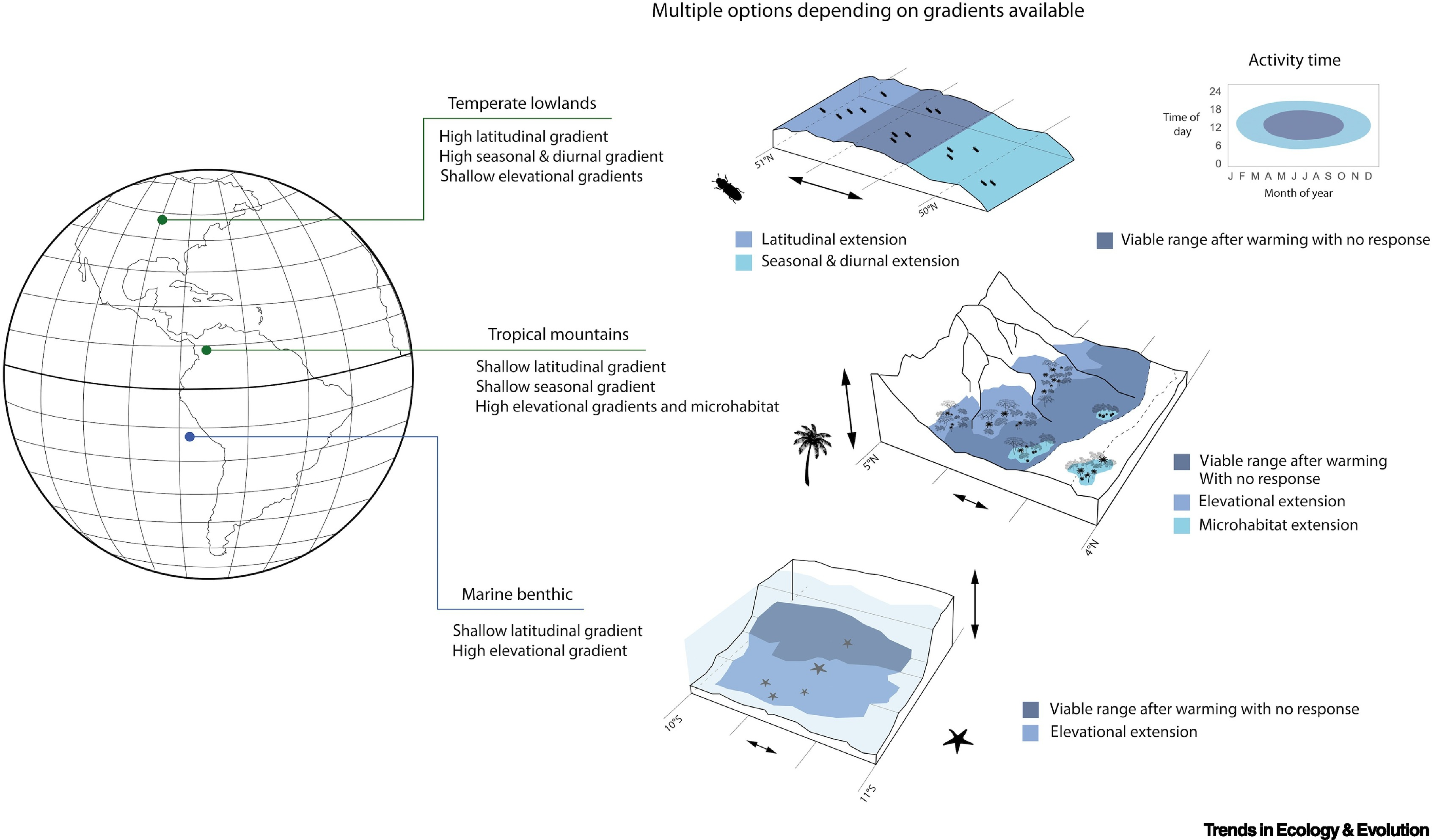
Species don’t just move north or bloom earlier — they respond to climate across multiple axes and at multiple scales. Some shift upwards in the canopy or burrow deeper into the soil. Others track temperature changes within a growing season, or even across the day–night cycle. From daily rhythms to elevational climbs, organisms navigate a multidimensional thermal landscape.

 Species track temperature in both space and time, at varying scales. This tracking could happen the ‘traditional way’, to higher latitudes or up the mountain, but also vertically within the vegetation or under water, or within the growing season or even within a day – species have a whole multidimensional climate space available to them to move in.

This has quite important implications, you know. It means, for example, that we may be underestimating species’ capacity to track climate change. A species might not shift northward as expected, but may instead emerge earlier in the season, find cooler microhabitats nearby, or shift into new life-history timings – adaptations that go unnoticed if we’re looking in only one direction.

The way a species responds depends deeply on its ecological context — the landscape, the climate, the traits. In some systems, spatial shifts dominate; in others, time is the primary axis of change. Often, it’s both — and more.

To capture this complexity, we argue for a paradigm shift: one that recognizes that species are moving not just in one direction, but across multiple dimensions of space, time, and thermal scale. In our recent synthesis, we outline a conceptual framework that reflects this – highlighting how species can and do respond to directional climate change along intertwined spatial and temporal gradients, from the macro to the micro.

Why does this matter? Because future conservation and management strategies depend on our ability to anticipate where, when, and how species will respond to continued climate change. A multidimensional understanding allows us to improve our attribution, sharpen our predictions, plan better interventions and make better use of the complexity of ecological landscapes to protect biodiversity there where it wants to be.

Species are moving. But to keep up, we need to follow them not just north, but up, down, deeper, earlier – and in every direction climate change makes available!

Check out the full paradigm shift in our recent publication: Fredston, A. L., Tingley, M. W., Neate-Clegg, M. H., Evans, L. J., Antão, L. H., Ban, N. C., … & Scheffers, B. R. (2025). Reimagining species on the move across space and time. Trends in Ecology & Evolution.

Posted in General | Tagged , , , , | 1 Comment

What mountain roads do to root-associated fungi

Some papers just hit harder than others. And this latest one – just out in Molecular Ecology – sits right at the top of the epic scale. The topic? The impact of mountain roads on plant-fungal interactions.

Here’s the thing: we’ve been looking at the effects of mountain roads for years – since 2007, in fact, when the first surveys of the Mountain Invasion Research Network (MIREN) kicked off. And over time, we learned a lot: changes in plant communities, upslope and downslope shifts in distributions, effects on functional traits – you name it. But one thing remained a mystery: what was going on belowground.

So, we decided to go digging. Literally.

We set out with an ambitious plan: sample roots from long-term MIREN plots – both roadsides and adjacent vegetation, across elevation gradients and multiple regions. The goal? To understand how root-associated fungi respond to road disturbance, and whether these patterns shift with altitude or across continents.

A Norwegian forest understory of Cornus suecica and Vaccinium vitis-idaea, one of the vegetation types of interest in our study.

Solid idea, right? But then came the execution.

Enter the epic field trips: Norway, Chile, Argentina. Samples flown in from Tenerife and the Czech Republic. Sorting root samples. Washing them. Cutting them into tiny pieces. Amplicon sequencing to reveal the fungal communities hiding inside. Add in a freezer disaster that cost us an entire region’s worth of samples (yep, that happened!), and then the analytical rabbit hole: plant species, fungal species, interactions, co-occurrence patterns… A deep dive into Joint Species Distribution Modelling to figure out what we can and cannot tease apart from this complex mess.

Scouting for plants in the Andes

Honestly? Easily the most time-consuming paper I’ve worked on so far. And that doesn’t even count the countless hours of meticulous, patient work by first author Dajana – without her expertise in soil microbial ecology, this paper simply wouldn’t exist.

But oh boy, was it worth it.

For the first time, we can now see the belowground implications of these heavily studied mountain roads. And the impact? Brutal. Roadside plots consistently showed a collapse in the complexity of plant-fungal and fungal-fungal co-occurrence networks – by 66–95% and 40–94% in total edge density, respectively. And yet, interestingly, fungal richness didn’t go down. Many of the key taxa were still present.

What this tells us is that the species are still there – just like aboveground, where we often see even more plant species in roadsides than in adjacent plots. But their networks are gone. Their roles, their interactions – the whole belowground social fabric – has unraveled. They’re in the roots, but they’re not doing what they’re supposed to be doing.

Example plot visualizing the loss of interactions in Chile. Each blue dot is a negative link between two species, each red dot a positive link. The left side shows the situation in the adjacent vegetation, where two groups of co-occurring species are clearly identified. The right side is the situation in the roadside, where that whole interaction network is disrupted and only some scattered points remain.

And in that ecological vacuum, the usual suspects step in: generalists like arbuscular mycorrhizae, who aren’t very picky about their plant partners, and pathogens with low host fidelity. They thrive. But more host-specific fungi – like ectomycorrhizae – don’t. Just like we saw in several of Jan Clavel’s PhD papers (e.g., here), those specialists don’t fare well in these unpredictable, human-altered environments.

Echium vulgare, one of the many European non-native species in Chilean roadsides. New species bring new belowground interactions, and networks that are often substantially less mature.

Our takeaway? Road disturbance leaves a consistent negative imprint on the connectivity between plants and fungi. It’s a stark reminder that even systems with high species richness can be fundamentally unstable and vulnerable – especially when facing additional pressures like climate change and biological invasions.

Road disturbance in action high in the dry Andes west of Mendoza, Argentina

So yes – please take the time to dive into this paper. We poured our hearts into it.

Reference: Radujkovic et al. (2025). Road Disturbance Shifts Root Fungal Symbiont Types and Reduces the Connectivity of Plant-Fungal Co-Occurrence Networks in Mountains. Molecular Ecology. https://doi.org/10.1111/mec.17771

Posted in Science | Tagged , , , , | Leave a comment

The Tea Bag Index: simple on the surface, complex beneath

Oftentimes the simplest scientific methods hide a whole iceberg of complexity. The Tea Bag Index (TBI) is no exception. On the face of it, it’s brilliantly straightforward: bury some green and rooibos Lipton tea bags, dig them up after about 90 days, and compare how much they’ve decomposed. What could be easier?

Well… as always in science, a lot, actually.

Our recent paper in Ecology Letters, based on a whopping 36,000 tea bags, sparked some healthy scientific debate. In a follow-up response to critiques by Mori (2025), we now dove deeper into the assumptions behind the TBI and clarified what this method can and cannot tell us.

At its core, the TBI is designed to give everyone – from scientists to students and citizen scientists – an accessible way to study decomposition across environments. It does this by estimating two key values:

  • S_TBI: how much material resists decomposition (a stabilisation factor)
  • k_TBI: how quickly decomposition starts (an initial rate)

The method’s strength lies in its simplicity and global standardisation. It allows us to compare results across locations and climates without the messy variation of local litter types. That makes it incredibly useful for large-scale studies. But because it’s such a simplification of the real world, it’s important to use it with care.

What the TBI tells us – and what it doesn’t

Plant material, including tea, breaks down in stages. Some parts go fast, others hang around for years. The TBI focuses on the early, fast stage, but in the real world, the slow stuff might start decomposing earlier than assumed. So, while the TBI gives us a valuable snapshot of early decomposition, it doesn’t reflect the full timeline of what happens to organic matter in soil.

Simplified TBI-model (left and middle) versus a more realistic decomposition model (right).

Rethinking the assumptions

The TBI assumes that 90 days is enough for green tea to reach a stabilised phase (so you can measure S_TBI) and that rooibos tea is still in its early phase (so you can measure k_TBI). Our data confirm that green tea generally fits this assumption well. Rooibos tea, however, shows more variation – and that variation isn’t always easy to explain.

Another assumption is that we can use green tea’s stabilisation factor to estimate that of rooibos tea. But our findings show that the predicted stabilisation (S_TBI) doesn’t always match what’s actually observed in long-term rooibos data. In fact, applying S_TBI early on might inflate k_TBI. However, since k_TBI tends to underestimate actual decomposition rates (k_real), this may not be a major issue.

So, what can we trust?

Despite its imperfections, the Tea Bag Index remains a valuable tool. It captures short-term decomposition well and enables comparisons across environments by using a consistent material. It’s not meant to replace more detailed, site-specific studies – it’s meant to complement them.

For future work, we suggest treating the two TBI parameters – k and S – as distinct components shaped by different environmental drivers. Combining TBI results with chemical analyses and longer-term studies could help bridge the gap between simplicity and ecological realism.

In the end, the Tea Bag Index doesn’t capture the whole story of decomposition – but it does capture a really useful chapter. And sometimes, that’s exactly what you need.

Posted in General, Science | Tagged , , | Leave a comment

The graph that surprises nobody

Our recent paper in Nature summarizing the work of the Dark Diversity Network contains a simple – and for that reason rather horrifying – graph. It’s not much more than a linear regression, a line through some points:

It summarizes the relationship between the Human Footprint Index – a measure of the human modificiation of the landscape at a coarse scale – and the percentage of suitable plant species in our Dark Diversity plots.

That percentage is something unique: the network’s elaborate monitoring design was set up in such a way that we could estimate the total potential species pool of an area. The graph shows the percentage of that total species pool that was actually present at the site.

Now, what surprises nobody: the graph shows a steep decline – from around 35 to 20 % – in that percentage between sites without a human footprint up till an index of eighteen. Humans remove species from the land – clear and simple. What makes this analysis unique is that we find this after correcting for the potential of a certain area, and thus only look at the loss in potential, not the total loss of species. That correction is necessary to unearth these strong patterns, otherwise they get lost in the high variability in species diversity worldwide.

Now, the shape of the graph: a strong decline in realized diversity potential with increasing human footprint – is likely not a surprise to anyone. Nevertheless, it’s a story that needs repeating: it is the direct imprint of humans on a landscape that kills its diversity and it is that human footprint that we’ll have to keep fighting if we want to turn the tide for global biodiversity.

Now, how to win that fight in our multifunctional landscapes where biodiversity rarely plays the first violin, that’s a different story. But I am here to keep fighting that fight!

Find the paper here: https://www.nature.com/articles/s41586-025-08814-5

Posted in General | Tagged , , , , | 1 Comment

Global impoverishment of natural vegetation revealed by ‘dark diversity’

Back in 2019, we ventured into the field with a rather unusual mission: to search for the biodiversity that wasn’t there. At first glance, this might seem counterintuitive – after all, we’re accustomed to documenting what exists. Yet, by exploring what is absent, we uncover a narrative of loss and missed ecological opportunities.

The idea of measuring missing biodiversity originated in Estonia and is termed “dark diversity.” This concept doesn’t refer to the simple absence of all species – like the glaring lack of palm trees in a Flemish heathland – but rather to those species that could theoretically flourish in an environment, yet remain missing. In essence, dark diversity represents the shadow of potential life that hints at both historical losses and unrealized natural potential.

Dark clouds over our dark diversity field site in a Flemish heathland. This particular plot was undergoing active restoration – future work will show us how much of the dark diversity would have returned.

To delve deeper into this phenomenon, the Dark Diversity Network set out on a global journey. Using a unique survey design and specifically developed statistical methods, the network aimed to distinguish between species that should be present and those that are not. The culmination of this effort was the publication of a first large-scale paper in Nature, whose findings are as unsettling as they are revealing.

Now, drawing on data from over 200 scientists, the network spans nearly 5,500 sites across 119 regions worldwide. This extensive collaboration exposed the hidden toll of human activities on natural vegetation. In ecosystems with minimal human interference, more than one-third of the potentially suitable species are present, with the remainder missing largely due to natural constraints like limited dispersal. By contrast, in areas heavily impacted by human activity, only one in five suitable species is found.

Area in northern Norway in which dark diversity is still low, thanks to the low human footprint.

Traditional biodiversity assessments – often based solely on the number of species recorded – failed to capture this nuanced decline. Such methods obscure the true impact of human disturbance by not accounting for the inherent potential of a given ecosystem. Instead, the study’s approach, which integrates the concept of dark diversity, reveals a far more comprehensive picture of ecosystem health.

Central to this research was the use of the Human Footprint Index, a composite metric that evaluates human population density, land-use changes (including urban development and agriculture), and infrastructure elements like roads and railways. The study demonstrated that as the Human Footprint Index increases, plant diversity diminishes—not only within the immediate vicinity but also across surrounding regions, sometimes extending hundreds of kilometres away.

Distribution of research sites in the DarkDivNet, and the relationship of the realized biodiversity potential as a function of the Human Footprint Index.

These findings are alarming, as they reveal that human disturbances extend well beyond urban centers -even infiltrating protected nature reserves. Pollution, logging, littering, trampling, and human-induced fires can drive plants from their native habitats and hinder natural recolonization. Notably, the adverse effects of human activity were less severe when at least one-third of the surrounding landscape remained pristine – a threshold that reinforces the global objective to safeguard 30% of our land.

This study underscores the importance of nurturing ecosystem health at a landscape level, not just within the confines of nature reserves. It’s clear that large-scale environmental dynamics significantly shape local biodiversity. This fits in neatly with the MicroFracNet we recently launched, an initiative dedicated to exploring biodiversity patterns across scales and deciphering how various drivers determine species presence or absence. We warmly welcome anyone interested in joining this exciting project!

Conceptual approach summarizing the calculation of the dark diversity species pool

Reference: Partel et al. (2025). Global impoverishment of natural vegetation revealed by dark diversity. Nature. https://www.nature.com/articles/s41586-025-08814-5.

Posted in Science | Tagged , , , , , , , , , | Leave a comment