We’ve written before on The 3D Lab about De Oorzaak as an ambitious citizen science effort to understand urban soundscapes in Flanders. This week marks an important milestone – the cherry on the cake: the project’s integrated scientific final report is finally out! It brings together years of work into a single synthesis that combines environmental measurements, citizen experiences, and health research.
You can find the mastodont of a report – of which we’re super proud – here: https://www.uantwerpen.be/nl/projecten/de-oorzaak/ (it’s in Dutch, though).
De Oorzaak – for those who missed it so far – is a collaboration between Universiteit Antwerpen, Universitair Ziekenhuis Antwerpen (UZA) and De Morgen, and has grown into the largest citizen science project on environmental noise ever conducted in Flanders. Hundreds of smart sensors, deployed across more than a thousand locations, were paired with ten thousand questionnaire responses to move beyond a simple “how loud is it?” question. Instead, the report asks what kinds of sound environments people actually inhabit, and how these relate to sleep, fatigue, stress, and well-being.
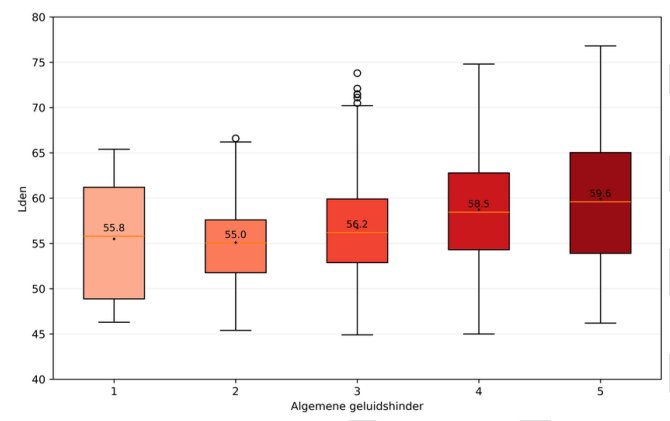
A consistent pattern emerges: higher noise annoyance is associated with poorer sleep quality, more fatigue, and higher stress levels. At the same time, these relationships are not strictly one-way. Being stressed or fatigued for other reasons can also lower tolerance to sound, highlighting that cities function as coupled human–environment systems rather than as collections of isolated stressors.
What resonates most with me in this report is – of course – the strong signal around the role of nature in shaping soundscapes. Natural sounds such as birdsong, rustling leaves, or flowing water are systematically evaluated as more pleasant than mechanical or technical sounds. Crucially, nature does not need to drastically reduce decibel levels to have a restorative effect. Improving the quality of the soundscape already matters.
The report also aims to translate science into action. One of the most concrete ideas perhaps is the proposal for an acoustic label for housing, analogous to the energy performance certificate, alongside recommendations on acoustic renovations, building design, coordinated reporting of noise nuisance and, of course, more nature! Together, these suggestions treat acoustic quality as a fundamental component of healthy living environments rather than an afterthought.
We hope this report can really support and create actual change. Of course, such a citizen science project is about much more than just doing science, we actually want to put the topic front and center in our collective mind, and as such accelerate change.
So, give it a read, and get doing!


 The 3D lab