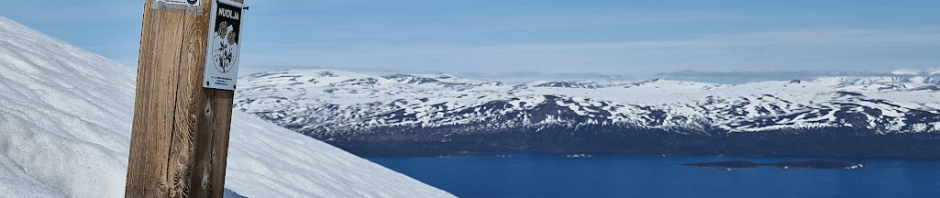
I’ve just returned from a field visit to northern Sweden – above the Arctic Circle. It was close to thirty degrees Celsius this week. We nearly got burned off the mountain.
This kind of heat is no longer unusual. It followed a strange winter, where most of the snow had melted away by February – only to be replaced by a late-season snow event that buried the mountain under snow well into spring. These abrupt shifts are exactly what we’re tracking in our Fingerprints of Change project on mount Nuolja, close to Abisko: how increasingly erratic weather affects plants, bumblebees, and the ecosystems they hold together.

It’s too early to say what the full impact of this year’s extremes will be, but we already see it’s substantial. And more importantly: this isn’t a fluke. These kinds of events are happening more frequently – in this system, and in every system.
Because climate change doesn’t play out like a slow, steady dial toward 1.5°C. It comes in jolts. It hits us with heatwaves, droughts, late snows, floods, storms. Shocks that used to be “once-in-a-lifetime,” but now seem to happen all the time. These Extreme Weather and Climate Events (EWCEs) are no longer exceptions. They’re part of the story, and in many cases, the main driver of change.
Yet in ecology, we’ve barely started paying them serious attention.
In our new paper, just published in Trends in Ecology and Evolution (TREE), we argue that this lack of focus isn’t because extreme events don’t matter. It’s because the data hasn’t let us see them properly.
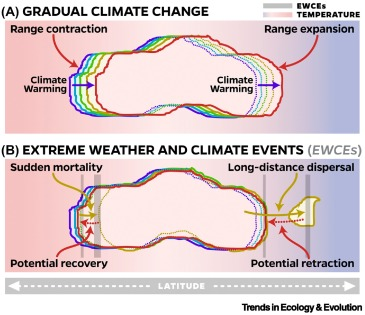
(A) In the classic view, climate warming drives a slow reshuffling of species. Populations gradually expand into newly suitable areas at the leading edge – typically toward higher latitudes, elevations, or ocean depths – while slowly disappearing from the trailing edge where conditions become too harsh. The result: a steady drift of ranges over time.
(B) But extreme weather can disrupt this smooth story. Sudden droughts, heatwaves, or cold snaps at the trailing edge can wipe out populations entirely, triggering abrupt contractions. These losses might be temporary (recovery is possible if conditions improve) but they can also leave lasting gaps. At the leading edge, storms or other extremes can fling seeds, spores, or individuals far ahead of the current range, sparking rapid expansions. Yet here too, the next extreme could push them right back.
What’s missing?
First: climate data. Most biodiversity studies still rely on coarse, long-term averages or climate station data far away from where organisms actually live. But extreme events are short-lived and highly local – meaning we need fine-scale data in both space and time to catch them. But what is more: as we don’t know where and when the most extreme events will happen, that fine-scaled data needs large spatial and temporal extents, and is that that is hardest to find.
Second: biodiversity data. Most monitoring efforts rely on just a few time points, maybe two or three surveys across several decades. That’s not enough to pick up the biological fingerprints of rapid, transient shocks.
This paper emerged from discussions at the Species on the Move conference in Florida. We highlight how extreme events can accelerate or limit species’ range shifts. For example:
- Storms can blow seeds or insects far beyond current range limits.
- Droughts and floods can wipe out entire local populations.
- Cold snaps can halt the northward spread of warm-adapted species.
So, while background warming may drive slow and steady shifts, extreme events can spark sudden advances or abrupt setbacks.

Where do we go from here?
To understand these dynamics, we need better tools. Microclimate models at the necessary resolution are demanding, but increasingly feasible. Long-term, standardized monitoring – like what we’re doing with the Fingerprints of Change-project in Abisko and through global collaborations like in the MIREN network – is helping us fill the gaps.
And it’s not just about research. Conservation planning must also start factoring in extreme events. That means short-term interventions, like shading turtle nests during heatwaves. But more importantly: long-term strategies, like ensuring connectivity so disturbed populations can recover through recolonization.

A call to think differently
As ecologists, we’re trained to look for trends. We love linearity, averages, gradual change in our data. But extremes defy those expectations. They’re noisy. They’re messy. It’s time we shift our perspective.
In this paper, we call for a different lens: from “microclimate” to “microweather.” From gradual trends to abrupt shocks. From averages to outliers.
Because it’s in the extremes where much of the future will unfold.


 The 3D lab