
Gaining a long-term perspective on ecosystem changes is challenging. Even when ecologists describe changes as happening “remarkably fast,” they are often difficult to observe within a single scientific career, let alone the lifespan of a project.
Occasionally, however, we can catch a rare glimpse of long-term evolutions, and these invaluable “blasts from the past” can lead to groundbreaking discoveries. An example of this is a new paper we recently published in the Nordic Journal of Botany, thanks to the diligent efforts of master’s student Dymphna Wiegmans.
In this paper, we unearthed historical vegetation surveys conducted after the creation of the ‘Rallarvägen’ (or ‘The Material Road’). This trail, established at the very beginning of the 20th century, was used to construct the vital railroad line connecting the mining town of Kiruna in northern Sweden to the Atlantic Ocean at the Norwegian town of Narvik.

At the dawn of the 20th century, northern Sweden was an incredibly remote and pristine area. The construction of this railroad, decades before the first real road opened up the region, was thus nothing short of a monumental achievement. The Rallarvägen trail was used by navvies (railway construction workers, known as “rallare” in Swedish) to transport materials and equipment necessary for building the railway.
The railroad project, known as the Iron Ore Line (Malmbanan in Swedish), began in the late 19th century and was completed in 1903. This line was essential for transporting iron ore from the rich deposits in Kiruna to the ice-free port of Narvik, enabling year-round shipping. The construction of the railroad through such a challenging and rugged landscape required significant human labor and ingenuity. Workers had to deal with harsh weather conditions, difficult terrain, and the logistical challenges of transporting heavy materials through an undeveloped wilderness.
Daydreaming about the achievements of these early railroad builders, we were now more actively interested in this historic disturbance and its impact on ruderal plant species, which thrive in disrupted environments but had up till then only few opportunities in this largely untouched landscape. Specifically, we wanted to understand the dynamics of both native and non-native ruderal species and how their distributions have evolved from that major railroad building project back in 1903 till now.

To our surprise, our research uncovered some unexpected findings. Using historical botanical records from 1903, 1913, and 1983, along with our own resurvey in 2021, we were able to partially reconstruct the long-term dynamics of these species. We initially hypothesized that the low levels of non-native ruderal species observed today indicated that their introduction was relatively recent, likely after the construction of the main highway (the ‘E10’ in the 1980s, compounded by increased tourism and climate change in recent decades.
Our historical sources tell an entirely different story, however. Many ruderal species were already present and common during the creation of the Rallarvägen. Remarkably, there were even more non-native species back then than there are now, and we have observed a consistent decline since then. Even more surprisingly, this decline has led to the current ruderal community having fewer warm-adapted species than during the era of railroad construction. This implies that warm-adapted species are disappearing rather than emerging. This pattern holds true for both native and non-native ruderals.
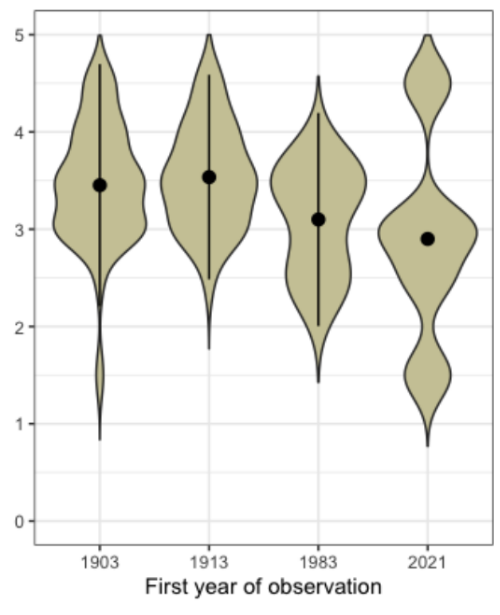
The conclusion is clear: a major historical disturbance, such as the construction of the railroad back in 1903, can send shockwaves through an ecosystem that are still felt a century later. In this case, the impact of that disturbance has been even greater than that of contemporary climate change, as evidenced by the decline in both species richness and the temperature affinity of the community over time.
Our historical data is incomplete, so there remains some uncertainty about the exact sequence of events. Nonetheless, we could piece together a remarkable history that begins with gardens, stables, and foreign soil filled with ruderal seeds, followed by a steady decrease in disturbance levels and a corresponding decline in non-native ruderal species richness. The construction of the highway in the 1980s and its use since then has not yet resulted in an increase in ruderals along the Rallarvägen, likely because the Rallarvägen was not used as a construction road for the building of the highway. Nor has the recent warming climate led to a resurgence of these species.

Nowadays, ruderal species are as expected most strongly related to hotspots of introductions, such as the small train stations scattered along the tracks. Interestingly, here again disturbance trumps climate: the relationship of ruderal species was much stronger with disturbance than with climate.
A final interesting observation to point at here is that only very few ruderals, and especially non-native ruderals, have found their way from the Rallarvägen in the valley to higher elevations. Despite the presence of some well-visited hiking trails crossing the Rallarvägen, the uphill expansion of non-natives is limited. That is remarkable, given that they have had more than a hundred years to do so. The conclusion should thus be that most of these species are currently truly at their climatic limits here in the high north. Only a change in climate could thus make them move higher up…
Let that unfortunately exactly be what is happening…
The paper, published in the Nordic Journal of Botany, can be found here: https://nsojournals.onlinelibrary.wiley.com/doi/10.1111/njb.04382


 The 3D lab