
I still remember those first groundshattering papers showing the impact of recent climate change on biodiversity. For decades, climate change had been looming in models and predictions — but suddenly, the evidence was real, visible in the field. Species weren’t just coping; they were moving. Polewards. Upslope. Earlier in the year. The fingerprints of a warming world were showing up in ecosystems across the globe.
What started as a trickle of evidence has grown into a flood. Today, the effects of climate change on biodiversity are so marked that even the simplest analyses can reveal them: species shifting uphill or toward the poles, flowering earlier, or altering migration schedules.
But here’s the catch: most research captures these shifts along only one axis – usually space (e.g. latitude or elevation) or time (e.g. phenology). The reality is far more complex. And we think it’s time to change that.
We – the participants of the wildly successful Species on the Move conference – came together to understand how species are responding to our rapidly changing world. The conference series has become a central hub for this kind of work, bringing together ecologists, biogeographers, and conservation scientists from around the globe. Two years ago, we gathered under the blazing Florida sun to take stock of where the field stood. (More on that memorable meeting here: https://the3dlab.org/2023/06/02/species-on-the-move-2/.)
Following that conference, a focused workshop sparked a key realization: while we’ve long known species are on the move, we’ve vastly underappreciated how multidimensional that movement might be.
Species don’t just move north or bloom earlier — they respond to climate across multiple axes and at multiple scales. Some shift upwards in the canopy or burrow deeper into the soil. Others track temperature changes within a growing season, or even across the day–night cycle. From daily rhythms to elevational climbs, organisms navigate a multidimensional thermal landscape.

This has quite important implications, you know. It means, for example, that we may be underestimating species’ capacity to track climate change. A species might not shift northward as expected, but may instead emerge earlier in the season, find cooler microhabitats nearby, or shift into new life-history timings – adaptations that go unnoticed if we’re looking in only one direction.
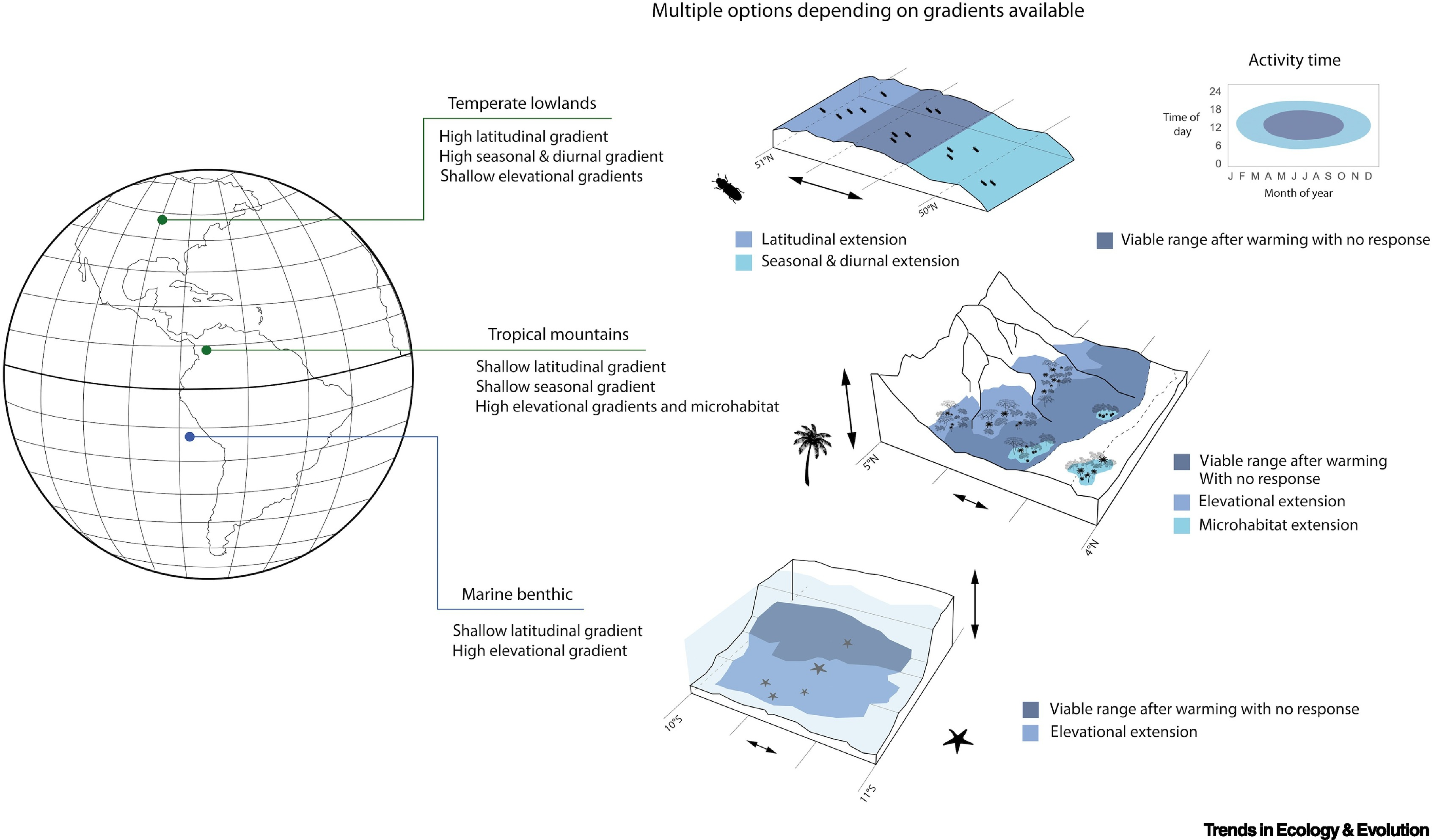
To capture this complexity, we argue for a paradigm shift: one that recognizes that species are moving not just in one direction, but across multiple dimensions of space, time, and thermal scale. In our recent synthesis, we outline a conceptual framework that reflects this – highlighting how species can and do respond to directional climate change along intertwined spatial and temporal gradients, from the macro to the micro.
Why does this matter? Because future conservation and management strategies depend on our ability to anticipate where, when, and how species will respond to continued climate change. A multidimensional understanding allows us to improve our attribution, sharpen our predictions, plan better interventions and make better use of the complexity of ecological landscapes to protect biodiversity there where it wants to be.
Species are moving. But to keep up, we need to follow them not just north, but up, down, deeper, earlier – and in every direction climate change makes available!
Check out the full paradigm shift in our recent publication: Fredston, A. L., Tingley, M. W., Neate-Clegg, M. H., Evans, L. J., Antão, L. H., Ban, N. C., … & Scheffers, B. R. (2025). Reimagining species on the move across space and time. Trends in Ecology & Evolution.




 The 3D lab
I recently listened to a podcast on the same issue. Of course, not as detailed as yours. The green anole is a stable in my East Texas backyard and now the Cuban brown anole has shown up. I also had black-bellied whistling-ducks in my trees. Research says they made it north to Houston from Mexico in the 1970s. Species are moving.