We had a hunch: the biogeography of soil microbial communities was going to be messy. Even less than plants or animals, microbes aren’t paying attention to the broad-brush macroclimatic gradients that ecologists often use to explain species distributions. They live and die by local conditions – the pH, the nutrients, the temperature fluctuations, the root exudates – exactly where they are.
That’s the theory, at least. But testing it has been hard. Soils are notoriously tricky – both to sample and to analyze – especially at the scale needed to disentangle regional and local drivers across landscapes.
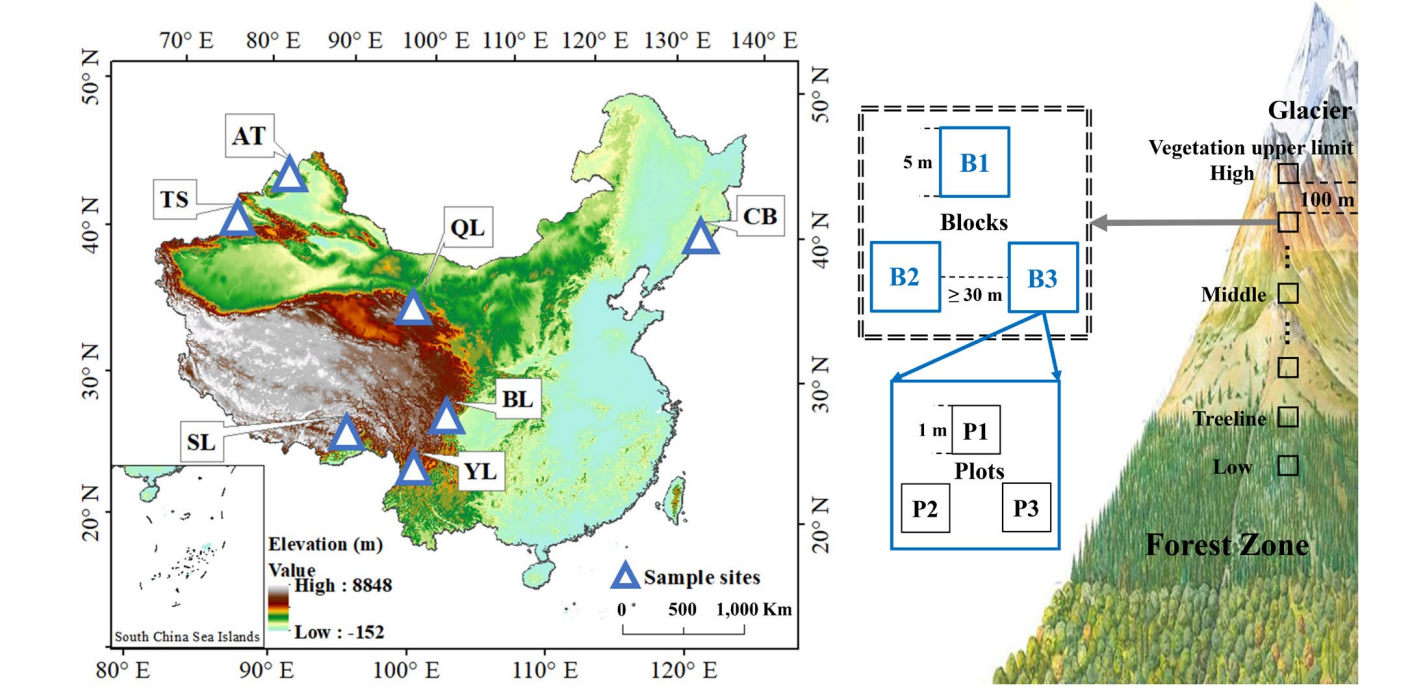
Now, a new study led by Kunwei Wang and a team from Northeast Normal University in China has taken a solid stab at this challenge. By collecting soil samples from across seven mountain transects spanning much of China’s vast climatic range, we set out to explore the spatial variation in soil microbial communities across a broad biogeographic scale – but with the resolution to zoom in on what’s happening locally.
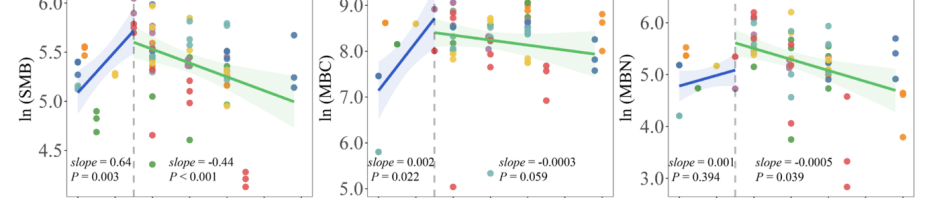
One of the clearest findings? A surprisingly relatively consistent hump-shaped pattern in microbial biomass. Across all mountains, microbial biomass peaked at or around the treeline. That’s fascinating – it suggests that the treeline isn’t just a conspicuous boundary for aboveground vegetation, but a key ecological transition belowground as well.

Microbial communities care most about the here and now
But the most revealing result came from the drivers of microbial variation. Above the treeline, local environmental variables (like soil pH, nutrients, and local temperature) explained far more of the variation in microbial biomass, carbon, and nitrogen than regional climate did.
In other words: macroclimate matters less than micro-conditions once you’re in the alpine zone.

This finding supports what many microbial ecologists have of course long known – that microbes live in a world of fine-scale variation, and that their distributions are far more tightly coupled to immediate environmental conditions than to broader climatic envelopes.
Why does this matter?
There are a few reasons why this matters – and why we need more of this kind of research.
First, it reinforces that understanding microbial biogeography means getting dirty, quite literally. We need high-resolution, site-level data on soils and microclimates to predict how microbial communities vary across space and respond to change. Macroclimate alone won’t cut it.
Second, and perhaps more implicative, it suggests that the effects of climate warming on soil microbes may be buffered by local environmental filters. If you want to know how a microbial community will respond to a changing climate, you need to know what’s happening in the top few centimeters of soil, not just what the nearest weather station is reporting.
This also implies that other anthropogenic drivers, like pollution, land use change, and physical disturbance, may become even more critical in shaping soil microbial dynamics in alpine ecosystems, as these often mess strongly with these local soil conditions that are so critical for soil microbes,
The take-home message?
Soil microbial biogeography is messy — beautifully, chaotically, locally messy. And that’s not a bad thing. But it does mean we need to shift our perspective if we want to understand or model belowground ecosystems. The fine print of the soil matters.
And the treeline? It’s not just a line in the landscape. It’s a biogeographical boundary that shapes life above and below the surface.
Find the paper here: Kunwei Wang et al. (2025) Biogeographic Patterns of Soil Microbial Biomass in Alpine
Ecosystems Depend on Local Rather Than Regional Drivers. Global ecology and biogeography.





 The 3D lab