
The 3D Lab is a dynamic team of young scientists, brought together by their shared enthusiasm for exploring scientific topics under my guidance. Currently, the team comprises one postdoc, one PhD student, and several master and bachelor students. For many, this is their first real experience with science, and I am deeply committed to making it as inspiring and impactful as possible.
A key feature of our lab is a series of voluntary sessions—usually held weekly—that cover various topics essential for budding scientists. These sessions are designed to empower team members with practical skills and critical insights into the scientific process. They fall into three main categories:
- Teamwork: Sharing findings, participating in journal clubs, “shut up and write” sessions, expert talks, and collaborative brainstorming.
- Statistics and coding: From introductions to R and Python to advanced topics like the Tidyverse, linear mixed models, and data visualization in R.
- The scientific process: Career prospects, paper writing, peer review, research design, and even hands-on fieldwork sessions – everything that makes you a scientist.
Most sessions (apart from fieldwork, obviously) are conducted online to accommodate diverse schedules, with recordings made available afterwards for key topics like R tutorials that students might need at a later point in their work. Interactivity is a priority—students share their input, collaborate, and learn from each other.
What topics do students value most?
Twice a year, I survey lab members (both new and returning) to understand their preferences for upcoming sessions. While I don’t strictly follow the voting results—sometimes students aren’t aware of what they need, I must admit—it provides valuable insights into their priorities. I thought to share those insights with you as well, as there might be others interested to learn about what students want!
Here’s what stood out in our latest poll:
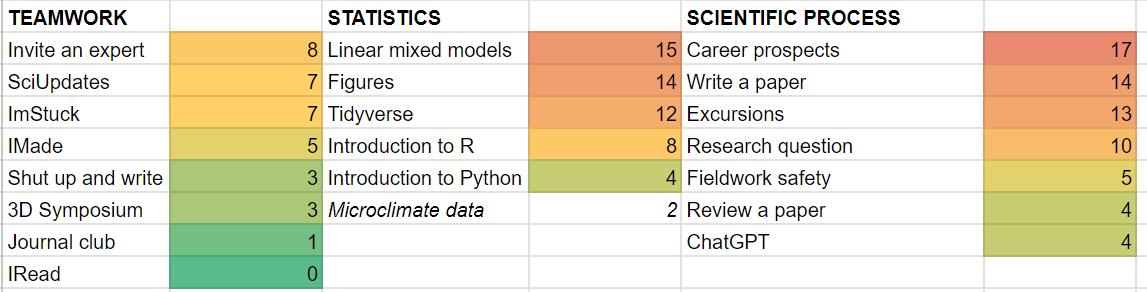
1. Statistics & coding: practical tools they crave
Unsurprisingly, sessions on the Tidyverse, figure creation in R, and linear mixed models consistently top the list. These workshops address gaps in the curriculum and equip students to handle real-world research challenges, and are really aligned with the ecological research they’ll be doing with me:
- Tidyverse: essential for cleaning messy data and merging datasets—tasks they frequently encounter in our projects. Our groups’ PhD researcher, Stijn, has developed an excellent tool to guide them through these processes.
- Figure making: A collaborative, creative session where we refine their data visualization skills together.
- Linear Mixed Models: Building confidence to transition from theory to application on real datasets.
2. The scientific process: navigating uncertainty
The most popular session this year in the wishlists was the discussion on career prospects, perhaps as a reflection of the concerns young scientists might have about the competitive academic job market and the need to explore non-academic opportunities – which remain often hard to find.
Other popular sessions in this category include how to write a paper and how to design a research question. I’m continuously enhancing these sessions to be more interactive, allowing students to exchange tips, insights, and experiences, which creates an engaging and collaborative learning environment.
Finally, my aspiring ecologists are always eager to get into the field, joining colleagues on projects to explore nature and gain hands-on experience. These fieldwork sessions not only immerse them in exciting research but also provide invaluable support for each other in collecting sometimes tedious or complex data. Students awaiting their summer expeditions to Scandinavia often jump at the chance to participate in local fieldwork projects in the Netherlands during spring, building both skills and camaraderie.
3. Teamwork
Students value sessions where we discuss the latest research in their field. While journal clubs and paper presentations (IRead) are less popular—likely due to time constraints or hesitation as early-career scientists to come up with strongly founded opinions—they’re highly enthusiastic for:
- Expert talks: Learning from guest speakers.
- SciUpdates: Hearing my latest updates on the research in the field, followed by lively discussions to inspire new perspectives.
Based on their feedback, I plan to expand our sessions further to include e.g., spatial data analysis in R. As a final note: these sessions remain entirely optional, supplementing our mandatory biweekly lab meetings where we discuss progress and shared concerns.
I’m curious to hear from others running young labs! What kinds of sessions have been successful in your teams? How do you balance student interests with essential skills they might not yet recognize as priorities? Are there ideas here that you’d like to adopt?


 The 3D lab