
It intuitively makes a lot of sense, doesn’t it? As the climate warms, species should be moving north, racing to stay within the climatic conditions they can survive in.
So, naturally, we thought the same when we set out to monitor long-term shifts in the distribution of forest understory plants, expecting to find a dominant northward migration. Except, that wasn’t at all what we found…
In fact, the actual trends were very striking: forest plants were 2.6 times more likely to move westward than northward. And this wasn’t just some fluke—this finding comes from the ‘ForestREPlot’ database, which compiles repeated surveys of forest understories from across Europe. It’s a remarkable dataset, tracking over 3,000 semi-permanent plots that have been resurveyed over periods ranging from 13 to 67 (!) years.
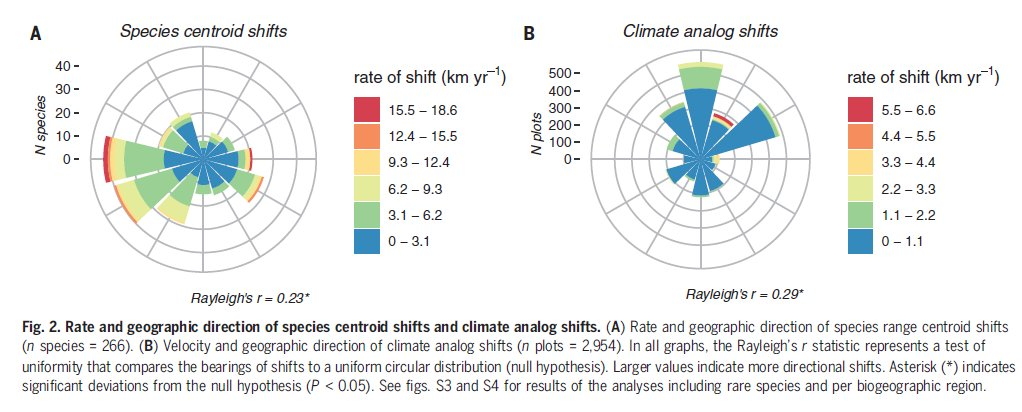
The power of this database lies in its ability to track long-term changes in species distributions across decades of global change. Moreover, by looking at both centroid shifts and colonization/extinction events, we were able to paint a comprehensive picture—not just of range edges, but of how entire species ranges are being reshaped. And the results, now published in Science, tell a clear story: northward movement is being eclipsed by these striking east-west shifts.
So, what’s driving this unexpected trend? After analyzing various potential global change drivers, the main culprit appears to be nitrogen deposition. Indeed, nitrogen-generalists are expanding westward, particularly into regions of Western Europe where nitrogen deposition has been strongest, such as Belgium and the Netherlands. While sulphur pollution from historical acid rain may have played a role, it doesn’t seem to be the primary factor here.
As surprising as these findings may be, they actually align with some of our recent thinking about microclimate. We’ve been hypothesizing that plant movements wouldn’t necessarily mirror macroclimatic trends, since plants experience microclimates—which don’t show the same northward shifts as macroclimate data would suggest. While this microclimate buffering gave us hope, our new study reminds us that we can’t overlook other global change drivers. Their impact on biodiversity may be just as significant—if not more so—than climate change itself.

More information:
- Press release of Utrecht University
- Me explaining the study (in Dutch) on the Dutch radio
- The study – Sanczuk et al. – in Science


 The 3D lab
thank you for this interesting article.
Information that everone should read.
Very interesting.